

At age 12, children can grow at very different rates. One child may have a sudden growth spurt, while another may grow slowly for a while and catch up later. So, asking about the average height for a 12-year-old is a useful starting point, but it does not tell the whole story.
A child’s height, growth pattern, puberty, genetics, nutrition, sleep, physical activity, and overall health can all affect growth. Doctors use stature-for-age growth charts to see how a child’s height compares with other children of the same age and sex.
In this guide, we will explain the average height for a 12-year-old, compare boys and girls, explain height percentiles, discuss growth spurts, show how to measure height correctly, and explain when a growth pattern may need medical attention. 📏🌱
You can also read: Average Height for a 13-Year-Old: Essential Growth Guide
Quick Answer: What Is the Average Height for a 12-Year-Old?
A broad reference range puts a 12-year-old boy at about 58–62 inches tall, or roughly 4’10″–5’2″. A 12-year-old girl may be around 59–63 inches, or about 4’11″–5’3″.
These numbers are only broad reference points. They are not medical limits or a definition of normal height.
The most useful way to understand a child’s growth is to look at their height percentile, previous measurements, growth velocity, family height, and stage of puberty.
Key Takeaways
The average height for a 12-year-old varies because children enter puberty and experience growth spurts at different times.
A 12-year-old boy may be around 58–62 inches, while a 12-year-old girl may be around 59–63 inches based on the broad ranges discussed in this guide.
Growth charts are more useful than one average number because they show how a child’s height compares with children of the same age and sex.
Puberty can cause rapid height changes. Girls often begin puberty earlier than boys, while boys may experience their major growth spurt later.
Genetics, nutrition, sleep, physical activity, and overall health can influence a child’s growth.
A single height measurement does not show the complete picture. Tracking measurements over time gives a much better view of a child’s growth trajectory.
Understanding Growth Spurts At Age Twelve

Age 12 is an important stage of development. Some children are still in late childhood, while others are already well into puberty. This can create large differences in height between children of the same age.
A growth spurt at age 12 may happen quickly. A child may seem to grow several inches over a relatively short period. Clothes and shoes may suddenly become too small, and parents may notice a clear change in body shape.
Other children may grow more slowly at 12 and experience faster growth later. This is especially common when puberty begins later.
So, there is no single height that every 12-year-old should reach.
The average height for a 12-year-old is best used as a reference point rather than a target. A child’s family genetics and puberty timing can make their healthy height quite different from the average.
A 12-year-old boy may still be waiting for his main puberty growth spurt. A girl of the same age may already have experienced rapid growth.
That difference does not automatically mean that one child is healthier than the other.
Instead of asking only, “How tall is my child?” it can be more helpful to ask, “How has my child grown over the past year or two?”
That is where a growth chart becomes useful.
What Is The Average Height For A 12-Year-Old?
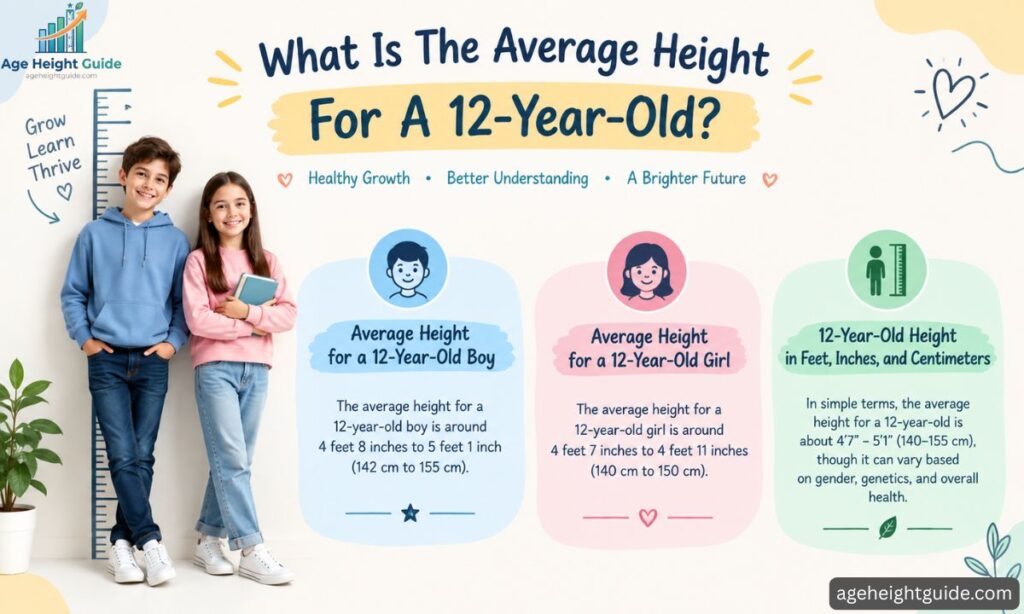
So, what is the average height for a 12-year-old?
A broad reference range is about 58–62 inches for boys and 59–63 inches for girls.
In feet and centimeters, that is approximately:
| Child | Broad Height Range | Feet & Inches | Approx. Centimeters |
| 12-year-old boy | 58–62 inches | 4’10″–5’2″ | 147–157 cm |
| 12-year-old girl | 59–63 inches | 4’11″–5’3″ | 150–160 cm |
These ranges should not be treated as exact CDC averages or medical cutoffs. Children can be shorter or taller and still have healthy development.
For a more precise assessment, healthcare professionals use age-specific stature-for-age growth charts and look at measurements over time.
Average Height for a 12-Year-Old Boy
A 12-year-old boy can have a wide range of healthy heights.
Some boys begin puberty early and start growing quickly around age 12. Others enter puberty later and may have their largest growth spurt during the next few years.
The CDC provides a boys’ growth chart that tracks stature-for-age from childhood through the teenage years.
The important question is not whether a boy matches the average height exactly. Instead, doctors look at his previous measurements and whether his growth pattern is developing as expected.
Average Height for a 12-Year-Old Girl
A 12-year-old girl may also have a wide range of healthy heights.
Girls often enter puberty earlier than boys. Because of this, some girls may already be experiencing a major growth spurt at age 12.
A girl’s height should be considered alongside her age, previous measurements, family height, and stage of puberty.
The CDC also provides a girls’ growth chart for tracking stature-for-age.
12-Year-Old Height in Feet, Inches, and Centimeters
Parents often search for height in different units. Here is a simple conversion of the broad ranges used in this article:
| Measurement | Boys | Girls |
| Inches | 58–62 in | 59–63 in |
| Feet and inches | 4’10″–5’2″ | 4’11″–5’3″ |
| Centimeters | 147–157 cm | 150–160 cm |
For an individual child, use their exact age in months and an official height percentile chart for a more accurate comparison.
12-Year-Old Height Chart in Feet, Inches & Centimeters
A 12-year-old height chart makes it easier to compare common measurements.
| Height | Feet & Inches | Centimeters |
| 58 inches | 4’10” | 147.3 cm |
| 59 inches | 4’11” | 149.9 cm |
| 60 inches | 5’0″ | 152.4 cm |
| 61 inches | 5’1″ | 154.9 cm |
| 62 inches | 5’2″ | 157.5 cm |
| 63 inches | 5’3″ | 160.0 cm |
| 64 inches | 5’4″ | 162.6 cm |
| 65 inches | 5’5″ | 165.1 cm |
This table is a unit-conversion guide, not a medical growth chart.
For medical growth tracking, age in months matters. A child who has just turned 12 is not at exactly the same point as a child who is almost 13.
Average Height for a 12-Year-Old by Age in Months
A child’s growth does not stop and start on birthdays.
A 12-year-old can be anywhere from 12 years 0 months to almost 13 years old. During that time, height can continue to change.
This is why official growth charts use age-specific measurements rather than treating every 12-year-old as the same age.
When tracking height, record the child’s:
exact age, height, date of measurement, and sex used for the applicable growth chart.
Comparing these measurements over time gives a better picture of growth velocity than checking one number.
How Tall Should a 12-Year-Old Boy Be?
If you are asking, “How tall should a 12-year-old boy be?”, there is no single correct answer.
A boy may be shorter or taller than his classmates and still have healthy growth.
For example, a boy who has always been shorter may simply be following a lower but steady height percentile. If he later enters puberty, his growth rate may increase.
On the other hand, a sudden and persistent slowdown in growth may deserve a closer look.
This is why a boys growth chart is more useful than comparing a child with classmates.
How Tall Should a 12-Year-Old Girl Be?
If you are asking, “How tall should a 12-year-old girl be?”, the same principle applies.
Girls can enter puberty at different ages. Some may have already gone through a noticeable growth spurt, while others may still be approaching it.
A girl’s height should be viewed alongside her previous growth measurements, family height, puberty stage, and general health.
A girl’s growth chart can help show whether her growth is following a consistent pattern.
Factors That Influence Height At Age Twelve: Genetics, Nutrition, Sleep

If you are wondering how tall a 12-year-old should be, age is only one part of the answer.
Genetics, nutrition, sleep, physical activity, puberty, and overall health can all affect growth.
Genetics
Genetics has a major influence on height.
Children inherit genes from both parents, so family height can provide useful clues about a child’s potential growth pattern.
A child with tall parents may naturally be taller. A child from a shorter family may naturally be shorter.
However, genetics does not predict height with complete accuracy. Siblings can also have different growth patterns.
That is why doctors look at the child’s own growth trajectory rather than comparing them with one sibling or classmate.
Nutrition
Good nutrition provides the body with the energy and nutrients needed for healthy development.
A balanced diet can include protein-rich foods, fruits, vegetables, whole grains, dairy products or other calcium-rich foods, and a variety of nutrient-dense foods.
Poor nutrition can interfere with healthy growth. However, no single food can guarantee extra height.
The goal is to help a child reach their natural growth potential rather than chase a specific number on a height measurement chart.
Sleep
Sleep is important for overall health and development.
Children around this age need enough sleep to support physical health, learning, mood, and daily functioning.
Good sleep habits are especially important during periods of rapid development.
Parents should think of sleep as one part of a healthy routine rather than a method for forcing additional height.
Physical Activity
Regular physical activity supports healthy bones, muscles, and general development.
Walking, running, cycling, swimming, sports, and other age-appropriate activities can help children stay active.
Exercise should not be viewed as a way to force a child to become taller. Its role is to support healthy physical development.
How Does Puberty Affect Height at Age 12?
Puberty can change the speed at which a child grows.
At age 12, some children may just be starting puberty, while others may already be experiencing major physical changes.
This can create noticeable differences between children of the same age.
Girls often begin puberty earlier than boys. Because of this, a girl may temporarily be taller than a boy who is the same age.
Later, the boy may experience a stronger puberty growth spurt and gain height more quickly.
This is one reason current height does not always predict final adult height.
Early and Late Growth Patterns
An early developer may look tall compared with peers for a period of time.
A later developer may look shorter during those same years.
Both patterns can occur during normal development.
The timing of puberty is therefore important when interpreting a 12-year-old’s height.
How Much Does a 12-Year-Old Grow Each Year?
There is no single yearly growth number that applies to every 12-year-old.
Growth speed changes with age and puberty.
A child may grow slowly for part of a year and then grow faster during a growth spurt.
This is why repeated measurements are more useful than one measurement.
For example, measurements taken at ages 10, 11, and 12 can show a much clearer growth trajectory than a single measurement taken on a birthday.
What Is a Healthy Growth Rate at Age 12?
A healthy growth rate depends on the child’s stage of development.
Children who are entering puberty may grow faster than children who have not started puberty. Growth may also vary from one year to another.
Rather than looking for one perfect number, doctors can compare several measurements and calculate growth velocity.
A steady pattern is often more informative than whether a child is exactly at the 50th percentile.
If growth slows sharply or changes in a persistent way, a pediatrician can review the child’s measurements and development.
Growth Chart Percentiles Explained In Simple Terms
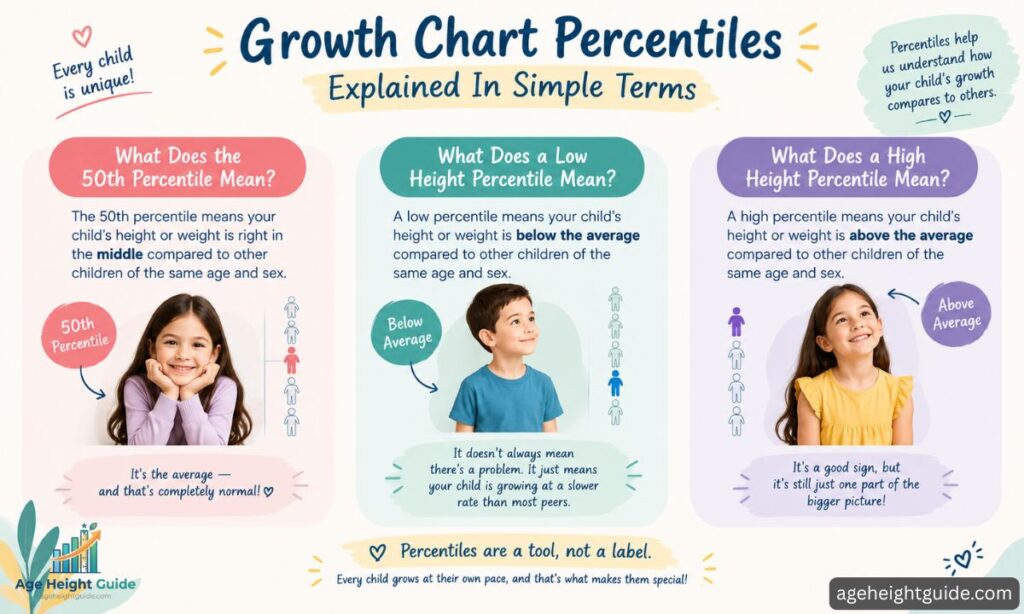
A growth chart percentile shows how a child’s measurement compares with measurements from children of the same age and sex.
For example, a child near the 50th percentile is around the middle of the reference distribution.
A child at a lower percentile is shorter than many children in the reference group. A child at a higher percentile is taller than many children in the same reference group.
Percentiles are not grades.
A child does not need to be at the 50th percentile to have healthy growth.
Official growth charts include several percentile curves. These help healthcare professionals track stature-for-age and other growth measurements.
What Does the 50th Percentile Mean?
The 50th percentile is the median.
It does not mean “perfect height.”
It simply means that the measurement is around the middle of the reference population.
A child at the 25th percentile can be healthy. A child at the 75th percentile can also be healthy.
What Does a Low Height Percentile Mean?
A lower height percentile does not automatically mean a child has a growth problem.
Family genetics can be one reason a child naturally follows a lower growth curve.
Doctors become more interested when a child’s growth pattern changes significantly or when other signs of health or development raise concern.
What Does a High Height Percentile Mean?
A high percentile means a child is taller than many children in the reference group.
This is not automatically a problem.
Family height and puberty timing can both influence a child’s position on the growth chart.
12-Year-Old Height Percentile: Why One Number Is Not Enough
It can be tempting to search for one “normal height” and use it as a pass-or-fail test.
Growth does not work that way.
A height percentile becomes much more useful when it is tracked over time.
For example, a child who remains near a similar percentile for several years may have a consistent growth pattern.
A child whose measurements suddenly move downward across major percentile lines may need a closer review.
The key is not the percentile alone. It is the child’s overall growth trajectory.
Can a 12-Year-Old Still Grow Taller?
Yes. Many 12-year-olds still have significant growth ahead of them.
How much a child grows after age 12 depends on factors such as puberty timing, genetics, current growth pattern, and biological development.
A child who has recently started puberty may still have substantial height growth ahead.
Another child who is further through puberty may have less growth remaining.
This is why current height alone cannot tell you exactly how tall a child will become.
Does Height at 12 Predict Adult Height?
A child’s height at 12 can provide some information, but it cannot give an exact prediction of adult height.
Family genetics and puberty timing are important.
Two children who are the same height at 12 can end up with different adult heights if their puberty timing and growth patterns differ.
For a rough estimate, healthcare professionals may consider family height and other growth information.
How to Measure a 12-Year-Old’s Height Correctly
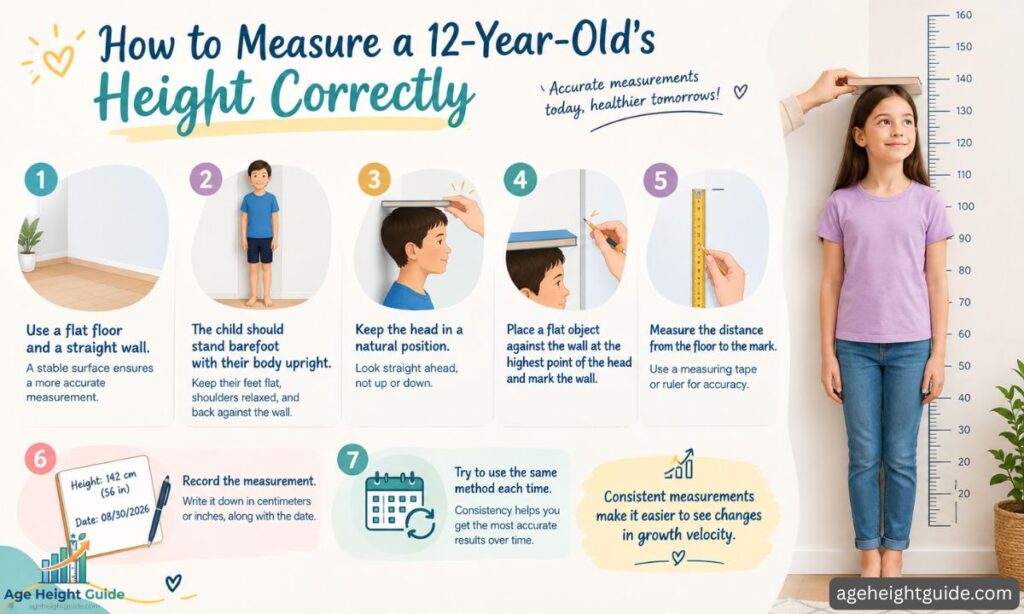
Accurate measurement matters when tracking height.
Use a flat floor and a straight wall. The child should stand barefoot with their body upright.
Keep the head in a natural position. Place a flat object against the wall at the highest point of the head and mark the wall.
Measure the distance from the floor to the mark.
Record the measurement in centimeters or inches, along with the date.
Try to use the same method each time.
Consistent measurements make it easier to see changes in growth velocity.
Common Mistakes Parents Make When Tracking Height
Parents can easily become worried when they compare their child with classmates.
One common mistake is treating the average height as a required target.
Another is checking height too frequently. Daily or weekly changes are usually not useful because normal growth is gradual.
Using different measurement methods can also create misleading results.
Parents should also avoid assuming that a low percentile automatically means something is wrong.
Finally, online height calculators and charts should not replace advice from a healthcare professional when there is a genuine growth concern.
Average Height vs. Normal Height: What’s the Difference?
Average height and normal height are not the same thing.
Average height describes a statistical middle.
Normal growth includes a much broader range.
A healthy 12-year-old does not need to be exactly the average height.
Two healthy children can have very different heights because of genetics, puberty timing, family height, and individual development.
That is why a growth chart is more useful than one average number.
Why Is My 12-Year-Old Shorter or Taller Than Their Friends?
It is common for children at age 12 to have different heights.
Your child may be shorter because of family genetics or later puberty.
Another child may be taller because they entered puberty earlier.
Differences in height between classmates do not automatically indicate a health problem.
The more useful question is whether your child’s own growth pattern is steady.
If you notice a major change in growth rate or have concerns about development, discuss the measurements with a pediatrician.
When Should You Worry About a 12-Year-Old’s Height?
Being shorter or taller than classmates is not automatically a reason to worry.
However, parents may want to speak with a pediatrician if they notice a major or persistent change in a child’s growth pattern.
A doctor may want to review the child’s previous height measurements, family history, puberty stage, nutrition, and overall health.
Growth concerns can be more important when they occur alongside other symptoms or noticeable changes in development.
The goal is not to diagnose a problem from a single measurement. It is to understand whether the child’s overall growth and development are progressing appropriately.
Average Weight for a 12-Year-Old
Parents often search for average weight for a 12-year-old at the same time as height.
Weight is different from height because a healthy weight depends on age, sex, height, and body composition.
For children and teenagers, healthcare professionals commonly consider BMI-for-age rather than using one fixed “ideal weight.”
This means weight should be viewed alongside height and age rather than considered by itself.
Final Thoughts
The answer to “What is the average height for a 12-year-old?” is not one exact number.
A broad reference range is about 58–62 inches for boys and 59–63 inches for girls. But healthy children can be shorter or taller than these ranges.
The better question is often whether the child is following a steady growth pattern.
Genetics, nutrition, sleep, physical activity, puberty, and overall health can all influence growth.
A height measurement chart can help parents record measurements, while an official growth chart can provide age- and sex-specific context.
Most importantly, avoid treating the average as a goal that every child must reach. Children grow at different speeds, and puberty can change that speed quickly.
Focus on the child’s own growth trajectory, not just how they compare with classmates. 📏🌱
Frequently Asked Questions
What is the average height for a 12-year-old?
A broad reference range is about 58–62 inches for boys and 59–63 inches for girls. These are benchmarks, not medical limits. A child’s height percentile and growth pattern provide more useful context.
How does puberty affect height at age 12?
Puberty can trigger a faster growth spurt. Some children begin earlier, while others develop later. This can create large height differences between children of the same age.
Are there differences in height between 12-year-old boys and girls?
Yes. 12-year-old boys and girls can have different average heights and puberty timing. Girls often begin puberty earlier, while boys may experience their strongest growth later.
What factors influence a 12-year-old’s height?
Important factors include genetics, nutrition, sleep, physical activity, puberty timing, and overall health.
How can I tell if my 12-year-old’s growth is normal?
Look at several height measurements over time rather than one number. A pediatrician can plot the measurements on an appropriate growth chart and assess the child’s growth pattern.
What are the signs of abnormal growth in a 12-year-old?
A major or persistent change in growth rate, a noticeable shift in height percentiles, or growth concerns combined with other symptoms may deserve medical evaluation.
Is 5 feet short for a 12-year-old?
Five feet is 60 inches, or about 152.4 cm. It falls within the broad reference ranges discussed in this article. Whether it is typical for a specific child depends on exact age, sex, family height, and growth history.
Is 5’5″ tall for a 12-year-old?
Five feet five inches is 65 inches, or about 165.1 cm. That is above the broad ranges discussed earlier. Being taller than average does not automatically indicate a problem.
What is the average height for a 12-year-old in cm?
The broad ranges discussed here are approximately 147–157 cm for boys and 150–160 cm for girls. For a precise comparison, use an age- and sex-specific stature-for-age growth chart.
When do boys stop growing?
Boys usually continue growing through the teenage years. The timing varies, and the largest height gains often occur during the puberty growth spurt.
When do girls stop growing?
Girls generally reach most of their adult height earlier than boys, but the timing varies. Growth slows as puberty progresses.
Can nutrition make a 12-year-old taller?
Good nutrition supports healthy growth and helps a child reach their natural potential. However, no single food or diet can guarantee extra height.
Should parents compare their child with classmates?
Not closely. Children can be at very different stages of puberty. A child’s own growth trajectory is more useful than comparing them with classmates.
Why are growth charts important?
Growth charts help track height and other measurements over time. They allow healthcare professionals to compare a child’s measurements with age- and sex-specific reference data.
What if my 12-year-old is much shorter than other children?
Being shorter than peers does not automatically mean there is a problem. Family genetics and puberty timing can explain many differences. If growth seems unusually slow or changes significantly, discuss the measurements with a pediatrician.

Stoke is the author behind Age Height Guide, creating simple and informative content about average height, age, growth, and related measurements.