


At 13, height can change quickly. One teenager may suddenly grow several inches, while another may seem to grow more slowly. This can make parents wonder: What is the average height for a 13-year-old?
On U.S. growth charts, the approximate median height at age 13 is around 62 inches (157 cm) for girls and 61 inches (155 cm) for boys. These numbers are useful reference points, but they are not a target every teenager should reach. A healthy 13-year-old can be shorter or taller than the median.
The height of a 13-year-old depends on several factors, including genetics, puberty timing, nutrition, sleep, physical activity, overall health, and environmental conditions. Puberty can make height differences especially noticeable because teenagers enter their fastest growth periods at different ages.
Age also matters in months. A teen who has just turned 13 may be at a very different stage of development from a teen who is almost 14.
The CDC recommends its 2000 CDC Growth Charts for children and adolescents ages 2 through 20 in the United States. These charts use measurements such as stature-for-age to show how a child’s height compares with others of the same age and sex. More importantly, doctors can use repeated measurements to understand a teen’s growth pattern over time.
In this guide, we’ll explain the average height for a 13-year-old, the difference between boys and girls, height percentiles, puberty and growth spurts, factors that influence growth, how to measure height correctly, and when it may be appropriate to speak with a healthcare professional.
You can also read: Average Height for a 14-Year-Old Boy: Helpful Guide
Key Takeaways:
- Average height for a 13-year-old girl: approximately 62 inches (157 cm) near the 50th percentile.
- Average height for a 13-year-old boy: approximately 61 inches (155 cm) near the 50th percentile.
- The 50th percentile is the median, not a required or ideal height.
- A healthy 13-year-old can be shorter or taller than the median.
- Genetics is a major influence on height, while nutrition, sleep, physical activity, health, and environment also contribute.
- Girls generally enter puberty earlier, so they may be slightly taller than boys around age 13.
- Boys often reach their fastest growth later and may continue growing for longer during adolescence.
- Growth percentiles are most useful when viewed as part of a growth curve over time.
- The CDC recommends CDC growth charts for children and adolescents ages 2 to 20 in the United States.
Understanding Growth Percentiles And Puberty Milestones At Age 13

A growth percentile provides context for a teenager’s height. It compares the measurement with children of the same age and sex in the reference population.
For example, a teen near the 50th percentile is close to the middle of the reference population. A teen at the 25th percentile is shorter than many children in that reference group, while a teen at the 90th percentile is taller than most of them.
The 50th percentile does not mean “perfect” or “average” in the sense of a required target. It represents the median.
At age 13, puberty can create large differences between teenagers. One teen may already have experienced a major growth spurt, while another may be several months or years away from their fastest growth period.
The CDC provides separate stature-for-age growth charts for boys and girls from ages 2 through 20.
What Percentile Means for Your Teen
Percentiles are not grades.
A 13-year-old at the 25th percentile is not “less healthy” simply because they are shorter than the median. Likewise, being at the 90th percentile does not automatically mean a teen has a health problem.
The more useful question is whether the teenager is following a reasonably consistent growth curve.
Doctors often compare several height measurements taken over time. This can reveal whether a teen is continuing along a familiar growth pattern or whether their growth has changed noticeably.
For example, a teenager who has consistently tracked near the 25th percentile may simply have a naturally shorter family growth pattern. A sudden and persistent change in that pattern may deserve closer attention.
Puberty’s Impact on Height
Puberty is one of the main reasons the height of a 13-year-old can vary so much.
During puberty, hormonal changes cause bones and the body to grow more rapidly. Teenagers experience changes in body composition, muscle development, and reproductive development. They may also experience a pubertal growth spurt.
Girls generally begin puberty earlier than boys. Boys normally begin testicular enlargement within a broad age range, and individual puberty timing can vary considerably.
Girls also tend to reach peak height velocity earlier than boys. AAFP reports average peak height velocity around ages 11–12 for girls and around 13–14 for boys, although individual timing varies.
This difference helps explain why the average height for a 13-year-old girl can be slightly greater than the average height for a 13-year-old boy at this particular age.
Individual Variation Is Normal
There is no single “correct” height for a 13-year-old.
Some teenagers are early bloomers. They may experience their major growth spurt at 11 or 12 and appear much taller than classmates at 13.
Others are late bloomers. Their biggest growth spurt may happen at 13, 14, or later.
Family height also plays an important role. A shorter teenager with shorter parents may simply be following a normal family growth pattern.
For this reason, one measurement should not be used to predict a teenager’s final adult height.
Height Differences Between Boys And Girls At 13

When comparing the average height for a 13-year-old girl with the average height for a 13-year-old boy, the difference is usually not dramatic.
Around age 13, girls may be slightly taller on average because they generally enter puberty earlier. Boys often experience their fastest growth later and can continue gaining height later into adolescence.
Average Height for 13-Year-Old Girls
The approximate median height for a 13-year-old girl is around 62 inches, or 157 cm.
That is approximately 5 feet 2 inches.
However, the average height for a 13-year-old girl is only a reference point. It does not mean every healthy girl should be 62 inches tall.
| Measurement | Approximate value |
| Median height | ~62 inches |
| Centimeters | ~157 cm |
| Feet and inches | ~5 ft 2 in |
| Reference | CDC stature-for-age |
The exact percentile changes according to the teenager’s age in months. CDC growth data provide measurements by age and sex, so a teen who is 13 years and 1 month is not necessarily at the same percentile as one who is 13 years and 11 months.
Average Height for 13-Year-Old Boys
The approximate median height for a 13-year-old boy is around 61 inches, or 155 cm.
That is approximately 5 feet 1 inch.
Again, the average height for a 13-year-old boy should be viewed as a midpoint rather than a goal.
| Measurement | Approximate value |
| Median height | ~61 inches |
| Centimeters | ~155 cm |
| Feet and inches | ~5 ft 1 in |
| Reference | CDC stature-for-age |
The exact boy’s stature-for-age percentile depends on age in months and the teen’s measured height.
Why Girls Are Taller at This Age
Girls generally enter puberty earlier than boys.
Because the pubertal growth spurt begins earlier, many girls have already gained a substantial amount of height by age 13. Boys often reach their fastest growth phase later.
This can create a temporary difference in height at age 13.
It does not mean girls will remain taller throughout adulthood. Boys often continue growing later and for a longer period.
When Boys Catch Up
Many boys continue gaining height after girls have already started to slow down.
Boys generally reach peak height velocity later than girls. Their later growth spurt can allow them to catch up and eventually become taller on average in adulthood.
This is why comparing a 13-year-old boy and girl only by their current height can give a misleading picture of their eventual adult height.
Factors That Influence Height At 13

If your teen is taller or shorter than the average height for a 13-year-old, there may be several explanations.
Height is influenced by a combination of inherited traits, development, health, and environment.
Genetics: The Primary Determinant
Genetics and height are strongly connected.
MedlinePlus Genetics explains that researchers estimate about 80% of height variation is associated with inherited DNA sequence differences. Height is polygenic, which means many genes contribute to the final result rather than one single “height gene.”
If both parents are tall, their child may have a greater genetic potential for height. If both parents are shorter, the child may naturally be shorter.
However, genetics does not determine an exact final height. Siblings can have different heights because they inherit different combinations of genetic variants.
Doctors can also consider family height and mid-parental height estimates when evaluating growth, but these calculations are only estimates.
Nutrition’s Critical Role
Good nutrition supports normal growth and development during adolescence.
A growing teenager needs enough energy and a balanced diet containing important nutrients such as:
- Protein
- Calcium
- Vitamin D
- Iron
- Zinc
- Healthy fats
- Fruits and vegetables
- Whole grains
Severe or prolonged nutritional problems can interfere with normal growth.
The goal should not be to make a teenager taller than their natural potential. Instead, good nutrition helps the body reach its healthy growth potential.
Sleep and Overall Health
Sleep is an important part of overall teenage health.
A healthy sleep routine supports physical and mental well-being during adolescence. Poor sleep can affect mood, learning, energy, and daily functioning.
Sleep cannot override genetics or guarantee extra height. However, adequate sleep is part of a healthy lifestyle during the years when teenagers are growing rapidly.
If a teen has persistent sleep problems, discussing them with a healthcare professional can be helpful.
Physical Activity and Bone Health
Regular physical activity supports strong bones, muscles, and overall health.
Activities such as:
- Walking
- Running
- Jumping
- Cycling
- Sports
- Other age-appropriate physical activities
can help teenagers remain active.
Exercise does not make a teenager exceed their genetic height potential. Its role is to support healthy bones, muscles, fitness, and development.
Medical Conditions
Some medical conditions can affect height and growth.
These may include:
- Hormonal disorders
- Chronic illnesses
- Genetic conditions
- Nutritional problems
- Gastrointestinal conditions
- Bone or skeletal disorders
A teenager who suddenly stops growing or moves downward across several major percentile lines may need further evaluation.
A healthcare professional can review the teen’s growth chart, growth rate, family history, puberty stage, nutrition, medications, and overall health.
Environmental and Socioeconomic Factors
The environment can also influence growth and development.
Access to nutritious food, healthcare, safe living conditions, and other resources can affect whether a teenager reaches their genetic growth potential.
MedlinePlus notes that environmental influences, including nutrition, illness, healthcare, and socioeconomic conditions, can contribute to differences in adult height.
How to Measure a 13-Year-Old’s Height Correctly
Before comparing your teenager with a height chart for 13-year-olds, make sure the measurement is accurate.
A small measurement error can change the apparent percentile, especially when tracking a teenager over time.
Follow these steps:
- Remove shoes and bulky hair accessories.
- Have the teen stand on a hard, level floor.
- Keep the heels close to the wall when possible.
- Ask the teen to stand naturally and look straight ahead.
- Keep the body upright without stretching upward.
- Place a flat object gently on top of the head.
- Mark the wall at the point where the object touches it.
- Measure from the floor to the mark.
- Record the height in inches or centimeters.
For the most useful height tracking, measure in a consistent way each time.
There is no need to measure every few days. Measurements taken over longer intervals can provide a more useful picture of a teen’s growth pattern.
Height Percentiles: Where Does Your Teen Rank?

Height percentiles help put a teenager’s measurement into context.
The CDC uses stature-for-age to assess linear growth in children and adolescents. Its charts provide separate references for boys and girls from ages 2 through 20.
How to Read a Growth Chart
A typical growth chart has:
- Age on the horizontal axis
- Height on the vertical axis
- Multiple percentile curves
To use a chart, find the teenager’s exact age and height. The point where they meet indicates the approximate percentile.
For example, a teen around the 50th percentile is close to the median of the reference population.
The important thing to remember is that the percentile is not a grade.
A teen at the 10th percentile is not automatically unhealthy, and a teen at the 90th percentile is not automatically healthier.
The full growth history provides much more context.
The 50th Percentile Baseline
The 50th percentile represents the median height in the reference population.
For a 13-year-old, the approximate median is:
| Teen | Approximate median height |
| Girls | ~62 inches / 157 cm |
| Boys | ~61 inches / 155 cm |
These values help answer what the average height for a 13-year-old is, but they should not be treated as ideal or required heights.
A teenager can be below or above the 50th percentile and still have healthy growth.
Understanding Growth Curves
A single measurement tells only part of the story.
A growth curve shows how a teenager’s height changes over time.
For example, suppose a teen has tracked around the 25th percentile for several years and continues to grow at a steady rate. That pattern may be perfectly normal.
Now imagine the teen has always tracked around the 75th percentile but suddenly begins dropping toward much lower percentiles. That change may deserve closer attention.
This is why doctors usually look at the overall growth pattern rather than focusing only on today’s height.
When Percentiles Shift
Some movement between percentiles can occur naturally.
However, a large or persistent change in a teenager’s growth curve may require closer evaluation.
Possible explanations can include:
- Puberty timing
- Measurement differences
- Nutritional problems
- Chronic illness
- Hormonal conditions
- Normal variation
A percentile change should always be interpreted in the context of the individual teen.
Using CDC Charts
The CDC recommends the 2000 CDC Growth Charts for children and adolescents ages 2 through 20 in the United States. These include separate stature-for-age charts for boys and girls.
For children from birth through age 2, CDC and the American Academy of Pediatrics recommend using WHO growth standards rather than the standard CDC charts used for older children and teenagers.
Average Height for a 13-Year-Old: Inches and Centimeters
For readers who want the quick answer, the approximate median heights are:
| Age | Girls | Boys |
| 13 years | ~62 inches | ~61 inches |
| Centimeters | ~157 cm | ~155 cm |
| Feet and inches | ~5’2″ | ~5’1″ |
These numbers are approximate.
The exact CDC percentile depends on the teenager’s age in months, sex, and measured height.
More importantly, the median should not be used as a pass-or-fail measurement. Healthy teenagers can fall both below and above it.
Is 5 Feet Short for a 13-Year-Old?
Not necessarily.
A 13-year-old who is 5 feet tall (60 inches) is below the approximate median for both boys and girls, but that alone does not indicate a health problem. Being below the average height for a 13-year-old does not automatically mean a teenager is unhealthy.
Family height, puberty timing, growth rate, and previous measurements all matter. These factors can explain why a teenager may be shorter or taller than the median.
For example, a teen who has always tracked on a lower percentile and is continuing to grow steadily may simply have a naturally shorter growth pattern.
The better question is not:
“Is 5 feet too short?”
Instead, consider:
“Is this teenager growing consistently for their age, family pattern, and stage of puberty?”
Looking at the teen’s growth curve over time is usually more useful than comparing one measurement with the average height for a 13-year-old.
Is 5 Feet 5 Inches Tall for a 13-Year-Old?
A height of 5 feet 5 inches (65 inches) is above the approximate median for both boys and girls at age 13. This means a 13-year-old who is 5’5″ is taller than the typical average height for a 13-year-old, based on the approximate median.
However, being taller than the median does not automatically mean a teenager is unusually tall or that something is wrong.
Some healthy teenagers naturally fall well above the 50th percentile. Height can vary because of genetics, puberty timing, family growth patterns, and other factors.
The most useful way to interpret 65 inches is to place the measurement on the correct CDC height percentile chart using the teen’s exact age in months and sex. This gives a more accurate picture than comparing the teen with the average height for a 13-year-old alone.
Why Accurate Height Tracking Is Critical During the Teenage Years
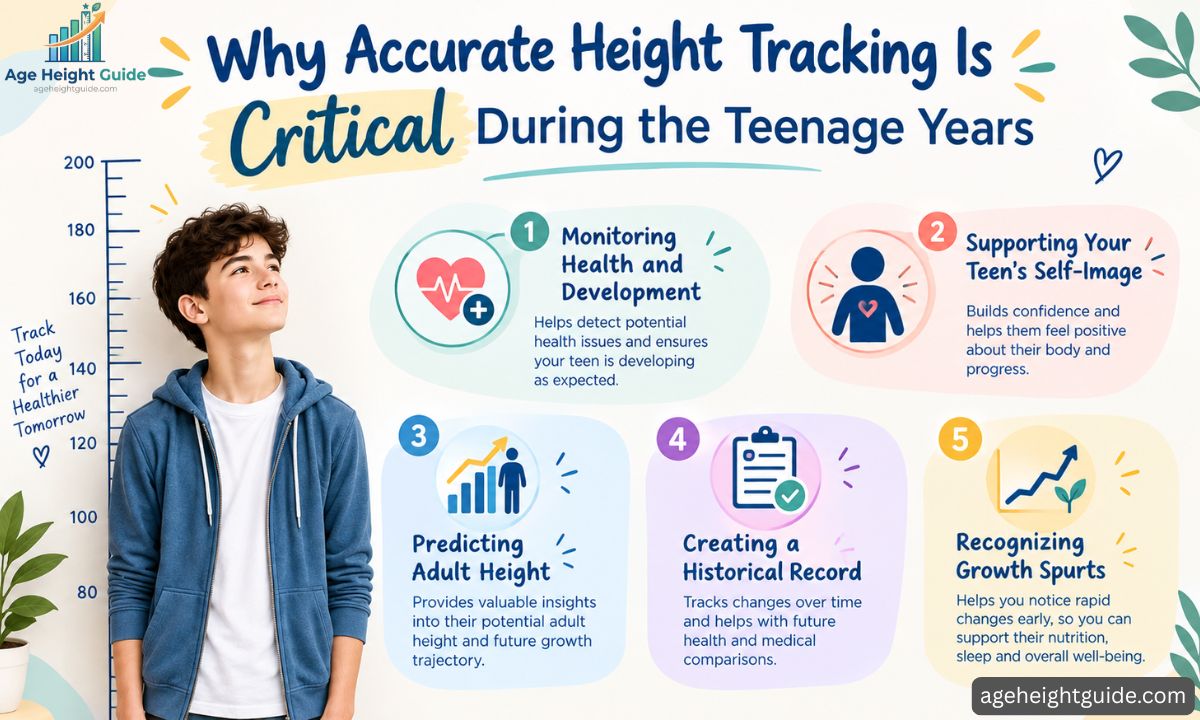
Teenage growth can happen quickly.
A teenager may gain several inches during a relatively short period, especially around a growth spurt. Consistent measurements can therefore provide useful information about the overall growth pattern.
Monitoring Health and Development
Regular height measurements can help identify changes in growth.
If a teenager’s growth slows unexpectedly or their measurements begin moving away from their established growth curve, a healthcare professional can investigate possible causes.
A kids’ height chart can make it easier for parents to record measurements in one place.
Supporting Your Teen’s Self-Image
Teenagers often compare their height with classmates, friends, and siblings.
One teen may feel too short. Another may feel too tall.
Parents can help by explaining that puberty happens at different times. A difference in 13-year-old height does not necessarily predict final adult height.
Healthy growth does not look the same for everyone.
Predicting Adult Height
Current height can provide useful information about future growth, but it cannot predict adult height perfectly.
Doctors may consider:
- Current height
- Growth rate
- Puberty stage
- Parents’ heights
- Family growth patterns
- Medical history
- Bone development when medically appropriate
A mid-parental height calculation may also be used as a rough estimate.
It is important to remember that an estimate is not a guarantee.
Creating a Historical Record
A growth chart for kids can also become a valuable record of childhood.
Parents may record height at birthdays, school years, or other milestones.
Over time, these measurements can show how quickly a child grew through childhood and adolescence.
Recognizing Growth Spurts
A growth spurt is a period when height increases faster than usual.
Girls generally reach peak height velocity earlier than boys. AAFP reports average peak height velocity around ages 11–12 for girls and 13–14 for boys, although individual development varies.
This explains why two 13-year-olds can have very different heights while both are developing normally.
When Should You Talk to a Doctor About Your Teen’s Height?
Most differences in height are normal, and being above or below the average height for a 13-year-old does not automatically mean there is a health problem.
Still, certain growth patterns deserve professional attention.
Consider speaking with a pediatrician or another healthcare professional if:
- Your teenager’s growth suddenly slows.
- Height repeatedly moves downward across major percentile lines.
- Your teen stops growing for an unusually long period.
- Puberty appears significantly delayed or unusually early.
- There are other concerning symptoms.
- Your teen has ongoing digestive problems, unexplained weight changes, persistent fatigue, or other health concerns.
- Your family is concerned about the teenager’s overall growth or development.
Puberty timing is also important. AAFP notes that delayed puberty can warrant evaluation, including when there are no signs of puberty by age 13 in girls or age 14 in boys.
The goal is not to make every teenager match the average height for a 13-year-old or the 50th percentile.
The goal is to understand whether the individual teenager is growing and developing appropriately for their age, family pattern, and stage of puberty.
A growth chart ruler can make height tracking simple while also creating a physical record of childhood.
Instead of writing measurements on a door frame that may eventually be painted over, families can use a dedicated chart that can move with them.
For parents who enjoy keepsakes, height tracking can turn a simple measurement into a memorable family tradition.
Why We Use Wooden Growth Charts
A wooden growth chart can combine practical height tracking with home décor.
A ruler-style chart can record measurements from early childhood through adolescence.
If you choose one for your family, look for a chart with clear measurements, durable construction, and a design that fits the space where you plan to use it.
Beautiful Ways to Measure Growing Up
A kids’ height chart does not have to look clinical.
Families can choose simple ruler-style designs, decorative themes, or other styles that fit a child’s bedroom, hallway, or playroom.
The most important feature is that measurements remain easy to read and record.
Personalization That Makes It Yours
A personalized growth chart can include details such as:
- Child’s name
- Birth date
- Measurement dates
- Family messages
- Milestones
- Custom artwork
These details can turn a basic growth chart ruler into a personal family keepsake.
Made in the USA with Care
If you purchase a handcrafted growth chart, consider checking details such as where it is made, what materials are used, how it is finished, and how durable it is.
For product recommendations, specific claims about manufacturing and materials should always come directly from the seller or manufacturer.
From Childhood Through Adolescence
A well-designed growth chart ruler can remain useful for many years.
It can start with toddler measurements and continue through childhood and adolescence.
The teenage years can be especially interesting because height may change rapidly during puberty.
A Legacy for Future Generations
A physical growth chart can eventually become a family keepsake.
Years later, parents and grown children can look back at the measurements and remember different stages of childhood.
That makes height tracking more than a collection of numbers. It can become a record of how a child changed over time.
What Can Help a 13-Year-Old Reach Their Healthy Growth Potential?

Parents often ask how to make a teenager taller.
There is no safe method that can guarantee extra height beyond a person’s natural genetic potential.
However, healthy habits can support normal development.
Eat a Balanced Diet
Offer regular meals that provide protein, whole grains, fruits, vegetables, and other nutrient-rich foods.
Calcium and vitamin D are especially important for healthy bones.
The goal is adequate nutrition, not a special “height-increasing” diet.
Get Enough Sleep
Encourage a consistent sleep schedule.
Good sleep supports overall health during adolescence and helps teenagers function well during school, sports, and daily activities.
Stay Physically Active
Regular movement supports healthy bones, muscles, cardiovascular fitness, and general well-being.
Walking, running, jumping, cycling, and sports can all be part of an active lifestyle.
Manage Health Conditions
If a teenager has a chronic illness or persistent symptoms, appropriate medical care is important.
Addressing an underlying health issue can help support normal development and overall health.
Final Thoughts
Understanding the average height for a 13-year-old can provide useful context, but the median is only one point on a wide range of normal growth.
At around age 13, the approximate median height is 62 inches (157 cm) for girls and 61 inches (155 cm) for boys. These numbers should not be treated as required heights or health targets.
The more important information often comes from a teenager’s growth curve and how their height changes over time.
Puberty timing also matters. Girls generally enter puberty earlier and reach their fastest growth sooner, while boys often reach peak height velocity later and continue growing later into adolescence.
Genetics and height are closely related. MedlinePlus estimates that about 80% of height variation is associated with inherited DNA sequence differences, while nutrition, health, environment, and other factors also contribute.
If you want to understand your teenager’s height more accurately, measure consistently, use the appropriate CDC growth chart, and focus on the overall growth pattern rather than one number. The CDC recommends its growth charts for children and adolescents ages 2 through 20 in the United States.
Most importantly, avoid comparing your teenager too closely with classmates.
Some teens grow early. Others grow later.
What matters most is healthy development and a steady growth pattern over time.
Frequently Asked Questions
What is the average height for a 13-year-old?
The approximate median height at age 13 is about 62 inches (157 cm) for girls and 61 inches (155 cm) for boys. The exact value varies with age in months and the growth reference used.
What is the average height for a 13-year-old boy?
The approximate median height for a 13-year-old boy is around 61 inches (155 cm). Individual boys can be shorter or taller because genetics and puberty timing strongly affect growth.
What is the average height for a 13-year-old girl?
The approximate median height for a 13-year-old girl is around 62 inches (157 cm). Being shorter or taller than this number does not automatically indicate a health problem.
What factors influence how tall a 13-year-old will be?
Several factors influence height, including genetics, puberty timing, nutrition, sleep, physical activity, overall health, and environmental conditions. Genetics accounts for a large share of height variation, but it does not determine one exact final height.
How does nutrition affect a teen’s growth and height?
A balanced diet provides the energy and nutrients needed for normal development. Protein, calcium, vitamin D, iron, and other nutrients support overall health and bone development. Severe or prolonged nutritional problems can interfere with normal growth.
When do growth spurts typically occur during adolescence?
Growth spurts occur at different times. Girls generally reach peak height velocity earlier, often around ages 11–12, while boys generally reach it later, around ages 13–14. Individual puberty timing can vary significantly.
What are growth percentiles, and how do I interpret them?
A growth percentile compares a teenager’s height with the heights of children of the same age and sex in the reference population. The 50th percentile is the median. Percentiles are most useful when viewed over time as part of a growth curve.
Why should I use a growth chart to track my child’s height?
A growth chart helps you record measurements and see how height changes over time. It can show whether a teenager is generally following a consistent growth pattern. The CDC provides stature-for-age charts for boys and girls ages 2 through 20.
Can a 13-year-old still grow taller?
Yes. Many 13-year-olds still have significant growth ahead. This is especially true for teenagers who are earlier in puberty. Boys often continue growing later into adolescence than girls.
Does being shorter than average mean a 13-year-old has a health problem?
No. Being below the 50th percentile does not automatically indicate a problem. Family height, puberty timing, and the teen’s previous growth pattern are important when interpreting height.
Does being taller than average mean a 13-year-old will be tall as an adult?
Not necessarily. Current height is useful information, but adult height also depends on genetics, growth rate, puberty timing, and how long the teenager continues growing.
Is 5 feet short for a 13-year-old?
Five feet is below the approximate median height for both boys and girls at age 13, but it does not automatically mean the teenager is unhealthy. The overall growth pattern, family height, and puberty stage provide more useful context.
Is 5 feet 5 inches tall for a 13-year-old?
Five feet 5 inches is above the approximate median for both boys and girls at age 13. A teenager at this height may simply be taller than the median. The exact percentile should be checked using the appropriate CDC chart.
When should I be concerned about my child’s height and seek medical attention?
Consider speaking with a healthcare professional if growth suddenly slows, height repeatedly moves downward across major percentile lines, puberty appears significantly delayed, or other symptoms are present. A doctor can review the teenager’s growth history, family pattern, puberty stage, nutrition, and overall health.
Which growth chart should I use for a 13-year-old?
For children and adolescents ages 2 to 20 in the United States, the CDC recommends the 2000 CDC Growth Charts, including separate stature-for-age charts for boys and girls.

Stoke is the author behind Age Height Guide, creating simple and informative content about average height, age, growth, and related measurements.