

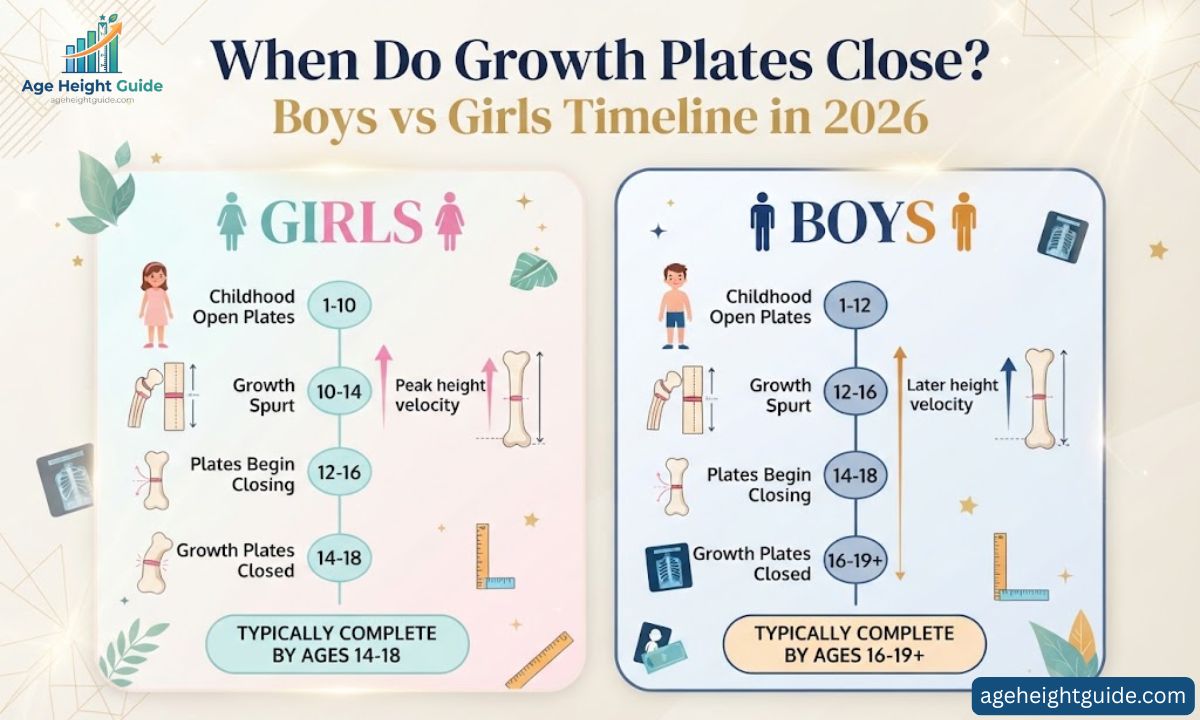
If you are wondering when do growth plates close, the short answer is that they usually close near the end of puberty. For many girls, growth plates close around the mid-teen years. For many boys, they close a little later. The exact timing can vary because puberty, genetics, health, and individual development all affect growth.
Growth plates are areas of cartilage near the ends of growing bones. They help bones grow longer during childhood and adolescence. As puberty progresses, these plates gradually become thinner and eventually harden into solid bone. Once a growth plate is fully closed, that bone can no longer grow longer.
So, when do growth plates close in girls and boys? The answer is not one exact age for every child. Most girls finish skeletal growth earlier than boys because girls usually enter puberty earlier. Boys often have a longer growth window.
This guide explains the growth plate closure age, signs of open growth plates, the role of puberty, and what parents should know about height after growth plates close.
You can also read: Kids Growth Supplements: Do They Work? Science Guide in 2026
What Are Growth Plates?
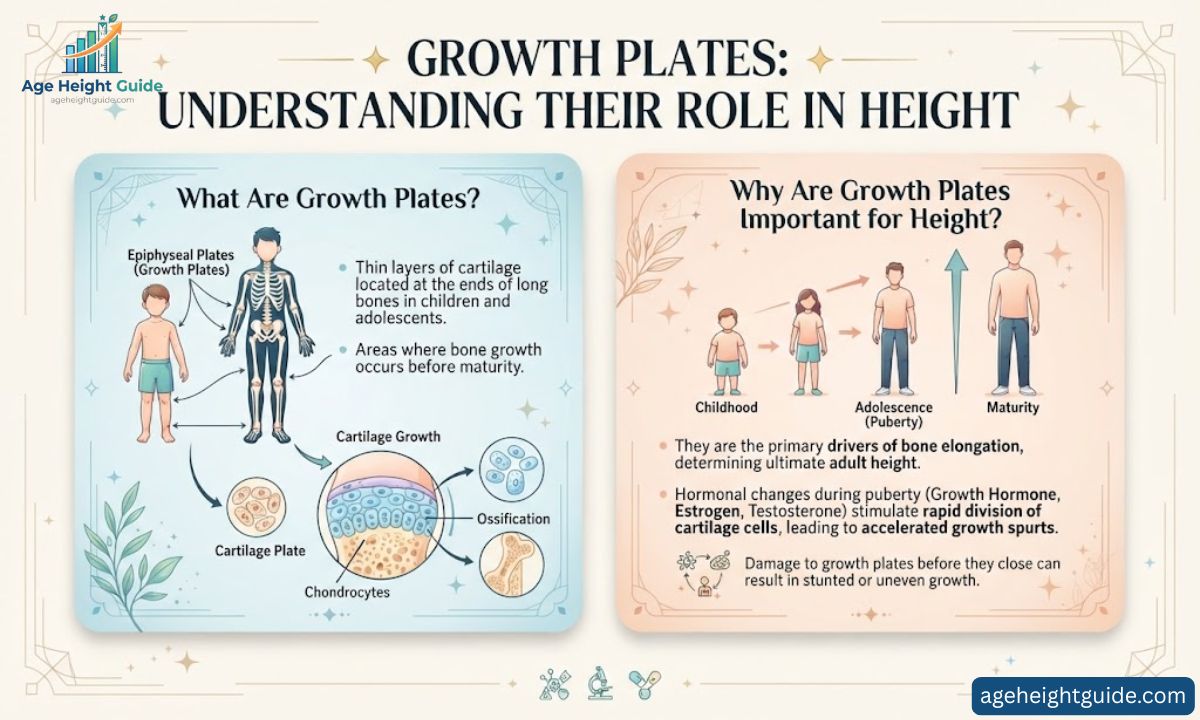
Growth plates are areas of cartilage near the ends of long bones. They are also called epiphyseal plates or physes. These flexible areas allow a child’s bones to increase in length during growth.
Growth plates are found near the ends of many long bones. These include the femur in the thigh, the tibia and fibula in the lower leg, and bones in the arms, hands, and feet.
During childhood, cells in the growth plates multiply. They help the bones become longer. New bone gradually replaces the cartilage. This process helps children gain height as they move from childhood into adolescence.
During puberty, hormone changes speed up physical development. The growth process then gradually slows down. Eventually, the cartilage in the growth plates hardens into solid bone.
This process is called growth plate closure or growth plate fusion. Understanding when do growth plates close can help parents understand why height growth eventually stops.
Once a growth plate is completely closed, the long bone cannot continue increasing in length. This is why significant natural height growth is no longer expected after growth plate closure.
Why Are Growth Plates Important for Height?
Your child’s height depends on many factors, including genetics, nutrition, health, hormones, and the timing of puberty.
However, growth plates are especially important because they are the areas that allow the long bones to lengthen.
While the plates remain open, a child can continue gaining height. Once they close, further lengthening of the long bones is no longer expected.
That is why questions such as when do growth plates close, are my growth plates still open, and can you grow taller after growth plates close are closely connected.
When Do Growth Plates Close in Girls?
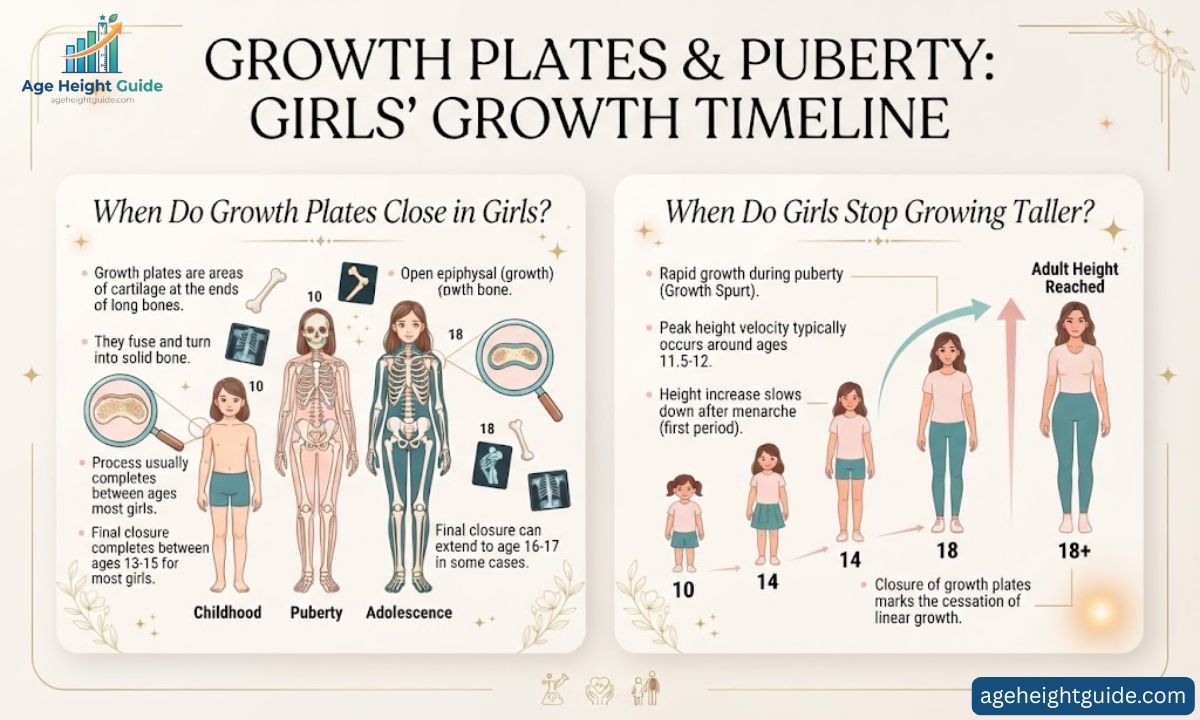
For many girls, growth plates close around the mid-teen years. A common range is about 13 to 15 years. Some girls may finish growing earlier or later. The timing depends on when puberty starts and how quickly it progresses.
Girls usually begin puberty earlier than boys. Their major growth spurt also tends to happen earlier. This means many girls reach most of their adult height before boys of the same age.
One useful milestone is the start of menstruation. After a girl’s first period, height growth usually slows down. Nemours KidsHealth notes that girls typically grow about 1 to 2 more inches after their periods begin. However, this can vary from person to person.
So, when do growth plates close in girls? There is no single age that applies to every girl. The timing can vary based on puberty, genetics, and overall development.
A girl who enters puberty early may finish growing earlier. A girl who enters puberty later may continue growing for longer.
This is why age alone cannot confirm whether a girl’s growth plates are still open. A healthcare professional can assess growth patterns and, when appropriate, use a bone age X-ray to learn more about skeletal maturity.
When Do Girls Stop Growing Taller?
Girls generally reach most of their adult height by the mid-teens, but the exact age depends on puberty timing.
A better question than simply asking when do growth plates close in girls is:
When did puberty begin, and how far has it progressed?
That information gives a better picture of how much growth may remain.
When Do Growth Plates Close in Boys?
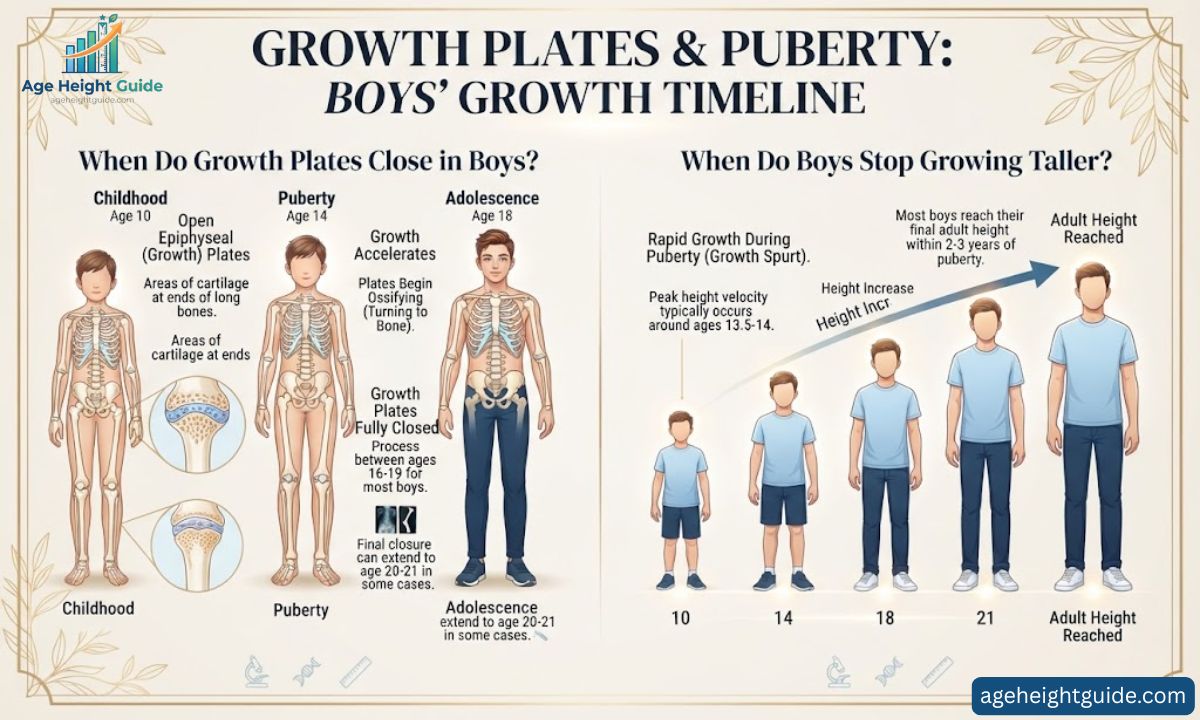
For boys, growth plates usually close later than in girls. A typical range is about 15 to 17 years. However, the timing can vary from one boy to another.
So, when do growth plates close in boys? Boys often reach growth plate closure later because they usually begin puberty later than girls.
Boys also tend to have their peak growth spurt later. Their fastest height growth often happens during the early to mid-teen years.
Some boys, especially those who enter puberty later, may continue growing into the later teen years. Their growth plates may remain open for longer.
This is why a 14-year-old boy who is shorter than his classmates may still have significant growth ahead. Current height does not always predict final height.
Being shorter at one age does not automatically mean a child will be short as an adult. Doctors look at the child’s growth pattern, family height, puberty stage, and overall health.
If there is concern about remaining growth, a healthcare professional may also consider bone age to assess skeletal maturity.
When Do Boys Stop Growing Taller?
Many boys reach most of their adult height by the later teen years. However, the exact timing varies.
A late bloomer may continue growing after many classmates have stopped. Puberty timing is therefore more useful than age alone when thinking about remaining height.
Growth Plate Timeline: Boys vs Girls
If you are wondering when do growth plates close, the answer depends on the child’s sex, puberty timing, genetics, and overall development. Girls usually reach growth plate closure earlier than boys because puberty tends to begin earlier.
Here is a more detailed comparison:
| Growth Factor | Girls | Boys |
|---|---|---|
| Puberty timing | Usually begins earlier | Usually begins later |
| Peak growth spurt | Usually occurs earlier | Usually occurs later |
| Fastest height growth | Often occurs in early adolescence | Often occurs in early to mid-adolescence |
| Typical growth plate closure | Around 13–15 years | Around 15–17 years |
| Later growth possible? | Yes, especially with later puberty | Yes, and later growth is more common |
| Main factor affecting closure | Puberty and hormonal changes | Puberty and hormonal changes |
| Final height timing | Usually reached earlier | Usually reached later |
| Bone maturity | Usually occurs earlier | Usually occurs later |
| Can growth plates reopen? | No | No |
| Can closed bones lengthen naturally? | No | No |
| Does age alone confirm closure? | No | No |
| Can bone age help? | Yes, when medically appropriate | Yes, when medically appropriate |
Does a Later Growth Spurt Mean More Height?
Not necessarily. A later growth spurt means the child’s growth timeline is shifted. It does not guarantee a specific final height.
Genetics, family height, puberty timing, nutrition, health, and other factors can affect final height.
Why Age Is Not Enough
Age alone cannot tell you whether the growth plates are still open. Two children of the same age can be at different stages of puberty and skeletal development.
For example, one 15-year-old may be close to the end of their growth period. Another 15-year-old who entered puberty later may still have significant growth ahead.
If you are asking when do growth plates close for a specific child, a healthcare professional may look at the child’s growth pattern, puberty stage, family history, and overall health. A bone age X-ray may also be used when appropriate to assess skeletal maturity.
What Causes Growth Plates to Close?
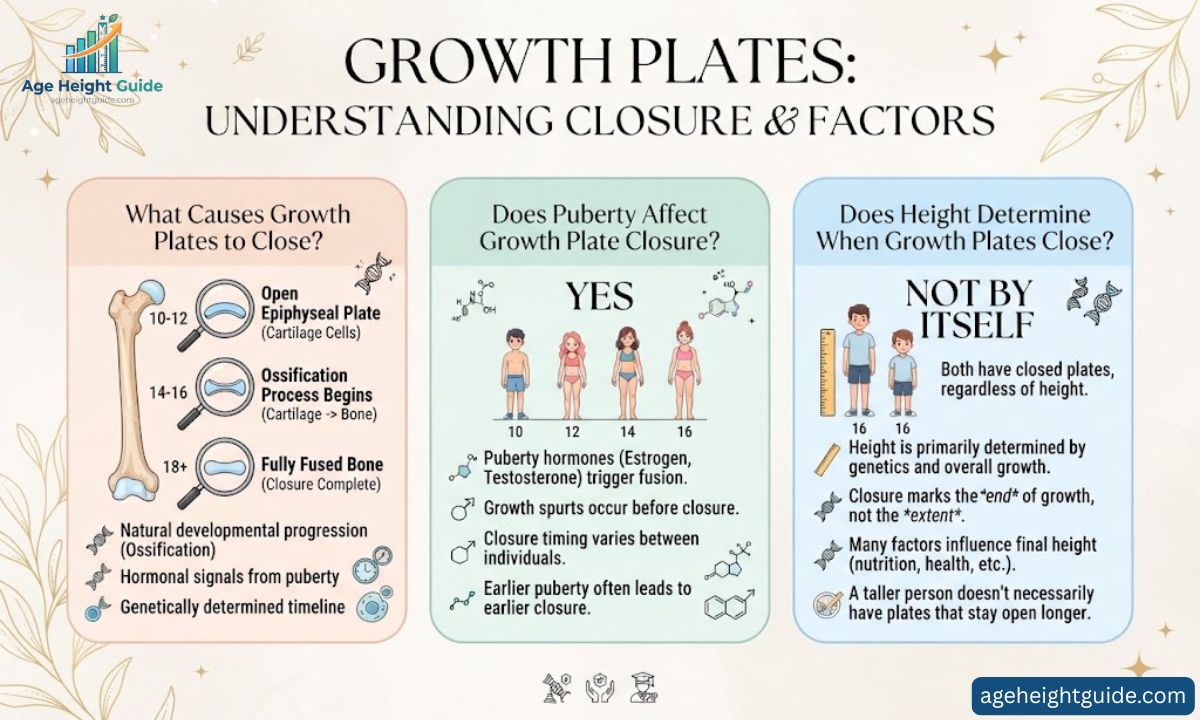
Puberty hormones are the main driver of growth plate maturation and closure.
As a child moves through puberty, hormonal changes affect the growth plates. The cartilage gradually becomes thinner and is replaced by bone. Eventually, the plate disappears as a separate growth area.
This means growth plate closure is a normal part of human development.
Does Puberty Affect Growth Plate Closure?
Yes.
The timing and progression of puberty are closely connected with skeletal maturity. Children who enter puberty earlier may reach growth plate closure earlier. Children who enter puberty later may have more time before the plates fully fuse.
That is one reason two children of the same age can have very different heights and still both be developing normally.
Does Height Determine When Growth Plates Close?
Not by itself.
A child’s current height does not tell you exactly whether the growth plates are open or closed.
Two teenagers can be the same age and have different puberty stages. One may be near the end of skeletal growth while another may still have several years of growth remaining.
How Do You Know If Your Child’s Growth Plates Are Still Open?

You cannot reliably determine whether growth plates are open just by looking at a child.
Signs such as growing taller, needing larger shoes, or outgrowing clothes can suggest that a child is still developing. However, they cannot confirm whether a specific growth plate is open.
The most reliable way to assess bone age and skeletal maturity is a bone age X-ray, usually involving the left hand and wrist. Doctors compare the X-ray with standard images to estimate how mature the child’s bones are.
A pediatrician or pediatric endocrinologist may recommend a bone age study when a child’s growth pattern raises questions.
What Is a Bone Age X-Ray?
A bone age X-ray is an imaging test used to estimate skeletal maturity.
The test looks at the bones of the hand and wrist. Growth plates are visible on X-rays because they contain softer, less mineralized tissue than mature bone. As the skeleton matures, the growth plates become thinner and eventually close.
A bone age study can help doctors estimate:
- how mature a child’s skeleton is
- how much growth may remain
- whether puberty or skeletal development is progressing earlier or later than expected
- whether additional evaluation may be needed
It is important to remember that bone age does not predict height with perfect accuracy. It is one tool doctors use along with growth charts, family history, physical development, and medical history.
Signs Your Child May Still Be Growing
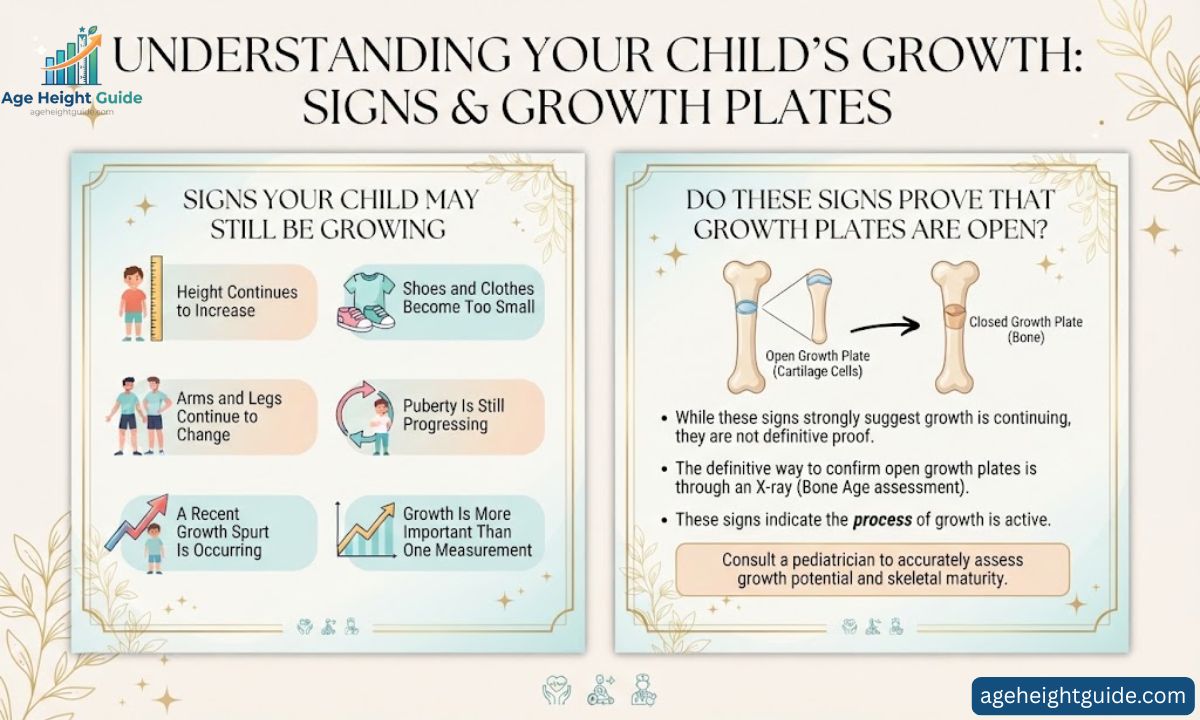
While only a medical evaluation can confirm skeletal maturity and whether the growth plates are still open, some everyday changes can suggest that a child has more height growth ahead. These signs are not a definite test, but they can help parents understand a child’s overall growth pattern.
Height Continues to Increase
One of the clearest signs of ongoing growth is a steady increase in height. If your child’s height continues to rise over several months, their body is still going through physical development.
Tracking height on a growth chart can make this easier to see. A single measurement does not tell you much. What matters is how height changes over time and whether your child is following a consistent growth pattern.
Shoes and Clothes Become Too Small
Children who are still growing may outgrow their shoes and clothes quickly. You may notice that:
- Shoes become tight or uncomfortable
- Pants become shorter
- Sleeves no longer reach the wrists
- Clothing sizes need to be changed more often
These changes can happen during periods of faster growth, especially during a growth spurt.
Arms and Legs Continue to Change
During childhood and adolescence, different parts of the body may grow at different rates. A child may temporarily look taller, slimmer, or less proportionate as the arms, legs, and torso develop.
Long bones in the arms and legs contain growth plates. When these plates are still open, the bones can continue to lengthen as part of normal growth.
Puberty Is Still Progressing
Ongoing puberty can be another sign that physical development is not yet complete. Puberty involves many changes, including changes in body composition, hormones, reproductive development, and growth rate.
The timing of puberty varies from child to child. Some children have their major growth spurt earlier, while others grow later. Because of this, puberty stage alone cannot confirm whether the growth plates are open.
A Recent Growth Spurt Is Occurring
A noticeable increase in height over a short period may indicate that a child is going through a growth spurt. Growth often speeds up during puberty before gradually slowing as the body approaches skeletal maturity.
A recent growth spurt does not mean that a child will continue growing at the same rate. Growth usually slows as the growth plates gradually mature and eventually close.
Growth Is More Important Than One Measurement
Parents sometimes focus on a child’s current height or compare them with classmates. However, one height measurement cannot show whether a child has finished growing.
A better approach is to look at the child’s growth rate over time. Regular measurements can show whether height is increasing, staying stable, or changing more slowly.
Genetics, puberty timing, nutrition, overall health, and other factors can all influence a child’s growth pattern. Two healthy children of the same age may therefore have very different growth timelines.
Do These Signs Prove That Growth Plates Are Open?
No. These signs can suggest that a child is still growing, but they cannot prove that every growth plate remains open.
The most reliable way to assess skeletal maturity is through a medical evaluation. When appropriate, a healthcare professional may use a bone age X-ray to assess how mature the bones are and estimate how much growth may remain.
If you are concerned that your child is growing much faster or slower than expected, or their height has changed very little over time, discuss their growth pattern with a pediatrician or other qualified healthcare professional.
The key point is simple: continued height growth, changing clothing or shoe sizes, ongoing puberty, and a recent growth spurt can all suggest that a child is still developing, but only medical assessment can determine skeletal maturity with greater confidence.
Can You Still Grow Taller After Growth Plates Close?

Once growth plates close, the long bones cannot continue lengthening.
That means a person cannot naturally reopen a fused growth plate with stretching, exercise, supplements, or special foods. A closed growth plate has been replaced by solid bone.
This is why products claiming to reopen closed growth plates or restart normal bone-length growth should be viewed with caution.
Can Stretching Make You Taller After Growth Plates Close?
Stretching can improve flexibility and posture, but it does not make the long bones longer after growth plate closure.
Someone may look slightly taller when standing with better posture, but this is different from increasing skeletal height.
Can Exercise Reopen Growth Plates?
No.
Regular physical activity is valuable for healthy bones, muscles, and overall development, but exercise does not reopen a fused growth plate.
The same applies to hanging exercises, stretching routines, and other internet methods that promise permanent height increases after skeletal maturity.
Can Supplements Reopen Growth Plates?
No reliable evidence shows that a supplement can reopen a completely fused growth plate.
Nutrition is important during childhood and adolescence because the body needs adequate nutrients for normal growth and bone development. But that is different from extending the natural growth window after the growth plates have closed.
What Actually Matters While the Growth Window Is Open

While growth plates are still open, the goal should not be chasing a magic number on the height chart.
The goal is to support normal growth and development.
Genetics plays a major role in adult height, but other factors also matter. Nutrition, sleep, physical activity, overall health, and hormones can all influence a child’s development.
1. Balanced Nutrition
Children need enough calories, protein, vitamins, minerals, and other nutrients for normal development.
A balanced diet can include:
- Protein-rich foods
- Dairy or suitable calcium-rich alternatives
- Fruits and vegetables
- Whole grains
- Healthy fats
- Foods containing vitamin D
- Zinc-rich foods
The goal is to prevent genuine nutritional gaps rather than provide unnecessary megadoses of nutrients.
2. Enough Sleep
Sleep is an important part of healthy childhood development.
Children and teenagers need regular, adequate sleep as their bodies grow and change.
A consistent sleep schedule can also support daily energy, learning, mood, and physical activity.
3. Regular Physical Activity
Regular physical activity supports strong bones and muscles.
Children can participate in age-appropriate activities such as walking, running, cycling, swimming, sports, and strength exercises performed with proper technique and supervision.
Exercise supports health, but it does not override genetics or reopen closed growth plates.
4. Track Growth Over Time
One height measurement tells you very little.
A growth chart shows how a child is growing over months and years. Doctors look at the pattern rather than focusing only on whether a child is taller or shorter than classmates.
A child who consistently follows their growth curve may be developing normally even if they are shorter than some peers.
What If My Child Is Not Growing as Expected?
Every child grows at a different rate. However, a major change in growth pattern deserves attention.
Talk with a pediatrician if your child:
- Stops gaining height for an extended period
- Drops significantly across growth chart percentiles
- Has signs of very early or delayed puberty
- Is much shorter or taller than expected for their family pattern
- Has other symptoms along with poor growth
Understanding when do growth plates close can also help parents understand changes in height during childhood and puberty.
Doctors may review the child’s growth history, family height, nutrition, puberty stage, and overall health.
If needed, they may order blood tests or imaging. A bone age X-ray may also help assess skeletal development and estimate how much growth may remain.
The goal is not to predict an exact final height. It is to understand whether the child’s growth pattern is progressing as expected.
Does Nutrition Change When Growth Plates Close?
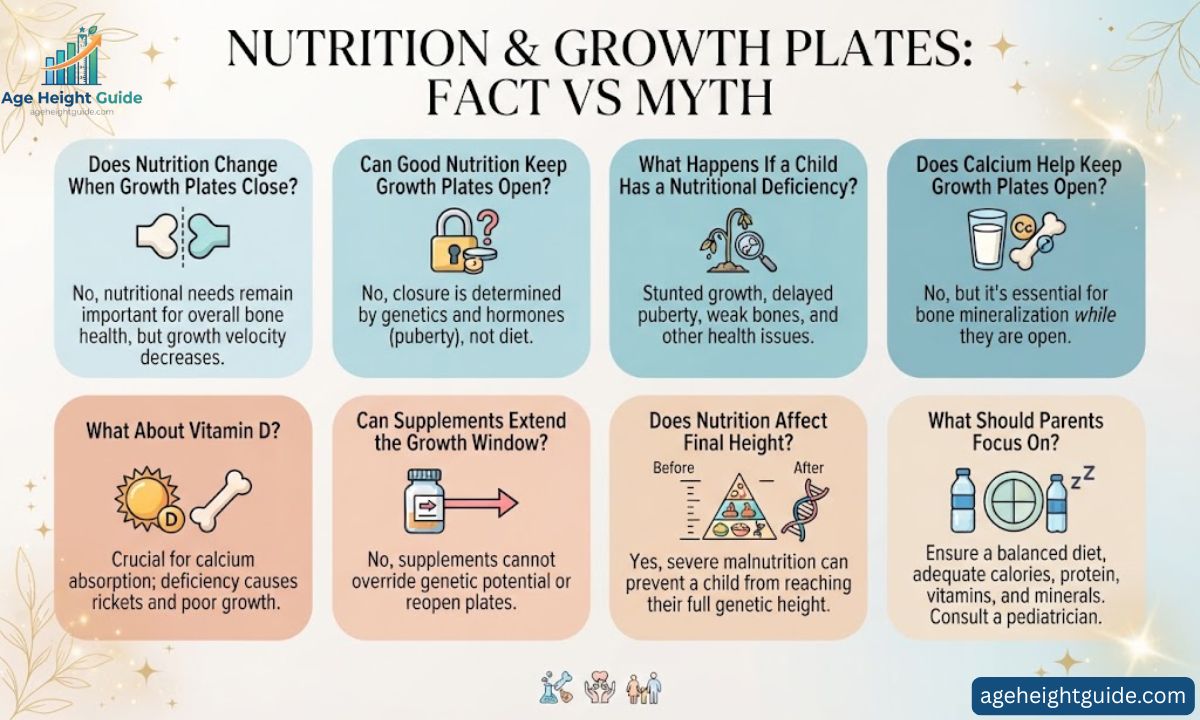
Nutrition plays an important role in a child’s overall health and development. A balanced diet provides the energy, protein, vitamins, and minerals the body needs during childhood and adolescence. However, nutrition does not normally determine the exact date when growth plates close.
The timing of growth plate closure is mainly linked to puberty, hormones, genetics, and overall skeletal maturity. As a child moves through puberty, the growth plates gradually become thinner and eventually harden into solid bone.
Once a growth plate has completely closed, that bone can no longer become longer through normal growth.
Can Good Nutrition Keep Growth Plates Open?
Good nutrition can support normal height growth, but it cannot keep growth plates open indefinitely.
Children need enough nutrients while they are growing. A diet that provides adequate protein, calcium, vitamin D, zinc, iron, and other essential nutrients helps support healthy bones and normal physical development.
However, getting more nutrients than the body needs does not usually delay growth plate closure. For example, a well-nourished child does not normally stay in the growth phase longer simply because they consume extra vitamins or minerals.
The goal should be to correct nutritional gaps and support healthy development rather than trying to extend the natural growth window.
What Happens If a Child Has a Nutritional Deficiency?
A significant nutritional deficiency can affect normal growth. If a child does not get enough calories, protein, or certain essential nutrients, their growth rate may slow down.
In these cases, identifying and correcting the deficiency can help support healthier growth. The effect depends on the child’s age, the severity of the deficiency, how long it has been present, and the child’s overall health.
This is different from trying to make a healthy child grow beyond their natural potential. Correcting a deficiency helps the body function normally; it does not guarantee extra height.
Does Calcium Help Keep Growth Plates Open?
Calcium is important for building and maintaining strong bones. Children and teenagers need adequate calcium as their skeleton develops.
However, calcium does not normally keep the growth plates open for a longer period. A child who already gets enough calcium does not generally gain additional height simply by taking extra calcium.
Calcium is best viewed as part of healthy bone nutrition, not as a way to delay growth plate closure.
What About Vitamin D?
Vitamin D helps the body absorb calcium and supports normal bone health. Low vitamin D levels can be a concern for growing children, particularly when intake or sunlight exposure is inadequate.
If a child has a vitamin D deficiency, a healthcare professional may recommend dietary changes or supplementation. Correcting a deficiency can support normal bone health and development.
But extra vitamin D does not normally prevent growth plates from closing once the body reaches the appropriate stage of skeletal maturation.
Can Supplements Extend the Growth Window?
There is an important difference between filling a nutritional gap and extending the natural growth period.
If a child has a genuine deficiency, an appropriate supplement may help correct that deficiency and support normal growth. But for a healthy child who already receives adequate nutrition, taking additional vitamins or height growth supplements does not mean the growth plates will remain open longer.
Parents should also be careful with products that promise to increase height by changing growth plate closure or extending puberty. Such claims should be evaluated carefully, especially when the product does not have strong scientific evidence behind it.
Does Nutrition Affect Final Height?
Nutrition can influence a child’s ability to reach their normal growth potential. Poor nutrition, severe deficiencies, or certain health conditions may interfere with normal growth.
At the same time, final height is influenced by many factors. Genetics, puberty timing, hormones, health, nutrition, and the child’s overall growth pattern all play a role.
This means nutrition is important, but it is only one part of the picture. A balanced diet cannot guarantee a specific adult height, and extra nutrition cannot normally override the body’s natural growth plate closure process.
What Should Parents Focus On?
Instead of trying to keep growth plates open, parents should focus on healthy development. Knowing when do growth plates close can help set realistic expectations about height growth.
A growing child needs:
- A balanced diet with enough protein and nutrients
- Enough calcium and vitamin D
- Regular physical activity
- Adequate sleep
- Regular growth monitoring
- Medical advice when growth seems unusual
Good nutrition supports normal growth but does not delay growth plate closure. The goal is to help children reach their natural growth potential through healthy habits and proper healthcare..
Growth Plates and Final Adult Height
Final height is influenced by genetics and many aspects of development.
Parents often compare a child with classmates, siblings, or relatives. But every child grows at a different pace. Puberty can also start at different ages.
Understanding when do growth plates close can help explain these differences. A child who is short before puberty may have more time to grow. A child who is tall early may enter puberty sooner and finish growing earlier.
That is why current height alone cannot predict final adult height.
Doctors look at the child’s growth pattern, puberty stage, family history, and sometimes bone age. These factors can provide a better estimate of remaining growth.
The Bottom Line
When do growth plates close? They usually close near the end of puberty. Girls generally reach skeletal maturity earlier, often around the mid-teen years, while boys tend to finish later. Nemours Kids Health gives typical closure ages of about 13–15 for girls and 15–17 for boys, but individual timing can vary.
The most important point is that there is no single age that applies to every child.
Puberty timing, genetics, health, and individual development all matter.
While the growth plates are open, good nutrition, enough sleep, regular physical activity, and proper medical care can support normal growth.
After a growth plate fully closes, the long bone cannot continue lengthening naturally.
If you need to know whether your child’s growth plates are still open, do not rely on height alone. A doctor can evaluate the growth pattern and, when appropriate, use a bone age X-ray to assess skeletal maturity.
Frequently Asked Questions
When Do Growth Plates Close?
Growth plates usually close near the end of puberty. Typical timing is around 13–15 years for girls and 15–17 years for boys, but the exact age varies between individuals.
When Do Growth Plates Close in Girls?
For many girls, growth plates close around ages 13–15. Girls generally mature earlier than boys, but some may finish earlier or later depending on when puberty begins and progresses.
When Do Growth Plates Close in Boys?
For many boys, growth plates close around 15–17 years. Boys generally enter puberty later than girls, so their growth window often remains open longer.
How Do You Know If Your Growth Plates Are Closed?
You cannot know for certain from height or appearance alone. A bone age X-ray of the hand and wrist is commonly used to assess skeletal maturity and growth plate development.
Can Growth Plates Reopen After They Close?
No. Once a growth plate has fully fused into solid bone, it does not naturally reopen. Stretching, exercise, or supplements cannot restart normal long-bone growth.
Do Girls Stop Growing Before Boys?
Usually, yes. Girls generally enter puberty earlier and reach skeletal maturity earlier than boys. This is why growth plate closure typically happens earlier in girls.
Can You Still Grow Taller After Growth Plates Close?
Normally, no. Once the growth plates of the long bones have fully closed, those bones cannot continue to lengthen.
Can Nutrition Keep Growth Plates Open Longer?
Good nutrition supports normal growth, but it does not normally keep growth plates open beyond their natural developmental timing. Puberty and skeletal maturation play the main roles in closure.
Can Exercise Keep Growth Plates Open?
No. Exercise supports healthy bones, muscles, and overall development, but it does not delay normal growth plate fusion.
Can Supplements Make You Taller?
Supplements cannot guarantee extra height beyond a person’s natural growth potential. If a child has a genuine nutrient deficiency, correcting it can support normal growth. But supplements should not be viewed as a way to reopen closed growth plates or extend puberty.
Is a Bone Age X-Ray Accurate?
A bone age study is a useful medical tool for assessing skeletal maturity, but it is not a perfect prediction of final adult height. Doctors interpret it together with growth history, puberty stage, family history, and other health information.
What Is the Best Way to Support Growth Before Growth Plates Close?
Focus on the basics: a balanced diet, adequate sleep, regular physical activity, healthy weight, and routine medical care. If your child’s growth pattern seems unusual, a pediatrician can assess whether further testing is needed.

Stoke is the author behind Age Height Guide, creating simple and informative content about average height, age, growth, and related measurements.