

Does stress stunt growth in kids? For most children, everyday stress does not make them shorter or permanently stop normal growth. A school test, a sports competition, a disagreement with a friend, or a busy week can trigger a short-term stress response. The body is designed to recover from these normal challenges.
Chronic, severe, and unrelieved stress is different. Research suggests that long-lasting stress can affect the hormone systems involved in growth, especially when high stress also disrupts sleep, appetite, nutrition, and overall health.
A 2023 review in Hormone Research in Paediatrics examined the relationship between stress and growth in children and adolescents. It explains how prolonged stress can affect the growth hormone–IGF-1 system and other hormone pathways involved in normal development. It also highlights the importance of reducing chronic stress during childhood and adolescence.
The good news is that parents can control practical things. Protecting sleep, supporting regular meals, creating a safe home environment, and getting medical advice when a child’s growth curve changes can all matter.
This guide explains whether Does stress stunt growth in kids, what type of stress may affect growth, how cortisol and growth are connected, and what parents should know about nutrition and healthy development.
You can also read: How Tall Will My Daughter Be? 2026 Height Formula & Growth Guide
The short answer: normal stress no, chronic stress can
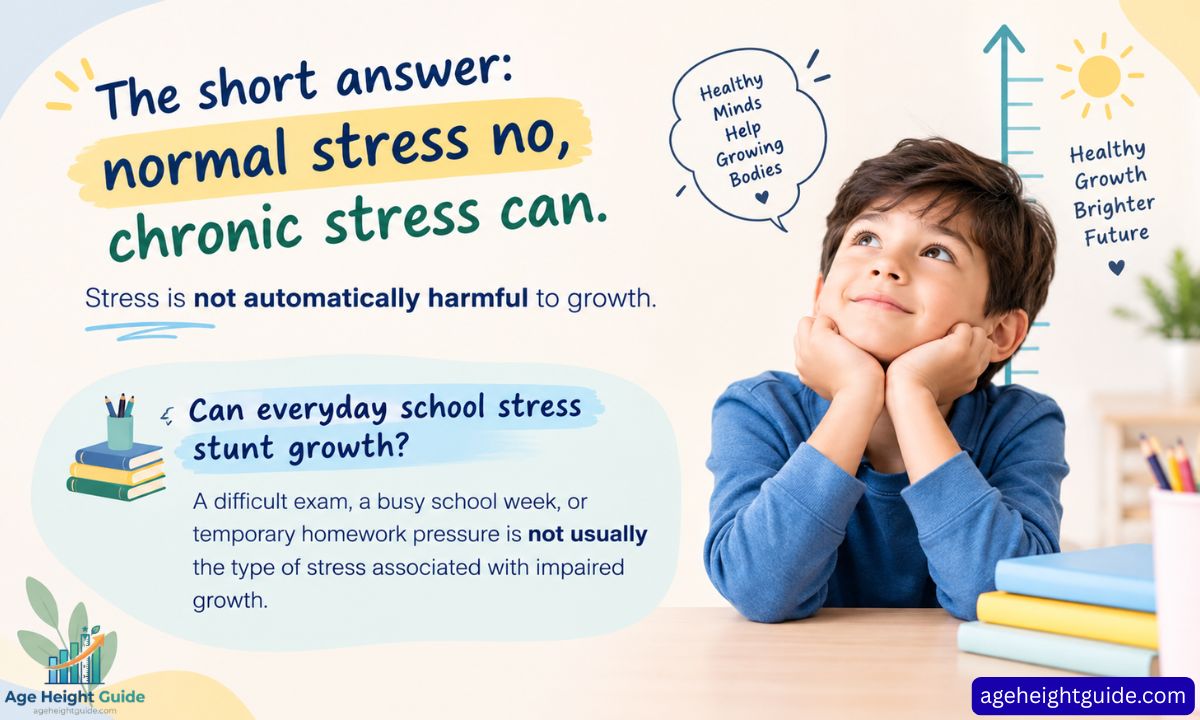
Stress is not automatically harmful to growth.
A child may feel stressed before a test, during a football match, before a performance, or while meeting new people. These situations can briefly increase stress hormones. Once the challenge passes, the body normally returns toward its usual state.
So, can stress stunt growth in kids after one difficult day or one stressful week?
Usually, no.
The concern is chronic stress. This means stress that continues for a long time without enough recovery or support. Severe ongoing stress can keep the body’s stress-response system active. Research has linked prolonged stress with changes in cortisol, growth-related hormones, metabolism, and other systems involved in child development.
That does not mean every stressed child will become shorter.
The more realistic concern is that chronic stress may affect growth directly through hormonal pathways or indirectly by causing a child to:
- eat less
- sleep poorly
- lose interest in normal activities
- become sick more often
- experience ongoing emotional distress
- miss regular meals
- train hard without eating enough
For most parents, this distinction is the most important part of the answer.
Normal childhood stress is not the same as chronic toxic stress.
Can everyday school stress stunt growth?
A difficult exam, a busy school week, or temporary homework pressure is not usually the type of stress associated with impaired growth.
Children experience stress as part of normal development. Learning new skills, adapting to change, competing in sports, and dealing with social situations can all create temporary pressure.
The body is built to handle short-term challenges.
The concern increases when stress becomes persistent and starts changing daily life. If a child is consistently losing sleep, skipping meals, losing weight, withdrawing from normal activities, or showing a sustained change in behavior, the issue deserves more attention.
In other words, parents should look at the pattern, not one stressful event.
What counts as stress to a child’s body?
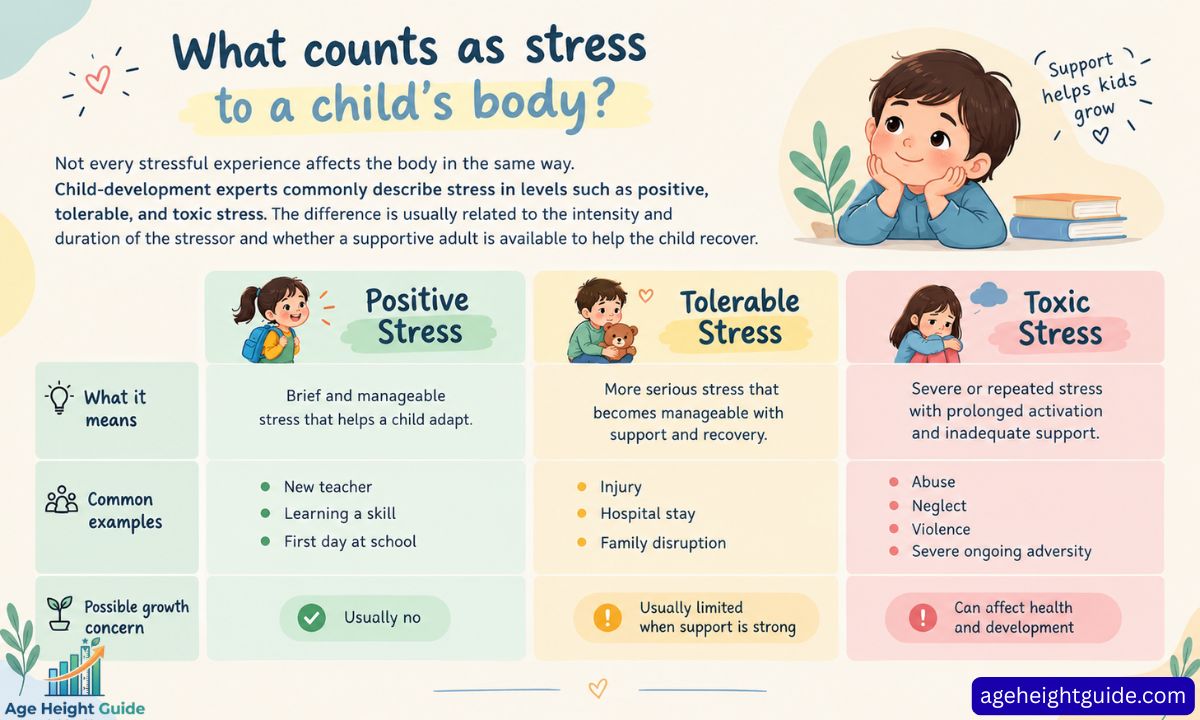
Not every stressful experience affects the body in the same way.
Child-development experts commonly describe stress in levels such as positive, tolerable, and toxic stress. The difference is usually related to the intensity and duration of the stressor and whether a supportive adult is available to help the child recover.
| Type of stress | What it means | Common examples | Possible growth concern |
| Positive stress | Brief and manageable stress that helps a child adapt | New teacher, learning a skill, first day at school | Usually no |
| Tolerable stress | More serious stress that becomes manageable with support and recovery | Injury, hospital stay, family disruption | Usually limited when support is strong |
| Toxic stress | Severe or repeated stress with prolonged activation and inadequate support | Abuse, neglect, violence, severe ongoing adversity | Can affect health and development |
This distinction is important because many parents searching for how Does stress stunt growth in kids are thinking about normal school pressure or sports pressure.
Those situations are not automatically toxic stress.
The bigger concern is severe, ongoing stress that continues for months or longer and affects a child’s physical and emotional health.
A supportive relationship can also matter. A child who experiences a difficult event but has stable adults, safety, routines, food, sleep, and emotional support may respond very differently from a child who experiences ongoing adversity without reliable support.
Stress vs. chronic stress: what parents should watch
| Short-term stress | Chronic stress |
| Comes and goes | Continues for a long time |
| Child usually recovers | Child struggles to return to baseline |
| Sleep remains mostly normal | Sleep may become disrupted |
| Appetite remains fairly stable | Appetite may decrease or become irregular |
| Normal activities continue | School, sports, or social life may change |
| Temporary worry | Persistent fear, irritability, or withdrawal |
The goal is not to remove every stressful experience from childhood.
The goal is to give children enough safety, support, sleep, nutrition, and recovery to handle normal challenges.
How does chronic stress affect growth, according to the research?
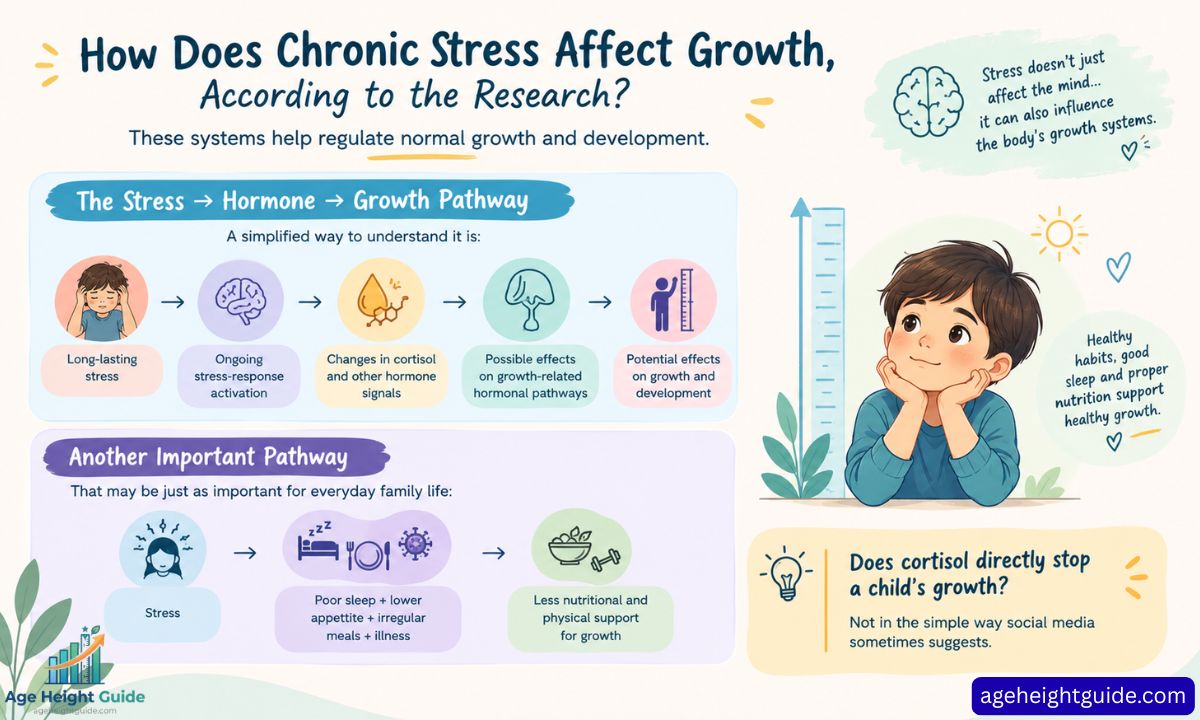
The connection between chronic stress and growth is more complicated than saying “stress makes kids shorter.”
One important pathway involves cortisol, a hormone released as part of the body’s stress response.
Short-term cortisol changes are normal. They help the body respond to challenges.
Long-lasting stress can keep this system activated for too long. Research has found that persistently elevated cortisol can affect the growth hormone–IGF-1 axis, along with thyroid and puberty-related hormone pathways.
These systems help regulate normal growth and development.
The stress → hormone → growth pathway
A simplified way to understand it is:
Long-lasting stress
↓
Ongoing stress-response activation
↓
Changes in cortisol and other hormone signals
↓
Possible effects on growth-related hormonal pathways
↓
Potential effects on growth and development
But there is another pathway that may be just as important for everyday family life:
Stress
↓
Poor sleep + lower appetite + irregular meals + illness
↓
Less nutritional and physical support for growth
This second pathway is especially relevant because parents can often address some of these factors.
A child under stress may not sit down and eat a normal meal. They may snack instead. They may skip breakfast. They may stay awake worrying about school. They may spend less time outside or become less active.
Over time, these changes can affect the conditions that support healthy development.
Does cortisol directly stop a child’s growth?
Not in the simple way social media sometimes suggests.
Cortisol is a normal hormone. The body needs it.
The concern is prolonged stress-system activation, not the normal cortisol response to an ordinary challenge.
Research on chronic stress suggests that persistently high cortisol can interfere with hormone pathways involved in growth hormone, IGF-1, thyroid function, and puberty.
That is why it is more accurate to discuss chronic stress and growth than to say that every stressful experience stunts height.
What are the signs stress might be reaching your child’s body?
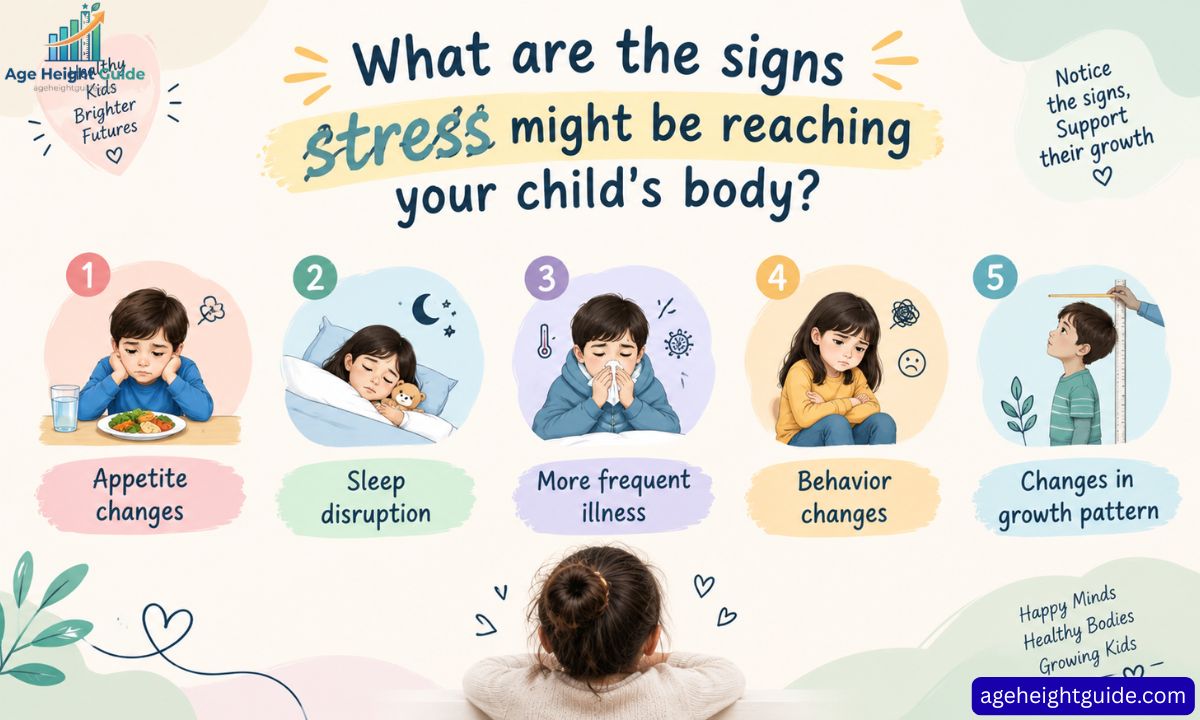
Chronic stress may not look like a child saying, “I am stressed.”
Instead, it can appear as changes in normal routines.
Parents should pay attention to patterns involving appetite, sleep, behavior, school performance, energy, and overall health.
1. Appetite changes
A child who suddenly eats much less may not be getting the same amount of energy and nutrients they previously received.
Look for:
- skipped meals
- smaller portions
- loss of interest in favorite foods
- sudden picky eating
- frequent stomach complaints around stressful situations
- noticeable weight changes
Stress does not always reduce appetite. Some children may eat more when anxious. The important point is a persistent change from the child’s usual pattern.
2. Sleep disruption
Stress can make it harder for a child to relax at bedtime.
You may notice:
- difficulty falling asleep
- waking during the night
- nightmares
- early waking
- tiredness in the morning
- difficulty concentrating during the day
Sleep matters during childhood because normal development depends on adequate rest.
3. More frequent illness
Long-lasting stress can affect several parts of the body. If a child seems unusually run down or repeatedly becomes ill, parents should consider the full picture rather than blaming everything on growth.
4. Behavior changes
A stressed child may become:
- unusually irritable
- withdrawn
- anxious
- less interested in hobbies
- more emotional
- less social
- less focused at school
One bad day does not indicate a growth problem.
A persistent cluster of changes deserves attention.
5. Changes in growth pattern
This is one of the most important signs.
Children do not all grow at the same speed. Some are naturally shorter because of genetics or normal variation.
What matters is whether a child continues to follow an expected growth curve.
A pediatrician can compare height and weight measurements over time instead of judging growth from one measurement.
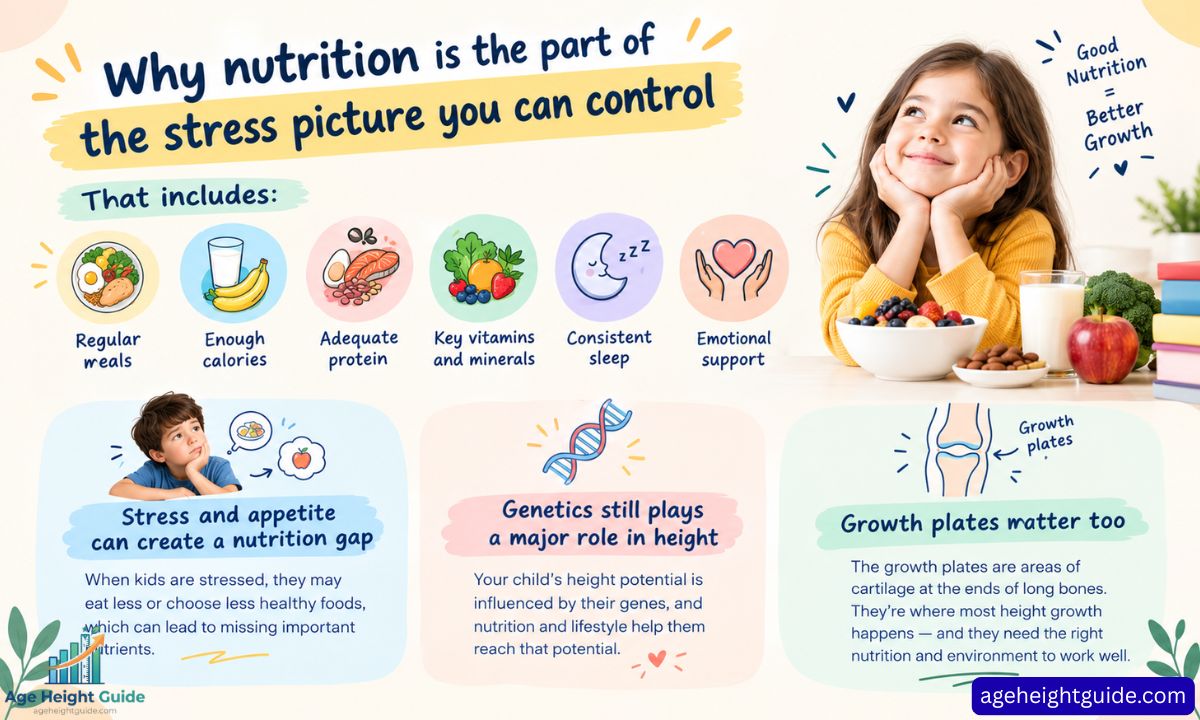
Why nutrition is the part of the stress picture you can control
Parents cannot always remove every source of stress.
You may not be able to eliminate school pressure, friendship problems, competition, or every difficult event.
But you can often create a better foundation around the child.
That includes:
regular meals + enough calories + adequate protein + key vitamins and minerals + consistent sleep + emotional support
Nutrition cannot erase stress.
But poor nutrition can add another problem when a child is already under pressure.
Stress and appetite can create a nutrition gap
Imagine a child who normally eats three good meals.
During a stressful period, breakfast disappears. Lunch becomes half a meal. Dinner is only a few bites.
That child is now receiving less of the nutrients needed for normal development.
Important nutrients include:
- calcium
- vitamin D
- zinc
- magnesium
- protein
- iron
- vitamin C
- other vitamins and minerals from a balanced diet
This does not mean taking more supplements will make the child taller.
It means that adequate nutrition supports normal growth, while persistent nutritional gaps can work against healthy development.
Genetics still plays a major role in height
Stress is only one part of the growth picture.
Genetics is a major determinant of adult height. Family height, puberty timing, nutrition, health, hormones, and other factors also contribute.
That is why two healthy children can eat similar foods, sleep similar hours, and still end up at different adult heights.
A child being shorter than classmates does not automatically mean stress is stunting growth.
Growth plates matter too
Height increases while the growth plates in the long bones remain open.
Once growth plates close during puberty, significant natural height growth is no longer possible.
That is why a pediatrician may consider a child’s age, puberty stage, growth history, and growth curve when evaluating height concerns.
The key message is simple:
Do not judge a child’s growth from one measurement. Look at the trend over time.
Sports pressure: the stress most parents actually ask about
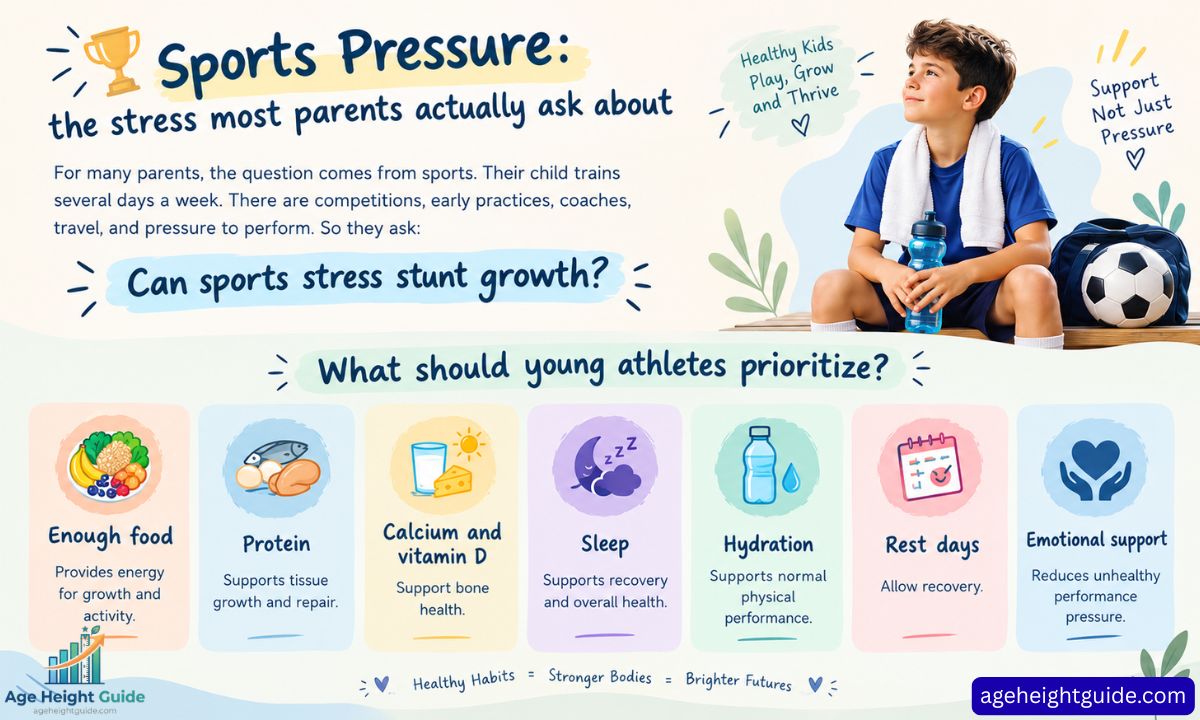
For many parents, the question comes from sports.
Their child trains several days a week. There are competitions, early practices, coaches, travel, and pressure to perform.
So they ask:
Can sports stress stunt growth?
Usually, normal physical activity does not stunt height.
Exercise is an important part of healthy childhood development.
The bigger concern is the combination of high training demands + inadequate nutrition + poor recovery + insufficient sleep.
A young athlete who trains hard but does not eat enough may struggle to meet the body’s energy needs.
That is different from exercise itself “stopping growth.”
What should young athletes prioritize?
| Priority | Why it matters |
| Enough food | Provides energy for growth and activity |
| Protein | Supports tissue growth and repair |
| Calcium and vitamin D | Supports bone health |
| Sleep | Supports recovery and overall health |
| Hydration | Supports normal physical performance |
| Rest days | Allow recovery |
| Emotional support | Reduces unhealthy performance pressure |
The question is rarely:
“Is my child exercising too much?”
It is often:
“Is my child recovering enough for the amount of activity they are doing?”
Parents should also watch for extreme dieting, fear of food, unexplained weight loss, or intense pressure around body size. Those issues deserve professional attention.
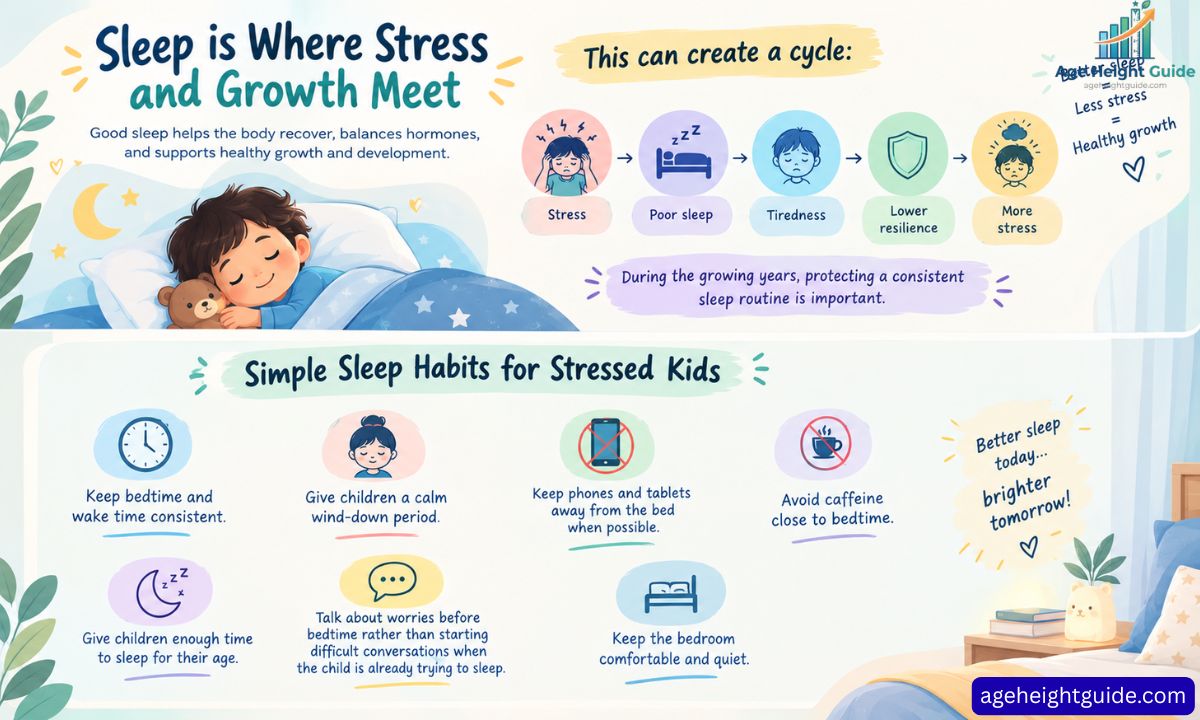
Sleep is where stress and growth meet
Sleep is one of the most practical areas parents can improve.
A stressed child may lie awake worrying about school, friends, sports, or family problems.
Then the next day they may be tired, irritable, and less focused.
This can create a cycle:
Stress → poor sleep → tiredness → lower resilience → more stress
During the growing years, protecting a consistent sleep routine is important.
Simple sleep habits for stressed kids
- Keep bedtime and wake time consistent.
- Give children a calm wind-down period.
- Keep phones and tablets away from the bed when possible.
- Avoid caffeine close to bedtime.
- Give children enough time to sleep for their age.
- Talk about worries before bedtime rather than starting difficult conversations when the child is already trying to sleep.
- Keep the bedroom comfortable and quiet.
A perfect sleep routine is not required.
The goal is consistency.
One late night does not stunt growth.
The concern is chronic sleep deprivation over a long period.
Can growth recover once the stress is resolved?
This is one of the most encouraging questions parents can ask.
Research on chronic stress suggests that reducing prolonged stress can support better health and development. The 2023 review specifically notes that targeted interventions to reduce stress during childhood and adolescence may provide long-term health benefits and support adequate growth.
But recovery is not guaranteed in every situation.
It depends on:
- the child’s age
- how long the problem lasted
- nutritional status
- overall health
- puberty stage
- whether growth plates remain open
- the underlying cause of slow growth
Some children may experience catch-up growth after an underlying problem is corrected.
Others may need medical evaluation because stress is not actually the main cause of their slower growth.
That is why a changing growth curve deserves attention.
If your child’s height has noticeably slowed during a prolonged stressful period, do not wait for a supplement to solve the problem.
Start by identifying the cause.
Can stress cause a temporary slowdown without permanent height loss?
Yes, this is an important distinction.
Growth is not perfectly linear.
Children can grow in spurts. They can also have periods when their height changes more slowly.
A temporary slowdown does not automatically mean permanent height loss.
This is why pediatricians use repeated measurements and growth charts.
For example, a child may be shorter than classmates but consistently follow their own growth curve. Another child may be average height but suddenly drop across several growth measurements.
The second pattern may deserve more investigation.
So when parents ask, “Can stress make my child shorter?”, the better question is:
“Has my child’s normal growth pattern changed?”
When should you talk to a pediatrician?
Talk with your child’s pediatrician if you notice a persistent change in growth or several physical and emotional symptoms occurring together.
Consider getting medical advice if:
- your child drops noticeably across their growth curve
- height growth slows for a prolonged period
- a major stressor has continued for months
- appetite loss persists
- your child is losing weight
- sleep problems continue
- your child is unusually tired
- illness becomes frequent
- puberty seems unusually early or delayed
- your child has ongoing digestive symptoms
- you are worried about nutrition or eating behavior
A pediatrician can look at the child’s complete history rather than one isolated height measurement.
They may review:
height + weight + growth velocity + puberty + nutrition + family height + medical history + symptoms
If necessary, they can also decide whether further testing or referral is appropriate.
Most importantly, do not assume that stress is the cause simply because your child is going through a difficult period.
Slow growth can have many causes.
Where a multivitamin honestly fits (and where it does not)
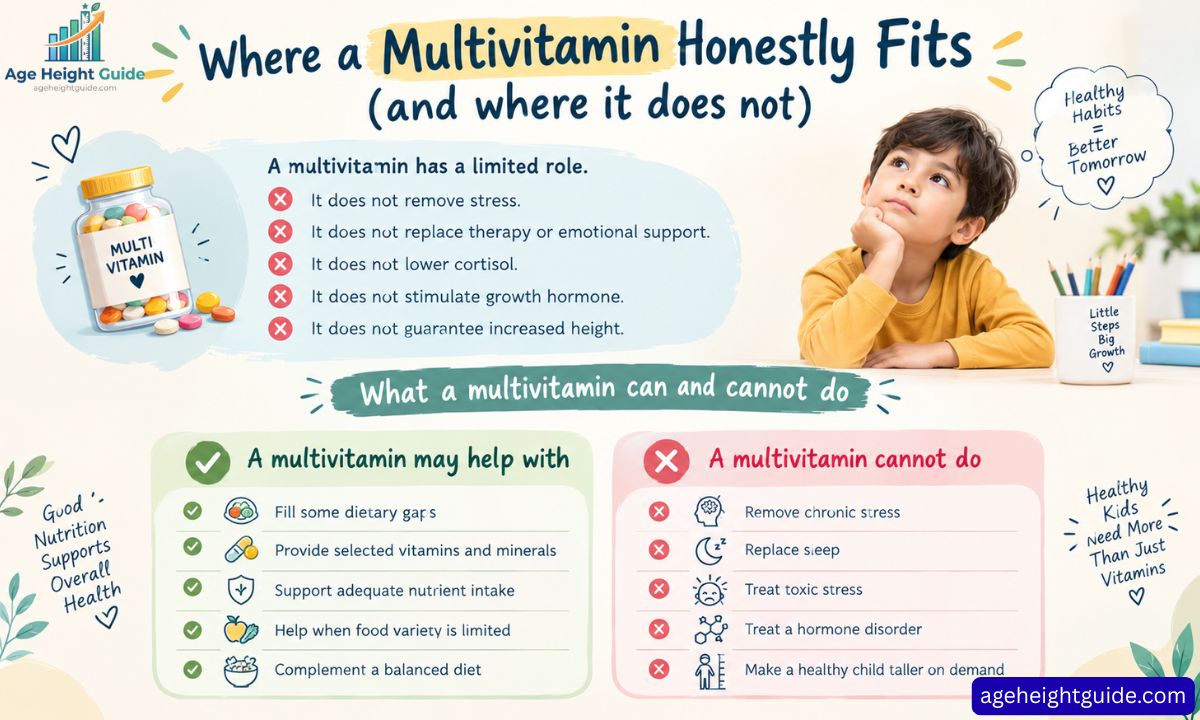
A multivitamin has a limited role.
It does not remove stress.
It does not replace therapy or emotional support.
It does not lower cortisol.
It does not stimulate growth hormone.
And it does not guarantee increased height.
What a multivitamin can do is help provide selected nutrients when a child’s diet is inconsistent or limited.
This may be useful for some children, especially those with very selective eating patterns.
But food should remain the foundation.
What a multivitamin can and cannot do
| A multivitamin may help with | A multivitamin cannot do |
| Fill some dietary gaps | Remove chronic stress |
| Provide selected vitamins and minerals | Replace sleep |
| Support adequate nutrient intake | Treat toxic stress |
| Help when food variety is limited | Treat a hormone disorder |
| Complement a balanced diet | Make a healthy child taller on demand |
If a child has a diagnosed deficiency, a pediatrician can recommend the appropriate approach.
Parents should also avoid giving multiple overlapping supplements without checking the total intake.
More is not always better.
What makes Tallori different
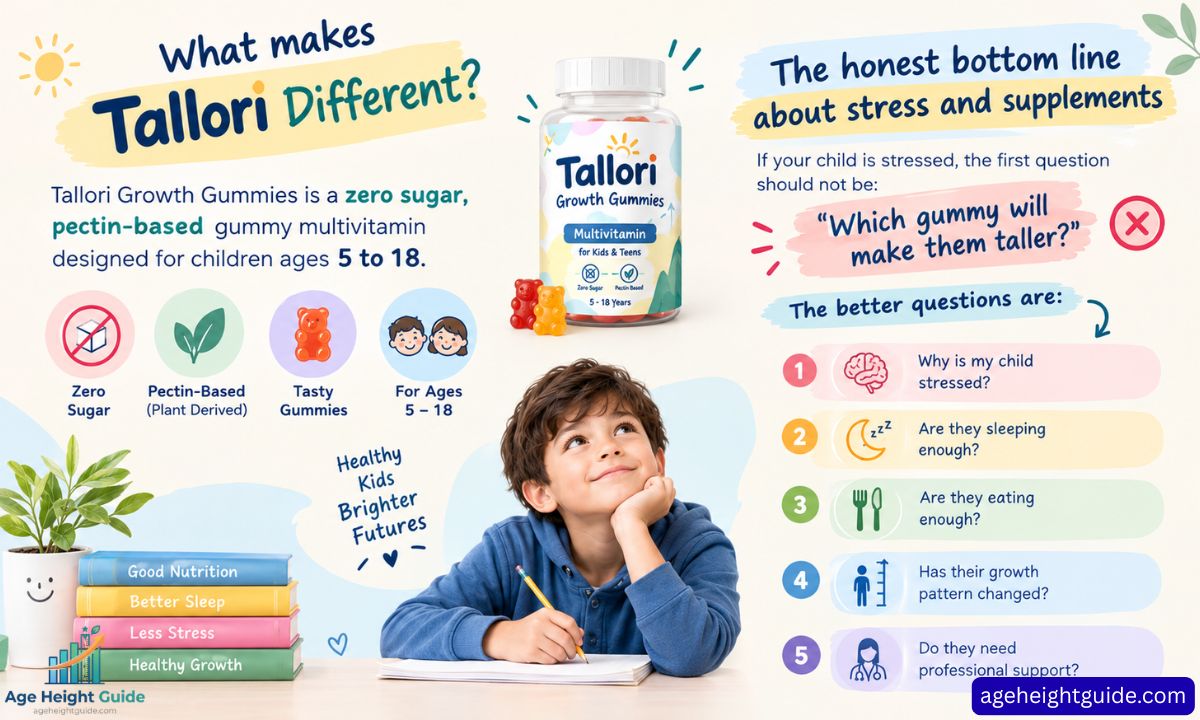
Tallori Growth Gummies is a zero-sugar pectin-based gummy multivitamin designed for children ages 5 to 18.
Its role should be understood clearly: it is a nutritional supplement, not a treatment for chronic stress or a guarantee of increased height.
The formula lists seven vitamin and mineral doses on the label:
| Nutrient | Listed amount |
| Vitamin C | 25 mg |
| Vitamin D3 | 25 mcg |
| Vitamin K2 MK-7 | 100 mcg |
| Calcium | 300 mg |
| Magnesium glycinate | 50 mg |
| Zinc citrate | 6 mg |
| Algae DHA | 50 mg |
Tallori also contains a Clean Growth Blend with botanicals. The product information states that the blend totals 112.4 mg, while individual botanical doses are not separately listed on the panel.
The gummies are sweetened with monk fruit and xylitol and contain no added sugar.
The important point for parents is what the product does not claim to do.
Tallori should not be viewed as a way to remove stress, control cortisol, treat a growth disorder, or guarantee that a child will become taller.
If stress has caused a child to eat poorly, a nutritional supplement may be one tool for filling dietary gaps. But the main priorities remain:
address the stressor → protect sleep → support regular meals → monitor growth → speak with a pediatrician when needed.
That order matters.
The honest bottom line about stress and supplements
If your child is stressed, the first question should not be:
“Which gummy will make them taller?”
The better questions are:
“Why is my child stressed?”
“Are they sleeping enough?”
“Are they eating enough?”
“Has their growth pattern changed?”
“Do they need professional support?”
Nutrition can support normal development, but it cannot replace a safe environment, adequate sleep, balanced food, or medical care.
Stress, growth, sleep, and nutrition: the complete picture
It is tempting to search for one cause of a child’s height.
Real growth is more complicated.
A child’s adult height is influenced by genetics, puberty timing, nutrition, overall health, hormones, sleep, and other biological factors.
Stress can fit into that picture in more than one way.
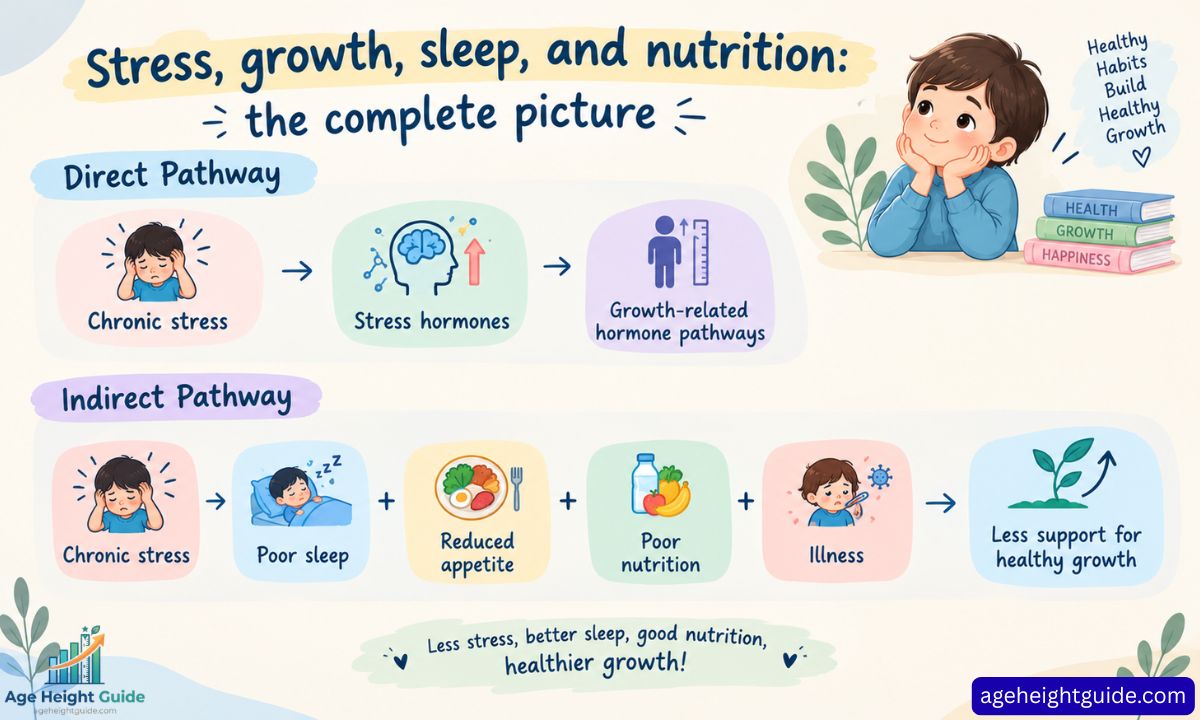
Direct pathway
Chronic stress → stress hormones → growth-related hormone pathways
Indirect pathway
Chronic stress → poor sleep + reduced appetite + poor nutrition + illness → less support for healthy growth
The second pathway is especially important for parents because many parts of it are manageable.
You may not be able to remove every stressful event.
But you can help your child eat regular meals.
You can protect bedtime.
You can create a safe routine.
You can listen.
You can ask for professional help.
And you can monitor the child’s growth over time.
What Parents Should Remember About Stress and Height
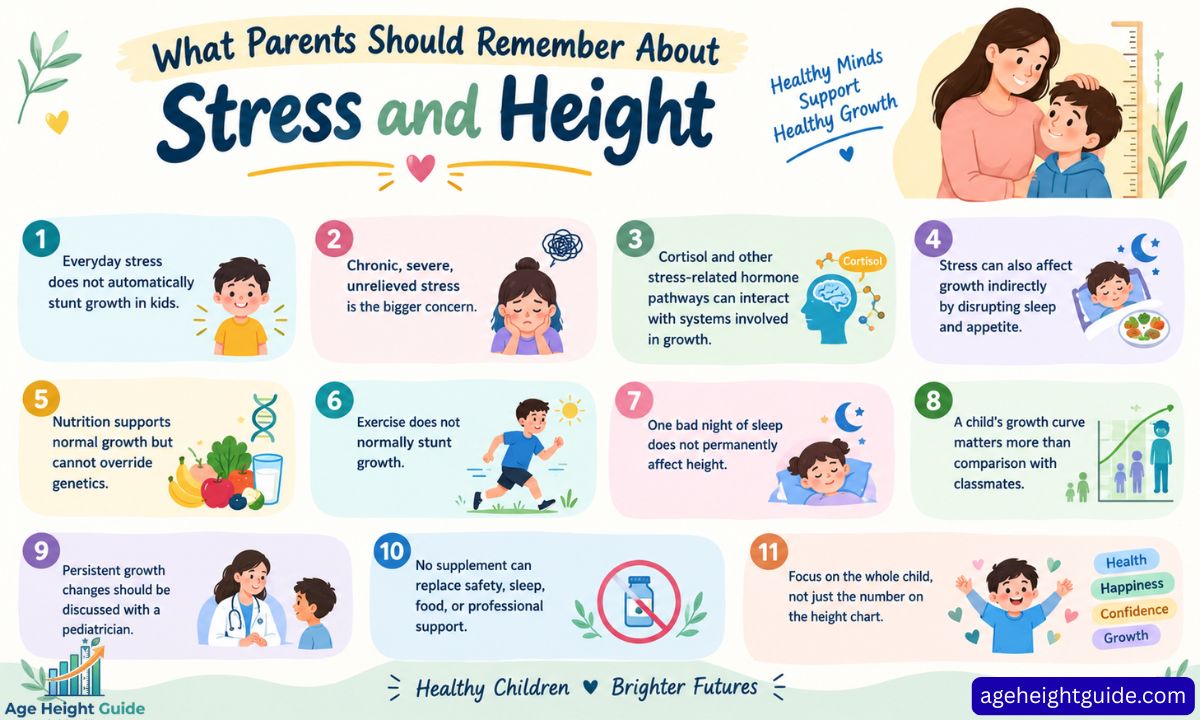
If you remember only a few points from this guide, remember these practical takeaways. The question “Does Stress Stunt Growth in Kids?” does not have a simple yes-or-no answer for every situation. Normal, short-term stress is part of childhood and does not automatically make a child shorter. The bigger concern is chronic stress that continues for a long time and begins to affect sleep, appetite, nutrition, emotional health, or normal daily life.
Understanding the difference can help parents avoid unnecessary worry while still knowing when to take a growth concern seriously.
1. Everyday stress does not automatically stunt growth in kids
Does stress stunt growth in kids after a difficult test, sports competition, busy school week, or argument with a friend? Usually, no.
Children experience short periods of stress all the time. Their bodies release stress hormones to help them respond to challenges. Once the stressful situation passes, the body can return toward its normal state.
A child does not become permanently shorter because they had a stressful day or a few difficult weeks.
The concern is different when stress becomes severe, persistent, and difficult to escape. That type of chronic stress may affect several systems involved in healthy development.
2. Chronic, severe, unrelieved stress is the bigger concern
When parents search “Does Stress Stunt Growth in Kids?”, they may be thinking about normal school pressure. But research on stress-related effects on growth is more concerned with long-lasting and severe stress.
Chronic stress can keep the body’s stress-response system active for an extended period. This may affect cortisol and other hormone pathways involved in growth and development.
It is also important to remember that chronic stress can affect a child indirectly.
A stressed child may:
- eat less
- sleep poorly
- lose interest in normal activities
- experience frequent physical symptoms
- have lower energy
- struggle at school
- become withdrawn or irritable
So the question is not only whether stress can affect hormones. Parents should also ask whether stress is changing the child’s everyday habits.
3. Cortisol and other stress-related hormone pathways can interact with systems involved in growth
Cortisol is a normal hormone. Your child’s body needs it to respond to challenges.
The problem is not a normal temporary rise in cortisol. The concern is prolonged activation of the stress response.
Research on chronic stress has discussed possible effects on the growth hormone–IGF-1 axis, thyroid function, and puberty-related hormone pathways. These systems are important for normal childhood growth and development.
This does not mean that every child with anxiety or school stress will have impaired growth.
It means that long-lasting stress can become one factor in a much larger picture of child growth and development.
Parents should therefore avoid extreme claims such as “all stress stops growth.” The evidence is more specific than that.
4. Stress can also affect growth indirectly by disrupting sleep and appetite
This may be one of the most practical points for parents.
A child under stress may struggle to sleep. They may also lose their appetite or become much more selective about food.
That can create a chain:
Stress → poor sleep → tiredness
and:
Stress → lower appetite → less food and fewer nutrients
Over time, these changes can make it harder for a child to get the energy and nutrients needed for normal development.
This is why the answer to “Does Stress Stunt Growth in Kids?” should not focus only on hormones.
Parents should also look at sleep, appetite, nutrition, activity, and overall health.
Protecting these basic needs can give a child a stronger foundation during a stressful period.
5. Nutrition supports normal growth but cannot override genetics
Nutrition matters, but it does not determine height by itself.
Genetics plays a major role in a child’s eventual adult height. Family height, puberty timing, health, nutrition, and other biological factors also contribute.
A child cannot eat a certain food and override their genetic growth pattern.
However, inadequate nutrition can make it harder for the body to meet its normal growth and development needs.
Important nutrients include protein, calcium, vitamin D, zinc, magnesium, iron, and other vitamins and minerals.
The goal is not to make a child taller than their natural potential.
The goal is to make sure they have the nutritional support needed to reach their healthy growth potential.
6. Exercise does not normally stunt growth
Parents sometimes connect sports with height because young athletes can train hard.
But normal physical activity and exercise do not automatically stunt growth.
Running, swimming, cycling, football, basketball, strength training with appropriate supervision, and other age-appropriate activities can be part of a healthy lifestyle.
The bigger concern is when heavy training is combined with:
- inadequate food intake
- extreme dieting
- insufficient recovery
- poor sleep
- unexplained weight loss
- excessive performance pressure
A young athlete needs enough energy to support both physical activity and normal development.
So if you are asking “Does Stress Stunt Growth in Kids?” because your child plays competitive sports, look at the complete picture rather than blaming exercise itself.
7. One bad night of sleep does not permanently affect height
A single late night is not going to permanently change your child’s adult height.
Children can occasionally stay up late because of travel, school events, celebrations, illness, or other circumstances.
The concern is persistent poor sleep.
A child who regularly struggles to fall asleep, wakes frequently, or gets too little sleep may not be recovering as well as they should.
Stress can make this problem worse.
A consistent bedtime, a calm evening routine, reduced screen use before bed, and enough time for sleep can all help.
If sleep problems continue for a long time, parents should discuss them with a healthcare professional.
8. A child’s growth curve matters more than comparison with classmates
Children do not all grow at the same rate.
One child may have an early growth spurt. Another may grow later. Some children are naturally shorter or taller because of family genetics.
That is why comparing your child with classmates can create unnecessary worry.
A growth curve gives a much better picture.
Pediatricians can look at repeated height and weight measurements and evaluate growth velocity over time.
For example, being shorter than classmates does not automatically mean that stress is affecting growth.
A more important concern is a noticeable change in a child’s usual growth pattern.
So instead of asking only:
“Is my child shorter than other kids?”
parents should also ask:
“Is my child continuing to grow along their expected pattern?”
9. Persistent growth changes should be discussed with a pediatrician
If a child seems to be growing more slowly than before, do not automatically assume stress is responsible.
Many different factors can affect growth, including:
- genetics
- nutrition
- puberty timing
- hormone conditions
- chronic illness
- digestive problems
- medication
- sleep problems
- emotional stress
A pediatrician can review the child’s growth chart, growth velocity, weight, family history, nutrition, puberty stage, and other symptoms.
Parents should especially seek medical advice if a child has a noticeable change in their growth curve over repeated measurements.
It is also worth talking to a pediatrician if chronic stress is affecting appetite, sleep, weight, school, mood, or everyday functioning.
10. No supplement can replace safety, sleep, food, or professional support
This is perhaps the most important point.
If you are searching “Does Stress Stunt Growth in Kids?”, you may also come across products that promise to increase height or counteract stress.
Be careful with those claims.
A supplement cannot remove the source of chronic stress. It cannot replace a safe environment, adequate sleep, balanced meals, emotional support, or medical care.
A multivitamin for kids may help fill certain nutritional gaps when a child’s diet is limited. But it should be viewed as nutritional support, not a treatment for chronic stress or a guaranteed height solution.
If a child is struggling emotionally, the underlying problem deserves attention.
If a child is not eating enough, the eating problem deserves attention.
If a child is not sleeping, the sleep problem deserves attention.
And if a child’s growth curve is changing, the growth concern deserves medical evaluation.
11. Focus on the whole child, not just the number on the height chart
The final takeaway is that stress, growth, sleep, nutrition, genetics, and overall health are connected.
Parents do not need to make childhood completely stress-free. That is not realistic.
Instead, focus on helping your child recover from normal challenges and providing support when stress becomes too much.
If you are still asking “Does Stress Stunt Growth in Kids?”, remember the key distinction:
Short-term everyday stress is not the same as chronic, severe, unrelieved stress.
A stressful school day does not automatically stunt height.
A difficult sports competition does not automatically stunt height.
One poor night of sleep does not permanently stop growth.
But prolonged stress that disrupts sleep, appetite, nutrition, health, and emotional well-being deserves attention.
The best approach is simple:
Support your child’s emotional health.
Protect consistent sleep.
Offer regular, nutritious meals.
Encourage healthy physical activity.
Watch the growth pattern over time.
Talk with a pediatrician when something changes, or concerns persist.
Healthy growth is not controlled by one food, one supplement, one night of sleep, or one stressful event. It is the result of many factors working together during childhood and adolescence.
And that is the most accurate answer to the question “Does Stress Stunt Growth in Kids?”Everyday stress does not automatically stunt growth, while chronic and severe stress can become a concern when it affects the body’s hormonal systems, sleep, nutrition, and overall health.
Frequently Asked Questions
Does stress stunt growth in kids?
Everyday stress usually does not stunt growth in kids. A short period of school pressure, sports nerves, or a difficult week is not the same as chronic stress. Research suggests that severe and prolonged stress can affect hormone systems involved in growth, especially when it continues without enough support or recovery.
Can chronic stress affect a child’s height?
Yes. Chronic stress and growth can be connected through both hormonal and indirect pathways. Prolonged stress may affect cortisol, the growth hormone–IGF-1 pathway, thyroid function, and other systems involved in development. Stress can also reduce appetite and disrupt sleep, which may further affect healthy growth.
Can school stress stunt growth?
Normal school stress is not generally considered a cause of permanent short stature. Exams, homework, presentations, and temporary academic pressure are common childhood experiences. The concern is persistent stress that lasts for a long time and begins affecting sleep, appetite, mood, health, or growth patterns.
Can sports stress stunt growth?
Sports themselves do not normally stunt growth. Physical activity supports healthy development. The bigger concern is under-fueling, especially when a young athlete trains heavily but does not eat enough or sleep enough. Parents should watch the balance between training, food, recovery, and emotional pressure.
How does cortisol affect growth in children?
Cortisol is a normal stress hormone. Short-term increases are part of a healthy stress response. With prolonged stress, persistently elevated cortisol can affect hormone pathways involved in growth hormone, IGF-1, thyroid function, and puberty. This is why chronic stress deserves attention, rather than treating every normal stressful event as a growth threat.
Can stress make a child stop growing?
Severe, ongoing stress can be associated with impaired growth, but a child temporarily growing more slowly does not automatically mean stress is the cause. Children grow at different rates and often experience natural growth spurts and pauses. A pediatrician can evaluate growth velocity and growth charts to determine whether a real change has occurred.
Can a child catch up in height after chronic stress?
Some children may experience catch-up growth after an underlying problem is addressed, especially while growth plates remain open. Recovery depends on the child’s age, puberty stage, health, nutrition, and the original cause of the growth problem. A pediatrician can give a more useful answer based on the child’s growth history.
What are the signs that stress is affecting my child physically?
Look for a persistent combination of appetite changes, sleep problems, frequent illness, tiredness, behavior changes, anxiety, withdrawal, or changes in school performance. One symptom alone may have many causes. Several changes that continue for months deserve professional attention.
Does poor sleep from stress affect growth?
Long-term inadequate sleep can be a concern for healthy development. Stress may make it harder for children to fall asleep or stay asleep, creating a cycle of stress and poor recovery. One late night does not stunt growth. The concern is chronic sleep deprivation.
Can poor nutrition caused by stress affect height?
Yes, inadequate nutrition can interfere with the nutrients and energy the body needs for normal development. A stressed child may skip meals or eat much less than usual. Supporting regular, balanced meals is therefore one of the most practical ways parents can protect the nutritional side of healthy growth.
Can vitamins make a stressed child taller?
No vitamin or gummy can guarantee increased height.
A multivitamin for kids can help fill certain nutritional gaps when dietary intake is limited, but it cannot remove chronic stress, change genetics, replace sleep, or treat a medical growth disorder.
Is Tallori a treatment for chronic stress?
No. Tallori Growth Gummies is a nutritional supplement, not a treatment for chronic stress, anxiety, hormone disorders, or other medical conditions. Parents should address the underlying stress and seek professional support when needed.
When should I talk to a pediatrician about my child’s growth?
Talk to your pediatrician if your child has a noticeable change in their growth curve, persistent appetite loss, unexplained weight changes, ongoing sleep problems, frequent illness, or a major stressor that is affecting daily life. A doctor can assess the child’s growth pattern and look for causes unrelated to stress.
What is the most important thing parents can do?
Start with the basics:
Support your child’s emotional safety. Protect sleep. Offer regular meals. Encourage healthy activity. Monitor growth over time. And seek medical advice when something changes.
You do not need to make childhood completely stress-free.
You need to help your child recover from normal stress and get support when stress becomes too much.
Everyday stress is not the same as chronic stress. And when parents understand that difference, they can focus on what actually supports healthy growth.
This article is for informational purposes only and is not medical advice. If you have concerns about your child’s growth, nutrition, sleep, stress, or development, speak with a qualified pediatrician or other healthcare professional.
Growing up is better together.

Stoke is the author behind Age Height Guide, creating simple and informative content about average height, age, growth, and related measurements.