


How tall will my daughter be? Most parents want a simple answer, but no formula can tell you your daughter’s exact adult height. The most common way to estimate adult height is the mid-parental height formula. For a girl, add the mother’s and father’s heights, subtract 5 inches (13 cm), and divide by 2.
The formula gives an estimated adult height, not a guarantee. Genetics plays a major role in height, while puberty timing, nutrition, sleep, activity, and overall health can affect how a child grows. Mayo Clinic also notes that there is no sure way to know exactly how tall a child will be as an adult.
This guide explains how tall your daughter may be, how to calculate her estimated height, how much you should trust the result, when girls stop growing, how growth charts help, and what parents should know about growth spurts, puberty, growth plates, nutrition, and height prediction.
You can also read: Does Coffee Stunt Your Growth? 2026 Facts & Truth
The mid-parental height formula, step by step

The mid-parental height formula is one of the simplest ways to estimate a child’s adult height from both parents’ heights.
For a daughter, use this formula:
(Mother’s height + Father’s height − 5 inches) ÷ 2 = Estimated adult height
You can also use centimeters:
(Mother’s height + Father’s height − 13 cm) ÷ 2 = Estimated adult height
The important rule is simple: use the same measurement system for both parents. Do not add one parent’s height in inches and the other parent’s height in centimeters.
Daughter height formula
| Step | What to do |
| 1 | Measure the mother’s height |
| 2 | Measure the father’s height |
| 3 | Add both heights |
| 4 | Subtract 5 inches or 13 cm |
| 5 | Divide the result by 2 |
| 6 | Treat the answer as an estimate, not a guarantee |
Example of the formula
Suppose the mother is 5 feet 4 inches and the father is 5 feet 10 inches.
Convert the heights to inches:
- Mother = 64 inches
- Father = 70 inches
Now calculate:
(64 + 70 − 5) ÷ 2
129 ÷ 2 = 64.5 inches
That gives an estimated adult height of about 5 feet 4.5 inches.
Mayo Clinic describes this same basic method and emphasizes that it is only a way to make an estimate. A child’s actual adult height can differ because children grow at different rates and puberty does not happen at exactly the same age for everyone.
Why does the formula subtract 5 inches for girls?
The adjustment accounts for the average difference in adult height between males and females. For a girl, the formula subtracts about 5 inches (13 cm) before dividing by two.
For a boy, the calculation uses the opposite adjustment:
(Mother’s height + Father’s height + 5 inches) ÷ 2
The formula is useful because it combines information from both parents instead of using only the mother’s or father’s height.
Worked examples with real numbers
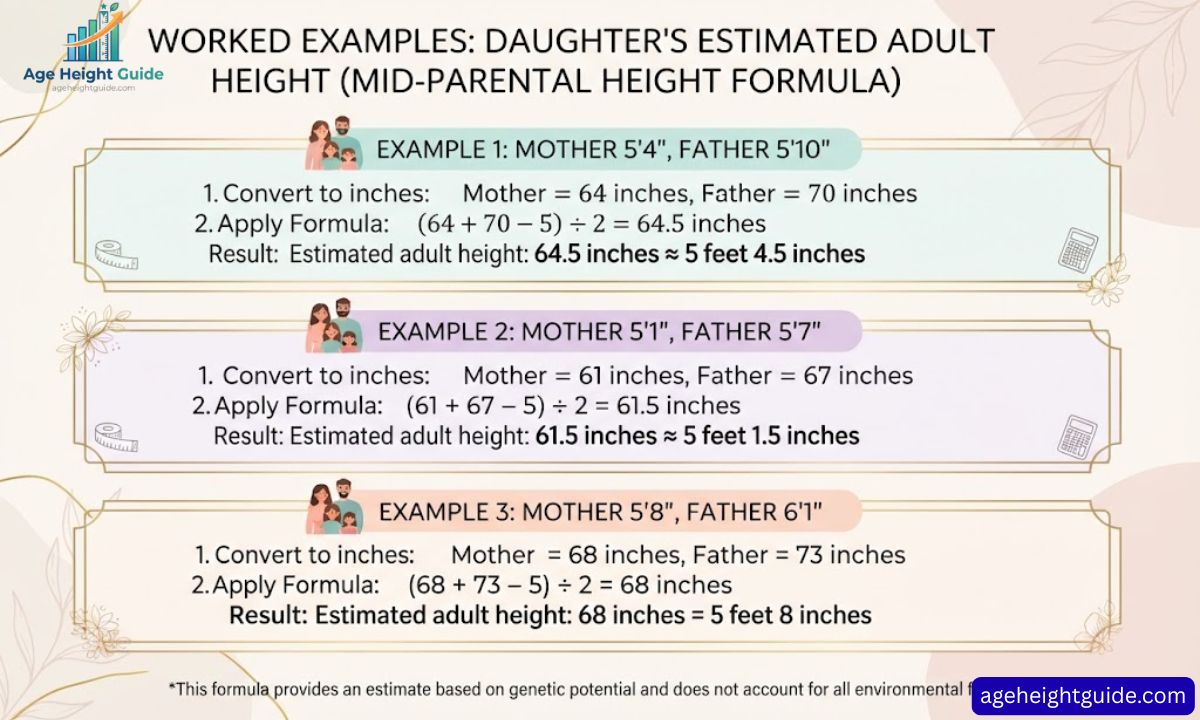
Real examples make a daughter’s height prediction easier to understand. Here are three examples using the mid-parental height calculation.
Example 1: Mother 5’4″, Father 5’10”
Mother = 64 inches
Father = 70 inches
(64 + 70 − 5) ÷ 2 = 64.5 inches
Estimated adult height:
64.5 inches ≈ 5 feet 4.5 inches
Example 2: Mother 5’1″, Father 5’7″
Mother = 61 inches
Father = 67 inches
(61 + 67 − 5) ÷ 2 = 61.5 inches
Estimated adult height:
61.5 inches ≈ 5 feet 1.5 inches
Example 3: Mother 5’8″, Father 6’1″
Mother = 68 inches
Father = 73 inches
(68 + 73 − 5) ÷ 2 = 68 inches
Estimated adult height:
68 inches = 5 feet 8 inches
What do these examples show?
The estimate often falls near the parents’ average height, but that does not mean every daughter will finish at the exact number.
A daughter’s adult height can be higher or lower than the formula result. Siblings with the same parents can also finish at different heights.
That is why the mid-parental height formula should be viewed as a starting point for understanding family height patterns, not as a promise about the future.
How much should you trust the number?
Treat the result as an estimate, not a forecast.
If a calculator tells you that your daughter may reach 5 feet 4 inches, it does not mean she will definitely be 5 feet 4 inches as an adult. The formula cannot account for every factor that affects growth.
Genes have a major influence on height. Children also grow at different speeds and enter puberty at different times. Some girls have their major growth spurt earlier, while others continue growing later into the teen years.
A better way to think about the formula is:
It gives you a useful family-based estimate. It does not tell you the exact final height.
Estimated height vs. actual adult height
| Question | What the formula can tell you | What it cannot tell you |
| Family height pattern | Yes | — |
| Rough adult height estimate | Yes | — |
| Exact final height | No | Exact result |
| Puberty timing | No | Individual timing |
| Growth rate | No | Current growth velocity |
| Growth problems | No | Medical diagnosis |
| Growth-chart pattern | No | Your daughter’s personal trajectory |
Your daughter’s current growth pattern may provide more useful information than one calculation. If she has consistently followed a similar growth curve, that pattern gives her pediatrician important context.
When do girls stop growing?
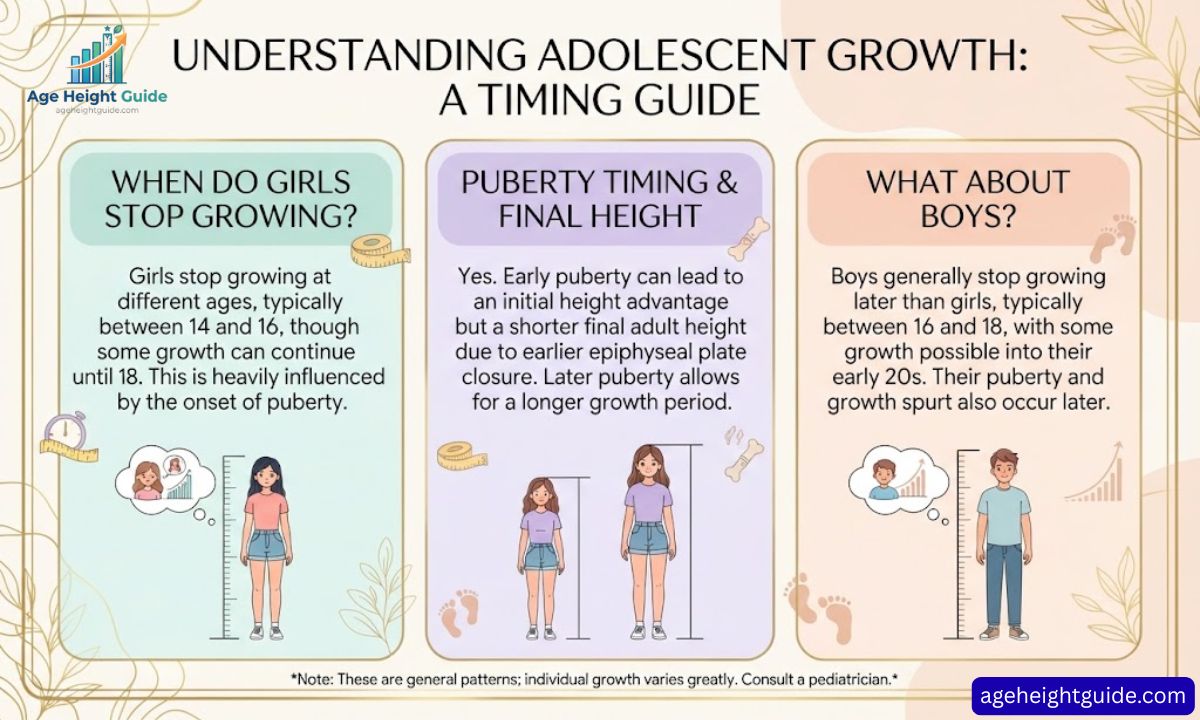
Girls do not all stop growing at the same age.
According to Nemours KidsHealth, most girls begin sexual development between about 8 and 13 years old, and the main height growth spurt usually happens between about 10 and 14.
The timing of puberty matters because the major growth spurt happens during puberty.
| Growth milestone | Typical timing |
| Puberty begins | About ages 8–13 |
| Major height growth spurt | About ages 10–14 |
| Peak height growth | Around 2 years after puberty begins |
| First period | Often around age 12.5 on average |
| Growth after first period | Usually about 1–2 more inches |
| Adult height | Often reached around 14–15, depending on puberty timing |
These are general patterns, not deadlines.
Nemours notes that menstruation usually begins after the peak rate of height growth. After the first period, many girls grow about 1 to 2 more inches, although individual growth varies.
Does puberty timing change final height?
It can change when a girl reaches her adult height.
A girl who enters puberty earlier may reach her final height earlier. A girl who enters puberty later may continue growing for longer.
That is why age alone cannot tell you exactly how much growth remains.
For example, two 13-year-old girls can be at very different stages of puberty. One may be close to her adult height, while another may still have substantial growth ahead.
What about boys?
The same basic family-height formula can be used for boys, but the sex adjustment changes.
For a boy:
(Mother’s height + Father’s height + 5 inches) ÷ 2
Boys also tend to enter their major growth spurt later than girls. Nemours KidsHealth reports that boys generally grow most quickly between about ages 12 and 15.
The other prediction methods, and what they are worth
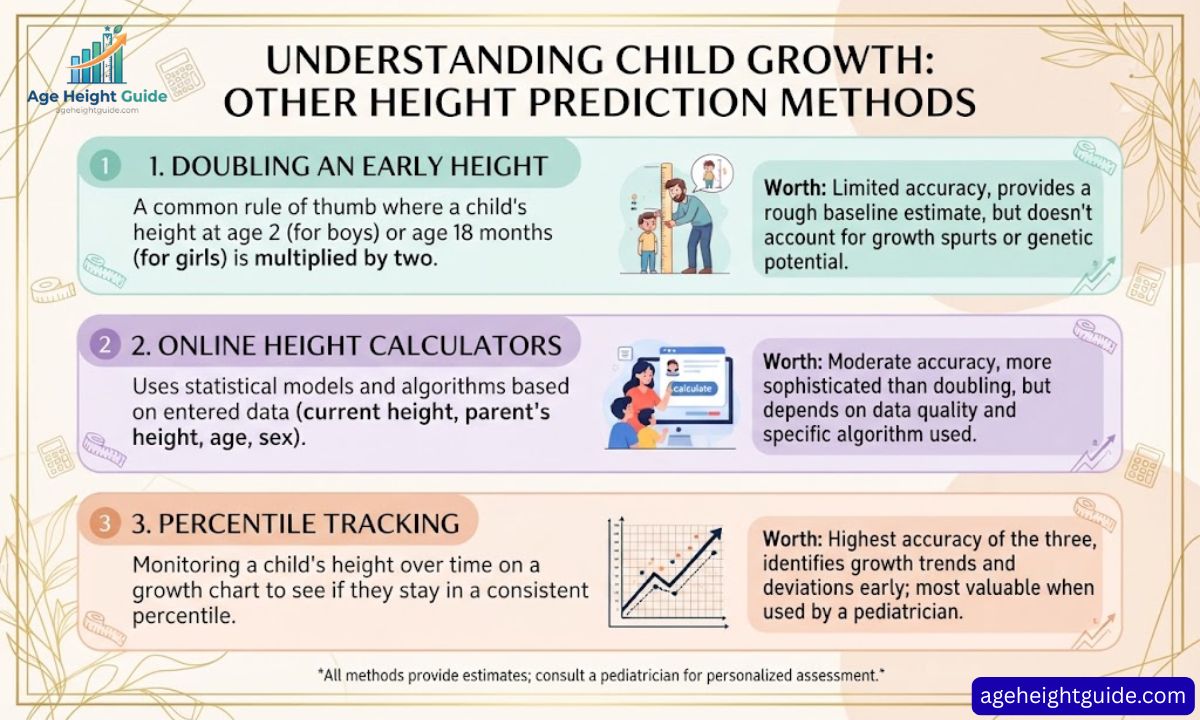
The mid-parental height formula is not the only method used to estimate adult height.
1. Doubling an early height
One older shortcut is to double a girl’s height at about 18 months or a boy’s height at age 2.
This method can give a rough estimate, but it becomes less useful as a child gets older. If your daughter is already a teenager, her current growth pattern and puberty stage are much more relevant.
2. Online height calculators
Many height calculators simply perform the same mid-parental calculation automatically.
A calculator can make the math easier, but it cannot remove the uncertainty in the formula.
If a website asks for only the mother’s and father’s heights, it may simply be putting a user-friendly interface around the same basic equation.
3. Percentile tracking
Growth-chart tracking can provide information that a one-time calculator cannot.
A pediatrician can plot your daughter’s height against other girls of the same age and monitor whether her growth follows a consistent pattern.
The CDC explains that growth charts are tools used to track growth in children and adolescents. They are not meant to be used as the sole diagnostic tool.
Which method gives the most useful information?
| Method | Main benefit | Main limitation |
| Mid-parental formula | Simple family-based estimate | Not exact |
| Early-height shortcut | Easy rough estimate | Limited usefulness later |
| Online calculator | Fast and convenient | Often uses the same formula |
| Growth chart | Shows growth over time | Needs accurate measurements |
| Pediatric assessment | Uses several pieces of information | Requires a healthcare professional |
For a parent asking how tall will my daughter be, the best approach is not to rely on one number alone.
What your pediatrician does that a calculator cannot
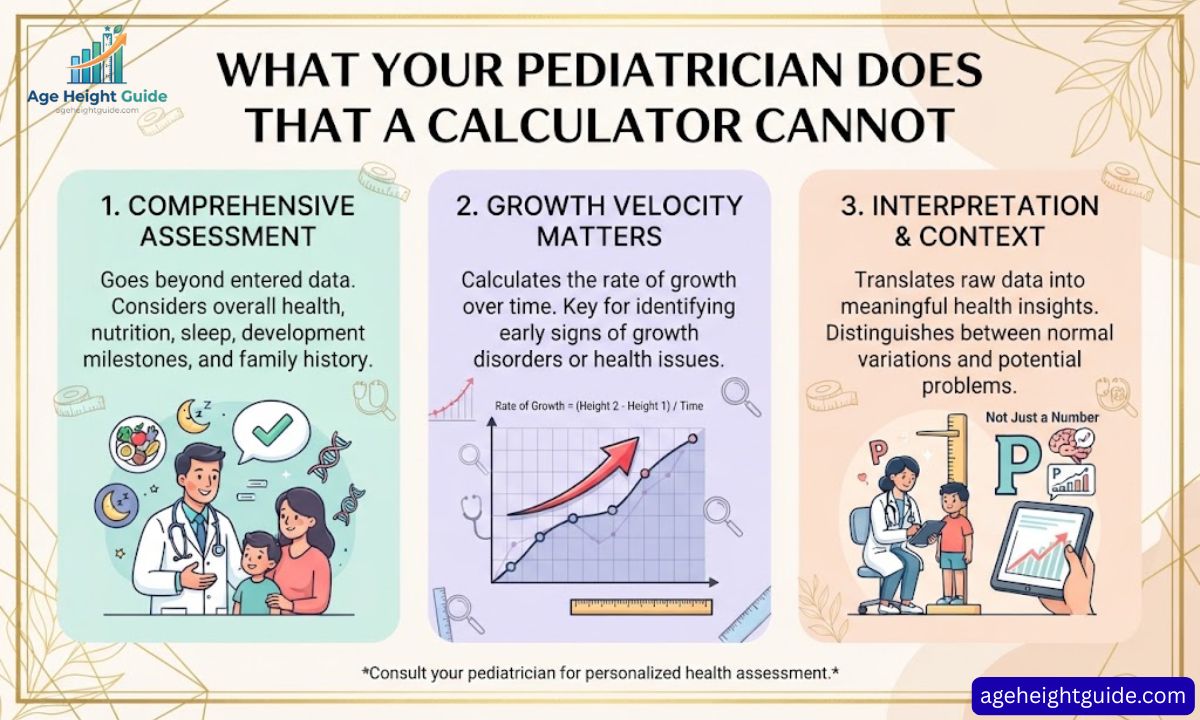
A height calculator only uses the information you enter.
A pediatrician can look at the bigger picture.
During routine care, a healthcare professional can record your child’s:
- Height
- Weight
- BMI
- Age
- Puberty stage
- Growth pattern
- Relevant health history
The measurements can then be plotted on an appropriate growth chart.
The CDC describes growth charts as percentile curves that help healthcare professionals and parents track growth in children and adolescents. The important information is often the pattern over time, not one isolated measurement.
Why growth velocity matters
Imagine two girls who are both at a relatively low height percentile.
Girl A has stayed close to the same percentile for several years.
Girl B used to grow steadily but has recently shown a clear slowdown.
Those two situations are not necessarily the same.
A consistent growth pattern can be reassuring, while a significant change in growth rate may deserve a closer look.
That is one reason a pediatrician can provide information that a daughter height calculator cannot.
Why growth charts matter more than one number

A growth chart shows where a child’s measurements fall compared with a reference population.
Percentiles help describe a child’s position on the chart.
For example, a child’s height percentile may change over time. The important question is often whether her growth follows a reasonably consistent pattern.
Growth charts should not be used by themselves to diagnose a condition. They are one part of the overall clinical picture.
What parents should track
If you want a clearer picture of your daughter’s growth, keep accurate records of:
| Measurement | Why it matters |
| Height | Shows current stature |
| Date of measurement | Allows growth rate to be tracked |
| Weight | Adds context to overall growth |
| Puberty changes | Helps explain growth timing |
| Family heights | Provides genetic context |
| Previous measurements | Shows the growth trajectory |
Accurate measurements matter. Measure without shoes, on a flat surface, with the heels positioned properly and the head held in a neutral position.
What actually influences where a girl lands in her range

The final number on the scale is not controlled by one factor.
Genetics
Genetics has a major influence on final height. Family height is therefore one of the most useful starting points when estimating a child’s adult stature.
That is why the mid-parental height formula uses both parents.
However, genetics does not mean that every child will reach the same height as a parent. Children inherit a combination of genetic variants, so siblings can have different adult heights.
Nutrition
Good nutrition supports normal growth and development.
The key point is not that eating a particular food will make a healthy child taller than her genetic potential.
Instead, a balanced diet helps provide the nutrients the body needs for normal development.
Important nutrients include:
- Calcium
- Vitamin D
- Protein
- Zinc
- Magnesium
- Iron
- Other vitamins and minerals
If a child has a true nutrient deficiency, correcting that deficiency can be important for health and normal development.
But taking extra nutrients when there is no deficiency does not mean a child will automatically grow taller.
Calcium
Calcium is important for normal bone development.
According to the NIH Office of Dietary Supplements, children ages 9–13 and teens ages 14–18 have a recommended calcium intake of 1,300 mg per day.
Food sources include:
- Milk
- Yogurt
- Cheese
- Calcium-fortified beverages
- Some tofu
- Certain vegetables
- Other calcium-containing foods
The goal is adequate nutrition, not excessive supplementation.
Vitamin D
Vitamin D helps the body absorb calcium and supports bone health.
A child who is deficient may need guidance from a healthcare professional.
However, more is not automatically better. A supplement should not be treated as a shortcut for increasing a healthy child’s genetic height potential.
Protein
Protein provides amino acids needed for many functions in the growing body.
Good food sources can include:
- Eggs
- Fish
- Chicken
- Meat
- Beans
- Lentils
- Yogurt
- Milk
- Soy foods
- Nuts and seeds, when appropriate
A varied diet is usually more useful than focusing on one so-called height growth food.
Sleep
Sleep is an important part of a healthy routine during childhood and adolescence.
A consistent sleep schedule supports overall health and development. It is better to think of sleep as part of healthy growth rather than as a trick for adding inches.
Physical activity
Regular physical activity supports strong bones, muscles, coordination, and general health.
Exercise does not make a healthy child exceed her genetic height potential.
Likewise, normal supervised physical activity does not automatically stunt growth.
The goal is balanced activity along with adequate food, recovery, and sleep.
Chronic health conditions
Some health conditions can affect normal growth.
If a child has poor growth, a change in growth rate, delayed puberty, or another concerning pattern, a pediatrician can decide whether further evaluation is needed.
That is another reason not to rely only on an online adult height prediction.
Does age change how much growth is left?
Yes.
A younger child who has not entered puberty may have more years of growth ahead than a teenager who is already near the end of puberty.
But age alone does not tell the complete story.
Puberty stage, growth rate, family pattern, and health all provide context.
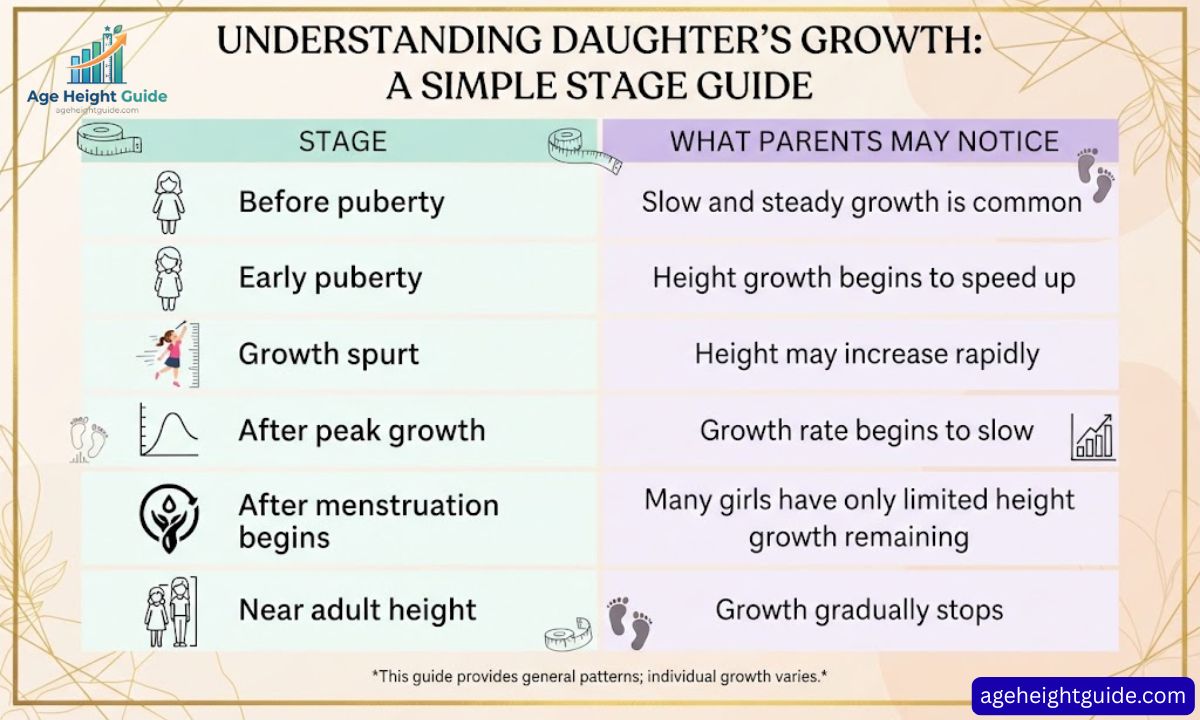
Simple growth-stage guide
| Stage | What parents may notice |
| Before puberty | Slow and steady growth is common |
| Early puberty | Height growth begins to speed up |
| Growth spurt | Height may increase rapidly |
| After peak growth | Growth rate begins to slow |
| After menstruation begins | Many girls have only limited height growth remaining |
| Near adult height | Growth gradually stops |
The timing varies from girl to girl.
What does not change the number
There are many online claims about ways to make children taller.
Some promise extra inches through:
- Stretching
- Hanging exercises
- Special diets
- Height pills
- Growth powders
- “Secret” supplements
- Special shoes
- Posture devices
- Growth gummies marketed as guaranteed height boosters
These claims should be treated carefully.
Stretching and posture exercises can affect how someone stands or appears to stand, but they do not lengthen the long bones and permanently increase adult height.
A supplement also cannot simply override genetics and guarantee a certain number of extra inches.
Nemours KidsHealth states that no pill, formula, or nutritional supplement can increase a child’s height beyond their natural potential.
What healthy habits can do
Healthy habits still matter.
They can help a child:
- Meet nutritional needs
- Maintain healthy bones
- Support normal development
- Get enough rest
- Stay physically active
- Avoid preventable nutrition gaps
That is different from promising that a child will become taller than her natural growth potential.
Can a calculator tell me my daughter’s exact adult height?
No.
A daughter height calculator can provide an estimate based on the parents’ heights.
It cannot know:
- Exactly when puberty will begin
- Exactly how quickly your daughter will grow
- Her complete genetic profile
- Future health changes
- Whether her current growth pattern will continue
So if a calculator says 5 feet 5 inches, do not treat that number as a guaranteed final measurement.
Can my daughter be taller or shorter than the formula?
Yes.
The formula gives an estimate based on parental height.
A child can finish somewhat above or below that estimate.
That is normal.
The formula should help parents understand a broad family pattern, not create anxiety about a specific number.
What if my daughter is shorter than her friends?
Being shorter than classmates does not automatically mean something is wrong.
Children enter puberty at different times. A girl who starts puberty later may continue growing after some of her classmates have already reached most of their adult height.
The more useful question is often:
Is she continuing to grow at an expected rate for her?
If you notice a significant change in her growth pattern, speak with her pediatrician.
When should parents talk to a pediatrician?
Consider discussing growth with your child’s healthcare professional if you notice:
- A clear slowdown in growth
- A major change in her usual growth pattern
- Puberty that seems unusually early or delayed
- Poor weight gain or unexplained weight changes
- Persistent digestive or other health symptoms
- Concerns about nutrition
- A large difference between expected family height and observed growth
You do not need to diagnose the reason yourself.
A pediatrician can review measurements, growth charts, puberty timing, family history, and other relevant information.
Where nutrition fits, and where it does not
Nutrition has an important but limited role in height growth.
If a child has enough calories and nutrients and is otherwise healthy, adding more vitamins does not guarantee extra height.
If a child has a real deficiency or an inadequate diet, improving nutrition can help support normal growth and development.
That distinction is important.
Healthy nutrition supports a child’s natural growth potential. It does not create a new genetic height limit.
Where Tallori fits, and where it does not
Tallori Growth Gummies should not be presented as a way to change your daughter’s mid-parental height estimate or guarantee extra inches.
A children’s nutritional formula may be useful when it helps fill specific dietary gaps, but it should complement—not replace—a balanced diet.
For parents considering a children’s supplement, look at the actual ingredient amounts on the label and compare them with age-appropriate nutritional needs.
Tallori’s product information lists nutrients such as vitamin D3, vitamin K2, calcium, magnesium, zinc, vitamin C, and algae-derived DHA. Parents should still consider their child’s overall diet and discuss individual nutrition concerns with a healthcare professional.
The important message is simple:
No growth gummy can guarantee a specific adult height.
Nutrition, sleep, activity, and routine health care can help support normal development during the years when a child is growing.
A simple way to estimate your daughter’s adult height
If you want a quick calculation, use this:
Mother’s height + Father’s height − 5 inches ÷ 2
For example:
64 + 70 − 5 = 129
129 ÷ 2 = 64.5 inches
So the estimated adult height is:
64.5 inches, or about 5 feet 4.5 inches.
Remember that this is an estimate.
Daughter height calculation table
| Mother’s height | Father’s height | Estimated daughter’s height |
| 5’0″ | 5’6″ | 5’0.5″ |
| 5’1″ | 5’8″ | 5’2″ |
| 5’2″ | 5’10” | 5’3.5″ |
| 5’3″ | 5’10” | 5’4″ |
| 5’4″ | 5’10” | 5’4.5″ |
| 5’5″ | 6’0″ | 5’5″ |
| 5’6″ | 6’0″ | 5’5.5″ |
| 5’7″ | 6’1″ | 5’6.5″ |
| 5’8″ | 6’2″ | 5’7.5″ |
These examples demonstrate the formula. They are not promises about the final height of a particular child.
The Bottom Line: What Parents Should Know

If you are asking how tall will my daughter be, start with the mid-parental height formula.
For a girl:
(Mother’s height + Father’s height − 5 inches) ÷ 2
Use the result as an estimate, not a promise.
Your daughter’s final height is influenced strongly by genetics, while healthy nutrition, sleep, physical activity, and overall health help support normal growth and development.
Puberty timing also matters. Girls do not all grow on the same schedule, and two girls of the same age can have very different amounts of growth remaining.
Most importantly, do not judge your daughter’s growth from one number alone. A growth chart, accurate measurements, and the pattern of growth over time can provide a much clearer picture.
If you notice a meaningful change in growth or have concerns about puberty, nutrition, or development, talk with your child’s pediatrician.
Frequently Asked Questions
How tall will my daughter be?
You can estimate your daughter’s adult height with the mid-parental height formula:
(Mother’s height + Father’s height − 5 inches) ÷ 2
The result is an estimate. It cannot tell you her exact adult height.
How do I calculate my daughter’s adult height?
Measure both parents without shoes, use the same unit, add their heights, subtract 5 inches for a girl, and divide by 2.
For centimeters, subtract 13 cm instead of 5 inches.
How accurate is the mid-parental height formula?
The formula is useful for a rough family-based estimate, but it is not an exact prediction.
Children can finish taller or shorter than the estimate. Their growth chart, growth rate, puberty timing, and overall health provide additional information.
At what age do girls stop growing?
Many girls reach their final adult height around 14 or 15, but timing varies.
Girls who enter puberty later may continue growing later than girls who mature earlier.
How much do girls grow after their first period?
Many girls grow about 1 to 2 inches after their first period, according to Nemours KidsHealth.
The amount varies from person to person.
Do girls get their height from their mother or father?
Both.
The mid-parental height formula uses both parents because family genetics from both sides influence adult height.
A daughter may resemble her mother, father, or other relatives in height.
Can my daughter be taller than the height formula predicts?
Yes.
The formula is an estimate, not a ceiling.
A child may finish above or below the calculated number.
Can vitamins make my daughter taller?
Vitamins can help correct a nutrient deficiency and support normal health, but they do not guarantee additional height in a child who already has adequate nutrition.
A balanced diet should remain the foundation.
Does calcium help girls grow taller?
Calcium is important for healthy bones and normal development, but taking extra calcium does not guarantee additional height.
The goal is to meet age-appropriate nutritional needs.
Does sleep affect a child’s growth?
Adequate sleep is part of a healthy routine during childhood and adolescence.
Sleep should be viewed as one part of supporting normal health and development rather than a method for adding guaranteed inches.
Does exercise stunt growth?
Normal, age-appropriate physical activity does not automatically stunt growth.
Exercise supports overall health and strong bones when paired with adequate nutrition and recovery.
What is the best way to predict my daughter’s adult height?
Start with the mid-parental height formula, then consider her actual growth pattern.
A pediatrician can use a growth chart and other health information to assess whether she is growing as expected.
When should I worry about my daughter’s height?
A single height measurement is usually less informative than the pattern over time.
Talk with a pediatrician if her growth rate changes noticeably, puberty seems unusually early or delayed, or you have ongoing concerns about nutrition or development.
Does the same formula work for boys?
Almost.
For boys, use:
(Mother’s height + Father’s height + 5 inches) ÷ 2
The sex adjustment is reversed.
Can an online height calculator predict exact adult height?
No.
An online height calculator can make the formula easier to use, but it cannot predict the exact future height of a child.
What matters more than one height measurement?
The growth trajectory matters greatly.
A pediatrician can look at measurements over time and compare them with an appropriate growth chart.
This article is for general educational information and is not medical advice. It does not diagnose or treat any condition. Always discuss individual growth, puberty, nutrition, or supplement questions with your child’s healthcare professional.

Stoke is the author behind Age Height Guide, creating simple and informative content about average height, age, growth, and related measurements.