


Wondering about the average height for a 13 year old? The CDC growth charts put the median height at about 61.4 inches for 13-year-old boys and 61.8 inches for 13-year-old girls. These numbers are useful reference points, but they are not height goals that every child should reach.
It is normal for a 13-year-old to be shorter or taller than these values. Puberty can start at different ages, so one child may already be in a major growth spurt while another may have more growth ahead.
A child’s growth curve, growth rate, family height pattern, and stage of puberty give a much clearer picture than one measurement.
In this guide, you will learn how the 50th percentile works, how puberty affects height at 13, how much growth may remain, and which daily habits support healthy development.
We will also cover nutrition, sleep, physical activity, growth plates, and when parents should talk with a pediatrician.
The goal is not to make every child match the average height for a 13 year old. It is to understand normal growth, recognize meaningful changes, and give your child the support they need to develop according to their own natural growth pattern.
you can also read: Best Growth Gummies for Kids in 2026 | 4 Brands Compared
Key Takeaways
- The average height for a 13 year old is a reference point, not a target every child should reach.
- The CDC stature-for-age charts place the median height at age 13 at about 61.4 inches for boys and 61.8 inches for girls.
- These median values are reference points, not required or ideal heights for every 13-year-old.
- Boys and girls can grow at different times because puberty does not begin at exactly the same age for everyone.
- A 13 year old boy may still have a major growth spurt ahead.
- Many girls have already experienced their fastest growth by age 13, although individual timing varies.
- Genetics, puberty timing, nutrition, health, and other factors all influence height.
- A balanced diet, enough sleep, physical activity, and good overall health support normal development.
- Teenagers ages 13–17 are generally recommended to get 8–10 hours of sleep each day.
- Being below the 50th percentile does not automatically mean a child is unhealthy or will remain short.
- Parents should look at growth over time instead of focusing on one measurement.
What Is the Average Height for a 13 Year Old Boy and Girl?
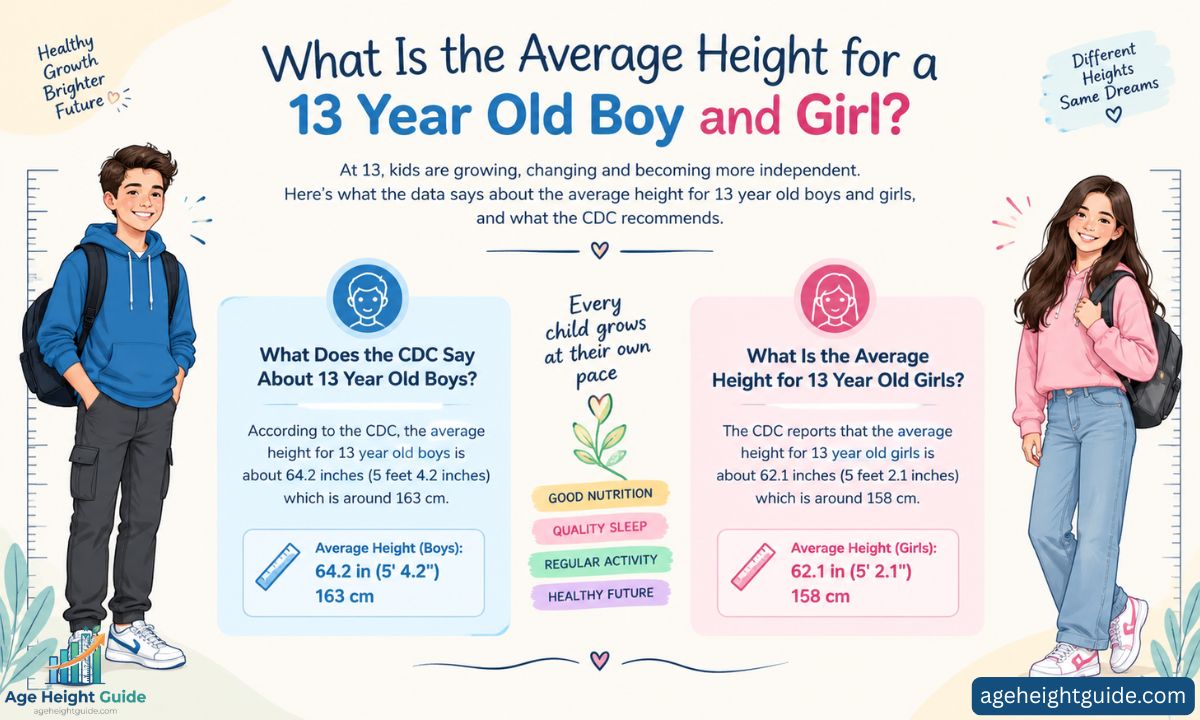
The average height for a 13 year old is best understood through a growth chart rather than a single universal number.
According to the CDC stature-for-age growth charts, the median height at age 13 is about 61.4 inches for boys and 61.8 inches for girls. These values are reference points from the CDC growth charts, not height goals that every child should reach.
It is also important to understand that the CDC does not create a new set of growth-chart reference data every year. The underlying U.S. growth-chart data have remained unchanged since the original growth-chart release. So these should not be described as brand-new “2026 CDC height data.”
The 50th percentile represents the middle of the reference population. Other percentiles show the wider range of heights seen among children of the same age and sex.
At age 13, puberty can make height differences especially noticeable. Some children have already gone through a major growth spurt, while others are just beginning theirs.
That means two healthy 13-year-olds can have very different heights.
What Does the CDC Say About 13 Year Old Boys?
For a 13 year old boy, the CDC stature-for-age chart provides a range of expected heights rather than one height that every boy should have.
The median reference point is about 61.4 inches, or just over 5 feet 1 inch. However, many healthy boys will be shorter or taller than this value.
The 50th percentile is simply the middle reference point. Boys above or below it can still have normal growth.
This is especially important because many boys experience their major growth spurt later than girls. A boy who is shorter at 13 may still gain substantial height during the later stages of puberty.
The better question is not simply, “How tall is he today?”
Instead, parents should ask:
- Has his height increased steadily?
- Is he following a similar growth curve over time?
- Has puberty started?
- Is his growth rate changing?
- Is there a family pattern of later puberty?
The CDC recommends using growth charts as part of an overall clinical assessment rather than as a stand-alone diagnostic tool.
What Is the Average Height for 13 Year Old Girls?
The average height for a 13 year old girl also varies across the CDC percentile chart.
The median reference height at age 13 is about 61.8 inches, or about 5 feet 1.8 inches. This is a population reference point, not a required height for every girl.
Girls often enter puberty earlier than boys. Because of this, a 13 year old girl may temporarily be taller than boys of the same age.
According to the American Academy of Pediatrics, girls generally experience their fastest height growth earlier than boys. For many girls, the fastest growth occurs before the first menstrual period, and height growth slows after the period begins.
However, puberty timing varies widely.
A girl who is shorter at 13 is not automatically experiencing abnormal growth. Her development should be considered together with her previous measurements, family height pattern, and puberty stage.
Average Height for 13-Year-Old Boys vs Girls
The difference between boys and girls at age 13 can be confusing because puberty happens at different times.
| Factor | 13-Year-Old Boys | 13-Year-Old Girls |
| Approximate CDC median height | 61.4 inches | 61.8 inches |
| Puberty timing | Often later | Often earlier |
| Growth spurt | May still be approaching or underway | Often occurs earlier |
| Height variation | Wide | Wide |
| Growth after puberty begins | Can continue rapidly | Usually slows after the first period |
| Best way to assess growth | Growth curve + puberty stage | Growth curve + puberty stage |
These are general patterns, not rules for every child. Healthy children can develop earlier or later than their peers.
The small difference between the median values also shows why it is not useful to compare every boy and girl against a single “normal” height.
What Does the 50th Percentile Mean?
The 50th percentile is often called the median.
If a child is at the 50th percentile for height, it means that roughly half of the reference population is shorter and half is taller.
It does not mean:
- the child is the healthiest
- the child has the ideal height
- the child will stay at the 50th percentile
- the child should try to reach that height
A child at the 25th percentile can be perfectly healthy. A child at the 75th percentile can also be perfectly healthy.
What matters more is the pattern over time.
For example, a child who has consistently tracked near the 25th percentile may simply have a naturally shorter family growth pattern. A child who suddenly drops across several major percentile lines may need closer evaluation.
How Does the 13 Year Old Growth Spurt Change Your Child?

A 13 year old growth spurt can cause noticeable changes in height, weight, body shape, appetite, and coordination.
Puberty is one of the fastest periods of physical growth. The timing is different for every child, however. The American Academy of Pediatrics notes that puberty-related growth can vary substantially between children.
During a growth spurt, a child may:
- grow several inches over a relatively short period
- need larger shoes or clothes
- experience increased appetite
- appear temporarily awkward or less coordinated
- gain muscle and change body shape
- notice other signs of puberty
These changes do not happen on the same schedule for everyone.
When Do Boys Usually Start Their Growth Spurt?
Boys generally begin their major pubertal growth spurt later than girls.
This is one reason a 13 year old boy may look shorter than some girls in the same class.
The American Academy of Pediatrics explains that boys typically trail girls in the timing of pubertal growth, although individual development varies.
A boy who has not had a dramatic growth spurt by 13 may simply be developing later.
Other signs of puberty can help provide context, including changes in the testicles and penis, body hair, voice, and muscle development.
If puberty appears significantly delayed, a pediatrician can evaluate the child’s overall growth and development.
How Does Puberty Timing Affect Height in Girls?
Girls usually experience their fastest height growth earlier than boys.
For many girls, the fastest growth happens before their first period. After the first period, growth usually slows, although many girls grow another 1–2 inches afterward.
This means a 13 year old girl who has already had her first period may have less remaining height growth than a girl who has not yet started menstruating.
But there is no exact amount of height that every girl will gain.
Puberty timing, genetics, health, and individual development all matter.
How Much Can a 13-Year-Old Grow in One Year?
There is no single number that describes how much every 13-year-old will grow in one year.
Growth can be slower before puberty, accelerate during the pubertal growth spurt, and slow again as puberty progresses.
The American Academy of Pediatrics notes that children can grow at very different rates during puberty. Some adolescents may experience rapid growth while others develop more gradually.
For this reason, parents should avoid using one yearly height estimate as a prediction of adult height.
A more useful approach is to measure height correctly at regular intervals and look at the overall growth rate and growth curve.
What Are the Main Factors That Impact Height Potential?
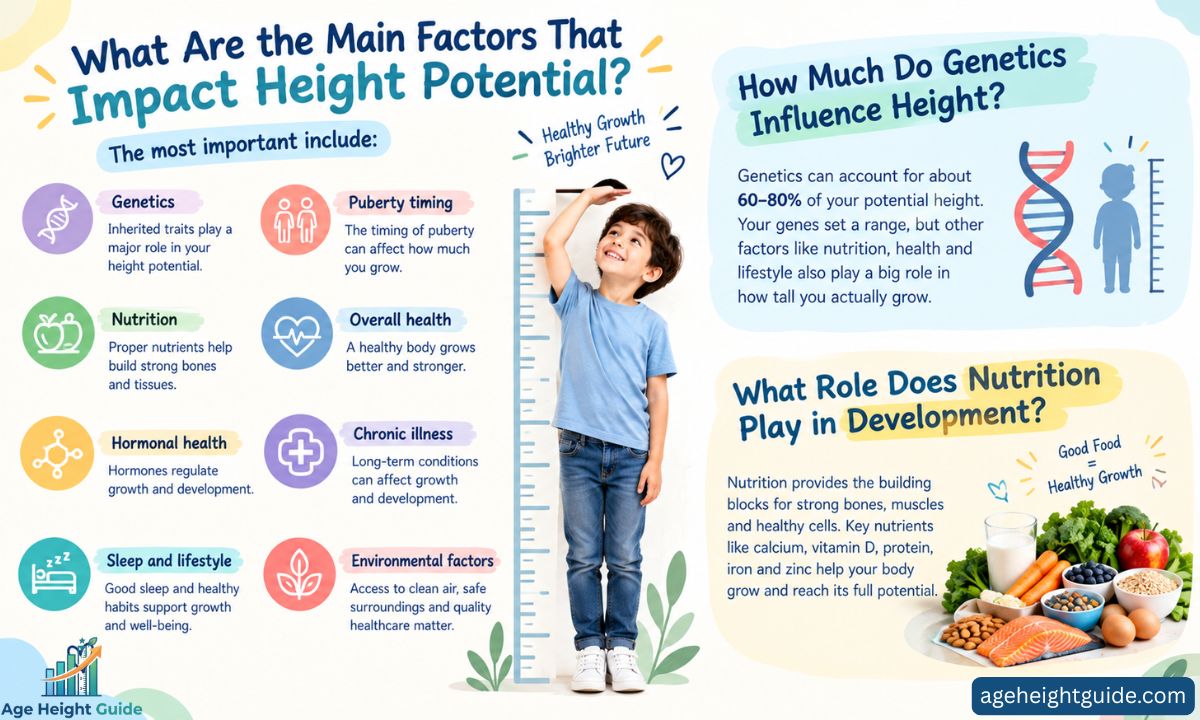
A child’s final height depends on several interacting factors.
The most important include:
- Genetics
- Puberty timing
- Nutrition
- Overall health
- Hormonal health
- Chronic illness
- Sleep and general lifestyle
- Environmental factors
There is no reliable formula that assigns a fixed percentage of height to genetics, nutrition, and sleep.
Height is a complex biological trait, and children with similar parents can still end up at different adult heights.
How Much Do Genetics Influence Height?
Genetics play a major role in determining height potential.
Children inherit many genetic variants from their parents that influence skeletal growth and development.
Family height can therefore provide useful context. However, it cannot predict a child’s exact adult height.
Two siblings can also have different growth patterns.
Puberty timing matters as well. One child may mature earlier and reach a certain height sooner, while another may continue growing later.
What Role Does Nutrition Play in Development?
Good nutrition provides the energy and nutrients children need for normal growth, bone development, and overall health.
Important nutrients include:
- Protein
- Calcium
- Vitamin D
- Zinc
- Iron
- Magnesium
- Other vitamins and minerals
However, nutrition should not be confused with a height-boosting treatment.
A well-nourished child does not normally become taller than their natural potential simply by taking extra vitamins or supplements.
The goal is to prevent nutritional deficiencies and support healthy development.
How Can Parents Support Healthy Growth Through Daily Habits?
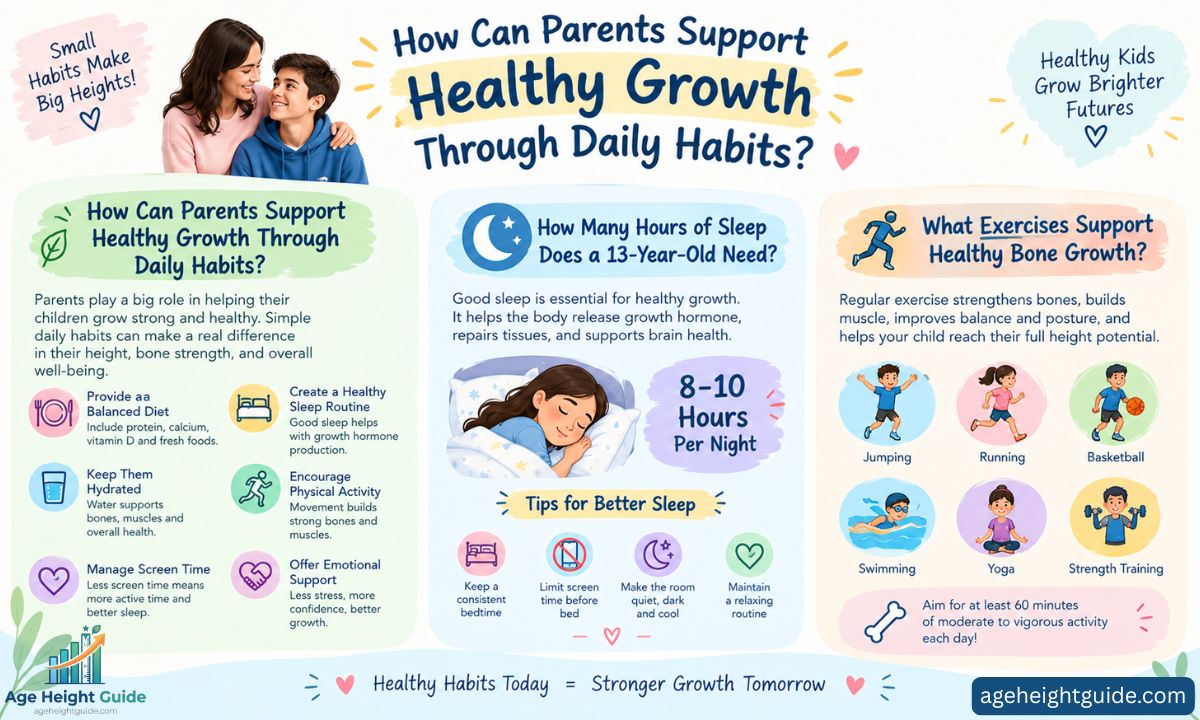
Parents cannot control a child’s genes or exact puberty schedule.
They can, however, create habits that support healthy development.
A balanced routine can include:
- Nutritious meals
- Enough protein and essential nutrients
- Calcium-rich foods
- Vitamin D from appropriate food, sunlight, or supplements when medically advised
- Regular physical activity
- Adequate sleep
- Good hydration
- Regular medical checkups
These habits support overall health while the child’s body follows its natural growth pattern.
How Many Hours of Sleep Does a 13-Year-Old Need?
Teenagers ages 13–17 are generally recommended to get 8–10 hours of sleep per 24 hours.
Sleep is important for overall physical and mental health.
Instead of focusing on one exact number, parents should aim for a consistent sleep schedule that gives their teenager enough time to reach the recommended range.
Helpful habits include:
- Keeping a regular bedtime
- Limiting stimulating activities before bed
- Keeping the bedroom comfortable and dark
- Avoiding unnecessary late-night screen use
- Planning enough time for sleep before school
Good sleep supports healthy development, but it should not be described as a way to make a child taller than their genetic potential.
What Exercises Support Healthy Bone Growth?
Regular physical activity supports strong bones, muscles, coordination, and overall health.
Weight-bearing activities can be especially useful for bone health. Examples include:
- Walking
- Running
- Jumping
- Dancing
- Hiking
- Sports
- Bodyweight exercises
Exercise does not stretch the bones beyond their natural growth potential.
The goal is to keep children active and support healthy bone growth and development.
Why Is Nutritional Support Critical for a 13 Year Old?

The teenage years involve rapid physical development.
A growing child needs enough energy, protein, vitamins, and minerals to support normal body functions.
Poor nutrition can interfere with healthy development, especially when a child has a restricted diet, nutritional deficiency, chronic illness, or another health concern.
But more is not always better.
A teenager who already gets enough nutrients does not necessarily benefit from taking high doses of vitamins.
Parents should focus on a varied diet first and discuss supplements with a healthcare professional when there is a specific need.
What Vitamins Are Most Important for 13 Year Olds?
Several nutrients are important during adolescence.
| Nutrient | Why It Matters |
| Calcium | Supports bones and teeth |
| Vitamin D | Helps the body absorb calcium and supports bone health |
| Protein | Supports muscle and tissue development |
| Zinc | Supports normal growth and immune function |
| Iron | Helps make hemoglobin and supports normal development |
| Magnesium | Supports muscles, nerves, and bones |
| Vitamin K | Plays a role in normal bone metabolism |
The exact nutritional needs of a teenager depend on diet, development, health, and other factors.
A supplement should fill a genuine nutritional gap rather than be marketed as a guaranteed way to increase height.
Is 5 Feet Short for a 13-Year-Old?
Being 5 feet tall at 13 does not automatically mean a child is too short.
For context, 5 feet is below the CDC median reference height at age 13 for both boys and girls. But being below the median does not automatically mean abnormal growth.
The answer depends on sex, exact age in months, previous height measurements, family pattern, and puberty stage.
For example, a child who has always tracked along a lower percentile may simply have a naturally shorter growth pattern.
Another child whose height has recently slowed or dropped substantially on the growth chart may need evaluation.
This is why one measurement cannot tell the whole story.
If you are concerned about a child’s height, compare measurements over time and discuss the growth curve with a pediatrician.
What If My 13-Year-Old Has Not Had a Growth Spurt Yet?
A late growth spurt does not automatically mean something is wrong.
Boys often enter their major pubertal growth phase later than girls. Some healthy teenagers are also simply later maturers.
Family history can provide useful clues. If a parent experienced puberty later than peers, the child may follow a similar pattern.
Still, delayed growth or puberty can sometimes have a medical cause.
A pediatrician can review:
- Previous height measurements
- Growth velocity
- Weight changes
- Family heights
- Puberty signs
- Nutrition
- Medical history
- Possible laboratory testing when appropriate
When Should Parents Talk to a Pediatrician?

Parents should consider speaking with a pediatrician if they notice a significant change in their child’s growth rate or development.
Examples include:
- Height growth appears to stop or slow significantly
- The child drops across important percentile lines
- Puberty appears unusually early or delayed
- The child has ongoing weight loss or poor weight gain
- There are symptoms of chronic illness
- The child has a very restricted diet
- Parents are concerned about overall development
Growth charts can help doctors identify patterns, but they are only one part of a complete assessment.
What Is Bone Age?
Bone age is an estimate of how mature a child’s bones are.
A healthcare professional may use a hand and wrist X-ray to assess skeletal maturity when there is a concern about growth or puberty.
Bone age can sometimes help doctors understand whether a child has more growth remaining than their chronological age alone would suggest.
It should not be used as a simple home prediction of adult height.
Empower Your Child’s Healthy Development
The goal should not be to make every child match the average height for a 13 year old.
Children develop on different schedules.
Instead, parents can focus on the things they can control: nutritious food, adequate sleep, regular physical activity, preventive healthcare, and a supportive environment.
If a child is shorter than classmates, that does not automatically mean something is wrong.
Likewise, being taller than average does not automatically mean a child will become exceptionally tall as an adult.
The most useful information comes from the child’s own growth pattern over time.
Frequently Asked Questions
Is 5 feet short for a 13 year old boy?
Five feet is below the CDC median reference height for a 13-year-old boy, but being below average does not automatically mean abnormal growth.
His exact age, growth history, family height, and puberty stage matter.
Can a 13 year old still grow after their first period?
Yes. Many girls continue to grow after their first period, although height growth usually slows.
The American Academy of Pediatrics notes that many girls grow another 1–2 inches after their first period, with individual variation.
How much do boys grow at age 13 on average?
There is no single growth amount that applies to every 13-year-old boy.
Growth depends heavily on puberty timing. A boy in the middle of a growth spurt may grow much faster than a boy who has not yet entered his major pubertal growth phase.
What vitamins support bone health in teenagers?
Calcium and vitamin D are especially important for healthy bones.
Protein, magnesium, vitamin K, zinc, and other nutrients also contribute to normal development.
Supplements should be used when needed rather than assuming that higher doses produce more height.
Does caffeine stunt a 13 year old’s growth?
Caffeine is not generally considered a direct cause of reduced height.
However, teenagers should avoid excessive caffeine because it can interfere with sleep. Since teenagers need 8–10 hours of sleep, habits that make adequate sleep harder are worth avoiding.
How many inches is a normal growth spurt per year?
There is no single number that defines a normal growth spurt for every teenager.
Growth can accelerate substantially during puberty, but the timing and speed vary from child to child.
Is my 13 year old child a late bloomer?
A child may be a later maturer if puberty starts later than it does for many peers.
However, “late bloomer” should not be used to dismiss persistent concerns. A pediatrician can assess the child’s growth pattern and pubertal development.
Should I worry if my child is below the 50th percentile?
Not necessarily.
The 50th percentile is simply the middle of the reference population. Children can be healthy at many different percentiles.
A consistent growth pattern is often more informative than one percentile measurement.
Can nutrition make a 13 year old taller?
Good nutrition supports normal growth and helps prevent deficiencies.
However, eating extra nutrients does not guarantee additional height beyond a child’s natural growth potential.
Do growth gummies increase height?
There is no simple gummy that can guarantee extra height in a healthy, well-nourished teenager.
A supplement may be useful when it corrects a genuine nutritional deficiency, but that is different from proving that a product increases height beyond natural potential.
When do growth plates close?
Growth plates close at different times depending on sex, puberty, genetics, and individual development.
They do not all close at the same age.
As puberty progresses and skeletal maturity is reached, the growth plates gradually close and height growth comes to an end.
What is the best way to track a 13 year old’s growth?
Measure height correctly and record it over time.
A pediatrician can plot the measurements on a CDC growth chart and assess the child’s growth curve, growth velocity, puberty stage, and overall health.
CDC growth charts are designed to help track growth in children and adolescents ages 2–20.

Stoke is the author behind Age Height Guide, creating simple and informative content about average height, age, growth, and related measurements.