


Every child grows at a different pace, so there is no single height that every 3-year-old girl should have. Still, knowing the average height for a 3 year old girl can help parents understand how their child compares with other girls of the same age.
At around 3 years old, the median height for girls is about 95.1 cm (37.4 inches) at 36 months on the WHO height-for-age standard. Children can be shorter or taller than this and still be healthy. What matters most is the child’s overall growth pattern, not one measurement.
For children age 2 and older, healthcare professionals commonly use growth charts to track stature-for-age, weight, and other measurements over time. The CDC provides growth charts for girls from ages 2 through 20 years.
In this guide, we’ll explain the average height of a 3 year old girl, how to measure height correctly, how growth charts and height percentiles work, how fast a 3-year-old may grow, and which factors can influence a child’s growth.
You can also read: What Is the Average Height for a 6-Year-Old Girl?
Key Takeaways:
- The average height for a 3 year old girl is about 37.4 inches (95.1 cm) at 36 months based on the WHO height-for-age standard.
- Average height is a reference point, not a target that every child must reach.
- A child’s height percentile shows how her height compares with girls of the same age and sex.
- Genetics, nutrition, sleep, physical activity, and overall health can influence child growth.
- Measuring height consistently helps parents follow a child’s growth curve over time.
- A child who is shorter or taller than average may still be growing normally.
- Growth often happens in small spurts rather than at the same rate every month.
- A sudden change in growth pattern is more important than one isolated measurement.
- A pediatrician can help interpret a growth chart for girls when parents have concerns about 3 year old girl height.
How Tall Is A 3 Year Old Girl On Average?
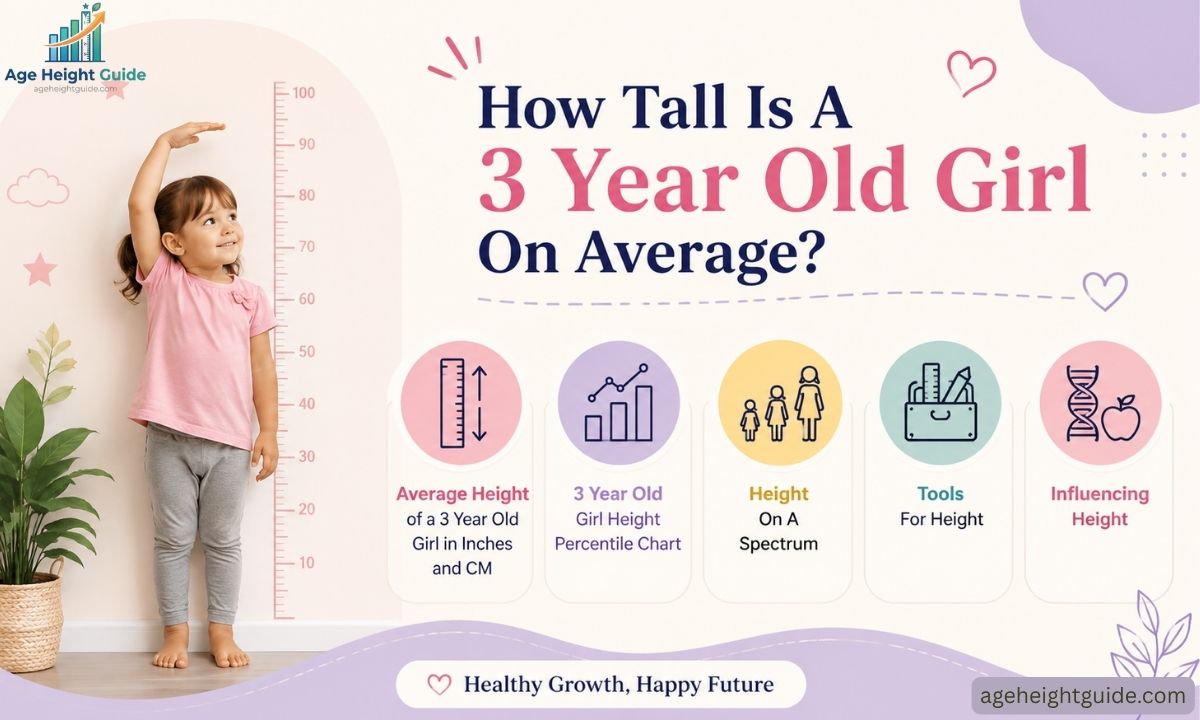
So, how tall is a 3 year old girl?
At exactly 36 months, the WHO height-for-age standard lists a median height of approximately 95.1 cm (37.4 inches) for girls. The standard also shows a broad spread of measurements around that median.
At 36 months, the -2 SD value is about 87.9 cm (34.6 inches), while the +2 SD value is about 102.2 cm (40.2 inches).
This means the number you see on a growth chart should not be treated as a pass-or-fail test.
| Age | Height reference for girls | Approx. equivalent |
| 3 years / 36 months | 87.9 cm (-2 SD) | 34.6 inches |
| 3 years / 36 months | 95.1 cm (median) | 37.4 inches |
| 3 years / 36 months | 102.2 cm (+2 SD) | 40.2 inches |
These WHO values are reference points, not a diagnosis or a definition of healthy versus unhealthy growth.
The average height of a 3 year old girl can therefore be thought of as roughly 37 to 38 inches, but individual children may fall above or below that point.
Average Height of a 3 Year Old Girl in Inches and CM
Parents often search for 3 year old girl height in inches because many home growth charts use inches. Others prefer centimeters because healthcare records often use metric measurements.
A height of 95.1 cm is approximately 37.4 inches. In simple terms, that is just over 3 feet 1 inch.
| Measurement | Approximate height |
| Centimeters | 95.1 cm |
| Inches | 37.4 inches |
| Feet and inches | About 3 ft 1.4 in |
Remember that converting between inches and centimeters does not change where a child falls on a growth chart.
3 Year Old Girl Height Percentile Chart
A height percentile compares a child’s height with measurements from other girls of the same age and sex.
For example, a girl around the 50th percentile is close to the middle of the reference population. A girl at a lower percentile is shorter than many girls her age, while a girl at a higher percentile is taller than many of them.
The CDC’s girls’ stature-for-age chart for ages 2–20 includes percentile curves such as the 5th, 10th, 25th, 50th, 75th, 90th, and 95th percentiles.
| Height percentile | What it means |
| 5th percentile | Taller than about 5% of girls in the reference group |
| 10th percentile | Taller than about 10% of girls |
| 25th percentile | Taller than about 25% of girls |
| 50th percentile | Around the middle of the reference group |
| 75th percentile | Taller than about 75% of girls |
| 90th percentile | Taller than about 90% of girls |
| 95th percentile | Taller than about 95% of girls |
A percentile is not a grade. Being at the 10th, 50th, or 90th percentile does not automatically mean a child is unhealthy.
The most useful information is often the growth trajectory. A child who consistently follows a lower percentile may be growing normally, while a sudden shift across percentiles may deserve more attention.
Height On A Spectrum
Children do not all follow the same growth pattern.
One 3-year-old girl may be close to the median height, while another may be several inches shorter or taller. Both can be healthy.
Family height plays an important role. A child with shorter parents may naturally have a lower height percentile. A child with tall parents may naturally track higher on the chart.
Growth can also happen in spurts. A child may appear to stay at nearly the same height for a while and then grow noticeably over a shorter period.
This is why doctors look at growth trends rather than relying on one measurement.
A useful question is not only:
“How tall is my 3 year old girl?”
It is also:
“Is she continuing to grow along a pattern that makes sense for her?”
Tools For Height
You do not need expensive equipment to measure a child’s height at home.
A few simple items can help:
- A flat wall
- A hard floor
- A straight ruler or measuring tape
- A flat book
- A notebook or growth record
- A children’s growth chart
For the most accurate clinical measurement, healthcare professionals may use a stadiometer. At home, consistency matters more than buying special equipment.
Try to use the same wall and measuring method each time. This makes changes easier to compare.
Influencing Height
A child’s height is influenced by many factors. Genetics provides a major part of the picture, but environment and overall health also matter.
Important factors include:
- Family height
- Nutrition
- Sleep
- Physical activity
- General health
- Long-term medical conditions
- Certain medications
- Normal individual variation
Parents should avoid comparing one child too closely with another. Two healthy children can have very different heights.
Tracking Your Child’s Growth Curve At Home

Tracking your child’s height can be a useful way to understand her growth pattern over time.
The goal is not to measure her every day. Height changes too slowly for daily measurements to provide useful information.
Instead, record measurements periodically and keep them together.
A growth curve shows how measurements change as a child gets older. Healthcare professionals can use this pattern to see whether a child is generally following her previous trajectory.
The CDC provides stature-for-age charts specifically for girls ages 2 through 20.
Pick A Reliable Surface
Choose a flat wall with a hard, level floor.
Avoid measuring on thick carpet because it can make positioning less consistent.
Have your child stand upright with her back against the wall. Try to keep her head and body in the same position each time.
Use A Reliable Tool
A wall-mounted measuring device is useful, but a simple measuring tape can work at home.
Place a flat book or similar object on top of your child’s head. Keep it level with the floor and mark the wall where it meets the head.
Then measure from the floor to the mark.
Do not pull the measuring tape tightly against the body. You want a straight vertical measurement.
Go Barefoot
Remove shoes before measuring.
Shoes can add height and make the result inaccurate. Thick socks can also affect how the feet sit on the floor.
Ask your child to stand naturally with both feet flat on the ground.
Measure In The Morning
Height can change slightly throughout the day because the spine is compressed by normal daily activity.
For consistent home tracking, measuring at roughly the same time of day can make comparisons easier.
The exact time is less important than using a consistent method.
How to Record Your Child’s Height Over Time
Create a simple record with the date, age, and height.
| Date | Age | Height | Notes |
| Example | 3 years | 95 cm | First measurement |
| Example | 3 years 3 months | — | Record new measurement |
| Example | 3 years 6 months | — | Compare with previous measurement |
| Example | 4 years | — | Review overall pattern |
Avoid becoming concerned about tiny changes between measurements. Home measurements can have small errors.
The bigger picture is the growth pattern over time.
Factors That Influence Your Three Year Old’s Height

There is no single food, exercise, or routine that determines how tall a child will become.
The height of a 3 year old girl reflects many influences working together.
Genetics
Genetics is one of the strongest influences on a child’s eventual height.
Children inherit genetic traits from both parents and other family members. This is why height often runs in families.
If parents and close relatives are generally shorter, a child may naturally track toward a lower height percentile.
The same is true for families in which adults are generally tall.
A child’s genetic potential does not mean her exact adult height can be predicted with certainty.
Nutrition
Good nutrition gives children the nutrients they need for normal development.
A balanced diet can include:
- Protein-rich foods
- Dairy or fortified alternatives
- Fruits
- Vegetables
- Whole grains
- Healthy fats
- Foods containing calcium
- Foods containing vitamin D
Children can be picky eaters, especially during the toddler years.
One difficult meal does not usually define a child’s nutrition. The overall eating pattern matters more.
If a child consistently eats a very limited diet or has difficulty gaining weight, parents can discuss it with a healthcare professional.
Sleep
Sleep is an important part of childhood development.
A regular sleep routine can support overall health, learning, mood, and physical development.
Three-year-olds need plenty of sleep across the day and night, although individual sleep patterns vary.
Instead of focusing only on height, parents should look at the child’s overall well-being.
Health And Medical Conditions
Some medical conditions can affect growth.
Examples can include certain endocrine conditions, chronic illnesses, nutritional problems, or other health issues.
However, being shorter than average does not automatically mean a child has a medical problem.
Doctors may look at several things together:
- Height
- Weight
- Growth velocity
- Growth percentile
- Family height
- Nutrition
- Medical history
- Physical development
If a child’s growth suddenly slows or her growth pattern changes noticeably, discussing it with a pediatrician is a sensible step.
Physical Activity
Active play supports children’s overall health and development.
At age three, physical activity can be simple and enjoyable:
- Running
- Walking
- Climbing
- Dancing
- Playing outside
- Throwing and catching
- Riding age-appropriate toys
- Playing simple movement games
Exercise does not make a child taller than her genetic potential. Its value is in supporting healthy physical development and an active lifestyle.
Genetics Vs Environment: What Determines The Height Of 3 Year Old Girls?

Think of height as the result of both genetics and environment. A child’s genes provide much of her potential for height, while nutrition, health, sleep, and other environmental factors can affect how she grows.
For a 3 year old girl, genetics is one of the strongest factors behind her current height and future growth. Children inherit many height-related traits from both parents. This is why height often runs in families. If both parents are shorter than average, their daughter may naturally have a lower height percentile. Likewise, children with taller parents may naturally track toward a higher percentile.
However, genetic potential does not determine a child’s exact height. It provides a range within which her growth may occur. Other factors can influence whether she reaches that potential.
How Genetics Affects A 3 Year Old Girl’s Height
Genes influence several parts of growth, including bone development, growth patterns, and the timing of physical development. A child may therefore be naturally shorter or taller than the average height for a 3 year old girl without having a health problem.
Family height can be especially useful when looking at a child’s growth chart. For example, a girl who has consistently tracked at a lower percentile and has parents who are also shorter may simply be following her family’s normal growth pattern.
This is why healthcare professionals do not judge a child’s growth from one height measurement alone. They look at measurements over time and compare them with the child’s previous growth trajectory.
How Environment Can Influence Height
Genes are important, but the environment also plays a role in healthy childhood growth. A child’s body needs enough nutrients, sleep, and overall support to grow normally.
Some important environmental factors include:
- Nutrition: A balanced diet provides protein, calcium, vitamin D, healthy fats, and other nutrients needed for normal development.
- Sleep: Good-quality sleep supports overall health and normal childhood development.
- Physical activity: Active play helps support strong bones, muscles, coordination, and overall physical health.
- General health: Ongoing illness or certain medical conditions can sometimes affect normal growth.
- Living conditions: Access to nutritious food, healthcare, and a healthy environment can influence a child’s ability to reach her growth potential.
These factors do not mean parents can control exactly how tall their child will become. Instead, they help create the conditions needed for healthy growth.
Genetics And Environment Work Together
It is not really a question of genetics vs environment. Both work together.
For example, two 3-year-old girls may have similar genetic potential but different growth patterns because of differences in nutrition, health, sleep, or other circumstances. At the same time, two girls who have similar lifestyles may still have very different heights because their genetic backgrounds are different.
This explains why comparing your child with another child of the same age can sometimes be misleading.
A girl who is 35 inches tall may be shorter than the average height for a 3 year old girl, but that number alone does not tell you whether she is healthy. Her previous measurements, family height, weight, growth velocity, and overall development provide much more useful information.
Can Parents Predict A Child’s Adult Height?
Parents can estimate their child’s genetic height potential by considering parental heights, but these methods provide only a rough estimate. They cannot tell you exactly how tall a child will be as an adult.
Healthcare professionals may use parental height along with a child’s height percentile, growth velocity, and medical history to understand her growth pattern.
The important point is that an estimate is not a guarantee. Children can grow differently from their parents, and the timing of puberty can also affect final adult height.
Why The Growth Chart Matters
A growth chart for girls helps put height measurements into context. Instead of asking only whether a 3 year old girl is tall or short, parents and healthcare professionals can look at how her height changes over months and years.
A child may remain around the same percentile for a long period and still be growing normally. Another child may start at one percentile and gradually move to another. A significant or persistent change in growth trajectory is usually more informative than a single measurement.
For children age 2 and older, stature-for-age charts can be used to track height over time. Healthcare professionals may also consider weight, BMI, family history, nutrition, and overall health when evaluating growth.
The Bottom Line
Genetics provides much of a child’s height potential, while environment and health can influence how that potential is expressed. Nutrition, sleep, physical activity, and good overall health all support normal development, but they cannot guarantee a specific height.
So, if your 3 year old girl height is above or below the average, there is not necessarily a reason to worry. The most useful question is whether she is growing consistently along her own growth curve.
If you notice that her growth has slowed significantly, stopped, or changed sharply across percentiles, talk with a pediatrician. They can review her measurements and family history to determine whether her growth pattern is within the expected range.
How Much Should a 3 Year Old Girl Grow Each Year?
Growth usually becomes slower after the rapid growth of infancy and toddlerhood.
After age 2, children generally grow at a steadier pace. A preschool child may grow roughly 2–3 inches (5–8 cm) per year, although the exact rate can vary from child to child.
At age three, children continue to grow steadily, but they do not all gain the same amount of height every year.
Rather than expecting a specific number of inches every year, parents should focus on whether the child’s measurements continue to follow a consistent growth trajectory.
A doctor may look at growth velocity, which means how quickly a child grows over a period of time.
For example, if a child was consistently tracking around a particular percentile and suddenly moves downward across several percentile lines, that may deserve closer attention.
The pattern matters more than a single number.
Understanding Growth Charts and Height Percentiles
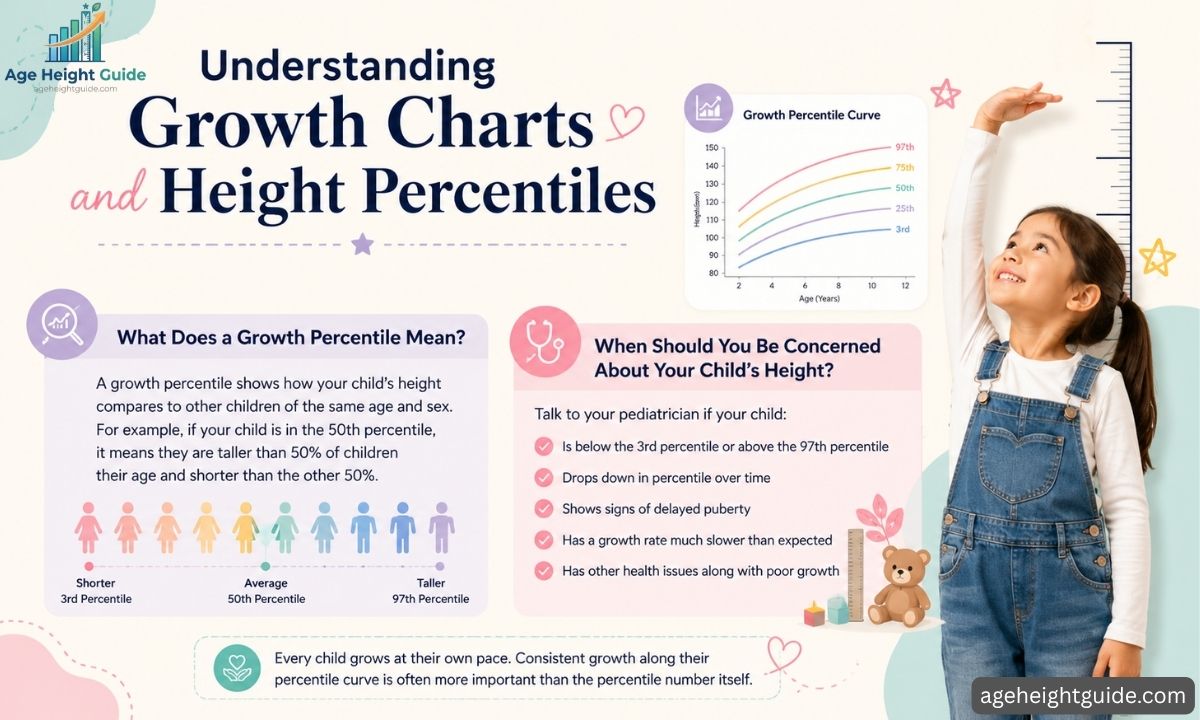
A growth chart is a visual tool that compares a child’s measurements with reference data for children of the same age and sex.
The CDC provides stature-for-age growth charts for girls from age 2 through 20 years.
A percentile does not tell you whether your child is healthy by itself.
For example, a child at the 25th percentile is not automatically less healthy than a child at the 75th percentile.
Instead, healthcare professionals consider the child’s complete growth pattern, including height, weight, growth velocity, family history, and overall health.
What Does a Growth Percentile Mean?
Suppose a child is at the 25th height percentile.
In simple terms, her height is greater than or equal to about 25% of girls in the reference population and lower than about 75%.
Likewise, a child around the 50th percentile is close to the middle of the reference group.
Percentiles are best used to understand growth trends, not to rank children.
When Should You Be Concerned About Your Child’s Height?
Being short does not automatically mean something is wrong.
However, parents should consider talking with a healthcare professional if:
- Growth seems to stop for an extended period.
- Height drops noticeably across growth percentiles.
- The child’s growth rate appears much slower than before.
- Height concerns occur together with poor weight gain.
- There are ongoing symptoms or chronic health concerns.
- You are worried about your child’s overall development.
A pediatrician can review the child’s measurements and decide whether further evaluation is needed.
Creative Family Traditions For Growth Milestones

Measuring your child’s height does not have to feel like a medical task.
You can turn it into a small family tradition.
A wooden growth chart or wall chart can become a visual record of how much your child has grown.
Just remember that the memories are more important than the number.
The “Height Day” Ritual
Choose a regular day every few months to measure your child’s height.
Take a photo, write down the measurement, and celebrate another milestone.
It can become a simple family tradition that your child looks forward to.
Growth Tokens In A Memory Jar
Place a small note in a memory jar each time you record a new measurement.
Write the height along with something your child enjoyed at that age.
For example:
- Favorite book
- Favorite food
- New word
- Favorite game
- A funny moment
- A new skill
Years later, the jar can become a special reminder of childhood.
Mini Interview At Every Mark
Along with the height measurement, ask your child a few simple questions.
You might ask:
- What is your favorite color?
- What makes you happy?
- What is your favorite game?
- What do you want to learn?
- What is your favorite book?
Your child’s answers will change much faster than her height.
That makes the growth record more meaningful.
Final Thoughts
The average height for a 3 year old girl is around 95.1 cm (37.4 inches) at 36 months on the WHO height-for-age standard.
But average does not mean expected for every child.
Some healthy girls will be shorter, while others will be taller. What matters most is how a child’s height changes over time and whether she generally follows her own growth curve.
Parents can measure height at home, record the results, and use a reliable growth chart to understand the bigger picture. For children age 2 and older, the CDC provides stature-for-age charts that healthcare professionals can use to track growth.
If you notice a major change in growth or have ongoing concerns about your child’s height, talk with her pediatrician. A healthcare professional can interpret her measurements in the context of family history, nutrition, health, and overall development.
Most importantly, try not to turn height into a competition. Every child has her own growth story, and those little changes are only one part of watching her grow.
Frequently Asked Questions About The Average Height For A 3-Year-Old Girl
What is the average height for a 3 year old girl?
The median height for a girl at 36 months is about 95.1 cm (37.4 inches) according to the WHO height-for-age standard. Individual children can be shorter or taller than this and still grow normally.
How is the average height for a 3 year old girl measured?
A child’s height should be measured standing barefoot on a hard, flat surface. Keep her body upright, feet flat, and head positioned straight. A flat object can be placed on top of the head to mark the wall, then the distance from the floor to the mark can be measured.
For medical measurements, healthcare professionals may use a stadiometer.
What factors influence a 3-year-old girl’s height?
Several factors can influence 3 year old girl height, including genetics, nutrition, sleep, overall health, physical activity, and certain medical conditions.
Genetics plays a major role, so children from the same family may naturally have similar growth patterns.
Is it normal if my 3-year-old girl is shorter than average?
Yes. Being shorter than average does not automatically mean that a child has a health problem.
A child may naturally follow a lower height percentile because of family genetics. Doctors usually look at the child’s growth pattern over time rather than one measurement.
If her growth slows significantly or her percentile changes sharply, speak with a pediatrician.
At what age does height growth slow down in girls?
Growth is generally much faster during infancy and early childhood than it is later in childhood. After the early years, growth continues at a steadier pace before increasing again during puberty.
The timing of puberty and later growth varies from child to child.
How does genetics affect a 3-year-old girl’s height?
Genetics has a major influence on height. A child’s height often reflects the height patterns of her parents and wider family.
However, genes are not the only factor. Nutrition, health, sleep, and other environmental factors also contribute to healthy growth.
A growth chart helps show how a child’s actual measurements compare with reference data over time.
Is 35 Inches Short For A 3 Year Old Girl?
A 35-inch height is below the median for a 3-year-old girl, but being shorter than average does not automatically mean there is a health problem.
A child’s height percentile and growth pattern over time are more useful than one measurement.
What Height Percentile Is Normal For A 3 Year Old Girl?
There is no single height percentile that every 3-year-old girl should be in.
Children can grow normally at different percentiles. Healthcare professionals look at the child’s growth curve, growth velocity, family height, and overall health when assessing growth.
Can A 3 Year Old Girl Grow Taller After Being Short?
Yes. A child who is shorter than average can continue to grow and may remain on a lower percentile or change position on the growth chart over time.
Genetics and overall health both influence childhood growth.
How Much Should A 3 Year Old Girl Weigh?
Weight varies by height, genetics, and individual growth pattern, so there is no single ideal weight for every 3-year-old girl.
Healthcare professionals usually consider weight-for-age, height, BMI-for-age, and growth trends together rather than using weight alone.
Does Nutrition Affect A 3 Year Old Girl’s Height?
Yes. Adequate nutrition supports normal growth and development.
A balanced diet that provides protein, carbohydrates, healthy fats, vitamins, and minerals can help meet a child’s nutritional needs. Poor nutrition over time can affect growth.
Can Parents Predict How Tall Their 3 Year Old Girl Will Be?
Parents can get a rough idea of genetic height potential from family height, but no method can predict a child’s exact adult height.
Genetics, nutrition, health, and puberty timing can all affect final height.
Should I Worry If My 3 Year Old Girl Is Not Growing?
Not necessarily. Children grow at different rates, and short periods of slower growth can occur.
However, if her growth appears to stop, slows significantly, or drops across growth percentiles, it is a good idea to discuss the pattern with a pediatrician.

Stoke is the author behind Age Height Guide, creating simple and informative content about average height, age, growth, and related measurements.