

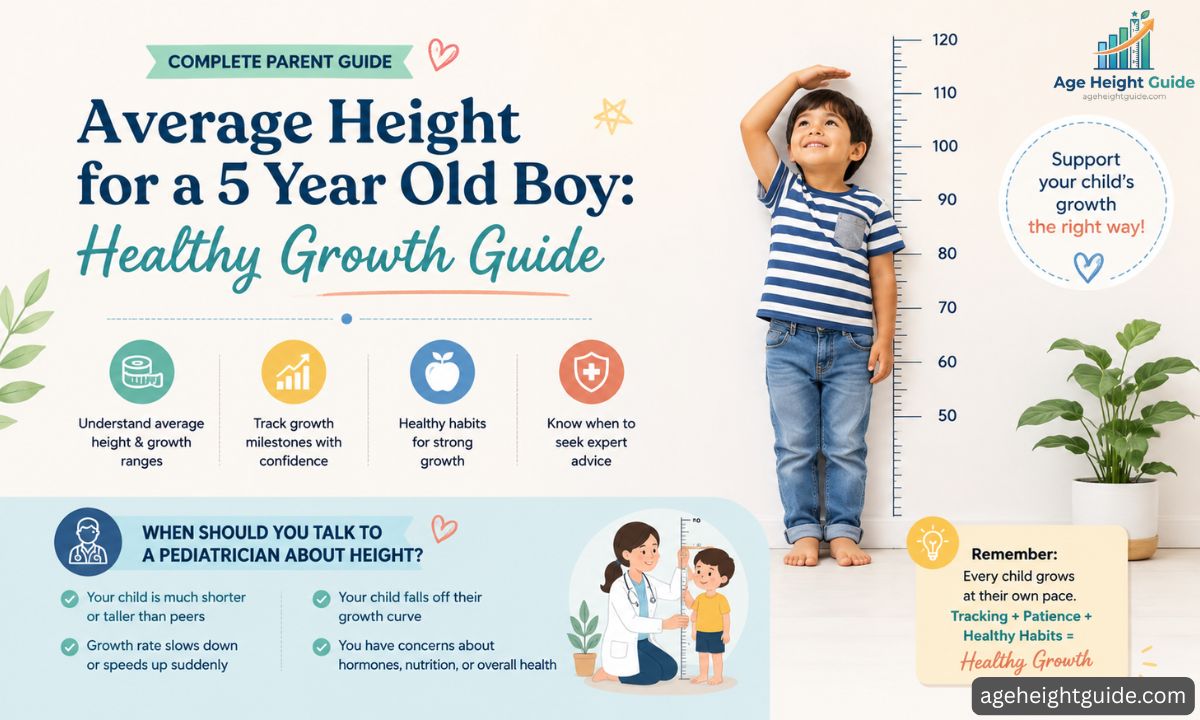
Watching your son grow can bring up many questions, especially when he starts school and you see children of different heights. One common question is, what is the average height for a 5 year old boy?
For a quick answer, a boy around age 5 is about 109 cm (43 inches) at the 50th percentile on the CDC boys’ stature-for-age growth chart. However, this is only a reference point. Healthy 5-year-old boys can be shorter or taller than this height.
The more important question is whether your child is following a steady growth pattern. Pediatricians look at height measurements over time rather than judging growth from one number.
For children age 2 and older in the United States, the CDC recommends its growth charts to monitor growth.
You can also read: Average Height of a 4-Year-Old Boy: Growth Guide
Key Takeaways
- Average height for a 5 year old boy: Around 109 cm (43 inches) is close to the 50th percentile on the CDC stature-for-age chart.
- Average does not mean required: A healthy boy can be shorter or taller than the 50th percentile.
- Growth patterns matter: A child’s growth trend over time is more useful than one height measurement.
- Percentiles provide context: A percentile compares a boy’s height with boys of the same age and sex in the reference population.
- Genetics matters: Family height has a strong influence on a child’s growth and eventual adult height.
- Healthy habits support growth: Balanced nutrition, adequate sleep, physical activity, and regular healthcare support healthy development.
- Accurate measurements matter: Consistent measuring makes a child’s growth record easier to interpret.
Average Height Range For 5-Year-Old Boys
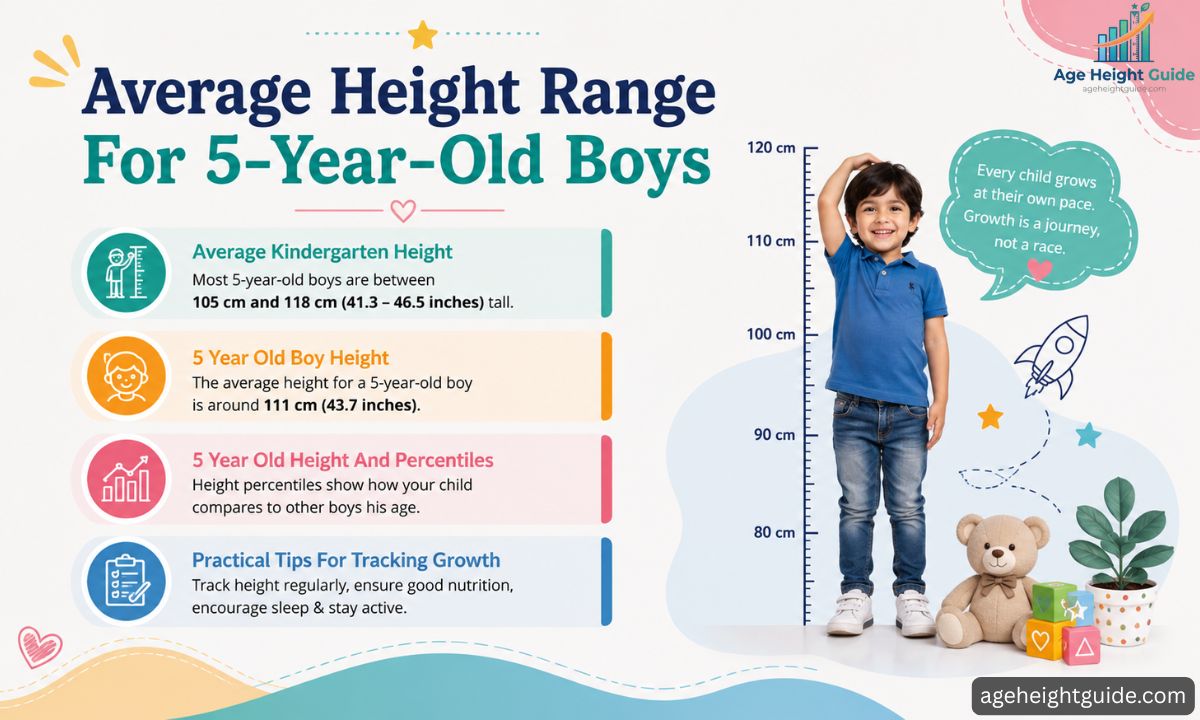
So, what is the average height for a 5 year old boy?
Around age 5, the 50th percentile on the CDC boys’ stature-for-age chart is about 109 cm, or 43 inches. But this number represents the middle of the reference population. It does not mean every 5-year-old boy should be exactly 43 inches tall.
Children naturally have different growth patterns. Two healthy boys of the same age may have noticeably different heights because of genetics, growth timing, and other factors.
Here are approximate reference points around age 5:
| Height Percentile | Approx. Height at Age 5 | What It Means |
| 10th | About 102 cm | Taller than about 10% and shorter than about 90% of boys in the reference group |
| 25th | About 106 cm | Below the middle of the reference group |
| 50th | About 109 cm / 43 in | Middle of the reference group |
| 75th | About 113 cm | Above the middle of the reference group |
| 90th | About 116 cm | Taller than most boys in the reference group |
These are approximate reference values, not strict limits for healthy height. The exact percentile depends on a child’s age in months. CDC growth-chart data provide values for specific ages and sexes, allowing growth to be assessed more precisely.
Average Kindergarten Height
Starting kindergarten is often when parents begin comparing their child’s height with classmates.
You may notice one boy is much shorter. Another may be several inches taller. This difference does not automatically mean that either child has a growth problem.
The average height for a 5 year old boy is only a reference point. Average kindergarten height can vary because children may enter school at different ages. Family height can also make a difference.
Some boys naturally stay near the middle of the growth chart. Others follow higher or lower percentiles. Both patterns can be healthy.
Instead of asking whether your son is the tallest or shortest child in his class, focus on whether he is growing consistently.
Children also grow in spurts. A boy who looks shorter than classmates may grow more quickly later. Heredity also plays an important role in height and growth.
5 Year Old Boy Height
5 year old boy height can vary considerably from one child to another.
The average height for a 5 year old boy is only a reference point. A single height reading cannot show how quickly your child is growing.
For example, a boy who has always followed a lower percentile may be developing normally. Another boy may start near the middle and later show a noticeable slowdown.
This is why doctors consider growth velocity and previous measurements. They also look at the child’s position on the growth curve.
Your son does not need to be exactly 43 inches tall to be healthy. The 50th percentile is simply the midpoint of the reference population.
Family height also provides useful context. Boys with shorter parents may naturally be shorter than their classmates. Boys from taller families may naturally be taller.
The key is to look at your child’s growth pattern over time, not just compare his height with the average.
5 Year Old Height And Percentiles
5 year old height and percentiles are easier to understand when you think of percentiles as comparison points rather than grades.
The average height for a 5 year old boy is close to the 50th percentile. It is only a reference point. It is not a required height.
Suppose your son is at the 25th percentile for height-for-age. In the reference population, about 25 out of 100 boys of the same age and sex are shorter. About 75 are taller.
Being at the 25th percentile does not automatically mean something is wrong.
The same applies to higher percentiles. A boy at the 75th or 90th percentile is taller than many boys his age. That alone does not indicate a health problem.
The most useful information is usually the growth trend over time. Repeated measurements can show whether your child is following a steady growth pattern. This is more useful than focusing on one percentile.
Practical Tips For Tracking Growth
Measure your child’s height periodically rather than every few days. Very frequent measurements can show small changes caused by posture or measurement error.
Record the date, age, and height each time. This creates a simple growth timeline that can be useful during pediatric visits.
Try to use the same method each time. Remove shoes, use a hard and level floor, and make sure your son stands upright.
If you notice a persistent slowdown in growth or a downward movement across several percentile lines, discuss it with his pediatrician. One unusual measurement is not enough to diagnose a growth problem.
5 Year Old Boy Height Chart
A 5 year old boy height chart helps parents understand where their child’s height falls compared with boys of the same age.
The CDC’s stature-for-age growth chart includes percentile curves for boys from age 2 through 20. It is designed to show how height compares with a reference population.
At around 5 years old, 109 cm (43 inches) is close to the 50th percentile. But the chart contains many percentiles because children naturally have different heights.
A percentile is not a health score. For example, being at the 25th percentile does not mean a child is less healthy than a boy at the 75th percentile.
The most useful question is whether your child’s measurements continue to follow a reasonably consistent growth curve.
How Growth Charts Define Normal 5-Year-Old Height
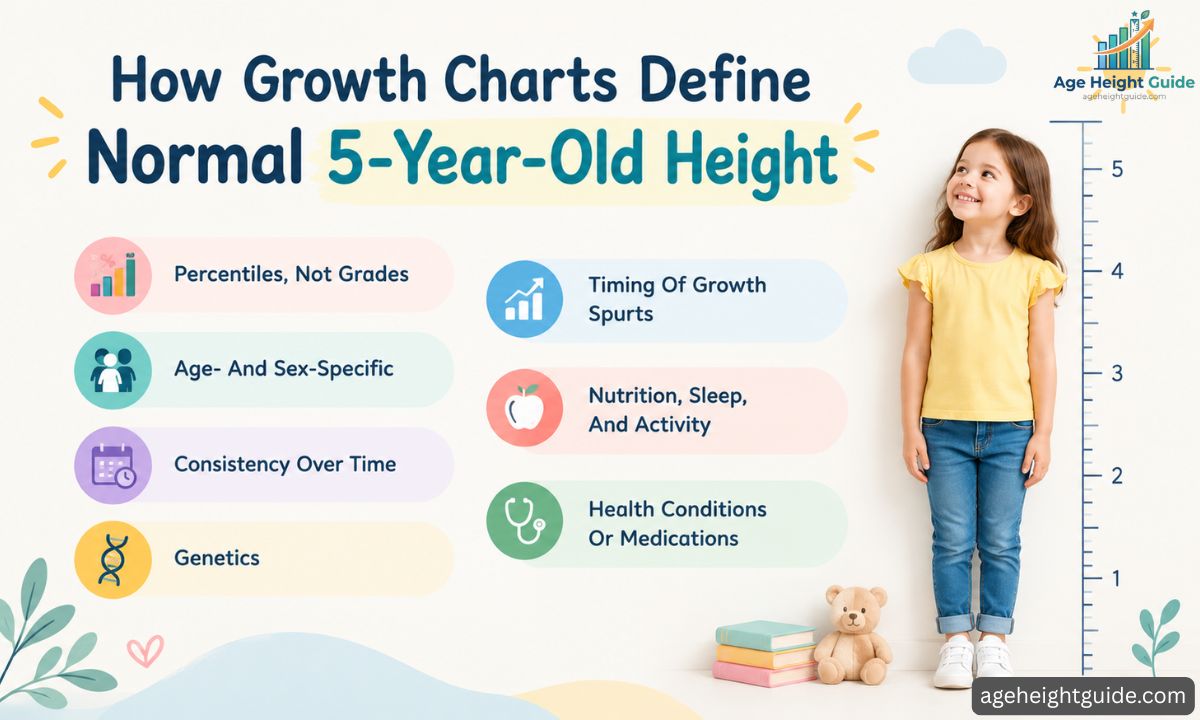
A growth chart is a useful reference tool. It helps healthcare professionals compare a child’s measurements with boys of the same age and sex.
The average height for a 5 year old boy is one reference point on the chart. It does not mean every boy should have the same height.
For children age 2 and older, CDC growth charts include stature-for-age, weight-for-age, and BMI-for-age references. These charts help track growth over time.
A growth chart does not label one height as healthy and every other height as unhealthy. Instead, it gives context for understanding how a child is growing.
Doctors also look at past measurements and the child’s growth pattern. This gives a clearer picture than one height measurement alone.
Percentiles, Not Grades
A percentile shows how a child’s measurement compares with the reference population.
The average height for a 5 year old boy is close to the 50th percentile. This percentile represents the middle of the reference group. A boy at the 10th percentile is shorter than most boys in that group.
The 50th percentile is not “better” than the 10th percentile. A lower percentile can still be healthy.
Parents should think of percentiles as points on a growth chart, not school grades. A child can remain healthy at a lower or higher percentile when his growth pattern stays consistent over time.
Age- And Sex-Specific
A 5 year old boy’s height should be compared with boys of the same age and sex.
Age matters because children continue to grow throughout childhood. A boy who is exactly 5 years old is not at the same growth stage as a boy who is 5 years and 11 months old.
CDC growth data are available by individual months of age. This allows healthcare professionals to assess height more precisely instead of treating every child between ages 5 and 6 as identical.
Consistency Over Time
A consistent growth curve is usually more informative than one height measurement.
A child’s percentile can move slightly as he grows. Growth spurts can also cause temporary changes.
A more concerning pattern is a persistent slowdown or a noticeable downward shift across percentile lines.
The American Academy of Pediatrics recommends looking at a child’s growth trend over time rather than focusing only on one percentile number.
Genetics
Genetics has a major influence on a child’s height.
Children inherit genes from both parents. These genes can affect growth patterns and potential adult height.
The average height for a 5 year old boy is only a reference point. Genetics helps explain why children of the same age can have very different heights.
A boy from a shorter family may naturally be shorter. A boy from a taller family may naturally be taller.
Genetics does not determine one guaranteed adult height. Instead, it contributes to a range of possible growth.
Family height can provide useful context when a pediatrician reviews a child’s growth chart. Heredity is also an important influence on growth..
Timing Of Growth Spurts
Children do not grow at exactly the same speed every month.
Some boys grow steadily, while others have periods when they grow more quickly followed by slower periods.
These growth spurts can make small changes in a child’s percentile position. This is one reason it is not helpful to compare your son’s height with a classmate’s height at only one point in time.
A child’s overall pattern across months and years provides a clearer picture of his growth and development.
Nutrition, Sleep, And Activity
A growing child’s body needs enough energy and nutrients for normal growth and development.
A balanced diet can provide protein, carbohydrates, healthy fats, vitamins, and minerals. Adequate sleep also supports healthy development.
Regular physical activity supports strong bones, muscles, coordination, and overall health. However, intense exercise does not make a normally growing child taller.
The goal is a healthy daily routine rather than trying to force a child toward a particular height.
Health Conditions Or Medications
Some health conditions can affect growth. Certain medicines may also influence growth in some children.
The average height for a 5 year old boy is only a general reference. A child’s height can vary because of nutrition, chronic illness, digestive conditions, hormonal disorders, and other medical factors.
However, being shorter does not automatically mean that a child has a medical condition. Many healthy children are naturally shorter because of family height or their individual growth pattern.
If your child is growing much more slowly than expected, shows a sustained drop across percentile lines, or has other symptoms, a pediatrician can assess the full picture.
How Tall Should A 5 Year Old Boy Be?
There is no single height that every 5-year-old boy should be.
The average height for a 5 year old boy is around 109 cm (43 inches) near the 50th percentile on the CDC boys’ stature-for-age chart. However, healthy boys can be shorter or taller than this reference point.
Instead of asking only, “How tall should my 5 year old boy be?” it is better to ask:
Is he growing consistently?
A boy who has always been on a lower percentile may simply have a naturally smaller growth pattern. Likewise, a boy on a higher percentile may come from a taller family.
The 50th percentile is a midpoint, not a target.
How Much Does A 5 Year Old Boy Grow Each Year?
The average height for a 5 year old boy can change as he grows. Children in middle childhood generally grow a little over 2 inches per year on average. Individual growth rates can vary.
Children can also grow in spurts. They may not grow at the same rate every month.
This is why parents should not expect the same amount of growth every month.
Doctors may calculate growth velocity by comparing measurements taken over time. This can provide more useful information than looking at one height measurement.
If your son’s growth seems to slow noticeably compared with his previous pattern, a pediatrician can review his measurements. They can then decide whether further evaluation is needed.
Nutrition Tips To Support Healthy Growth At Age Five

There is no special food that can guarantee extra height.
However, a balanced diet provides nutrients needed for bone health, muscle development, energy, and normal body function.
The goal is variety and adequate nutrition rather than trying to make a child reach a particular height.
Build Meals Around The “Big Three”
A simple meal can include protein, a carbohydrate source, and a healthy fat.
Protein-rich foods can include eggs, chicken, fish, beans, lentils, yogurt, tofu, and other suitable foods.
Whole grains, potatoes, fruits, and other carbohydrate foods provide energy for school, play, and daily activities.
Healthy fats can come from foods such as avocado, nuts, seeds, and nut butters when appropriate.
A child does not need a perfect meal every time. A varied diet across the day is more realistic.
Serve A Rainbow Daily
Different fruits and vegetables provide different nutrients.
Try offering several colors throughout the day. Berries, oranges, carrots, leafy greens, tomatoes, peas, and other colorful foods can provide vitamins, minerals, fiber, and other useful nutrients.
Your child does not need to eat every color at every meal.
Offering different foods regularly can help build a varied eating pattern.
Prioritize Iron And Zinc
Iron supports the production of hemoglobin and normal development.
Food sources include meat, beans, lentils, fortified cereals, and some leafy green vegetables.
Zinc also supports normal growth and immune function. Sources include meat, dairy foods, beans, and seeds.
If you think your child may not be getting enough iron, zinc, or another nutrient, speak with a healthcare professional before giving supplements.
Don’t Skip Calcium And Vitamin D
Calcium supports strong bones and teeth.
Children can get calcium from milk, yogurt, cheese, and suitable fortified alternatives. Some other foods also contribute calcium.
Vitamin D helps the body absorb calcium and supports bone health.
Rather than starting supplements without guidance, discuss your child’s specific nutritional needs with a pediatrician.
Measuring At Home: Simple Steps For Accurate Height Tracking
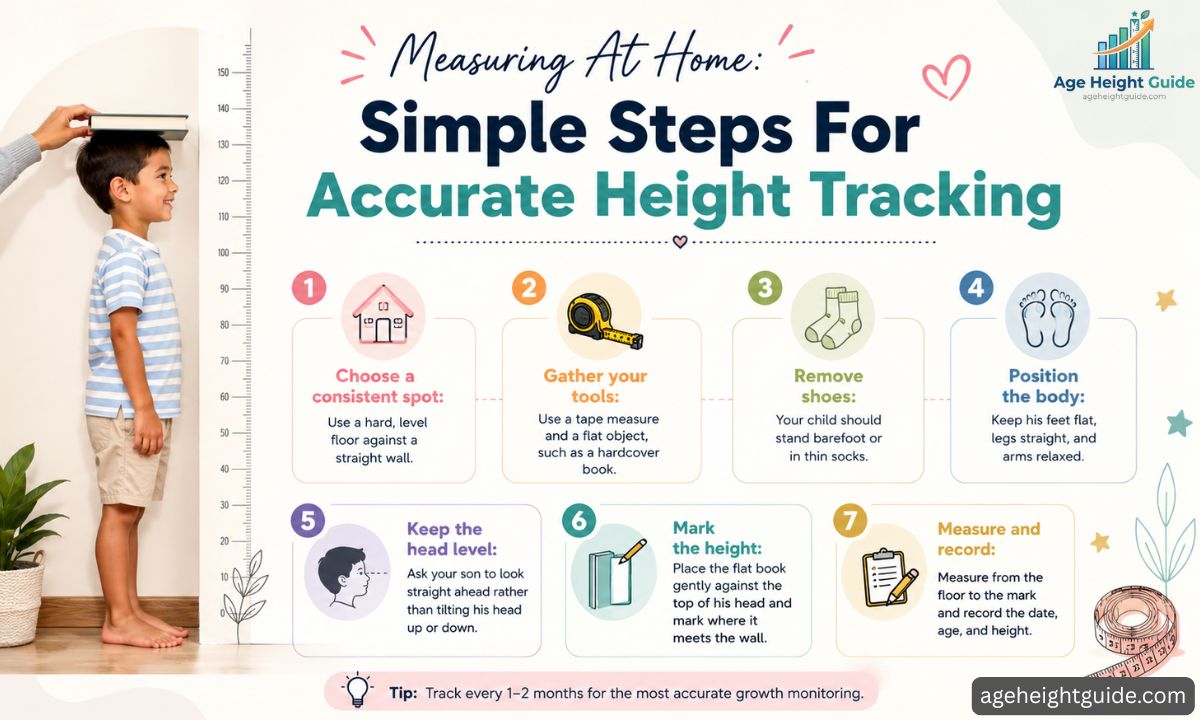
Accurate measurements make a growth chart more useful.
If your child’s height is measured differently each time, small errors can make the growth trend harder to interpret.
Follow these simple steps:
1. Choose a consistent spot: Use a hard, level floor against a straight wall.
2. Gather your tools: Use a tape measure and a flat object, such as a hardcover book.
3. Remove shoes: Your child should stand barefoot or in thin socks.
4. Position the body: Keep his feet flat, legs straight, and arms relaxed.
5. Keep the head level: Ask your son to look straight ahead rather than tilting his head up or down.
6. Mark the height: Place the flat book gently against the top of his head and mark where it meets the wall.
7. Measure and record: Measure from the floor to the mark and record the date, age, and height.
Try to use the same method each time. Consistent measurements make it easier to see the child’s growth pattern over time.
Understanding Percentiles: Interpreting Your Son’s Height Curve
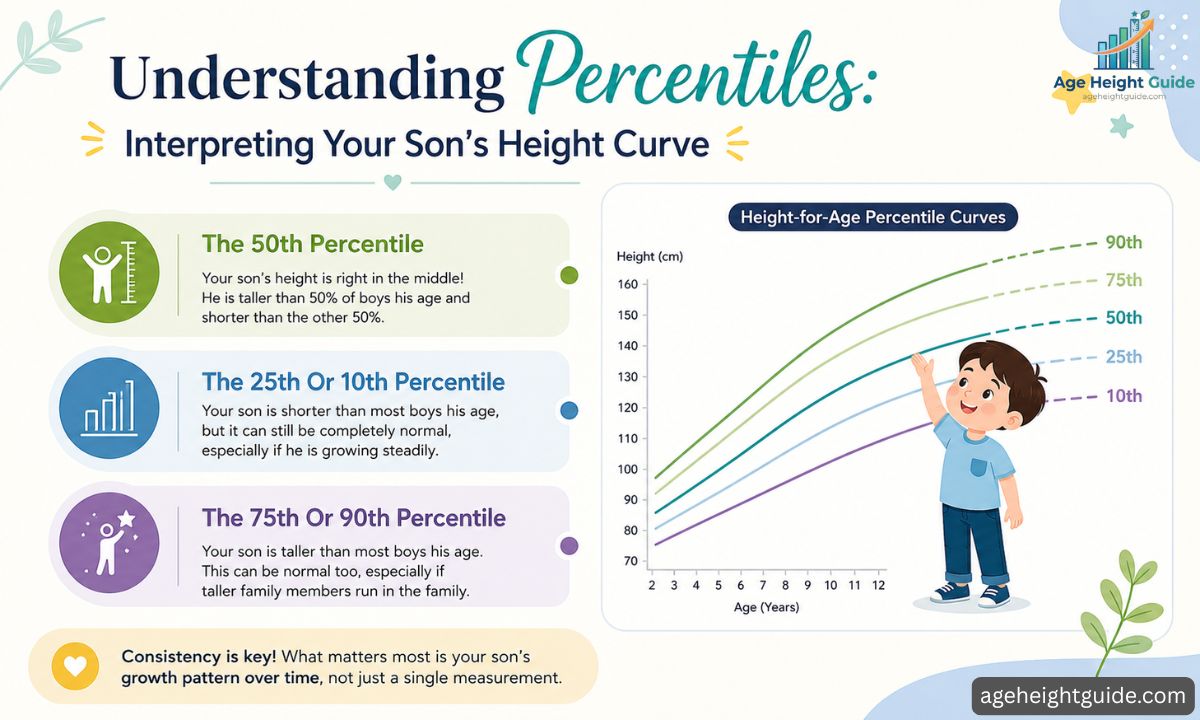
When parents first see a growth chart, the curved lines can seem confusing.
A percentile tells you where your child’s measurement falls compared with children of the same age and sex in the reference population.
For example, a boy at the 25th percentile is taller than about 25% of boys in the reference population and shorter than about 75%.
The number is not a grade, and it does not predict your child’s exact adult height.
The most useful information is how the measurement changes over time.
The 50th Percentile
The 50th percentile is the middle point of the reference population.
For a boy around age 5, it is about 109 cm (43 inches) on the CDC stature-for-age chart.
This is why about 43 inches is often used when discussing the average height for a 5 year old boy.
Your son does not need to be at the 50th percentile to be healthy.
The 25th Or 10th Percentile
A boy at the 25th percentile is shorter than many boys in the reference population but taller than about 25% of them.
A boy at the 10th percentile is shorter than most boys in the reference population.
Neither percentile automatically indicates poor health.
Doctors may consider family height, previous measurements, growth velocity, nutrition, development, and overall health when assessing growth.
A child who consistently follows a lower percentile may be healthy. A child who suddenly shows a sustained downward change may need closer evaluation.
The 75th Or 90th Percentile
A boy at the 75th percentile is taller than many boys his age.
At the 90th percentile, he is taller than most boys in the reference population.
Being tall is not automatically a health concern. Family genetics may explain a higher percentile.
As with lower percentiles, the important question is whether the child’s growth remains consistent and fits his overall health picture.
Why Growth Velocity Matters More Than One Measurement
One height measurement is a snapshot.
Several measurements collected over time show a growth pattern.
For example, a boy may be at a lower percentile but continue growing steadily along his usual curve. That can be more reassuring than a child whose height suddenly stops increasing as expected.
Children also grow in spurts. Their growth rate may not be identical from one month to the next.
This is why pediatricians use previous measurements to assess growth velocity and changes in the child’s growth curve. A single measurement rarely provides the complete picture.
Can Parents Predict Their Son’s Adult Height?
Parents can make a rough estimate of a child’s adult height from parental heights, but no simple formula can predict final height exactly.
One commonly used estimate for boys is:
(Father’s height + Mother’s height + 5 inches) ÷ 2
This provides only an estimate. A child’s actual adult height can be higher or lower.
Genetics, nutrition, overall health, hormones, and other factors can influence growth.
For this reason, a 5-year-old’s current height should not be treated as a precise prediction of his adult height. His growth pattern over time provides more useful information.
When Should You Talk With A Pediatrician About Height?
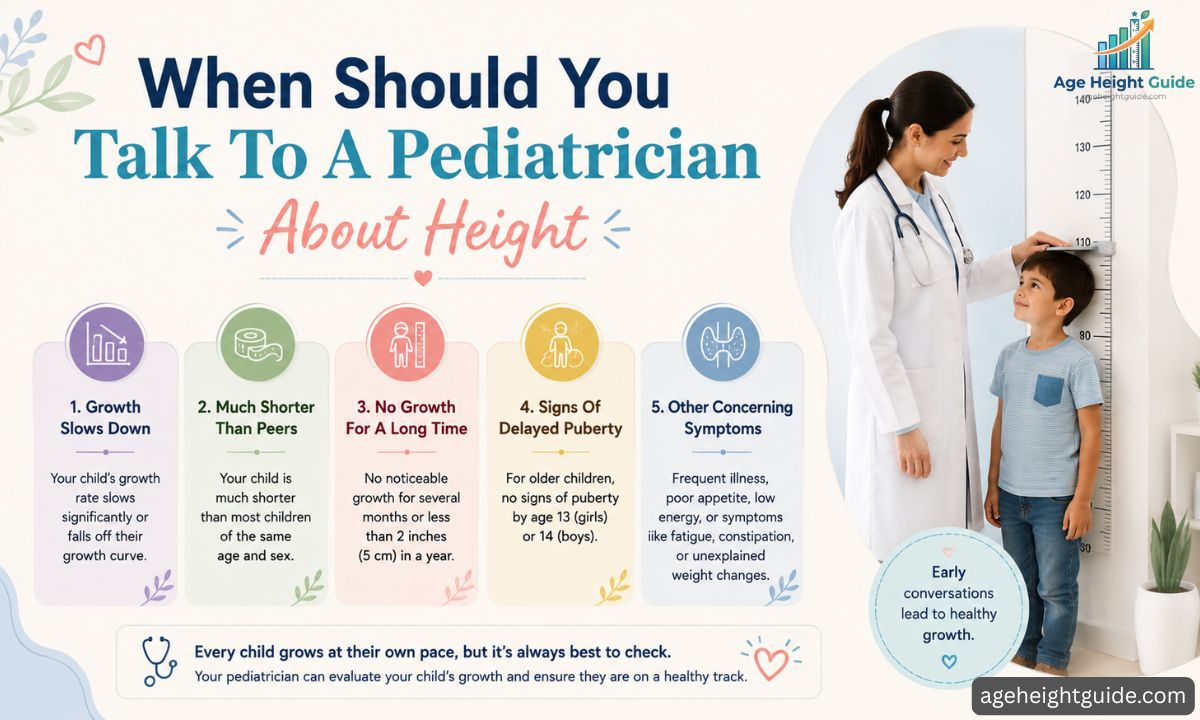
Most differences in height are not a reason to panic.
However, it is worth discussing your son’s growth with a pediatrician if you notice a clear change in his usual pattern.
| Growth Pattern | What To Do |
| Child is shorter but follows his usual curve | Discuss during routine healthcare visits |
| Growth appears slower than before | Talk with a pediatrician |
| Height moves downward across several percentile lines | Ask for a growth assessment |
| Child stops gaining height as expected | Contact a healthcare professional |
| Slow growth occurs with other symptoms | Discuss the full picture with a pediatrician |
The American Academy of Pediatrics notes that short stature and growth concerns should be assessed using the child’s measurements over time rather than one isolated measurement.
What Is A Healthy Growth Pattern At Age Five?
A healthy growth pattern is not defined by one perfect height.
Instead, healthcare professionals look for continued growth over time.
During middle childhood, children generally gain a little over 2 inches of height per year on average, although individual rates vary. Growth may also happen in spurts.
Your son may grow more quickly during one period and more slowly during another.
If his overall growth curve remains reasonably consistent, that is often more reassuring than whether he is at the 25th, 50th, or 75th percentile.
CDC vs WHO Growth Charts: Which Should You Use?
The appropriate growth chart depends on a child’s age and the clinical setting.
For children in the United States, CDC recommends WHO Growth Standards from birth to 2 years and CDC Growth Charts for children and adolescents age 2 and older. CDC charts for ages 2 through 20 include stature-for-age, weight-for-age, and BMI-for-age references.
Because a 5-year-old is older than 2 years, the CDC boys’ stature-for-age growth chart is the relevant CDC reference for tracking his height in the United States.
Growth charts are reference tools. They do not diagnose a medical condition by themselves. Healthcare professionals consider growth measurements along with family history, nutrition, development, and overall health.
Final Thoughts
The average height for a 5 year old boy is around 109 cm (43 inches) at the 50th percentile on the CDC stature-for-age chart. But average does not mean that every boy should be this height.
Some healthy boys will be shorter. Others will be taller.
The most important factor is your child’s growth pattern over time. A single height measurement gives only limited information, while repeated measurements can show whether your child is continuing along his expected growth curve.
Use a reliable growth chart, measure height consistently, provide a balanced diet, encourage normal physical activity, and keep regular pediatric checkups.
If your child’s growth seems to slow, his height moves downward across several percentile lines, or other symptoms appear, talk with his pediatrician. A healthcare professional can assess his growth velocity and consider family height, nutrition, health, and development.
CDC growth charts are valuable tools for monitoring growth, but they should not be used as the sole basis for diagnosing a health condition.
Frequently Asked Questions
What Is The Average Height For A 5 Year Old Boy?
The average height for a 5 year old boy is about 109 cm (43 inches) at the 50th percentile on the CDC stature-for-age chart. This is a reference point, not a required height. Healthy boys can be shorter or taller.
How Much Should A 5 Year Old Boy Grow In A Year?
Children in middle childhood generally grow a little over 2 inches per year on average, although individual growth rates vary. Growth can also occur in spurts. Pediatricians may focus on growth velocity and the overall growth pattern rather than one exact yearly number.
Is My 5 Year Old Boy Growing At A Normal Rate?
Look at his growth trend rather than one measurement. If his height continues to increase and generally follows his established growth curve, that can be reassuring. A noticeable slowdown or downward shift across percentile lines should be discussed with a pediatrician.
What Factors Affect A Child’s Height At Age 5?
Several factors can influence 5 year old height, including genetics, nutrition, sleep, physical activity, overall health, chronic conditions, and some medications. Family height is especially important because children inherit many traits that influence growth.
How Do Genetics Influence Height In 5 Year Olds?
Genetics provides much of the foundation for a child’s height. Children with taller parents often have a greater chance of being taller, while children from shorter families may naturally be shorter. Genes influence a range of possible growth rather than guaranteeing one exact adult height.
Are Growth Charts Reliable For Tracking My Child’s Height?
Yes. Growth charts are useful reference tools for tracking height over time when measurements are taken correctly. For children age 2 and older in the United States, CDC recommends the CDC Growth Charts, including stature-for-age charts. However, a growth chart should not be used by itself to diagnose a health condition.
Is 40 Inches Short For A 5 Year Old Boy?
Forty inches is below the middle of the CDC reference chart for a 5-year-old boy, but height alone does not determine whether a child is healthy. His exact age in months, previous measurements, family height, and growth velocity all matter.
Is 46 Inches Tall For A 5 Year Old Boy?
Forty-six inches is above the middle of the CDC reference chart for a 5-year-old boy. Being taller than average is not automatically a problem. Some children are naturally tall because of genetics and family height.
Is 42 Inches Normal For A 5 Year Old Boy?
A height of 42 inches can occur within the normal variation seen among 5-year-old boys. The exact percentile depends on the child’s age in months and the growth chart used. His previous measurements and overall growth pattern are more informative than one number.
Is 43 Inches Average For A 5 Year Old Boy?
Yes. About 43 inches (109 cm) is close to the 50th percentile for a 5-year-old boy on the CDC stature-for-age reference. However, the 50th percentile is a midpoint, not a target that every child needs to reach.
How Can I Measure My 5 Year Old Boy’s Height At Home?
Remove his shoes and have him stand on a hard, flat floor against a straight wall. Keep his feet flat, legs straight, and head level. Place a flat book on top of his head and mark where it meets the wall. Measure from the floor to the mark and record the date and measurement.
When Should I Worry About My Son’s Height?
Talk with a pediatrician if your child’s growth appears to slow, he stops gaining height as expected, he moves downward across several percentile lines, or he has other symptoms or health concerns. One measurement rarely tells the complete story.
Does Nutrition Make A 5 Year Old Boy Taller?
Good nutrition supports healthy growth, but no particular food can guarantee extra height. A balanced diet provides energy, protein, vitamins, minerals, and other nutrients needed for normal development. Nutrition supports a child’s growth potential rather than guaranteeing a specific height.
Can Parents Predict Their Son’s Adult Height?
Parents can make a rough estimate using parental heights, but it is not an exact prediction. Genetics and other factors influence final height, so a child’s actual adult height may differ from the estimate.
Does Being Short At Age 5 Mean My Son Will Be Short As An Adult?
Not necessarily. A child’s height at age 5 does not determine his final adult height. Family genetics, growth pattern, health, nutrition, and later growth all influence adult height.

Stoke is the author behind Age Height Guide, creating simple and informative content about average height, age, growth, and related measurements.