


A 14-year-old boy can be much shorter or taller than his classmates and still be growing normally. The average height for a 14-year-old boy is a useful reference, but it doesn’t tell the full story. Boys enter and move through puberty at different times, so that that height can change quickly during these years.
According to CDC growth charts, height for boys ages 2 to 20 is assessed using stature-for-age percentiles. The CDC chart includes the 3rd, 10th, 25th, 50th, 75th, 90th, and 97th percentile curves.
For a quick reference, the average height for a 14-year-old boy is around 65–66 inches, or about 5 feet 5 inches to 5 feet 6 inches. However, a healthy 14-year-old can fall well above or below this number.
The most useful question is not simply, “How tall is the average 14-year-old boy?” It is, “Is my son growing steadily along his own pattern?”
You can also read: How To Hang A Growth Chart: Complete Step-by-Step Guide in 2026
Key Takeaways:
- Average Height: The average height for a 14-year-old boy is roughly 65–66 inches (5’5″–5’6″), although normal height varies widely.
- Puberty Matters: Boys who enter puberty early may be taller at 14, while late bloomers may still have their main growth spurt ahead.
- Growth Percentiles: A growth chart shows how a boy’s height compares with other boys of the same age.
- Genetics Matter: Parents’ heights have a major influence on a child’s eventual adult height.
- Growth Rate Matters: A steady growth pattern is often more useful than comparing one measurement with an average.
- Tracking Helps: Regular height measurements can make it easier to see changes over time and discuss concerns with a healthcare professional.
What Is the Average Height For A 14-Year-Old Boy?
The average height for a 14-year-old boy is about 65–66 inches, or approximately 165–168 cm. This is close to the middle of the CDC stature-for-age growth chart, but it should not be treated as a required height. The CDC growth charts are designed to show how height is distributed among children and teens, not to define one “correct” height.
Here is a simple reference table:
| Age | Approximate Average Height | Approximate Height in cm |
| 13 years | About 62–64 inches | 157–163 cm |
| 14 years | About 65–66 inches | 165–168 cm |
| 15 years | About 67–68 inches | 170–173 cm |
| 16 years | About 68–69 inches | 173–175 cm |
| 17 years | About 69–70 inches | 175–178 cm |
These values are useful for general context. They are not a diagnosis or a prediction of adult height.
A boy who is 5’2″ at age 14 may still be healthy. A boy who is 5’9″ at age 14 may also be healthy. Their difference may simply reflect genetics, puberty timing, and individual growth patterns.
The CDC explains that growth charts show the distribution of measurements among children and adolescents and should not be used as the sole diagnostic tool.
Average Height For A 14-Year-Old Boy in Feet, Inches, and Centimeters
Parents often search for the answer in different formats. Here is the same estimate in one place:
| Measurement | Approximate average |
| Inches | 65–66 inches |
| Feet and inches | 5’5″–5’6″ |
| Centimeters | 165–168 cm |
| Meters | 1.65–1.68 m |
Remember that the average height for a 14-year-old boy is a population reference. It does not mean every 14-year-old should be close to 5’5″ or 5’6″.
Why Height Can Vary So Much At Age 14
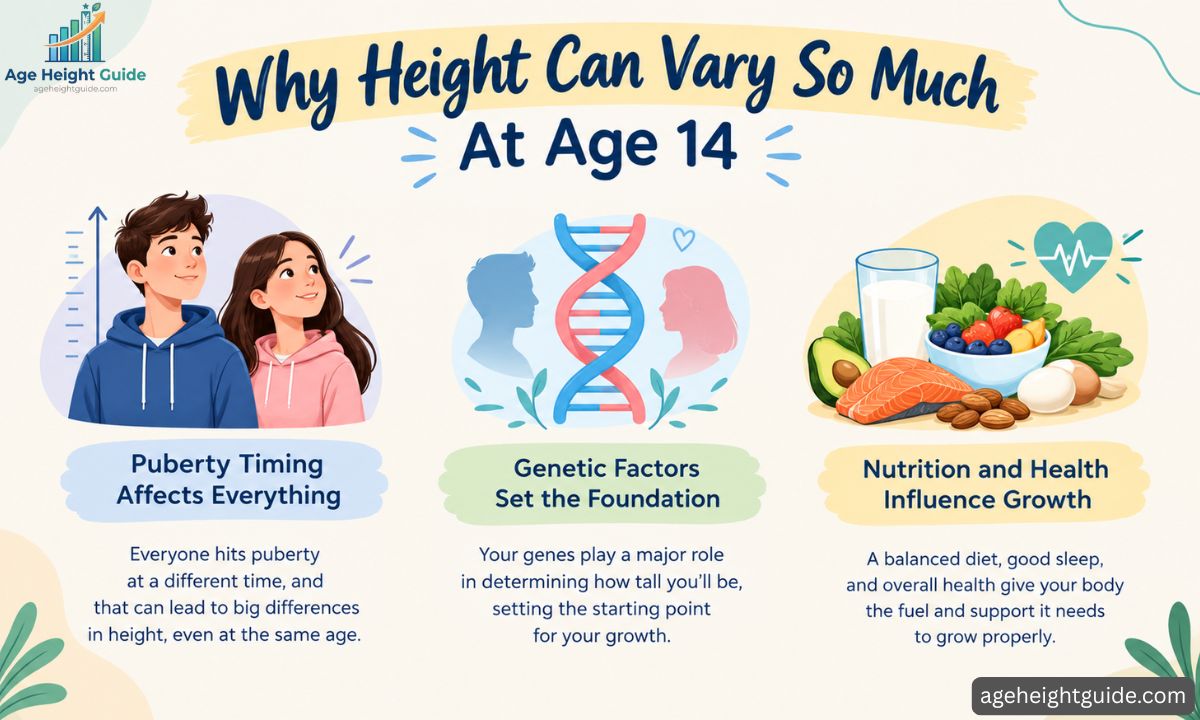
Fourteen is an important age for male growth and development. Some boys have already gone through a major growth spurt, while others are only starting to see faster changes.
That is why two boys of exactly the same age can have a large height difference.
Puberty Timing Affects Everything
Puberty timing is one of the biggest reasons height varies at age 14.
Some boys begin puberty around 11 or 12. Others start later. A boy who develops early may have already gained several inches by 14. A later developer may still have much of his teenage growth ahead.
This does not mean one boy will necessarily become taller as an adult. It means their growth schedules are different.
A late bloomer may look shorter than his friends today and then experience a faster growth spurt at 15 or 16.
Genetic Factors Set the Foundation
Genetics plays a major role in adult height. Parents pass many traits linked to growth and body size to their children.
If both parents are relatively tall, their son may have a higher expected adult height. If both parents are shorter, he may naturally fall closer to the lower part of the height range.
Genetics does not provide an exact number, though. Two children from the same family can also grow at different rates.
Nutrition and Health Influence Growth
Good nutrition gives the body the energy and nutrients it needs during adolescence.
A balanced diet should provide enough calories, protein, calcium, vitamin D, and other nutrients. Sleep and general health also matter.
Long-term health problems or poor nutrition can affect normal growth. If a teenager’s growth slows for a long period, it is worth discussing the pattern with a healthcare professional.
Understanding Growth Percentiles For 14-Year-Old Males
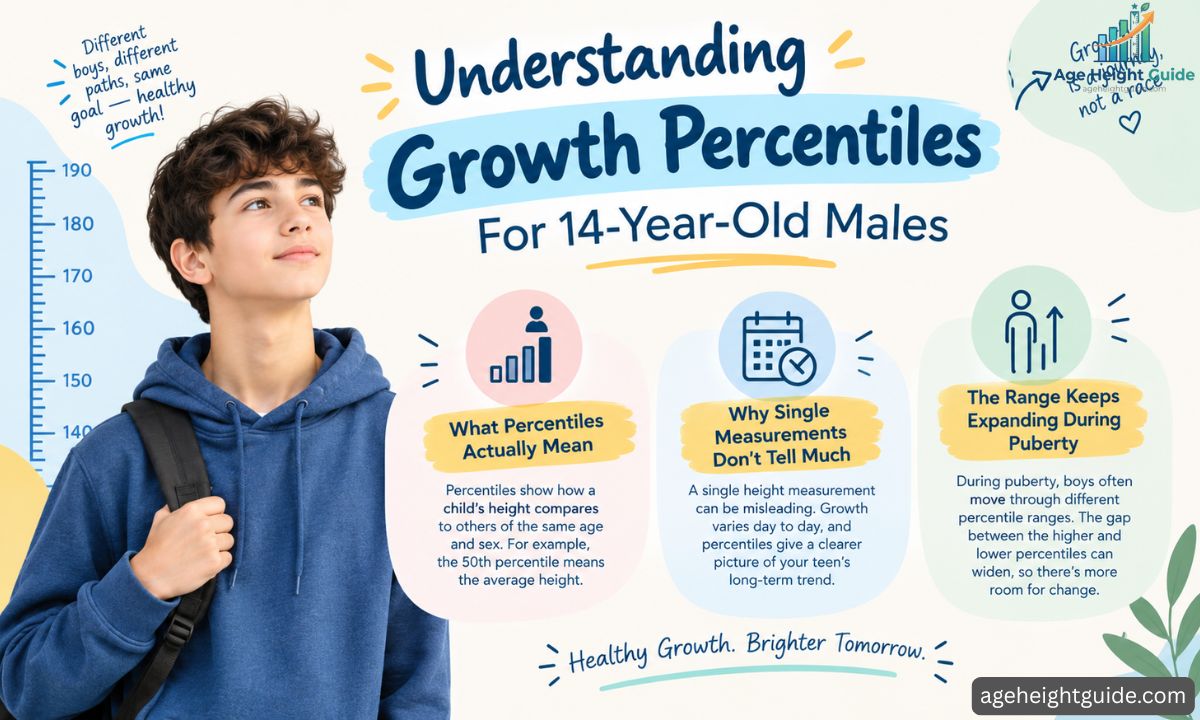
A growth percentile compares a boy’s height with the heights of other boys of the same age.
The CDC uses stature-for-age growth charts to track linear growth in children and adolescents. Its 2000 growth charts are recommended for children and adolescents age 2 and older.
For example, a boy around the 50th percentile is near the middle of the reference population. A boy at a lower percentile is shorter than many boys his age, while a boy at a higher percentile is taller than many of them.
What Percentiles Actually Mean
Percentiles can sound confusing at first.
If a boy is around the 75th percentile for height, his height is greater than that of roughly 75% of boys in the reference group.
If he is around the 25th percentile, he is taller than roughly 25% and shorter than roughly 75% of boys in that reference group.
Being at the 25th percentile does not automatically mean there is a problem. The same is true for being at the 75th percentile.
When looking at the average height for a 14-year-old boy, percentiles provide more context than a single average number.
The CDC growth charts include multiple percentile curves to help show normal variation in height.
Why Single Measurements Don’t Tell Much
One height measurement gives you a snapshot.
A series of measurements gives you a growth pattern.
For example, suppose a boy has stayed close to the 25th percentile for several years. He may simply have a naturally smaller build.
Now imagine a boy who was around the 60th percentile and then repeatedly drops toward much lower percentiles. That change may deserve closer attention.
This is why doctors look at growth over time, not just one number.
The Range Keeps Expanding During Puberty
The teenage years can create a wide range of normal heights.
One 14-year-old may have already completed much of his rapid growth. Another may still be waiting for his main puberty growth spurt.
This creates large differences between boys who are the same age.
The CDC chart provides percentile curves rather than one fixed height because children’s and teenagers’ bodies naturally differ in size and growth rate.
14-Year-Old Boy Height Percentile Chart
A simple percentile table can help parents understand the idea:
| Height Percentile | What It Generally Means |
| 3rd | Shorter than most boys in the reference group |
| 10th | Shorter than many boys |
| 25th | Below the middle |
| 50th | Around the middle |
| 75th | Above the middle |
| 90th | Taller than most boys |
| 97th | Taller than nearly all boys in the reference group |
These are percentile positions, not medical labels. The CDC notes that growth charts contribute to a broader clinical assessment and should not be used as the only diagnostic tool.
How Growth Spurts Typically Happen During The Teen Years
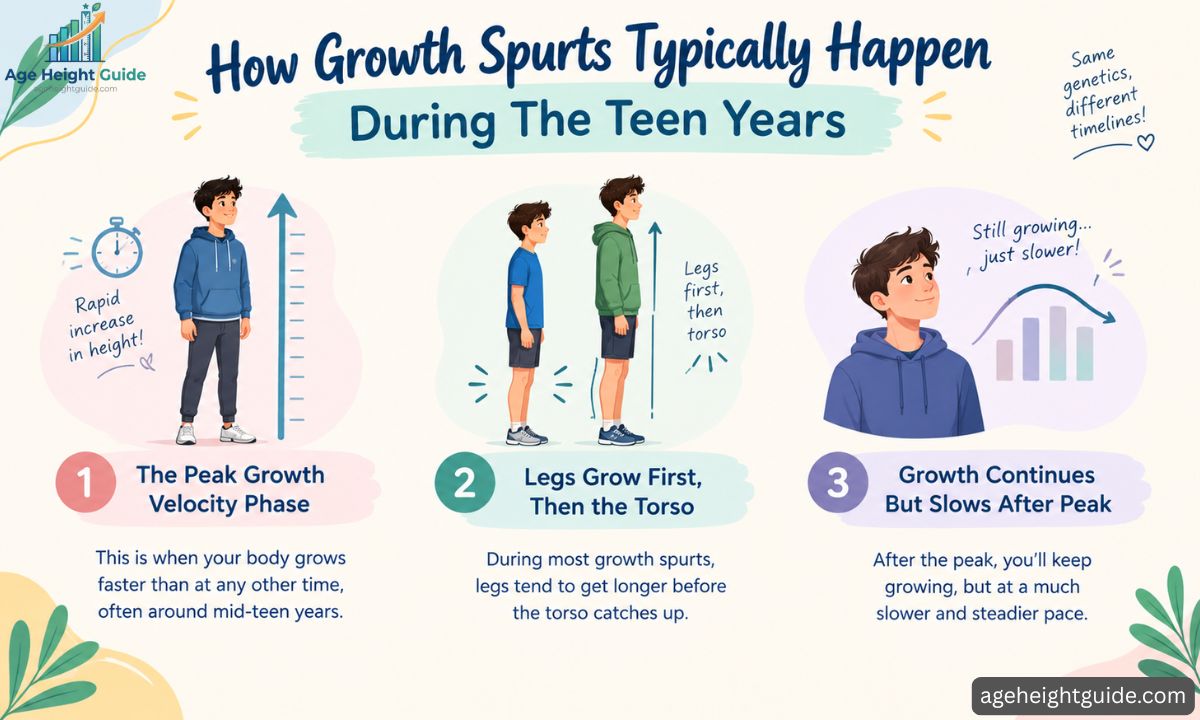
Teen boys usually do not gain height at the same speed every year.
Instead, growth velocity can speed up during puberty and then slow as a boy gets closer to his adult height.
The Peak Growth Velocity Phase
During the fastest part of puberty, some boys can gain several inches in a year.
The exact timing varies. A boy who starts puberty earlier may reach his fastest growth sooner. A later developer may reach that phase at 15 or even later.
This is why the average height for a 14-year-old boy should never be used as a prediction of where every boy will finish.
Legs Grow First, Then the Torso
Teen growth can look uneven.
The legs, feet, hands, and arms may appear to change before the torso catches up. This can give teenagers a temporarily lanky appearance.
As growth continues, the body becomes more proportionate.
This type of change is a normal part of adolescent development.
Growth Continues But Slows After Peak
After the fastest stage of the growth spurt, height gain usually slows.
Some boys reach most of their adult height during the later teen years. Others continue growing for longer.
The timing depends heavily on when puberty started and how quickly it progresses.
How Much Should A 14-Year-Old Boy Grow Each Year?
There is no single yearly number that applies to every 14-year-old boy.
A teenager in the middle of a growth spurt may gain height much faster than a boy who has already passed his peak growth period.
| Growth Stage | What May Happen |
| Before major puberty changes | Growth may be slower |
| Early puberty | Growth begins to accelerate |
| Peak growth | Height can increase rapidly |
| Later puberty | Growth gradually slows |
| Near adult height | Only small gains may remain |
The key is to look at the growth rate, puberty stage, and long-term pattern together.
How Parents Can Track Growth Accurately At Home
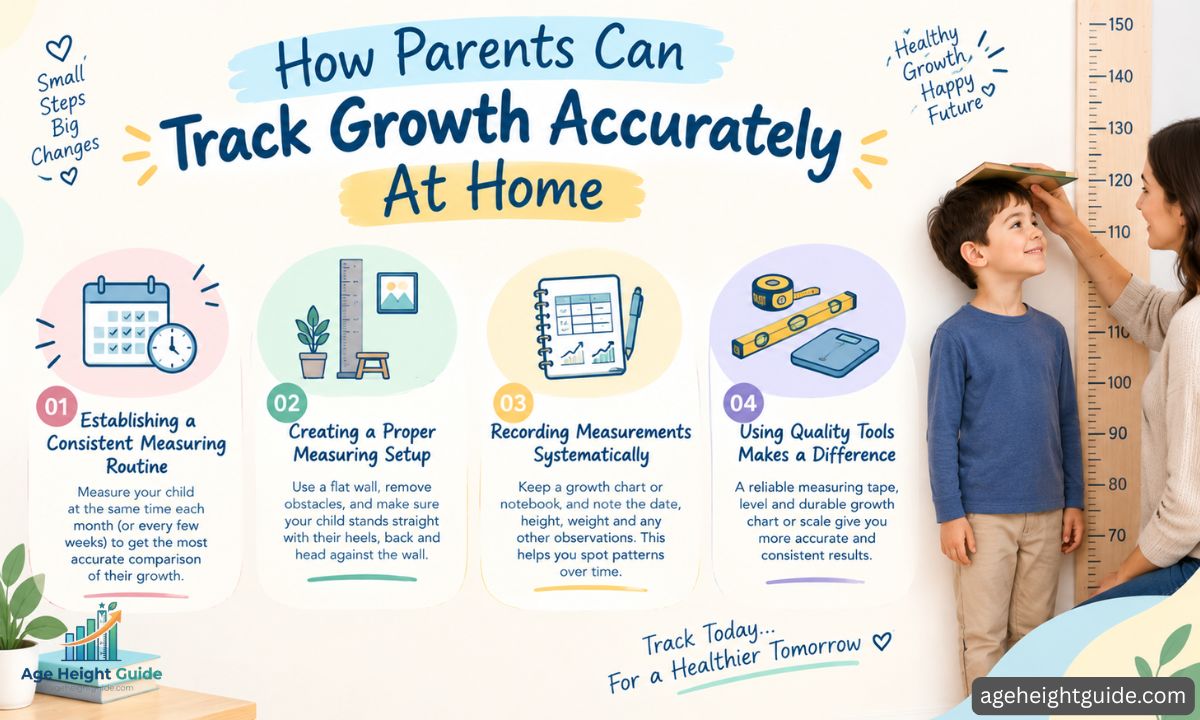
Consistent home measurements can help parents understand their child’s height growth between routine medical visits.
The goal is not to measure every day. It is to create reliable measurements that can be compared over time.
Establishing a Consistent Measuring Routine
Try to measure your teenager under similar conditions each time.
Use the same wall, the same measuring method, and a similar time of day when possible.
Height changes slightly during the day because of normal spinal compression. Consistency makes measurements easier to compare.
Creating a Proper Measuring Setup
Use a hard, level floor and a straight wall.
The teenager should stand barefoot with his body positioned naturally and his eyes looking straight ahead. A flat object can be placed level on top of the head to mark the height.
A growth chart ruler can also make long-term tracking easier.
Recording Measurements Systematically
You do not need to measure height every week.
Measuring every few months can provide a better view of the overall growth trend.
Record:
| Information | Example |
| Date | September 7, 2026 |
| Age | 14 years |
| Height | 65.5 inches |
| Height in cm | 166.4 cm |
| Notes | Recent growth spurt |
A record like this makes it easier to see how quickly your teenager is growing.
Using Quality Tools Makes a Difference
A permanent growth chart for boys can turn regular measurements into a visual record.
Instead of writing measurements on random pieces of paper, families can keep them in one place.
The tool itself does not make a child grow taller. Its value is in making height tracking simple and consistent.
When Height Differences Are Usually Nothing To Worry About
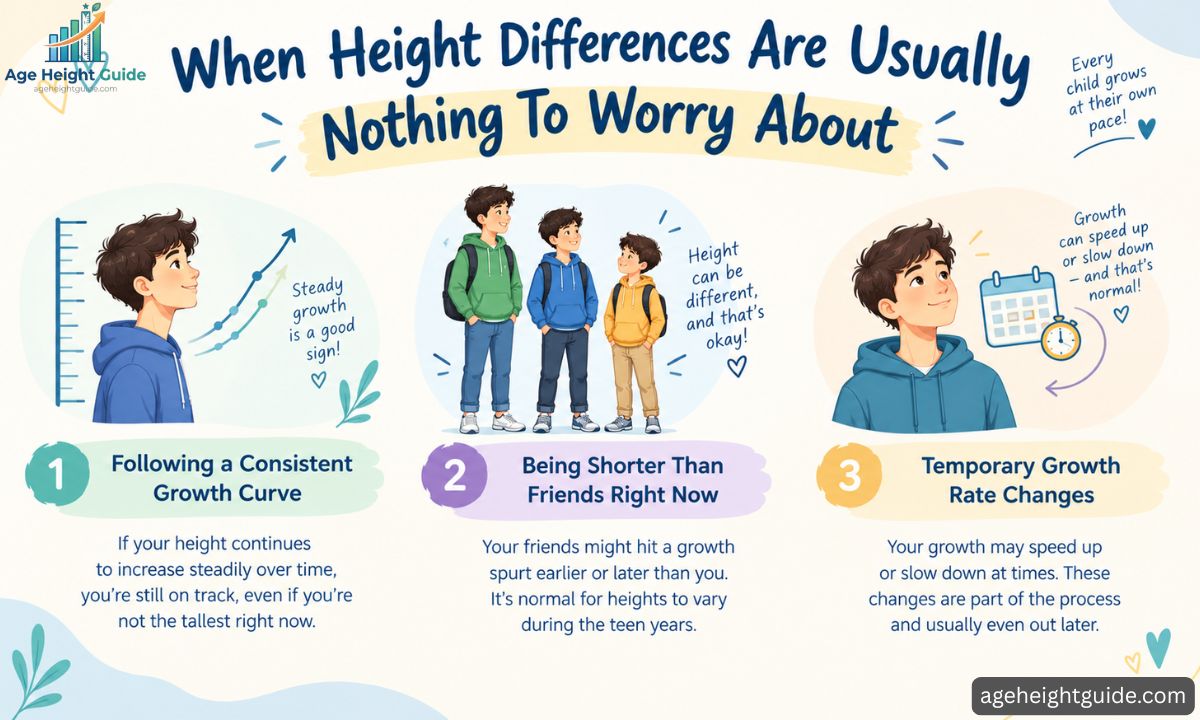
Most differences between teenagers are not automatically a sign of poor health.
A boy can be shorter than his classmates and still have a normal growth pattern.
Following a Consistent Growth Curve
Consistency is one of the most useful signs.
If your son has followed a similar percentile over several years, his height may simply reflect his individual body size.
A boy does not need to stay close to the 50th percentile to be healthy.
Being Shorter Than Friends Right Now
It is common for parents to compare their son with classmates.
But classmates may be at completely different stages of puberty.
One boy may have already had his major growth spurt. Another may not have started yet.
So being shorter than friends at 14 does not automatically mean he will remain shorter as an adult.
Temporary Growth Rate Changes
Growth does not always happen at a steady pace.
A boy may grow quickly for several months and then appear to slow down.
Short-term changes are easier to understand when you have several measurements over a longer period.
Why Consistent Measuring Matters More Than Averages
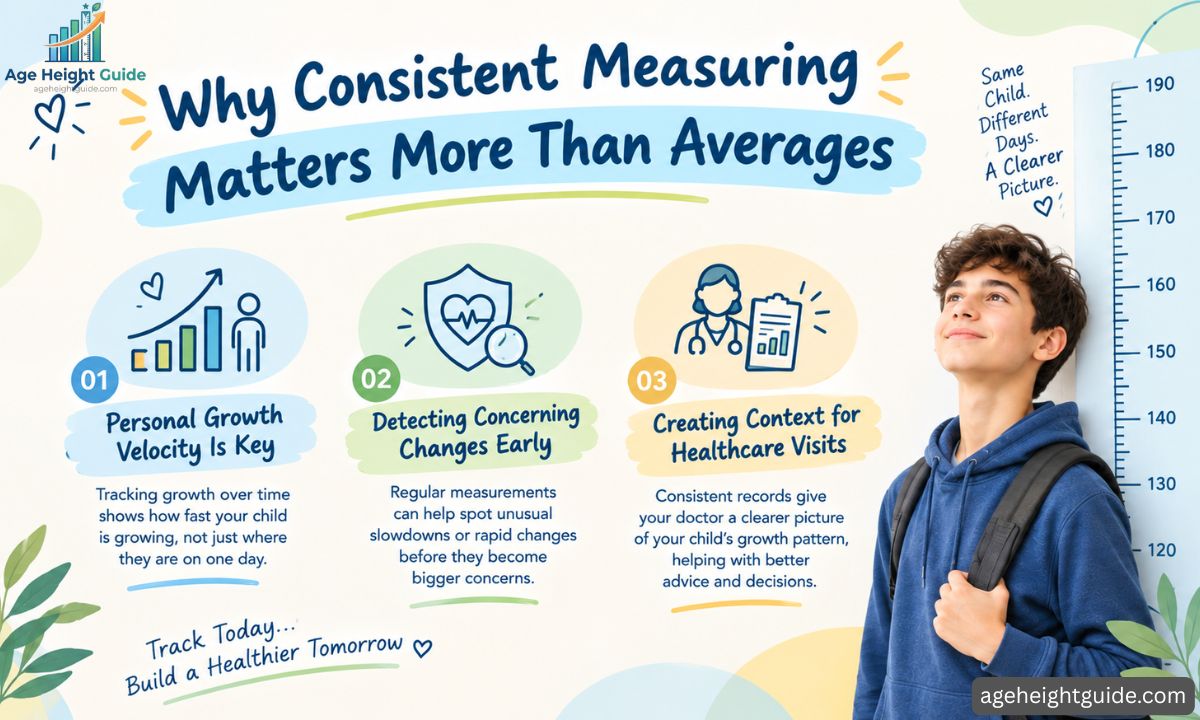
The average height for a 14-year-old boy gives useful context, but your child’s personal growth history often tells you more.
Averages describe populations. Growth tracking describes one child.
Personal Growth Velocity Is Key
Growth velocity means how quickly height changes over time.
For example, knowing that a boy is 64 inches tall is useful. Knowing that he grew from 61 inches to 64 inches over the previous year gives much more context.
That is why parents should focus on the growth rate, puberty stage, and long-term trend.
Detecting Concerning Changes Early
Regular measurements can help parents notice unusual changes.
A conversation with a healthcare professional may be appropriate if:
- growth appears to stop for a long period;
- height repeatedly moves down across major percentile lines;
- puberty seems significantly delayed;
- other health symptoms appear alongside poor growth;
- or the child’s growth pattern changes sharply.
A growth chart alone cannot diagnose a condition. CDC guidance describes growth charts as tools that contribute to an overall clinical assessment.
Creating Context for Healthcare Visits
A written record can make medical visits more useful.
Instead of saying, “I think my son stopped growing,” you can show previous measurements and dates.
That gives the healthcare provider a clearer view of the growth trend.
How Genetics Can Help Estimate Adult Height
Parents often ask whether a 14-year-old’s current height can predict his final adult height.
It can provide some clues, but it cannot give a perfect answer.
Genetic potential is strongly linked to the heights of both parents. Puberty timing also matters because boys who mature at different ages can be at very different points in their growth.
A boy who is shorter at 14 may still have several years of growth ahead.
A taller boy may already be closer to his adult height.
That is why current height should be viewed alongside the average height for a 14-year-old boy, family height, puberty stage, growth velocity, and previous measurements.
Can A 14-Year-Old Boy Still Grow Taller?
Yes.
Many 14-year-old boys are still actively growing.
Some may be in the middle of their growth spurt, while others may be approaching the end of their fastest growth phase. This is why the average height for a 14-year-old boy is only a general reference and does not show how much more a teenager may grow.
There is no single age when every boy stops growing.
The amount of remaining growth depends on puberty timing and biological maturity.
Factors That Can Support Healthy Growth

A teenager cannot change his genes, but healthy habits can support normal development.
Important areas include:
Balanced nutrition: A varied diet provides energy and nutrients needed for normal development.
Adequate sleep: Teenagers need enough sleep for overall health and development.
Physical activity: Regular activity supports strong bones, muscles, and general health.
Overall health: Treating ongoing health problems can help support normal growth.
When considering the average height for a 14-year-old boy, remember that healthy habits can support normal development but cannot determine a specific height.
These habits cannot guarantee a certain adult height. They simply help the body develop under healthy conditions.
Turning Growth Tracking Into A Meaningful Family Record
Growth tracking does not have to feel like a medical task.
For many families, a growth chart becomes a visual record of childhood. A small mark can show how much a child has changed from one birthday to the next.
A permanent boys’ growth chart can also make the process more fun.
Instead of focusing only on whether a teenager is taller or shorter than the average height for a 14-year-old boy, families can use the chart to celebrate steady progress.
Years later, those measurements can become a simple reminder of how quickly childhood passed.
Final Thoughts
Understanding the average height for a 14-year-old boy can give parents a useful starting point, but the average is only one piece of the picture.
A height of around 65–66 inches is close to the middle of the reference range, yet healthy boys can be considerably shorter or taller. CDC growth charts use percentile curves to show this wide variation in stature among children and adolescents.
The most important factor is often the child’s growth pattern.
If a boy has followed a similar percentile over time, his height may simply reflect his natural body size. If his growth rate changes sharply or puberty seems delayed, it is reasonable to discuss the pattern with a healthcare professional.
Most importantly, avoid judging a teenager’s future height from one measurement.
The teenage years are full of change. A boy who looks short at 14 may have a later growth spurt ahead, while a taller boy may already be further through puberty.
A growth chart for boys can help families record these changes, compare measurements over time, and preserve important milestones.
Frequently Asked Questions
How much should a 14-year-old boy grow each year?
There is no single growth rate that fits every 14-year-old boy. During an active growth spurt, some boys gain several inches in a year. Others may grow more slowly if they are before or after their fastest puberty growth phase.
What is the average height for a 14-year-old boy?
The average height for a 14-year-old boy is roughly 65–66 inches, or about 5’5″–5’6″ (165–168 cm). This is a general reference, not a required height.
Is 5’2″ short for a 14-year-old boy?
It is below the approximate average, but being shorter than average does not automatically mean something is wrong. Puberty timing, genetics, and personal growth pattern all affect height.
Is 5’8″ tall for a 14-year-old boy?
A height of 5’8″ is above the approximate average for a 14-year-old boy, but it can still fall within normal variation. Boys develop at different rates during puberty.
Does genetics play a role in determining a teenager’s height?
Yes. Genetics has a major influence on adult height. Parents’ heights can provide useful context, although they cannot predict an exact final height.
What factors besides genetics affect a teen’s growth?
Puberty timing, nutrition, sleep, general health, physical activity, and hormones can all influence growth. Long-term health problems can also affect normal development.
Why should parents track their child’s height at home?
Regular measurements help parents see the child’s growth trend rather than focusing on one number. They can also provide useful information to discuss during healthcare visits.
How often should I measure my 14-year-old’s height?
Measuring every few months is usually more useful than measuring every day or every week. Consistent measurements over time make the overall growth pattern easier to see.
How can I document my child’s height milestones in a meaningful way?
A permanent growth chart can provide a simple visual record. Families can mark measurements on birthdays or at other regular intervals and keep the chart as a long-term childhood keepsake.
When should I be concerned about my teenager’s growth rate?
Talk with a healthcare professional if growth appears to stop, the child repeatedly moves down across major percentiles, puberty seems significantly delayed, or other health concerns occur. Growth charts are useful tools, but they are not designed to diagnose a condition on their own.
Can a 14-year-old boy still grow after age 14?
Yes. Many boys continue growing after 14. The amount of remaining growth depends on puberty timing, growth velocity, and biological maturity.
What growth chart should I use for a 14-year-old boy?
For children and adolescents age 2 and older, the CDC recommends its 2000 Growth Charts, which include stature-for-age, weight-for-age, and BMI-for-age charts.
Is the 50th percentile the ideal height?
No. The 50th percentile is simply the middle of the reference population. Being above or below it does not automatically mean a teenager is healthier or less healthy.

Stoke is the author behind Age Height Guide, creating simple and informative content about average height, age, growth, and related measurements.