

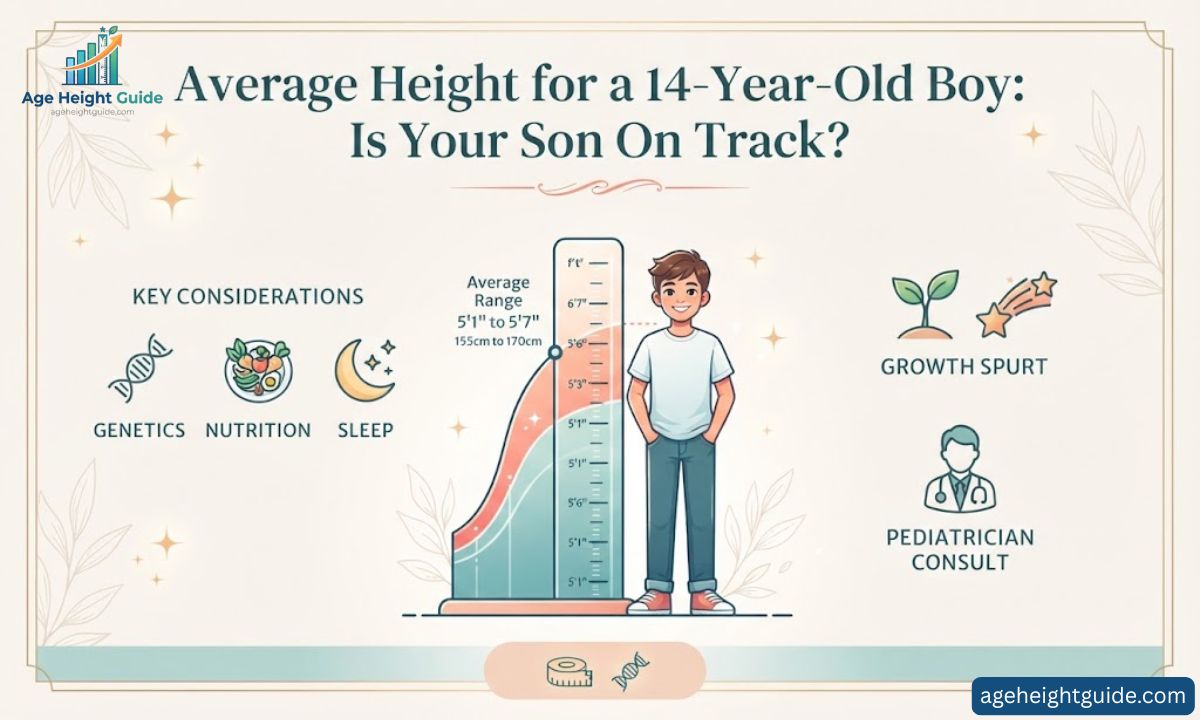
The average height for a 14-year-old boy is about 5 feet 4 inches (162 cm) at the 50th percentile on U.S. growth charts. But average does not mean every boy should be this height.
Some boys are shorter. Others are taller. Both can have healthy growth.
Puberty can also start at different ages. So, two boys who are both 14 can be at very different stages of development.
At age 14, many boys are still growing. Some may be in the middle of a fast growth spurt. Others may not have reached their fastest growth yet. Genetics, puberty, nutrition, sleep, physical activity, and overall health can all affect normal growth.
You can also read: How to Tell If Your Growth Plates Are Closed? Signs & X-Ray
Quick verdict in 60 words
The average height for a 14-year-old boy is around 5’4″ (162 cm) at the 50th percentile. Half of boys are taller, and half are shorter. A single height does not tell the full story. Doctors consider the child’s growth curve, growth rate, puberty stage, and family history. Many 14-year-old boys still have room to grow.
Average height for a 14-year-old boy by percentile
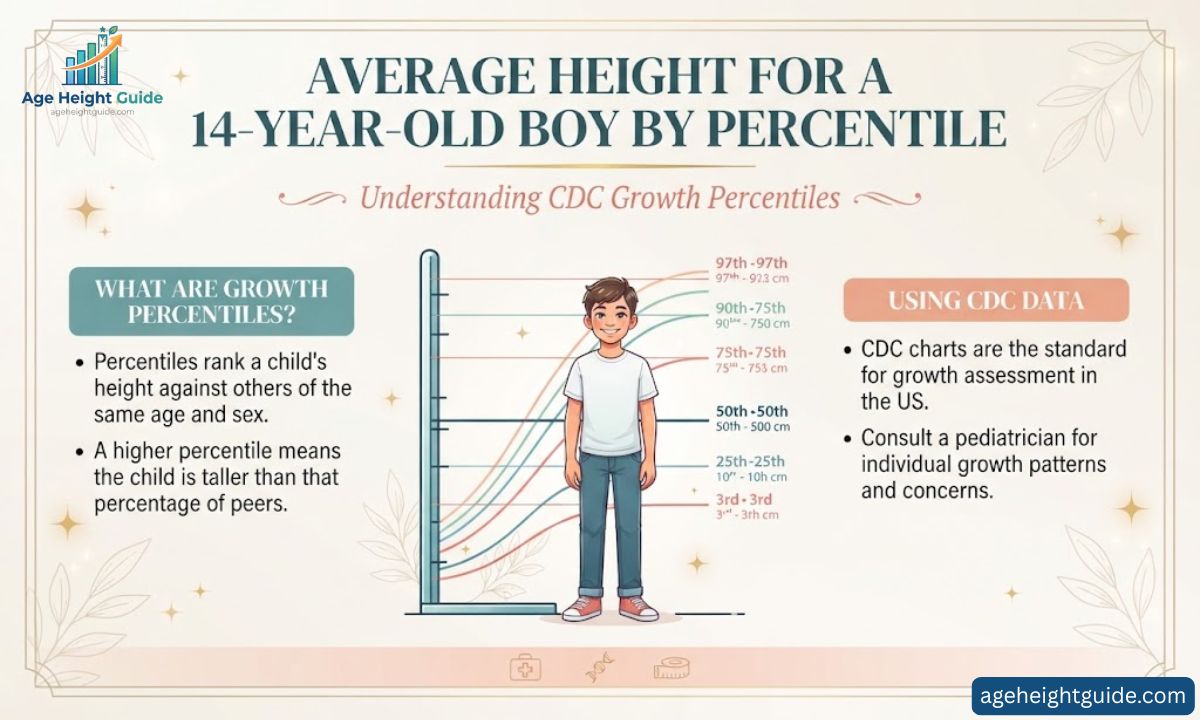
The CDC uses growth percentiles to compare a child’s height with other children of the same age and sex. The 50th percentile is the middle point of the reference population. It is often called the average, but it is not a target that every boy should reach.
Here is an approximate guide for the average height for a 14-year-old boy by percentile:
| Percentile | Approx. Height | Height (cm) |
| 3rd | About 5’0″ | 152 cm |
| 10th | About 5’2″ | 157 cm |
| 25th | About 5’3″ | 160 cm |
| 50th | About 5’4″ | 162 cm |
| 75th | About 5’6″ | 168 cm |
| 90th | About 5’8″ | 172 cm |
| 97th | About 5’10” | 178 cm |
These numbers are approximate and rounded. Exact values can vary based on age in months.
These percentiles describe the distribution of height in the reference population. They are not strict cutoffs for healthy or unhealthy growth.
For example, a boy at the 25th percentile is shorter than many boys his age. That does not automatically mean something is wrong. If he has followed a similar growth pattern for several years, that pattern may be more useful than his current percentile alone.
The same applies to taller boys. Being above the 75th percentile does not guarantee that a boy will remain tall as an adult.
The most useful question is often whether his height has followed a steady pattern over time.
Average height by age for boys 11 to 17
Boys’ average height changes during the teen years. Growth can become faster during puberty, especially when a boy reaches his main growth spurt.
A simple view of the 50th percentile looks like this:
| Age | Approx. Average Height | Approx. Height (cm) |
| 11 | 4’10” | 147 cm |
| 12 | 5’0″ | 152 cm |
| 13 | 5’2″ | 156 cm |
| 14 | 5’4″ | 162 cm |
| 15 | 5’6″ | 168 cm |
| 16 | 5’8″ | 173 cm |
| 17 | 5’9″ | 175 cm |
These figures are rounded examples from U.S. growth-chart data. Exact values vary with age in months.
Boys do not all grow at the same speed. One boy may grow several inches during a short period. Another may grow more slowly for a while.
Puberty timing is one major reason for this difference. Some boys start puberty earlier, while others develop later.
What does “average” actually mean?
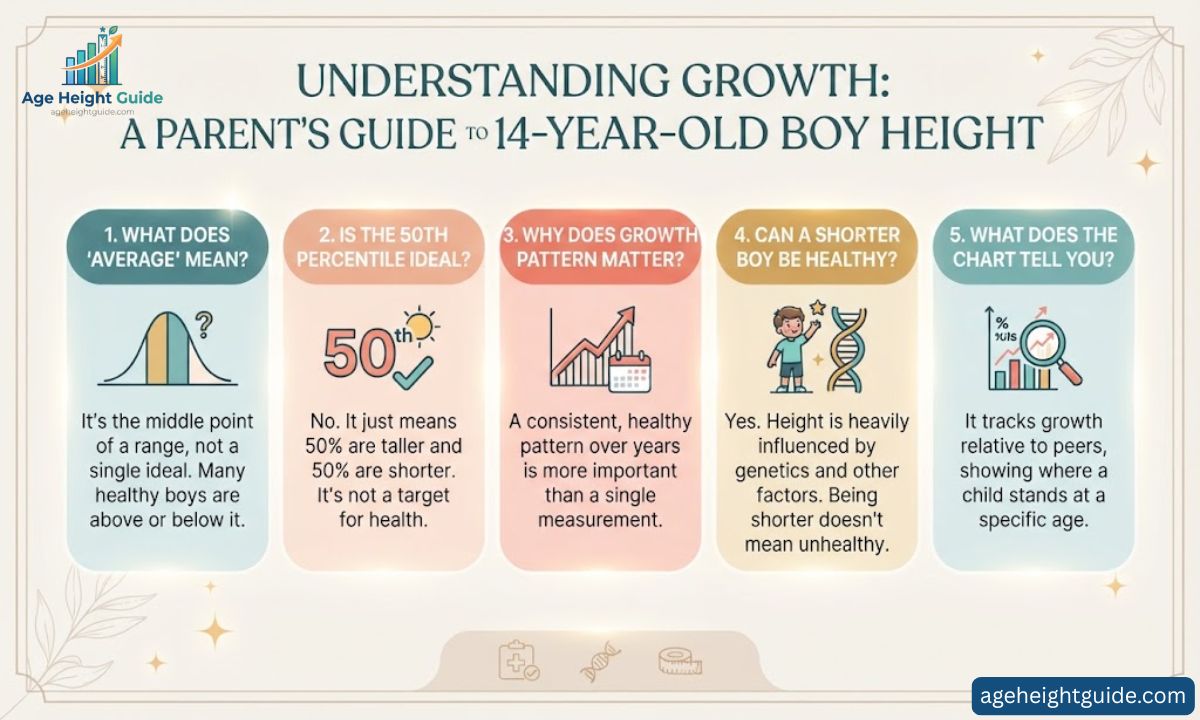
When people search for the average height for a 14-year-old boy, they often expect one exact number. In reality, there is no single height that every 14-year-old boy should reach.
The 50th percentile is often called the average. It represents the middle point of the reference population. About half of boys are taller than this point, while about half are shorter.
For example, a boy may be 5’2″ at age 14 while another boy may be 5’7″. Both can still have healthy growth. Height alone does not tell us whether a boy is developing normally.
Is the 50th percentile the ideal height?
No. The 50th percentile is not an ideal or target height.
When looking at the average height for a 14-year-old boy, it is important to understand that the average is only a reference point. A boy does not need to reach 5’4″ to have healthy growth.
Some boys naturally stay at lower percentiles. Others stay at higher percentiles. Genetics, family height, puberty timing, and overall health can all affect where a boy falls on the growth chart.
A boy who has stayed around the 25th percentile for several years may simply be following his normal growth pattern. If his height continues to increase at a steady rate, that pattern may be more meaningful than comparing him with the 50th percentile.
Why does the growth pattern matter?
Doctors usually look at more than one height measurement. They want to see how a child has grown over time.
A single measurement is only a snapshot. A growth chart can show whether a boy is following a fairly consistent pattern or moving across several percentile lines.
For example, being shorter than the average height for a 14-year-old boy is not automatically a problem. But a noticeable slowdown in growth may deserve more attention.
This is why previous height measurements can be useful during a pediatric visit. They help show the child’s growth rate and overall trend.
Can a shorter 14-year-old boy still be healthy?
Yes. A shorter boy can still be completely healthy.
Height is influenced strongly by genetics. Parents who are shorter may have children who are shorter than the population average. Puberty timing can also make a major difference during the teenage years.
Some boys enter puberty earlier and grow sooner. Others mature later and may have their main growth spurt at a later age.
So, comparing one 14-year-old boy with classmates can be misleading. Two boys can have different heights and still be developing normally.
What does the growth chart tell you?
A growth chart helps put a child’s height into context. It shows how his measurement compares with other boys of the same age and sex.
The average height for a 14-year-old boy is around the 50th percentile, but the chart includes many other percentiles. These percentiles show the wide range of heights seen in the reference population.
The CDC growth charts are useful for tracking growth, but they are not a diagnosis by themselves. A pediatrician may also consider growth speed, weight, puberty stage, family history, nutrition, and general health.
The key point is simple: average does not mean normal, and below average does not automatically mean unhealthy. For a 14-year-old boy, the growth pattern often tells a more useful story than one number.
Is your son on track?
The best way to judge whether a 14-year-old boy is growing normally is to look at his growth pattern.
If his height has stayed near the same percentile over the years, that gives useful information. Doctors also consider weight, growth speed, puberty, family height, health history, and general development.
A change in the growth curve can be more important than being short or tall. For example, moving down across several percentile lines may deserve a closer look.
Puberty is also important. Boys can enter puberty at different ages. The American Academy of Pediatrics considers puberty delayed when there are no signs of puberty by age 14.
This does not mean every shorter 14-year-old boy has delayed puberty. Some boys simply mature later. A pediatrician can review growth and development to understand what is happening.
The honest question behind the search
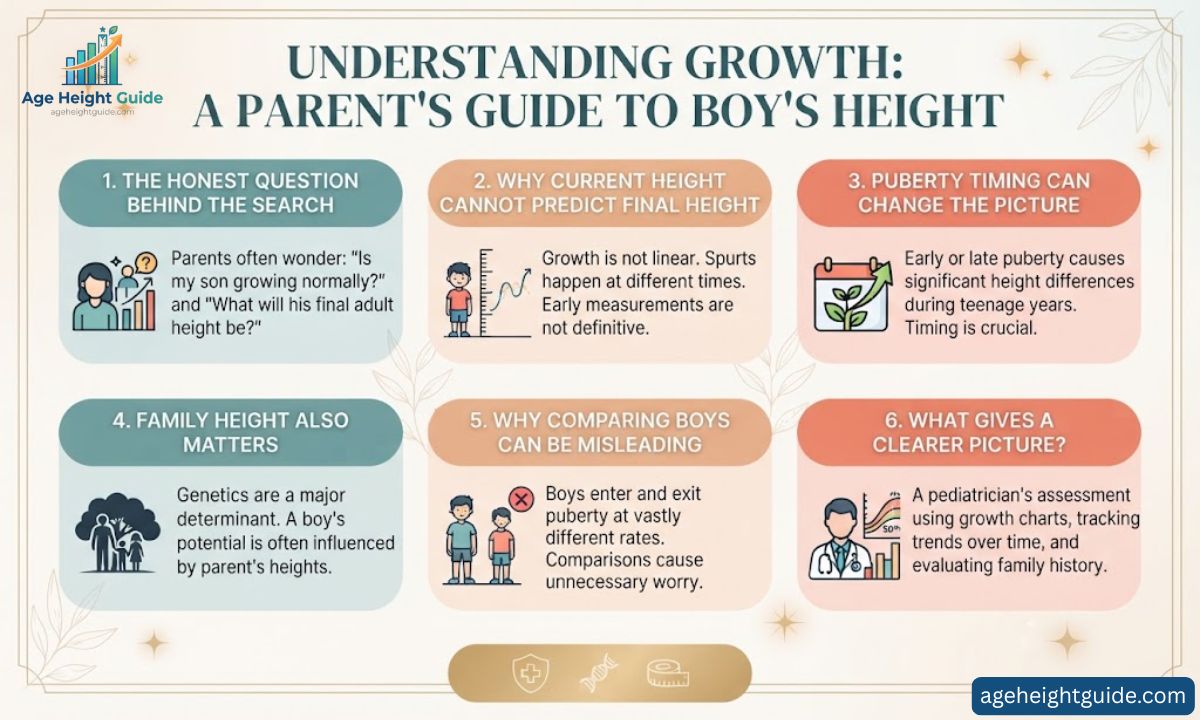
Parents who search for the average height for a 14-year-old boy are often asking a deeper question: “How much more can my son grow?”
That question is understandable. At 14, boys can look very different from one another. Some may already be tall and going through a strong growth spurt. Others may still look younger and have more puberty-related growth ahead.
The difficult part is that current height alone cannot tell you exactly how much growth remains.
Why current height cannot predict final height
A 14-year-old boy’s current height is only one part of the picture. His puberty stage, growth rate, family height, and overall health can all affect how much he may grow in the coming years.
For example, one boy may be 5’6″ at 14 because he started puberty early. Another boy may be 5’3″ because his puberty started later. The taller boy is not necessarily going to remain taller as an adult.
This is why the average height for a 14-year-old boy should be used as a reference point rather than a prediction of final adult height.
Puberty timing can change the picture
Puberty does not begin at exactly the same age for every boy.
Some boys start developing earlier. Others enter puberty later. Growth can speed up during puberty, so a boy who starts later may still have significant growth ahead.
A late-maturing boy may therefore be shorter than many classmates at 14. This does not automatically mean that he will remain short as an adult.
The important question is whether puberty is progressing normally and whether his height continues to increase over time.
Family height also matters
Genetics has a major influence on height.
A boy with shorter parents may naturally be shorter than the average height for a 14-year-old boy. A boy with taller parents may naturally be taller.
Family growth patterns can therefore provide useful context. Doctors often consider the heights of both parents when reviewing a child’s expected growth pattern.
However, family height cannot predict an exact final height. Puberty timing and individual development still matter.
Why comparing boys can be misleading
It is easy for parents to compare their son with classmates, cousins, or teammates. But two boys who are both 14 can be at very different points in puberty.
One may have already had his fastest growth period. Another may not have reached it yet.
This can make normal differences look concerning when they may simply reflect different development timelines.
Instead of asking only whether a boy is taller or shorter than his friends, it is more useful to look at his own growth pattern.
What gives a clearer picture?
A child’s previous height measurements can provide more useful information than one measurement.
If a boy has continued to grow at a steady rate and has generally followed his growth curve, that pattern can be reassuring. If his growth suddenly slows or his height drops across several percentile lines, it may be worth discussing with a pediatrician.
A doctor can also consider puberty stage, family history, nutrition, weight, general health, and other signs of development.
So, when looking at the average height for a 14-year-old boy, remember that the average is only a starting point. The more important question is whether your son is growing and developing along a pattern that makes sense for him.
What is still possible during the window
Many 14-year-old boys are still in puberty. The main growth spurt usually happens during puberty, but the timing differs from boy to boy.
A boy who enters puberty later may also have his growth spurt later. This means his current height should not automatically be treated as his final adult height.
Puberty is a process, not a single event. Height can continue to change while other signs of puberty are still developing.
How much can a 14-year-old boy grow?
There is no reliable number that applies to every 14-year-old boy.
Some boys may have a noticeable growth spurt after age 14. Others may already be closer to their adult height.
Remaining growth depends on puberty stage, genetics, health, nutrition, and skeletal maturity. The best approach is to look at the child’s growth rate and development instead of promising a specific number of inches.
Signs that a 14-year-old boy may still be growing
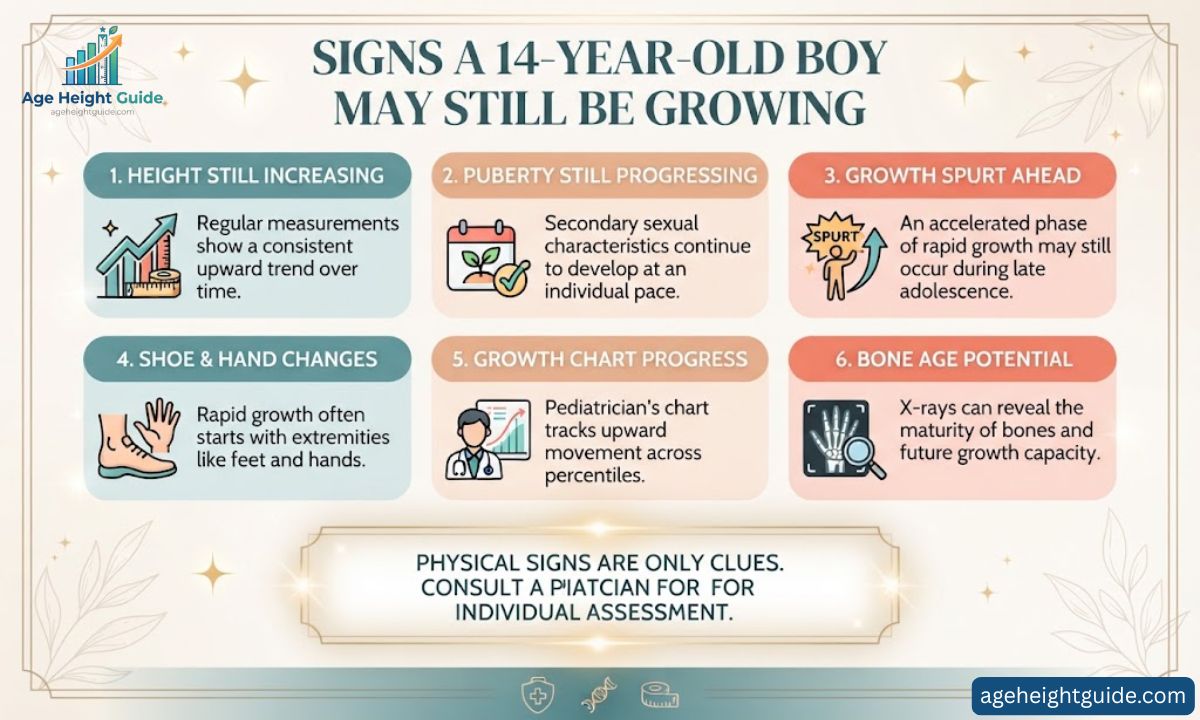
Many 14-year-old boys are still going through puberty and may have more height growth ahead. However, the signs of ongoing growth can vary from one boy to another.
If you are checking the average height for a 14-year-old boy, remember that current height does not show exactly how much growth remains. Puberty stage and growth pattern are often more useful clues.
1. His height is still increasing
One of the clearest signs is continued height gain over time.
If a boy is still getting taller when measured over several months, his body is still growing. The amount of growth can vary, so there is no fixed number of inches that every 14-year-old boy should gain.
Regular measurements can help show whether his growth is continuing.
2. His puberty is still progressing
Puberty can continue for several years.
A boy may still be developing changes such as a deeper voice, more facial or body hair, and changes in body shape. These changes can suggest that puberty is still progressing.
However, puberty signs do not tell you exactly how much taller he will become.
3. His growth spurt may still be ahead
Boys do not all reach their fastest growth at the same age.
Some boys have their main growth spurt earlier. Others may reach it later. A boy who entered puberty later may still have substantial growth ahead at 14.
This is one reason why comparing the average height for a 14-year-old boy with one individual boy can be misleading.
4. His shoe size or hands may change
Some parents notice changes in shoe size, hands, or overall body proportions during adolescence.
These changes can happen while the body is developing, but they are not reliable ways to predict final height. Shoe size, in particular, cannot tell you exactly how much a boy will grow.
They are better viewed as general signs of physical development rather than measurements of remaining height.
5. His growth chart shows continued progress
A growth chart can provide a clearer picture than physical signs alone.
If a boy continues to gain height and generally follows his previous growth pattern, that can suggest ongoing normal growth. A sudden slowdown or major change in his growth curve may need closer attention.
Doctors look at several measurements over time rather than relying on one height.
6. His bone age may show more growth potential
In some cases, a pediatrician may recommend a bone age X-ray.
Bone age helps estimate how mature the bones are. It can provide additional information when a child’s growth pattern or puberty timing is unusual.
A younger bone age may suggest that more skeletal growth remains. However, it cannot guarantee a specific final height.
Physical signs are only clues
It is important not to use one physical sign to predict how tall a boy will become.
Voice changes, facial hair, shoe size, body changes, and current height can all vary during puberty. None of these signs can accurately tell you the exact amount of remaining growth.
If you are concerned about your son’s growth, a pediatrician can review his previous height measurements, growth curve, puberty stage, family history, and overall health.
The average height for a 14-year-old boy is useful as a reference, but your son’s individual growth pattern is much more important than whether he is exactly at the average.
What does not work?
There are many online claims about getting taller during the teenage years.
Stretching, hanging, or special exercises cannot permanently lengthen the long bones after growth is complete. Exercise is still valuable for fitness and bone health, but it should not be presented as a way to add guaranteed inches.
The same applies to products that promise rapid height gains. There is no simple pill, drink, or routine that can guarantee a taller adult height in a healthy teenager.
Growth hormone is different. It is a medical treatment for certain diagnosed conditions. It is not a general height booster for every healthy teenager.
The safer approach is to support normal growth rather than chase a guaranteed height number.
What can nutrition actually do?

Nutrition matters because the body needs enough energy and nutrients for normal growth and bone development.
A balanced diet cannot change a child’s genetic height potential. But poor nutrition can interfere with normal development.
Good nutrition helps the body get the nutrients it needs during the growth years.
Calcium is especially important for growing bones. Teens ages 14 to 18 need 1,300 mg of calcium per day according to NIH guidance.
Vitamin D also supports bone health and helps the body absorb calcium.
A varied diet can provide important nutrients such as protein, calcium, vitamin D, zinc, iron, magnesium, and other vitamins and minerals.
| Nutrient | Why It Matters | Common Food Sources |
| Calcium | Supports bones and teeth | Milk, yogurt, cheese, fortified foods |
| Vitamin D | Supports bone health and calcium absorption | Fortified milk, fatty fish, eggs |
| Protein | Supports muscles and body tissues | Eggs, meat, fish, beans, dairy |
| Zinc | Supports normal growth and development | Meat, beans, dairy, nuts |
| Iron | Supports blood and normal development | Meat, beans, lentils, fortified foods |
| Magnesium | Supports muscles, nerves, and bones | Nuts, seeds, whole grains |
The goal is to correct or prevent nutrient gaps. It is not to push a healthy teenager above his natural height potential.
Food should come first when possible. Supplements may be useful when a child has a diagnosed deficiency or cannot meet nutritional needs through diet. Parents should discuss regular supplement use with a healthcare professional.
Why sleep matters during teenage growth
Sleep is an important part of healthy development.
Teenagers need enough sleep for normal physical and mental health. Poor sleep can affect energy, mood, learning, and daily function.
Sleep should not be treated as a magic height treatment. It is one part of a healthy routine that supports normal development during puberty.
A growing 14-year-old boy should have a regular sleep schedule, a balanced diet, and enough daily activity.
Does exercise affect height?
Regular physical activity is good for growing children and teenagers.
Running, walking, sports, and age-appropriate strength exercises can support fitness and bone health. Exercise also helps maintain a healthy body composition.
However, exercise does not override genetics. It also does not make the long bones grow beyond their natural potential.
The goal should be healthy movement, not a promise of extra inches.
Genetics and expected adult height
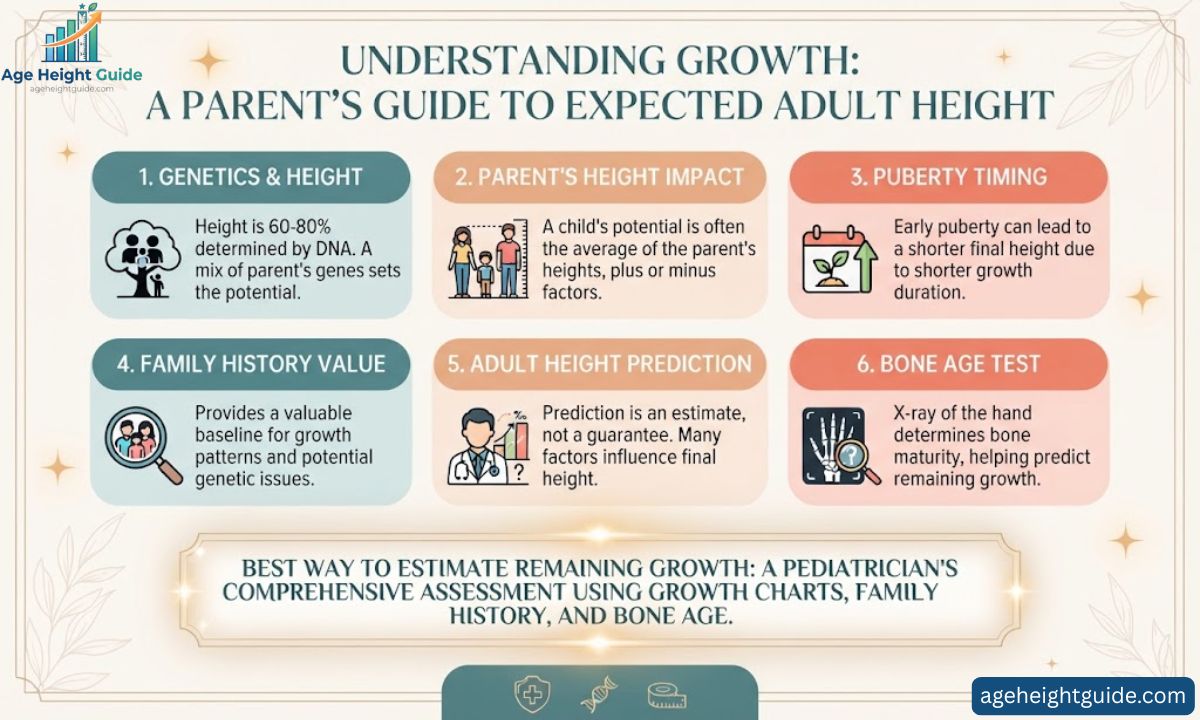
Genetics has a major role in determining adult height. This is why children in the same family often have similar height patterns, although every child is still different.
When parents are shorter or taller than average, their child may also grow within a similar family range. However, family height is only one part of the picture. Puberty timing, nutrition, health, and other factors can also affect growth.
This is important when looking at the average height for a 14-year-old boy. A boy who is shorter than the average may simply have a shorter family growth pattern. Another boy who is taller than average may come from a taller family.
How do parents’ heights affect a child’s height?
Parents’ heights can give doctors a rough idea of a child’s expected adult height. This is sometimes called the mid-parental height estimate.
For boys, a common clinical estimate uses the mother’s height and father’s height together. It provides a general range rather than an exact prediction.
This estimate should not be treated as a promise. A child’s final height can be higher or lower than the estimate.
Does puberty timing affect adult height?
Yes, puberty timing can change how a boy’s growth looks during the teenage years.
A boy who enters puberty early may be taller than many classmates at 14 because his growth spurt started sooner. A late-maturing boy may be shorter at the same age but continue growing later.
This means the average height for a 14-year-old boy cannot tell you how tall every boy will become. Two boys can have very different heights at 14 and still reach healthy adult heights.
Why family history is useful
Family history can help explain a child’s growth pattern.
If parents and close relatives tend to be shorter, a shorter child may simply be following a family pattern. If many family members are tall, a taller growth pattern may also be expected.
A pediatrician can combine this information with previous height measurements and puberty development. This gives a more complete picture than comparing a child with the population average.
Can you predict adult height?
There is no home method that can predict adult height with perfect accuracy.
Doctors can consider several factors when estimating future growth. These may include current height, growth rate, parents’ heights, puberty stage, and overall health.
A bone age test can sometimes provide additional information. It uses an X-ray, usually of the hand and wrist, to estimate how mature the bones are.
How does a bone age test help?
Bone age is different from chronological age. A 14-year-old boy may have a bone age that is somewhat younger or older than 14.
If bone development appears less mature, there may be more time available for growth. If the bones are more mature, less growth may remain.
However, bone age is still an estimate. It cannot tell a parent the exact adult height a boy will reach.
What is the best way to estimate remaining growth?
The best assessment comes from looking at several pieces of information together.
A pediatrician can review the child’s growth chart, previous height measurements, growth rate, family heights, puberty stage, and general health. When appropriate, a bone age assessment may add more information.
So, when considering the average height for a 14-year-old boy, it is better to focus on the child’s individual growth pattern rather than using the average as a prediction of adult height.
Why growth curve matters more than one number
A single height measurement is only a snapshot.
Imagine one boy is 5’2″ at age 14 and has always tracked near the same percentile. Another boy is 5’5″ but has recently dropped from a much higher percentile.
The first boy may simply be following his usual growth pattern. The second boy may need a closer look.
That is why pediatricians use growth charts. The trend gives more information than one measurement.
CDC growth charts help track growth over time. They are not a standalone diagnosis.
When should you talk to a pediatrician?
Talk with a pediatrician if your son’s growth pattern changes noticeably.
It is also worth discussing growth if his height is very low compared with the reference chart, his growth has slowed, or his height and weight patterns do not seem to match.
Another important point is puberty. If a boy has no signs of puberty by age 14, he should be evaluated by a healthcare professional.
A doctor may review previous measurements, family history, nutrition, general health, and puberty. If needed, further tests such as a bone age X-ray may be considered.
What is bone age and why does it matter?
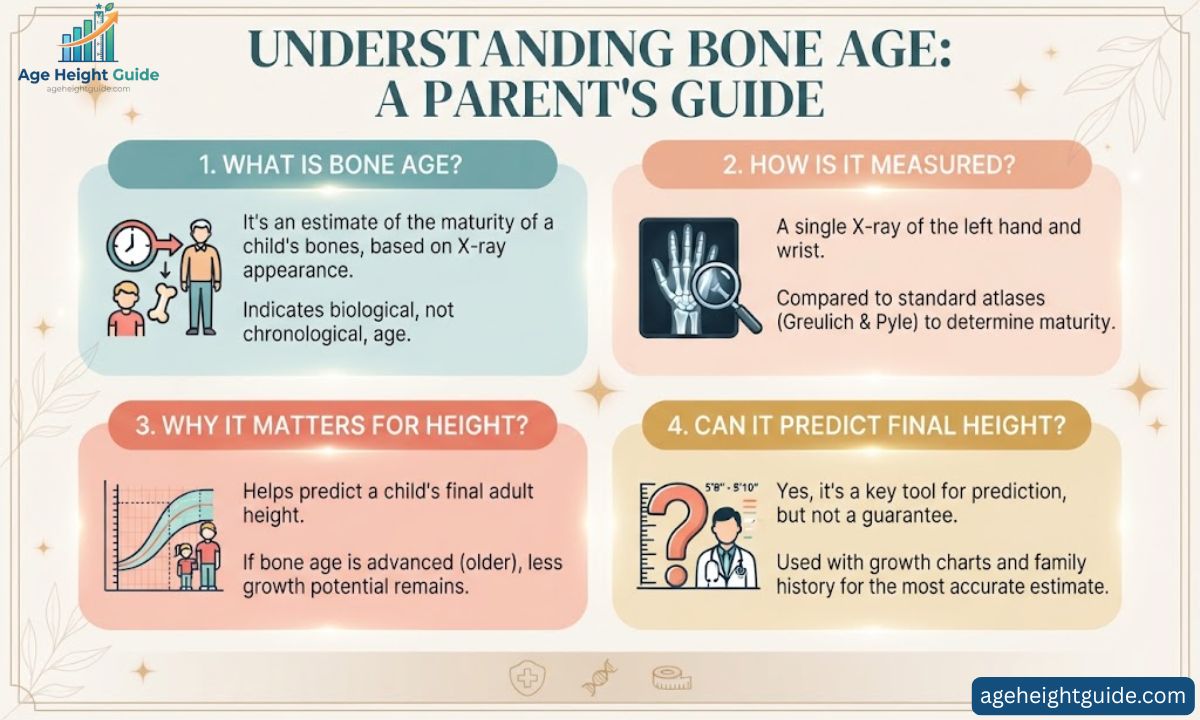
Bone age is an estimate of how mature a child’s bones are. It is different from chronological age. A 14-year-old boy may have bones that look younger or older than his actual age on an X-ray.
How is bone age measured?
Doctors usually estimate bone age with an X-ray of the hand and wrist. They compare the images with standard references for bone development. This helps show how mature the bones are and whether growth may still be continuing.
Why does bone age matter for height?
Bone age can give doctors more information about a child’s growth potential. For example, a 14-year-old boy with a younger bone age may have more time left to grow than his chronological age alone suggests.
This can be especially useful when a doctor is checking delayed puberty, unusual growth patterns, or a large difference between a child’s height and family pattern.
Can bone age predict final height?
Bone age can provide useful clues, but it cannot guarantee a specific adult height. Growth also depends on puberty timing, genetics, health, nutrition, and other factors.
So, a younger bone age may suggest that more growth time remains. It does not mean a child will reach a certain height.
For parents asking about the average height for a 14-year-old boy, bone age can provide more context than one height measurement alone. A doctor can look at bone age along with the child’s growth chart, puberty stage, and family history.
Growth plates and the end of height growth
Growth plates are areas of developing tissue near the ends of long bones. During childhood and puberty, they allow bones to lengthen.
As puberty progresses, growth plates gradually mature and eventually close. Once they are fully closed, the long bones no longer lengthen in the same way.
The timing is not identical for every teenager. Puberty timing varies, so a fixed age should not be used to predict the exact point when a specific boy stops growing.
Average height for a 14-year-old boy vs. normal height
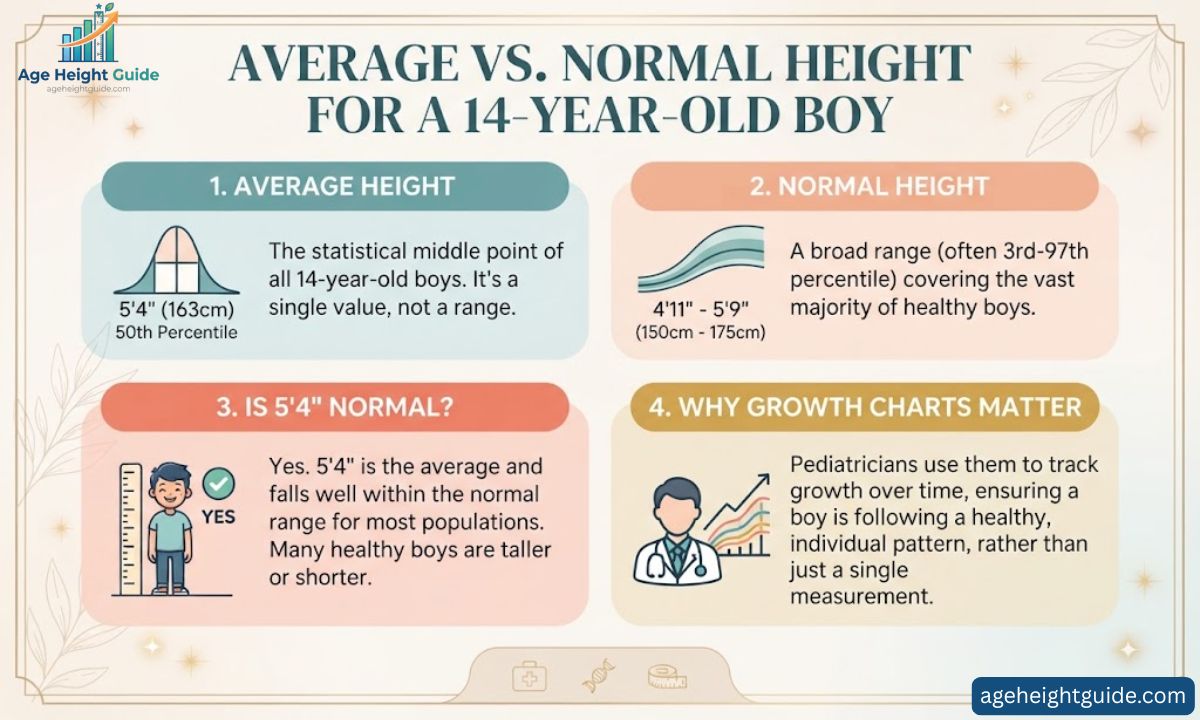
The average height for a 14-year-old boy is one point on a growth chart. It does not define the height every 14-year-old boy should have.
A boy can be shorter or taller than 5’4″ (162 cm) and still be growing normally. Boys enter puberty at different ages. Some grow earlier, while others have their main growth spurt later.
Is 5’4″ a normal height for a 14-year-old boy?
Yes, 5’4″ is around the middle of the height distribution for boys this age. But being below or above this number does not automatically mean there is a problem.
For example, a 14-year-old boy who is 5’1″ may still be healthy. Another boy may already be 5’8″. Both can have normal development if their growth pattern and puberty are progressing as expected.
What is the difference between average and normal height?
Average height is a statistical midpoint. It describes where the 50th percentile falls on a growth chart.
Normal growth is broader. Doctors look at a child’s height percentile, growth rate, puberty stage, family height pattern, and overall health. They do not use one height measurement alone to decide whether a child is growing normally.
Why growth charts matter
The CDC growth charts show height across different percentiles. These curves help doctors track how a child grows over time.
A single measurement can be useful, but the growth pattern often tells a clearer story. If a boy continues to gain height along a similar growth curve, that can be reassuring even if he is not close to the average.
So, when looking at the average height for a 14-year-old boy, use the number as a reference rather than a goal. A growth chart is most useful when it is viewed over time and alongside puberty, family history, and overall health.
What is a healthy height for a 14-year-old boy?
There is no single height that makes a 14-year-old boy healthy.
A healthy growth pattern can occur at many different heights. A boy who is shorter than the average may still be completely healthy if he is growing steadily and developing normally.
Likewise, being tall does not automatically mean that a boy is healthier.
The better question is whether his height, weight, growth rate, puberty, and overall development fit his individual pattern.
The bottom line on average height for a 14-year-old boy
The average height for a 14-year-old boy is around 5’4″ (162 cm) at the 50th percentile on U.S. growth charts.
But this number should not become a target.
Some boys are shorter. Some are taller. Puberty can change the timing of the growth spurt, and genetics has a major influence on the final result.
For parents, the most useful step is to track height over time. If the growth curve is steady and puberty is progressing normally, one number on the measuring tape usually tells only a small part of the story.
Don’t miss the growth window.
The teenage years are an important period of physical development.
A 14-year-old boy may still be going through puberty and his main growth spurt. The exact amount of remaining growth cannot be known from age alone.
Instead of focusing only on getting taller, focus on the basics that support healthy development. These include balanced nutrition, enough sleep, regular physical activity, and routine medical care.
If growth seems unusually slow or puberty has not started by age 14, a pediatrician can provide a more personal assessment.
Frequently Asked Questions
What is the average height for a 14-year-old boy?
The average height for a 14-year-old boy is about 5’4″ (162 cm) at the 50th percentile on U.S. CDC growth charts. This is a reference point, not a required height. Boys can be shorter or taller and still have healthy growth.
Is a 14-year-old boy still growing?
Yes, many 14-year-old boys are still growing. Boys enter puberty at different times, so some are earlier in their growth spurt while others are later. A boy’s age alone cannot show how much growth remains.
What is a normal height for a 14-year-old boy?
There is no single normal height. CDC growth charts show a wide distribution of heights across percentiles. A child’s own growth pattern is often more useful than comparing him with one average number.
When do boys grow the fastest?
Boys usually have their fastest growth during puberty. The exact timing varies because puberty does not start at the same age for every boy. Some boys have their growth spurt earlier, while others may grow later.
How much can a 14-year-old boy grow?
There is no fixed number of inches that applies to every boy. Remaining growth depends on puberty stage, genetics, health, nutrition, and skeletal maturity. A pediatrician can look at the growth curve and, when needed, use bone age to better understand growth potential.
Does nutrition affect a boy’s height?
Nutrition supports normal growth and bone development. It cannot guarantee extra height beyond a child’s natural potential. Calcium, vitamin D, protein, and other nutrients are important parts of a balanced diet. Teens ages 14 to 18 need 1,300 mg of calcium per day according to NIH guidance.
When should I worry about my 14-year-old boy’s height?
Consider talking with a pediatrician if your son’s growth has slowed, his growth curve has changed noticeably, or you have concerns about his overall development. A boy with no signs of puberty by age 14 should also be evaluated.
What is a healthy height for a 14-year-old boy?
A healthy height can vary widely. There is no single number that defines healthy growth. Doctors look at the child’s growth pattern, puberty, family history, weight, and overall health rather than judging health from height alone.
Medical disclaimer: This article is for general information only. Growth and puberty vary from child to child. If you are concerned about your son’s height, growth rate, or puberty, speak with a pediatrician.

Stoke is the author behind Age Height Guide, creating simple and informative content about average height, age, growth, and related measurements.