


If you are checking the average height for a 16-year-old boy, the CDC growth chart’s midpoint is about 5 feet 8 inches (173 cm). But the average is only one number. It does not tell you how tall every 16-year-old boy should be.
Teen boys can be shorter or taller than the average and still have a healthy growth pattern. Doctors look at height percentile, family height, puberty timing, and growth over time. A boy who is 5 feet 5 inches may be growing normally. A boy who is 5 feet 11 inches may also be growing normally.
At 16, many boys are close to their adult height. Still, some boys continue growing because puberty starts and ends at different times. Boys who enter puberty later may have more growth left in their late teens.
This guide explains the average height for a 16-year-old boy, broad height ranges, 16-year-old boy growth, growth plates, puberty, genetics, nutrition, sleep, and what parents can realistically expect.
You can also read: Average Height for a 14-Year-Old Boy: Is Your Son On Track?
How tall is the average 16-year-old boy?
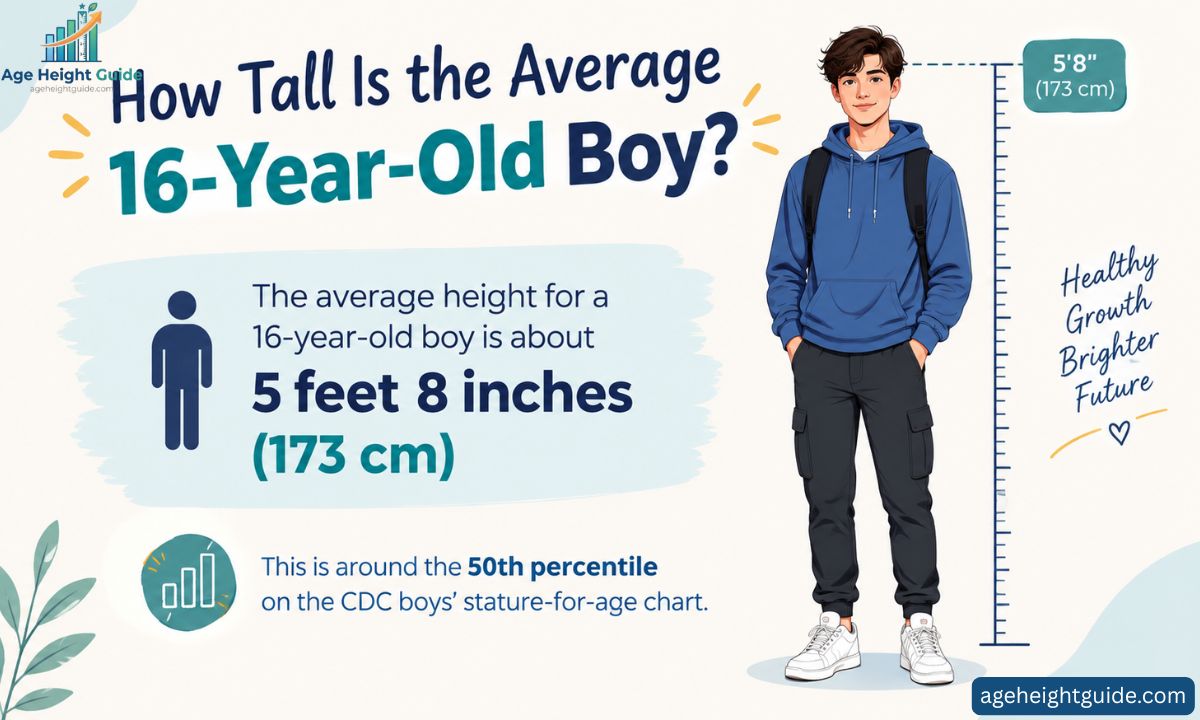
The average height for a 16-year-old boy is about 5 feet 8 inches (173 cm) around the 50th percentile on the CDC boys’ stature-for-age chart.
The 50th percentile is the middle point. About half of boys are taller than this point, while about half are shorter.
That does not make 5 feet 8 inches the ideal height for a 16-year-old boy. There is no single height that every teen should reach.
The CDC growth charts use percentiles to show how a child’s height compares with other children of the same age and sex. Doctors use these charts to look at the pattern of growth, not just one measurement.
A boy may stay near the 10th percentile for years and remain healthy. Another may stay near the 90th percentile. Both patterns can be healthy when growth is steady and development is progressing as expected.
So, when looking at the average height for a 16-year-old boy, think of 5 feet 8 inches as a reference point rather than a target.
Average height for a 16-year-old boy in feet and centimeters
| Measurement | Approximate height |
| Average height | 5 ft 8 in |
| Average height in centimeters | 173 cm |
| 50th percentile | About 173 cm |
| 5th percentile | About 160 cm |
| 95th percentile | About 184 cm |
These figures are rounded for easy reading. The CDC provides stature-for-age data by age and percentile. Exact values can vary slightly depending on the child’s precise age in months.
What is the normal height range for a 16-year-old boy?
There is no single normal height for a 16-year-old boy. A useful way to understand height is through percentiles.
For a general reference, a 16-year-old boy may fall around the following points on the CDC stature-for-age chart:
| Age | 5th percentile | 50th percentile | 95th percentile |
| 14 years | ~5 ft 0 in (153 cm) | ~5 ft 4 in (164 cm) | ~5 ft 9 in (176 cm) |
| 15 years | ~5 ft 3 in (160 cm) | ~5 ft 7 in (170 cm) | ~5 ft 11 in (181 cm) |
| 16 years | ~5 ft 3 in (160 cm) | ~5 ft 8 in (173 cm) | ~6 ft 0 in (184 cm) |
| 17 years | ~5 ft 4 in (163 cm) | ~5 ft 9 in (175 cm) | ~6 ft 1 in (185 cm) |
| 18 years | ~5 ft 4 in (164 cm) | ~5 ft 9 in (176 cm) | ~6 ft 1 in (186 cm) |
The 5th to 95th percentile points are best viewed as a broad reference range, not a strict definition of normal height. A boy outside these points is not automatically unhealthy.
This table also shows why the average height for a 16-year-old boy should not be treated as a pass-or-fail number.
The more useful question is:
Is he following his own growth curve?
Doctors look at changes over time. A single height measurement gives less information than several measurements taken during regular checkups.
Is a 16-year-old boy still growing?
Yes, some 16-year-old boys are still growing. Others are close to their final height.
The difference usually comes down to puberty timing, genetics, and individual development.
Boys tend to have their fastest growth spurt during puberty. Nemours notes that boys generally grow most quickly during the teen years, although the timing varies from person to person.
A boy who started puberty early may be close to his adult height at 16. A boy who started puberty later may still have noticeable growth ahead.
That is why comparing two 16-year-old boys can be misleading.
One may have already completed most of his teen growth. Another may still be moving through his main growth period.
How much can a 16-year-old boy grow?
There is no reliable number that applies to every 16-year-old boy.
Some teens may gain very little height after 16. Others may gain several centimeters.
The remaining growth depends largely on where the teen is in puberty and whether his growth plates are still open.
Boys who enter puberty later may continue growing later than their peers. So, the average height for a 16-year-old boy can tell you where the population midpoint sits. It cannot tell you exactly how much height one specific boy has left.
When do boys stop growing?

Most boys stop gaining significant height toward the end of puberty. However, there is no exact birthday when every boy stops growing.
Growth plates usually close near the end of puberty. The timing varies between individuals.
A boy who enters puberty later may continue growing after another boy the same age has stopped.
Once a growth plate has completely closed, that bone can no longer lengthen through that growth plate. This is why growth plate closure is more useful than age alone when thinking about remaining height.
Do boys grow after 16?
Some do. Many have already slowed down considerably by this age.
By the later teen years, many boys have completed most of their pubertal height growth. However, individual timing can differ.
A late developer can therefore have a different growth timeline. If a 16-year-old has only recently entered puberty, his growth timeline may not match that of a boy who started several years earlier.
What are the signs a 16-year-old boy may still be growing?

When looking at the average height for a 16-year-old boy, it is important to remember that age alone cannot tell you whether a teen has finished growing. Some boys are already close to their adult height, while others may still have more height to gain.
Physical changes can offer clues about where a boy is in puberty. However, these signs cannot show exactly how many inches or centimeters he may grow. The most useful information usually comes from his growth pattern, previous height measurements, and stage of puberty.
A 16-year-old boy may still be growing if he has some of these changes:
- Height is still increasing: If his height has increased during the past several months, he may still have active growth. Tracking height over time is more useful than comparing him with the average height for a 16-year-old boy.
- Puberty is still progressing: Boys who are still moving through puberty may have more growth remaining. Puberty timing varies, so two boys who are both 16 can be at different stages of development.
- Voice is still changing: Voice deepening is one of the changes that can occur during puberty. It may indicate that puberty is still progressing, but it cannot predict final height.
- Facial and body hair is developing: New facial or body hair can occur as puberty progresses. This is another clue about development, but it does not provide an exact estimate of remaining height.
- Body shape is changing: Boys may develop broader shoulders and increased muscle mass during puberty. These changes can happen while the body is still maturing.
- Muscle development is increasing: Continued changes in muscle size and strength can occur during the later stages of puberty. This does not mean that more height is guaranteed.
- Growth spurts are still occurring: A teen who has recently experienced a noticeable increase in height may still have some growth remaining. The timing of growth spurts differs from one boy to another.
- Puberty started later: A boy who entered puberty later than his peers may also reach his growth spurt later. This can mean that his growth timeline is different from the typical 16-year-old boy growth pattern.
Do these signs prove that a boy will grow taller?
No. These signs are only clues.
For example, a boy may have facial hair and a deeper voice but still have some height growth left. Another boy may have similar puberty changes and be close to his final height.
The average height for a 16-year-old boy is therefore not a tool for predicting one teen’s final height. It only describes a population reference point.
A growth chart is more useful because it shows how height has changed over time. A pediatrician can also consider puberty stage, family height, growth velocity, and overall development.
If there is uncertainty about remaining growth, a doctor may sometimes use a bone age X-ray to assess skeletal maturity. This can provide additional information, but it is still an estimate rather than a guarantee of final height.
What matters more than physical signs?
The most useful clues are usually:
- Height measurements over time
- Growth velocity
- Height percentile
- Puberty timing
- Family height
- Overall health and nutrition
- Growth plate and skeletal maturity when medically evaluated
So, if you are asking whether a 16-year-old boy may still grow, do not rely on one physical sign. Look at the complete growth picture.
The average height for a 16-year-old boy can provide useful context, but his own growth history tells you much more about where he may be in development.
Can a 16-year-old boy have a late growth spurt?
Yes.
Puberty does not begin at the same age for every boy. Some boys enter puberty earlier. Others enter later.
Later puberty can shift the timing of the growth spurt and final height development. Boys who start puberty later may continue getting taller later than their peers.
This is one reason parents should avoid comparing a 16-year-old boy with classmates. Two boys can be the same age but be at very different stages of puberty.
What decides how tall a 16-year-old boy will be?
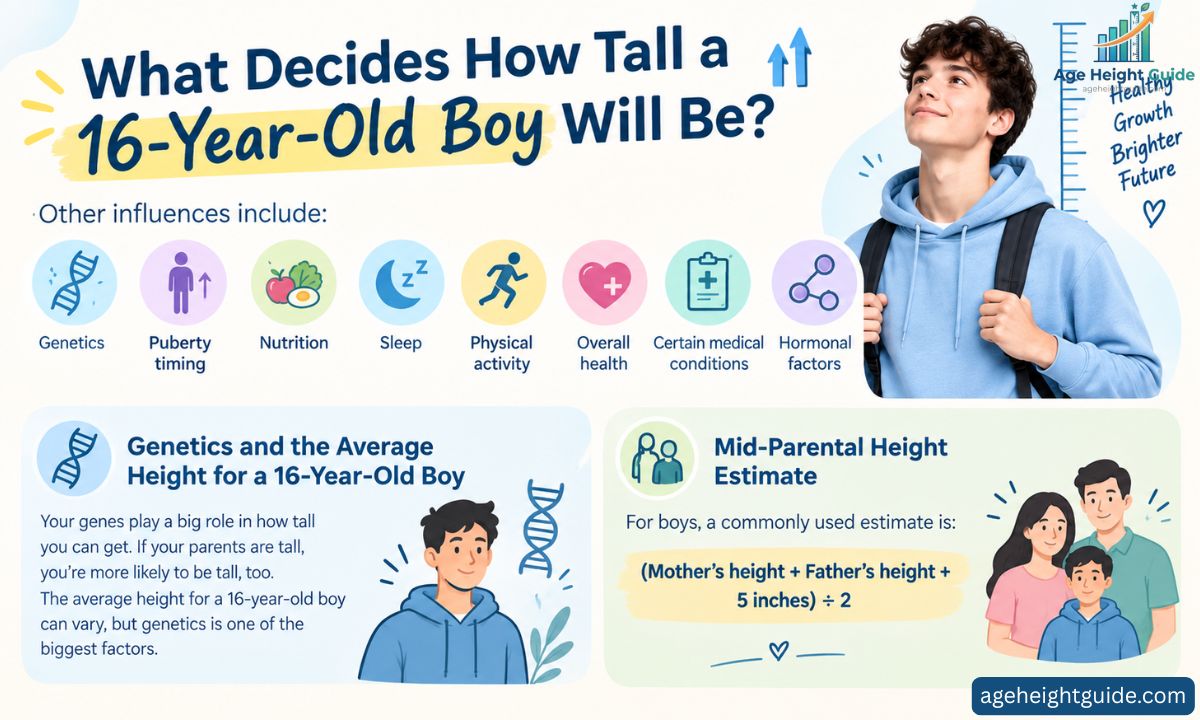
Several factors influence final height. The biggest factor is usually genetics.
Family height provides an important clue about a child’s expected growth pattern. But genes are not the only factor.
Other influences include:
- Genetics
- Puberty timing
- Nutrition
- Sleep
- Physical activity
- Overall health
- Certain medical conditions
- Hormonal factors
Genetics, nutrition, physical activity, health, environment, and hormones can all influence growth.
Genetics and the average height for a 16-year-old boy
Family height can explain why one teen is naturally shorter or taller than another.
A boy with shorter parents may naturally be shorter than the average height for a 16-year-old boy. A boy with tall parents may naturally be taller.
This does not mean genetics determines an exact final number. It means family traits are an important part of the growth picture.
Mid-parental height estimate
Parents sometimes use a simple mid-parental height formula to estimate adult height.
For boys, a commonly used estimate is:
(Mother’s height + Father’s height + 5 inches) ÷ 2
The result is only an estimate. It should not be treated as a guarantee.
A child’s actual adult height can be above or below the estimate because growth depends on many factors.
Can nutrition still support growth at 16?

Yes, good nutrition still matters.
But it is important to understand what nutrition can and cannot do.
A balanced diet supports normal development. It can help prevent nutritional deficiencies that may interfere with health and growth.
It cannot override genetics.
It also cannot reopen growth plates after they have closed.
Healthy eating, regular exercise, and enough rest can help children and teens reach their natural growth potential. No pill, formula, or nutritional supplement can simply guarantee a taller adult height.
Important nutrients for teen growth
A growing teenager needs a balanced diet that provides enough:
- Protein
- Calcium
- Vitamin D
- Zinc
- Magnesium
- Iron
- Other essential vitamins and minerals
Calcium is especially important for developing bones. The NIH Office of Dietary Supplements lists 1,300 mg of calcium per day for teens ages 14–18.
Good food sources include milk, yogurt, cheese, fortified foods, some fish, and certain vegetables.
The goal is not to take as many nutrients as possible.
The goal is to meet normal nutritional needs.
Can vitamins make a 16-year-old boy taller?
Vitamins do not work like a height booster.
If a teen has a nutritional deficiency, correcting that deficiency can support normal health and development.
But taking extra vitamins when nutritional needs are already met does not guarantee additional height.
That distinction is important.
A growth supplement should not be presented as a guaranteed way to add inches.
Does sleep affect growth in teenage boys?
Sleep is an important part of healthy teen development.
A 16-year-old should have a consistent sleep routine and enough total sleep each night.
Sleep supports many normal body processes, including physical recovery and development.
Instead of looking for a quick height solution, parents should focus on habits that support overall health:
Regular sleep + balanced nutrition + physical activity + good medical care
These habits cannot guarantee a certain adult height. They can, however, support healthy development.
Does exercise make a 16-year-old boy taller?
Exercise supports strong bones, muscles, fitness, and overall health.
It should not be presented as a way to force extra inches.
Regular physical activity is part of healthy development during the teen years.
Activities such as running, jumping, sports, walking, and age-appropriate strength training can all be part of a healthy routine.
The goal is health, not a guaranteed height increase.
What about the sugar in most growth gummies?
Parents often see growth gummies for kids, kids growth supplements, and height supplements for kids marketed with promises about growth.
The important question is not simply whether a product is a gummy.
Look at the label.
Check the amount of added sugar, the actual nutrient doses, serving size, and the claims made by the company.
A product that promises guaranteed inches should be approached carefully.
A supplement also should not replace a balanced diet.
For a healthy 16-year-old who already meets nutritional needs, more nutrients do not automatically mean more height.
How can parents support a growing 16-year-old boy?
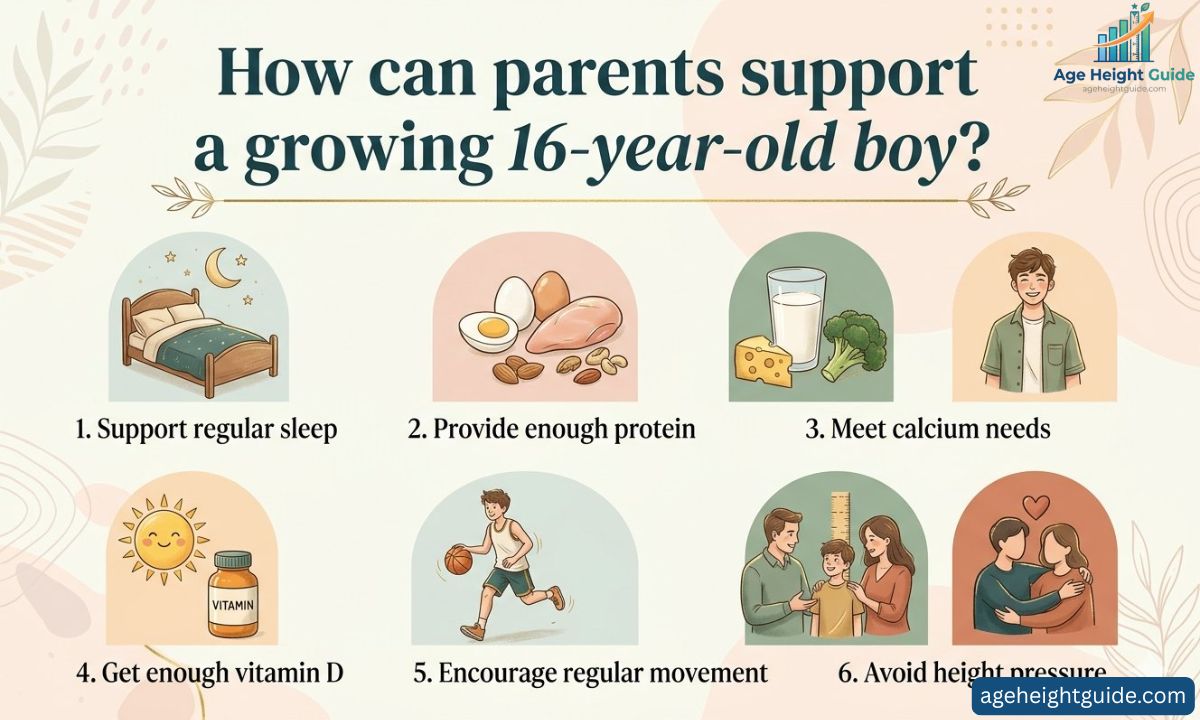
The basics matter most.
1. Support regular sleep
A consistent sleep schedule is important during adolescence.
Late-night screen use can make it harder for some teens to maintain good sleep habits.
Create a routine that makes enough sleep realistic.
2. Provide enough protein
Protein is needed for normal body growth and tissue maintenance.
Include foods such as:
- Eggs
- Milk and yogurt
- Fish
- Chicken
- Beans
- Lentils
- Meat
- Nuts and seeds
The goal is a balanced diet rather than a high-protein diet.
3. Meet calcium needs
Teen boys need calcium for normal bone development.
The NIH recommends 1,300 mg of calcium per day for teens ages 14–18.
Food is often the easiest way to meet this need.
4. Get enough vitamin D
Vitamin D helps the body absorb calcium and supports bone health.
Food choices, fortified foods, and appropriate sunlight exposure can all contribute to vitamin D status.
A pediatrician can recommend testing or supplementation when there is a reason to suspect deficiency.
5. Encourage regular movement
Physical activity supports bones, muscles, and overall fitness.
Sports and weight-bearing activities can be part of a healthy teenage routine.
6. Avoid height pressure
This is easy to overlook.
Constantly comparing a teen with taller classmates can create unnecessary pressure.
A better approach is to track his growth pattern and discuss concerns with his pediatrician.
When should parents talk to a pediatrician about height?
Most height differences are not automatically a sign of a problem.
Still, a medical evaluation can be useful if a teen:
- Stops growing unexpectedly
- Drops across several height percentiles
- Has delayed puberty
- Has other health symptoms
- Has very slow growth compared with his previous pattern
- Has a major difference between his growth pattern and family expectations
Doctors can review previous measurements and plot them on a growth chart.
In some cases, a doctor may consider a bone age X-ray. Bone age is a way to estimate skeletal maturity. It can provide information about how a child’s bones compare with typical development for that age.
How does a growth chart help at age 16?
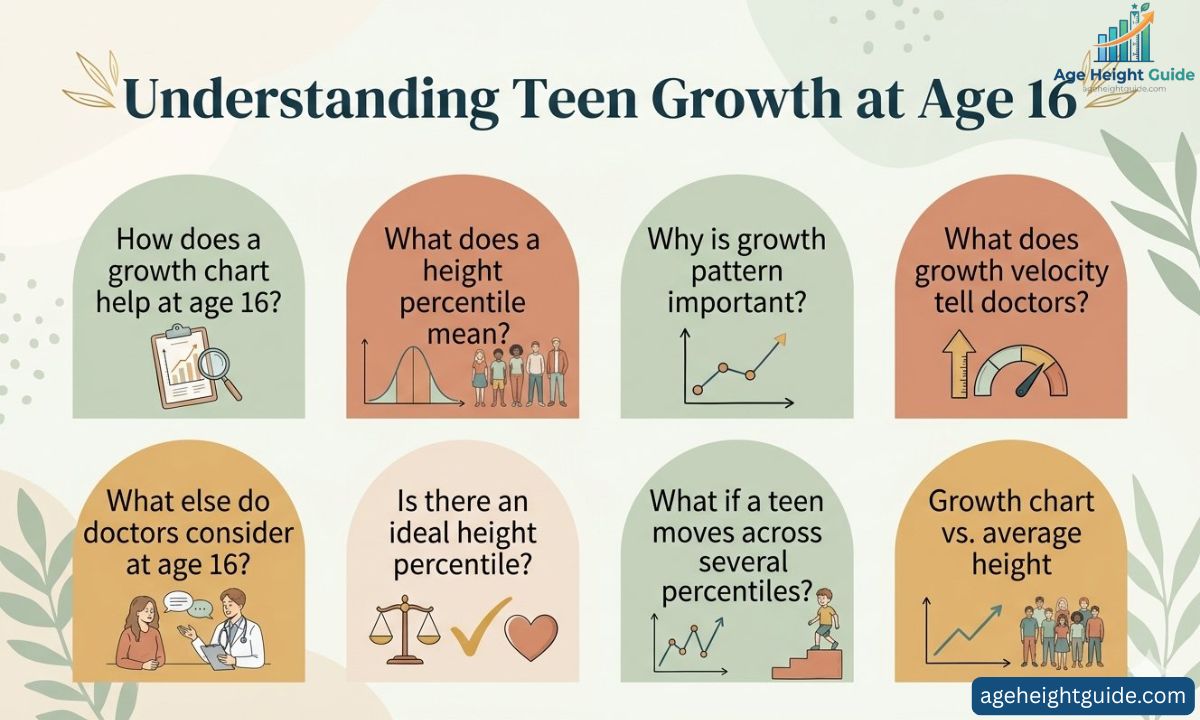
A growth chart can give a clearer picture than comparing a teen with one average number. The average height for a 16-year-old boy describes a population average. It does not show how every 16-year-old should grow.
Doctors use growth charts to look at height over time. They check where a teen’s height falls on the chart. They also look at whether that position has stayed fairly consistent.
What does a height percentile mean?
A height percentile compares a teen’s height with other boys of the same age and sex.
For example:
- A boy near the 15th percentile is shorter than many boys his age.
- A boy near the 50th percentile is close to the middle of the reference group.
- A boy near the 85th percentile is taller than many boys his age.
A percentile is not a grade. Being at a lower or higher percentile does not automatically mean there is a growth problem.
The important question is often whether the teen is following a steady growth pattern.
Why is growth pattern important?
Imagine a boy who has stayed close to the 15th percentile for several years. His height may be below the average height for a 16-year-old boy, but that alone does not mean something is wrong.
If his height continues to follow a similar pattern, it may simply reflect his normal growth pattern and family genetics.
Now consider another boy who was around the 60th percentile for several years. If his height suddenly moves much lower on the chart, that change may deserve closer attention.
A change in growth pattern can sometimes be more useful than the percentile number itself.
What does growth velocity tell doctors?
Growth velocity means how quickly height changes over time.
For example, a doctor may compare height measurements taken several months apart. This helps show whether a teen is still gaining height and at what rate.
Growth velocity can provide more information than one measurement.
A single height can tell you where a teen is today. Several measurements can show how that teen has been growing.
What else do doctors consider at age 16?
A growth chart is only one part of the assessment. Doctors may also consider:
- Previous height measurements: These show the teen’s growth pattern over time.
- Growth velocity: This shows how quickly height has changed.
- Puberty stage: Puberty timing differs from one boy to another.
- Family height: Parents’ heights can help provide genetic context.
- Overall health: Long-term health conditions can sometimes affect growth.
- Nutrition: Adequate nutrition supports normal development.
- Developmental history: The timing of puberty and earlier growth can add useful context.
This wider picture is especially important when looking at the average height for a 16-year-old boy. The average is useful for comparison, but it cannot predict one teen’s final height.
Is there an ideal height percentile?
There is no single ideal percentile that every healthy 16-year-old boy should reach.
Some healthy teens are naturally shorter than average. Others are naturally taller. Genetics, puberty timing, and many other factors can create normal differences in height.
A teen who stays on a similar growth curve may be developing normally even if he is not close to the 50th percentile.
What if a teen moves across several percentiles?
A noticeable change in growth pattern does not automatically mean there is a medical problem. Growth can vary, especially during puberty.
However, a significant or persistent change may be worth discussing with a pediatrician. The doctor can review earlier measurements and puberty development to understand what is happening.
The goal is not to make every teen reach the middle of the chart. The goal is to understand whether growth is progressing in a healthy and expected way.
Growth chart vs. average height
The average height for a 16-year-old boy is useful as a general reference. A growth chart provides more individual information.
| What you look at | What it can tell you |
|---|---|
| Average height | How one teen compares with a population average |
| Height percentile | Where his height falls within the reference group |
| Growth velocity | How quickly his height is changing |
| Growth pattern | Whether his height is following a consistent trend |
| Puberty stage | Whether development is progressing and when it started |
| Family height | Provides useful genetic context |
In short, a growth chart helps put height into context. It shows more than whether a teen is above or below the average height for a 16-year-old boy.
For parents, the most useful approach is to look at the growth pattern over time, rather than focusing on one number or trying to reach a specific percentile.
Average height vs. normal height for a 16-year-old boy
These two terms are easy to confuse.
Average height means the middle point of a reference population.
Normal height refers to a broader range of healthy growth patterns.
A boy does not need to be exactly 5 feet 8 inches to be healthy.
He may be shorter.
He may be taller.
The important question is whether his growth fits his individual pattern and stage of development.
| Question | What it means |
| What is the average height? | Around 5 ft 8 in / 173 cm at the 50th percentile |
| Does every 16-year-old need to be this height? | No |
| Can a 16-year-old still grow? | Yes, depending on puberty and growth-plate status |
| Does being shorter automatically mean a problem? | No |
| Does being taller automatically mean better health? | No |
| Can nutrition support normal growth? | Yes |
| Can supplements guarantee extra height? | No |
| What matters most? | Growth pattern, puberty, genetics, and overall health |
Can a 16-year-old boy still grow taller after his growth plates start closing?
Potentially, but the amount of remaining growth depends on how much skeletal maturation has occurred.
Growth plates are areas of cartilage near the ends of growing bones. They allow bones to lengthen during childhood and adolescence.
When a growth plate closes and becomes solid bone, that growth plate no longer adds length to the bone.
This is why age alone cannot tell you exactly how much height remains.
A 16-year-old who is nearly finished with puberty may have little height growth left.
A later-developing 16-year-old may have more.
Can food, stretching, or supplements reopen growth plates?
No.
There is no proven food, stretching routine, gummy, or vitamin that can reopen a completely closed growth plate.
Healthy nutrition can support normal growth while a teen is still developing.
It cannot reverse skeletal maturity.
Parents should be especially careful with products that promise rapid height increases or guaranteed inches.
What should parents look for in a growth supplement?
If a pediatrician recommends a supplement, read the label carefully.
Look for clear information about:
| What to check | Why it matters |
| Added sugar | Shows how much added sugar comes with each serving |
| Exact nutrient doses | Shows how much of each nutrient is provided |
| Serving size | Helps determine how much the teen actually receives |
| Age guidance | Helps confirm that the product is appropriate for the teen |
| Ingredient list | Shows what is actually in the product |
| Health claims | Helps identify promises that may be unrealistic |
| Third-party quality testing | Can provide additional information about product quality |
A supplement should fill a genuine nutritional need.
It should not replace meals.
It should also not be treated as a shortcut to a taller adult height.
What is the best way to predict adult height?
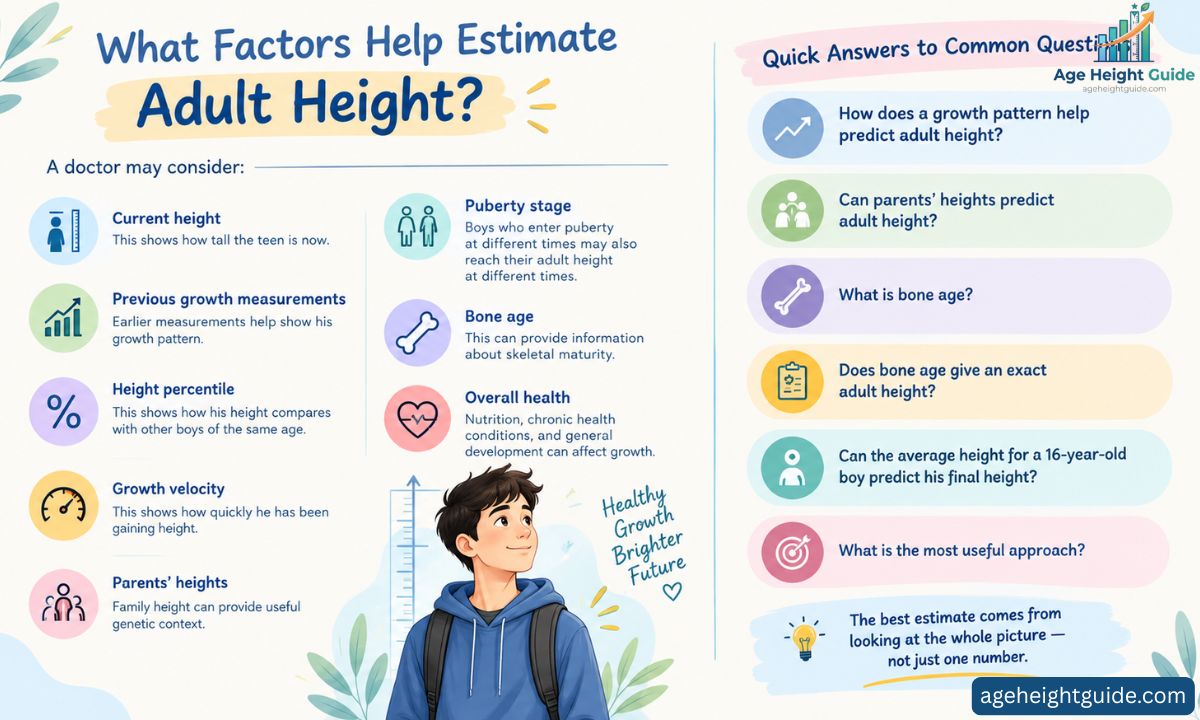
There is no method that can predict a teen’s final adult height perfectly. At age 16, the average height for a 16-year-old boy can provide a useful reference, but it cannot tell you exactly how tall that boy will become.
Doctors look at several factors together. They do not usually rely on one height measurement or one prediction formula.
What factors help estimate adult height?
A doctor may consider:
- Current height: This shows how tall the teen is now.
- Previous growth measurements: Earlier measurements help show his growth pattern.
- Height percentile: This shows how his height compares with other boys of the same age.
- Growth velocity: This shows how quickly he has been gaining height.
- Parents’ heights: Family height can provide useful genetic context.
- Puberty stage: Boys who enter puberty at different times may also reach their adult height at different times.
- Bone age: This can provide information about skeletal maturity.
- Overall health: Nutrition, chronic health conditions, and general development can affect growth.
Looking at these factors together gives a better picture than simply comparing a teen with the average height for a 16-year-old boy.
How does a growth pattern help predict adult height?
Previous height measurements are especially useful.
For example, a boy may have been around the same height percentile for several years. His doctor can review that pattern and see how quickly he has been growing.
Another boy may have entered puberty later and started growing more rapidly at a later age. His growth pattern may look very different.
This is why two 16-year-old boys with the same current height may not have the same remaining growth potential.
Can parents’ heights predict adult height?
Parents’ heights can provide a rough estimate of a child’s expected adult height.
One commonly used method is the mid-parental height estimate. For boys, the calculation adds about 5 inches to the mother’s height, adds the father’s height, and divides the total by two.
This is only a rough estimate. It does not account for every factor that affects growth.
A teen may ultimately be shorter or taller than the estimate. Genetics involve many different factors, so the calculation should not be treated as a guaranteed final height.
What is bone age?
A bone age study can provide additional information when a doctor needs to evaluate growth.
The test usually involves an X-ray of the hand and wrist. A doctor compares the appearance and maturity of the bones with standard reference images.
Bone age can help show whether skeletal development appears younger, similar to, or more advanced than expected for the teen’s chronological age.
This can be useful when puberty or growth timing is different from what is typical.
Does bone age give an exact adult height?
No. Bone age does not guarantee a final adult height.
It can help estimate remaining growth, but the result is still an estimate. Different prediction methods can also have some uncertainty.
For a 16-year-old boy, the result should be considered alongside current height, growth velocity, height percentile, puberty stage, family height, and overall health.
Can the average height for a 16-year-old boy predict his final height?
No. An average is not an adult-height calculator.
A boy who is shorter than the average height for a 16-year-old boy may still have more growth ahead. Another boy who is taller than average may already be close to his adult height.
Puberty timing makes a major difference. Some boys reach most of their adult height earlier, while others continue growing later.
The most useful approach is to look at the teen’s individual growth history rather than assuming that he will end up at the population average.
What is the most useful approach?
There is no single perfect prediction method. A doctor can combine growth measurements, growth velocity, puberty development, family height, and, when appropriate, bone age.
This gives a more complete picture of expected growth.
The key point is simple: the average height for a 16-year-old boy is a reference point, not a prediction of adult height. A teen’s own growth pattern provides much more useful information about where his development may be heading.
Why is the average height for a 16-year-old boy different from one teen to another?
Because teenagers do not all grow on the same schedule.
Genetics create large differences between families.
Puberty creates another major difference.
One 16-year-old may have entered puberty several years earlier. Another may have started later.
Nutrition, health, sleep, physical activity, and other factors also affect development.
That is why the average height for a 16-year-old boy should always be viewed as a reference point.
It is not a prediction for one individual.
The honest timeline
At 16, many boys are approaching the end of their height growth. Some are already close to their final adult height. Others may still have some growth left.
There is no reliable way to promise an exact number of inches without knowing the teen’s individual growth history and stage of development.
The best approach is simple.
Track height over time.
Support good nutrition.
Prioritize sleep.
Encourage regular activity.
Avoid extreme diets and unproven height products.
If growth seems unusually slow or puberty appears delayed, talk with a pediatrician.
The goal is not to force a teenager to reach the population average.
The goal is to support healthy development and understand his own growth pattern.
Frequently Asked Questions
What is the average height for a 16-year-old boy?
The average height for a 16-year-old boy is about 5 feet 8 inches (173 cm) at the 50th percentile on the CDC boys’ stature-for-age chart. This is a population reference, not a required height for every teen.
What is a normal height for a 16-year-old boy?
There is no single normal height. Height varies naturally between teenagers.
A boy can be shorter or taller than the average and still be healthy. Doctors look at the growth chart, previous measurements, growth rate, puberty timing, and family height.
Is 5’5″ short for a 16-year-old boy?
5 feet 5 inches is below the 50th percentile reference for a 16-year-old boy, but being below average does not automatically mean something is wrong.
A doctor’s interpretation depends on the teen’s overall growth pattern and development.
Is 5’8″ average for a 16-year-old boy?
Yes. Around 5 feet 8 inches (173 cm) is approximately the 50th percentile reference for a 16-year-old boy on the CDC stature-for-age chart.
Is 6 feet tall normal for a 16-year-old boy?
Yes. A 16-year-old boy can be around 6 feet tall and still fall within the upper part of the CDC height distribution.
Being taller than average does not automatically mean that a teen will continue growing for many more years.
Can a 16-year-old boy still grow taller?
Yes. Some 16-year-old boys continue growing, especially if puberty started later.
Others are already close to their adult height.
Puberty timing and growth-plate maturity matter more than age alone.
How much does a 16-year-old boy grow in a year?
There is no single number that applies to every boy.
Growth slows as puberty progresses. A boy who is near the end of puberty may grow very little, while a later-developing teen may have more growth remaining.
When do boys stop growing?
Most boys finish their major height growth toward the end of puberty.
The exact timing varies. Some boys finish earlier, while others continue growing later in the teen years.
Do growth plates close at 16 for boys?
Growth plates may still be open at 16, or they may be nearing closure, depending on puberty and skeletal maturity.
There is no single age when growth plates close for every boy.
Can a late bloomer grow after 16?
Yes.
Boys who enter puberty later may continue growing later than their peers.
This is one reason a 16-year-old’s age alone cannot determine his final height.
Does nutrition affect height at 16?
Nutrition supports normal growth and development.
A deficiency in an essential nutrient can affect health and development. But eating more of a nutrient than the body needs does not guarantee extra height.
A balanced diet remains the priority.
How much calcium does a 16-year-old boy need?
The NIH Office of Dietary Supplements recommends 1,300 mg of calcium per day for teens ages 14–18.
Food sources include dairy products, fortified foods, some fish, and certain vegetables.
Can vitamins make a 16-year-old taller?
No vitamin can guarantee extra height.
Vitamins and minerals are important when the body needs them, especially when a deficiency exists.
But supplements should not be treated as a guaranteed height-growth treatment.
Does sleep help a 16-year-old boy grow?
Good sleep supports normal teen health and development.
A consistent sleep routine is therefore important during the growing years.
Sleep should be viewed as part of healthy development, not as a guaranteed way to add inches.
Does exercise stunt growth?
Normal, age-appropriate physical activity does not need to be avoided because of height concerns.
Exercise supports bones, muscles, and overall health.
Teenagers should use proper technique and appropriate supervision for strength training.
How can I tell if my 16-year-old is still growing?
The best clue is his growth history.
Compare several height measurements over time. Puberty stage also provides useful context.
If there is concern about growth, a pediatrician can review the growth chart and decide whether further evaluation is needed.
When should I worry about my son’s height?
A single height measurement is usually not enough to identify a problem.
Talk with a pediatrician if your son has stopped growing unexpectedly, shows delayed puberty, drops significantly across growth percentiles, or has other symptoms that concern you.
What is the most important thing to remember about the average height for a 16-year-old boy?
The key point is simple: The average height for a 16-year-old boy is a reference point, not a requirement.
Around 5 feet 8 inches (173 cm) is the 50th percentile reference on the CDC chart. But healthy boys can be shorter or taller.
What matters more is the growth pattern, puberty timing, family height, nutrition, overall health, and whether growth is continuing as expected.

Stoke is the author behind Age Height Guide, creating simple and informative content about average height, age, growth, and related measurements.