


The average height for a 14-year-old girl is about 5 feet 3 inches (160–161 cm) around the 50th percentile on the CDC girls’ stature-for-age chart. However, there is no single height that every 14-year-old girl should be. Height can vary because children enter puberty at different times and grow at different rates.
A better way to understand height is to look at the CDC growth chart, height percentile, and growth pattern together. A girl who is shorter or taller than the average may still be growing normally.
At age 14, puberty also matters. Some girls are close to their adult height, while others still have measurable growth ahead. The timing of the growth spurt, first period, and other pubertal changes can affect how much height remains.
You can also read: Average Height for a 15-Year-Old Girl: 2026 Growth Guide
How tall is the average 14-year-old girl?
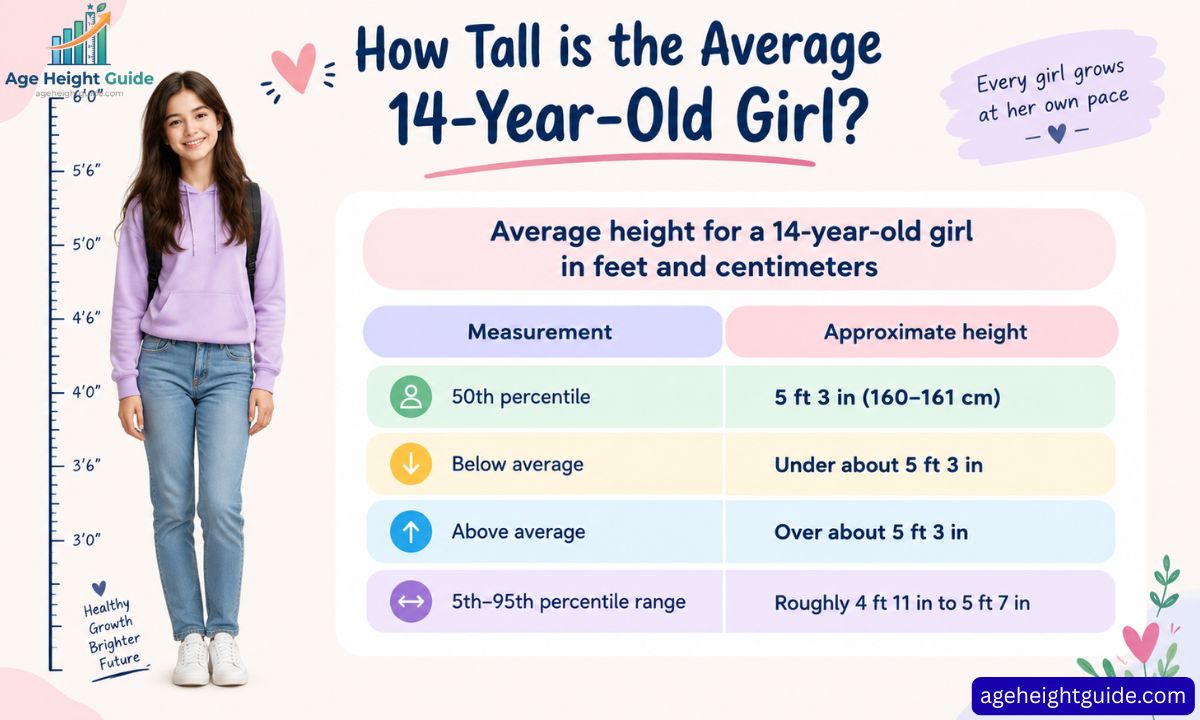
The average height for a 14-year-old girl is approximately 5 feet 3 inches (160–161 cm) at the 50th percentile on the CDC stature-for-age chart. The 50th percentile means that about half of the girls in the reference population are shorter and half are taller.
This number is an average, not a goal.
For example, a 14-year-old girl who is 5 feet tall is not automatically unhealthy. Likewise, a girl who is 5 feet 7 inches is not automatically outside a healthy growth pattern.
The more useful question is whether her height has followed a reasonably steady growth curve over time.
The CDC provides stature-for-age growth charts for children and adolescents from ages 2 through 20. These charts allow height to be viewed by percentile rather than as one fixed “normal” number.
Average height for a 14-year-old girl in feet and centimeters
| Measurement | Approximate height |
| 50th percentile | 5 ft 3 in (160–161 cm) |
| Below average | Under about 5 ft 3 in |
| Above average | Over about 5 ft 3 in |
| 5th–95th percentile range | Roughly 4 ft 11 in to 5 ft 7 in |
These are rounded values. The exact percentile changes with age in months, so a girl who is 14 years and 1 month is not being compared with the same reference point as a girl who is 14 years and 11 months.
What is the normal height range for a 14-year-old girl?
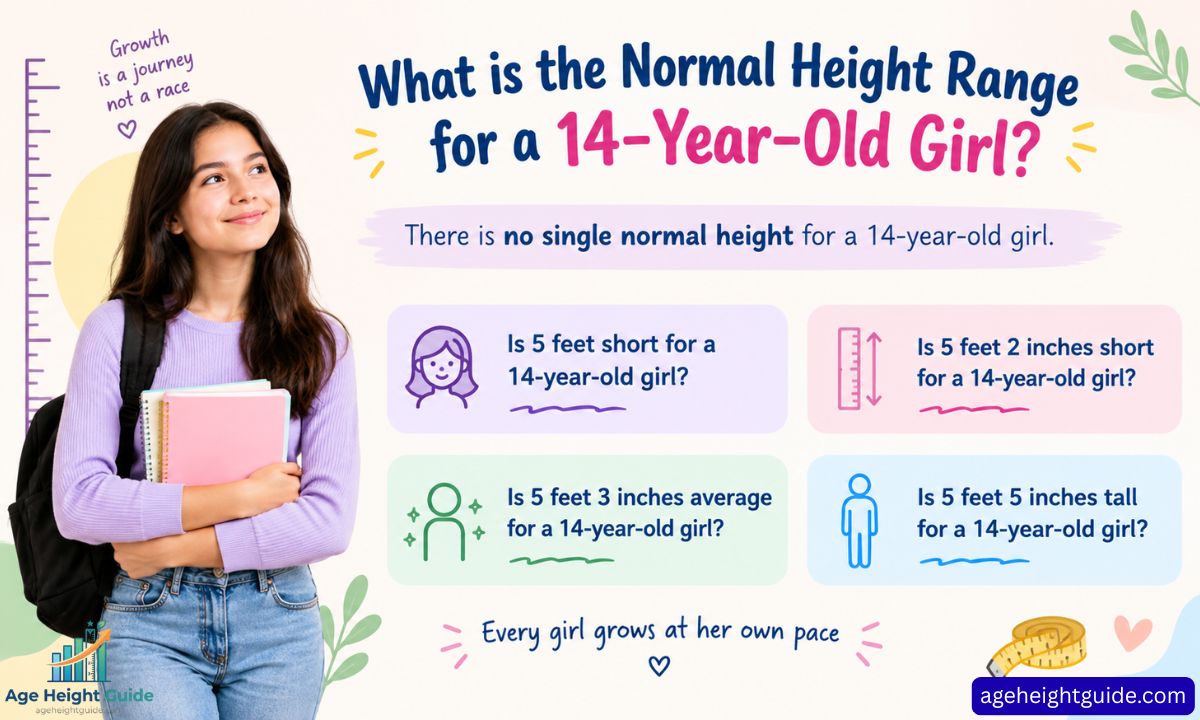
There is no single normal height for a 14-year-old girl.
Growth charts show a distribution of heights. Some girls are naturally shorter, some are near the middle, and some are taller. A height percentile becomes more useful when it is tracked over time.
14-year-old girl height percentile chart
| Percentile | Approximate height | What it means |
| 5th | About 4 ft 11 in (151 cm) | Shorter than most girls her age |
| 10th | About 5 ft 0 in (153 cm) | Below the middle |
| 25th | About 5 ft 1–2 in (156–157 cm) | Below the 50th percentile |
| 50th | About 5 ft 3 in (160–161 cm) | Middle of the reference population |
| 75th | About 5 ft 4–5 in (164–165 cm) | Above the middle |
| 90th | About 5 ft 6 in (167–168 cm) | Taller than most girls her age |
| 95th | About 5 ft 7 in (170 cm) | Taller than most girls her age |
The CDC’s clinical growth charts use percentile curves to show how height compares with a reference population. The exact value should be read from the chart according to the child’s precise age.
A percentile is also not a health score.
For example, moving from the 25th percentile to the 50th percentile does not automatically mean a child became healthier. What matters is the overall pattern of growth, along with puberty, nutrition, and general health.
Is 5 feet short for a 14-year-old girl?
Being 5 feet tall at 14 does not automatically mean a girl is too short.
Five feet is below the 50th percentile for this age. But percentile position alone cannot tell you whether something is wrong.
If she has always tracked around a similar percentile and is still growing, that may simply reflect her normal growth pattern and family height.
A doctor may pay more attention if her growth velocity slows sharply or if she drops across several major percentile lines.
Is 5 feet 2 inches short for a 14-year-old girl?
A height of 5 feet 2 inches (about 157 cm) is below the median but can still occur within the expected range of the CDC growth chart.
The key point is that “below average” does not mean “abnormally short.”
Her previous measurements, puberty stage, family heights, and rate of growth provide more useful context.
Is 5 feet 3 inches average for a 14-year-old girl?
Yes. 5 feet 3 inches is approximately at the 50th percentile for a 14-year-old girl on the CDC reference chart, allowing for rounding and exact age.
That makes it close to the middle of the reference population. It does not mean every healthy girl should be this height.
Is 5 feet 5 inches tall for a 14-year-old girl?
A height of 5 feet 5 inches (about 165 cm) is above the median for a 14-year-old girl.
It can still fall well within the expected range on a growth chart. Being taller than average is not, by itself, a sign of abnormal growth.
Is a 14-year-old girl still growing?

Yes, some 14-year-old girls are still growing.
However, growth is often slowing by this age because the main growth spurt usually happens earlier in female puberty. The fastest height growth generally occurs before the first menstrual period. After the first period, growth usually slows.
This means two girls who are both 14 can have very different amounts of growth remaining.
One may have started puberty early and be close to her adult height. Another may have entered puberty later and still have more growth ahead.
That difference does not necessarily mean either girl has a problem.
How much does a girl grow after age 14?
There is no single number that applies to every girl.
The amount of remaining growth depends on when puberty started, how far puberty has progressed, when the first period occurred, genetics, and overall health.
The American Academy of Pediatrics notes that most girls grow about 1–2 inches after their first period, although individual growth can vary.
So a 14-year-old who has already had her period may have less height growth remaining than a 14-year-old who has not yet reached that stage of puberty.
When do girls stop growing?
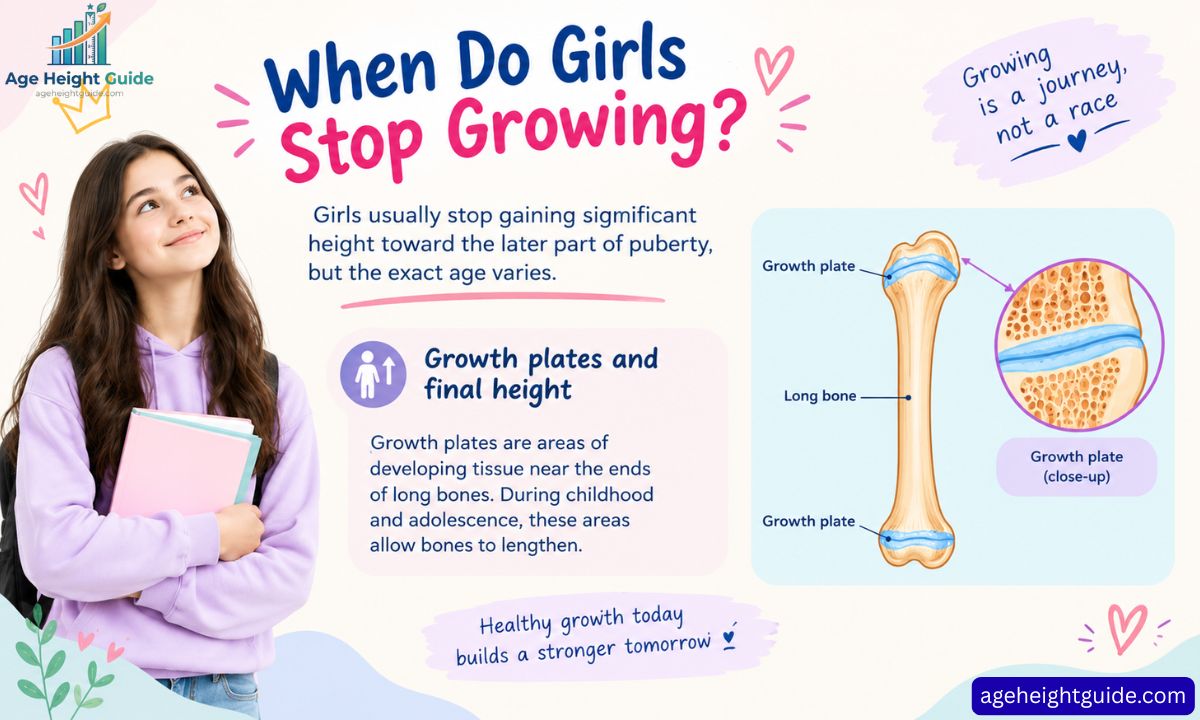
Girls usually stop gaining significant height toward the later part of puberty, but the exact age varies.
Puberty in girls commonly begins between about ages 8 and 13. Height growth is fastest earlier in puberty and slows after the first period. Many girls finish most of their height growth during the mid-teen years.
This is why saying that every girl stops growing at one exact age can be misleading.
Growth plates and final height
Growth plates are areas of developing tissue near the ends of long bones. During childhood and adolescence, these areas allow bones to lengthen.
As puberty progresses, the growth plates gradually mature and eventually close. Once they have fully fused, bones can no longer lengthen normally to increase standing height.
A person’s height, therefore, depends not only on chronological age but also on skeletal maturity and pubertal development.
If a doctor needs to assess skeletal maturity, a bone age X-ray of the hand and wrist may be used in the appropriate clinical setting.
How puberty and the first period affect height growth
Puberty is one of the biggest reasons height changes so quickly during the teen years.
In girls, breast development is usually one of the first visible signs of puberty. The height growth spurt follows during early puberty. The first menstrual period generally occurs later in the sequence.
After menstruation begins, height growth usually slows.
That does not mean a girl stops growing immediately after her first period. Some growth commonly remains, but the fastest phase has usually passed.
Puberty timing varies widely. Two girls of the same age can therefore have very different heights and still have a normal developmental pattern.
What decides how tall a 14-year-old girl will be?

Several factors influence final height, but genetics plays a major role.
Parents pass on many genes that affect skeletal growth, puberty timing, and adult height. Family height can therefore provide useful context when looking at a child’s growth pattern.
Other factors also matter, including:
- Nutrition
- Overall health
- Puberty timing
- Hormonal health
- Sleep
- Physical activity
- Long-term medical conditions
A useful way to think about it is that genetics creates much of the biological potential, while health and nutrition help determine whether a child can grow normally within that potential.
No food, exercise, or supplement can guarantee a specific adult height.
Does family height affect a girl’s adult height?
Yes.
A common clinical estimate is the mid-parental height formula for girls:
[(Father’s height − 5 inches) + Mother’s height] ÷ 2
The result is only an estimate. It should not be treated as an exact prediction because individual adult height can fall above or below the estimate.
Family height is most useful when combined with the child’s own growth history and puberty stage.
How to estimate adult height at age 14
There is no method that predicts adult height perfectly.
A doctor may consider several pieces of information:
| Factor | Why it matters |
| Current height | Shows present growth position |
| Previous heights | Shows the growth pattern |
| Growth velocity | Shows how quickly height is changing |
| Parents’ heights | Provides genetic context |
| Puberty stage | Indicates developmental timing |
| First-period timing | Helps understand remaining growth |
| Bone age | May help assess skeletal maturity |
| Overall health | Can identify factors that affect growth |
A height percentile is more useful when it is tracked over several measurements.
For example, a girl who remains around the same percentile over time may be following her expected pattern. A sudden and persistent change in growth rate may deserve closer evaluation.
Can nutrition still support growth at 14?

Yes. Good nutrition is important while a teenager is still growing.
But nutrition should be viewed as support for normal growth, not as a way to force additional inches.
A balanced diet provides energy, protein, vitamins, and minerals needed for bones, muscles, blood, and other tissues.
Important nutrients include:
- Protein
- Calcium
- Vitamin D
- Iron
- Zinc
- Magnesium
- Other vitamins and minerals from a varied diet
For teenagers ages 14–18, the NIH lists a calcium recommendation of 1,300 mg per day. Calcium can come from foods such as milk, yogurt, cheese, fortified beverages, tofu, and some vegetables.
The goal is not to take as many nutrients as possible.
If a teenager already gets enough of a nutrient, taking large extra amounts does not create a guaranteed height benefit.
What nutrients are important for growing girls?
| Nutrient | Role in a healthy diet | Common food sources |
| Protein | Supports tissues and muscle | Eggs, fish, chicken, beans, yogurt |
| Calcium | Helps build and maintain bones | Milk, yogurt, cheese, fortified foods |
| Vitamin D | Helps the body absorb calcium | Fortified foods, fatty fish, sunlight exposure |
| Iron | Important for blood and oxygen transport | Meat, beans, lentils, fortified cereals |
| Zinc | Supports normal growth and development | Meat, seafood, dairy, beans, nuts |
| Magnesium | Supports bones, muscles, and normal body functions | Nuts, seeds, whole grains, leafy greens |
A nutrient deficiency can affect health and development. That is different from saying that extra supplementation makes an already well-nourished teenager taller.
What about the sugar in most growth gummies?
Sugar is worth checking when comparing growth gummies or other supplements.
A gummy can contain useful nutrients, but it can also contain added sugar, flavoring, and other ingredients. Parents should read the Supplement Facts label instead of judging a product only by its marketing.
Look at:
- Added sugar
- Serving size
- Amount of each nutrient
- Ingredient list
- Age instructions
- Warnings
- Third-party testing, when available
A supplement should not be treated as a replacement for meals.
More importantly, a product that promises guaranteed inches should be approached carefully. There is no reliable supplement that can promise a specific amount of height for every 14-year-old girl.
How can parents support a growing 14-year-old girl?

Most healthy growth support comes from ordinary habits rather than a quick fix.
1. Prioritize sleep
Teenagers need adequate sleep for health, learning, mood, and physical development.
A consistent sleep schedule can help a teenager get the rest her body needs.
2. Offer balanced meals
Meals should include a mix of protein, whole grains or other carbohydrate sources, fruits or vegetables, and healthy sources of fats.
3. Support bone health
Calcium and vitamin D are important for bones. For teenagers ages 14–18, the calcium RDA is 1,300 mg per day.
4. Include iron-rich foods
Iron needs deserve attention during the teen years, especially after menstruation begins.
Good food sources include meat, poultry, seafood, beans, lentils, fortified cereals, and leafy greens.
5. Encourage regular physical activity
Running, jumping, sports, walking, and other weight-bearing activities support healthy bones and fitness.
Exercise does not lengthen bones on demand, but regular activity is an important part of overall health.
6. Avoid extreme dieting
Severe restriction can make it harder to meet energy and nutrient needs during adolescence.
A teenager who is struggling with food intake, weight, fatigue, or growth should be evaluated by a qualified healthcare professional.
What should parents look for in a growth supplement?
A supplement should be considered a way to fill a nutritional gap, not a shortcut to a taller adult height.
Before choosing one, check the label carefully.
| What to check | Why it matters |
| Added sugar | Helps you understand how much added sugar comes with each serving |
| Exact nutrient amounts | You should know how much of each ingredient is provided |
| Serving size | Prevents misunderstanding about the actual daily dose |
| Age range | Products are not automatically appropriate for every child |
| Ingredient list | Shows what the product actually contains |
| Safety warnings | Important for allergies, medicines, and health conditions |
| Third-party testing | Can provide additional information about quality |
| Health claims | Be cautious of promises of guaranteed height increases |
A proprietary blend can make it harder to know the exact amount of individual ingredients. A transparent label makes comparison easier.
Parents should also talk with a pediatrician or pharmacist before giving a teenager a supplement, especially if she takes medication or has a medical condition.
When should parents talk to a pediatrician about height?

A single height measurement rarely tells the whole story.
A pediatrician may want to review growth more closely when a child:
- Stops growing or grows much more slowly than expected
- Drops across several major height percentiles
- Has no expected signs of puberty by the usual age range
- Shows unusually early pubertal development
- Has ongoing digestive, endocrine, or other health symptoms
- Has a growth pattern that differs significantly from the family’s expected pattern
The American Academy of Pediatrics notes that puberty timing can vary substantially. It recommends discussing the situation with a pediatrician when there are no signs of puberty by age 13 in girls or when pubertal changes begin unusually early.
A doctor may review previous measurements, family history, nutrition, puberty, and health. In selected cases, testing such as a bone age X-ray may be considered.
The honest timeline
There is no guaranteed timetable for how many inches a 14-year-old girl will gain.
Growth depends on where she is in puberty and how much growth remains. A girl who started puberty later may continue growing after another girl of the same age has nearly reached her adult height.
A sensible timeline looks more like this:
| Stage | What may happen |
| Early puberty | Height growth begins to speed up |
| Peak growth | Height increases fastest |
| First period | Growth usually begins slowing |
| After first period | Some additional height growth is common |
| Later puberty | Growth gradually slows |
| Growth plate closure | Further bone-length growth ends |
The exact timing varies. Healthy development does not happen according to one fixed calendar.
The goal should be to support healthy development rather than chase a particular number on a measuring tape.
Frequently Asked Questions
What is the average height for a 14-year-old girl?
The average height for a 14-year-old girl is about 5 feet 3 inches (160–161 cm) around the 50th percentile on the CDC stature-for-age chart. This is a population midpoint, not a required height.
What is considered a normal height for a 14-year-old girl?
There is no single normal height. The CDC growth chart shows a wide distribution of heights. A girl’s percentile and growth pattern provide more useful information than comparing her with one average number.
Is 5 feet short for a 14-year-old girl?
Five feet is below the median for this age, but it does not automatically mean that a girl is unhealthy or has a growth problem. Her previous measurements and growth velocity are important.
Is 5 feet 2 inches short for a 14-year-old girl?
Five feet 2 inches is below the median but can still occur within the expected range of the CDC chart. A pediatrician looks at the complete growth pattern rather than one measurement.
Is 5 feet 3 inches average for a 14-year-old girl?
Yes. About 5 feet 3 inches is close to the 50th percentile for a 14-year-old girl on the CDC reference chart, with small differences depending on exact age and rounding.
Is 5 feet 5 inches tall for a 14-year-old girl?
Five feet 5 inches is above the median for a 14-year-old girl. It can still be well within the expected range of the growth chart.
How much does a 14-year-old girl grow after her first period?
Many girls grow about 1–2 inches after their first period, although the amount varies. Growth usually slows after menstruation begins because the fastest part of the pubertal growth spurt has already passed.
Can a 14-year-old girl still grow taller?
Yes. Some girls are still growing at 14. The amount of remaining growth depends on puberty timing, family height, current growth rate, and skeletal maturity.
When do girls stop growing?
Many girls finish most of their height growth during the mid-teen years, but the exact age varies. Puberty can begin and progress at different times, so chronological age alone cannot determine when growth will end.
Does having a period mean a girl has stopped growing?
No. Growth usually slows after the first period, but it does not necessarily stop immediately. Many girls gain additional height afterward.
Can vitamins make a 14-year-old girl taller?
Vitamins do not guarantee extra inches. They can help correct a nutrient deficiency and support normal health, but giving extra nutrients to a teenager who already gets enough does not guarantee additional height.
This article is for general educational information and is not a substitute for medical advice. If you are concerned about a child’s growth, puberty, nutrition, or development, speak with a pediatrician or other qualified healthcare professional.

Stoke is the author behind Age Height Guide, creating simple and informative content about average height, age, growth, and related measurements.