

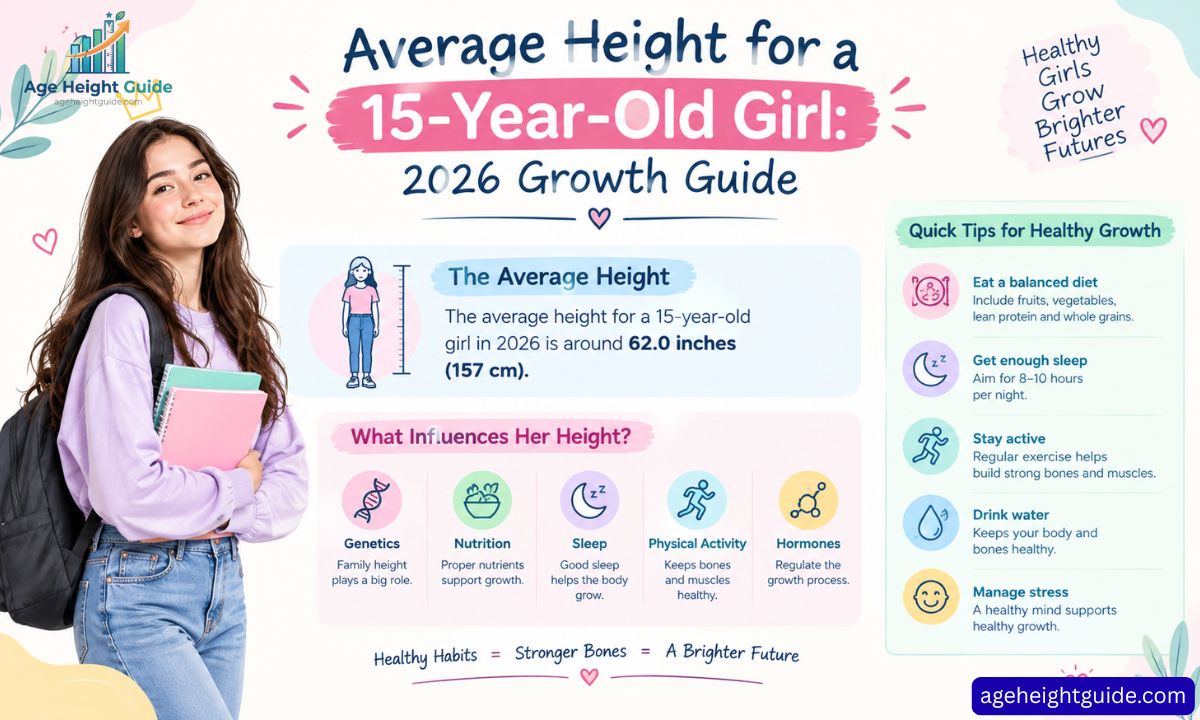
The average height for a 15-year-old girl is about 5 feet 4 inches (162 cm) at the 50th percentile on the CDC girls’ stature-for-age growth chart. However, the 50th percentile is a reference point, not a required height.
A girl can be shorter or taller than the average and still be growing normally. Her height percentile, previous measurements, growth rate, puberty timing, family height, nutrition, and overall health give more useful information than one number.
The CDC growth charts are designed to show how a child’s height compares with other children of the same age and sex. They are not meant to diagnose a health problem on their own.
You can also read: Average Height for a 15-Year-Old Boy: 2026 Growth & Health
How tall is the average 15-year-old girl?
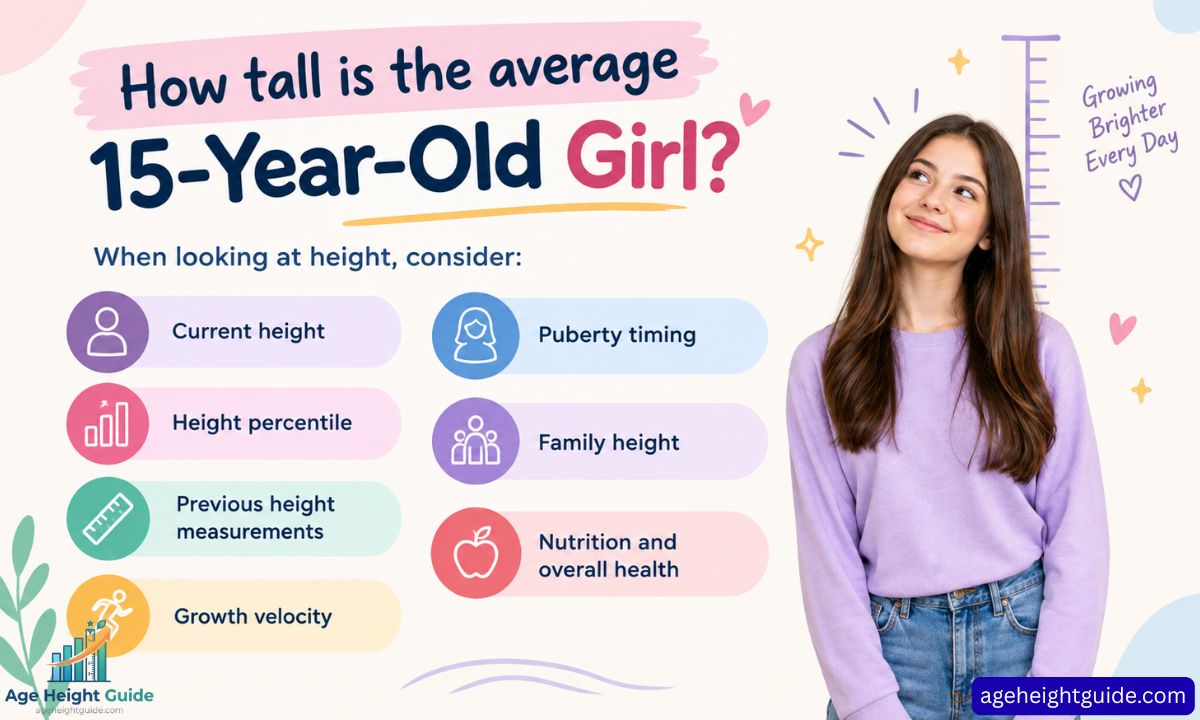
The average height for a 15-year-old girl is approximately 162 cm (5 feet 4 inches) at the 50th percentile on the CDC stature-for-age chart.
The 50th percentile means that about half of the reference population is shorter and half is taller at that age. It does not mean that every healthy 15-year-old should be close to 5 feet 4 inches.
For example, one 15-year-old girl may be 5 feet tall while another may be 5 feet 7 inches. Both can be developing normally if their growth pattern is appropriate for them.
When looking at height, consider:
- Current height
- Height percentile
- Previous height measurements
- Growth velocity
- Puberty timing
- Family height
- Nutrition and overall health
The CDC provides stature-for-age data for children and teens from ages 2 through 20.
What is the normal height range for a 15-year-old girl?

There is no single height that every 15-year-old girl needs to reach.
The CDC chart uses percentiles to show the distribution of height. A height around the 5th to 95th percentile covers a broad portion of the reference population, but this should not be treated as a universal medical definition of “normal.”
| Age | 5th percentile | 50th percentile | 95th percentile |
| 13 years | About 4’9″ | About 5’1″ | About 5’5″ |
| 14 years | About 4’10” | About 5’3″ | About 5’7″ |
| 15 years | About 5’0″ | About 5’4″ | About 5’7″ |
| 16 years | About 5’0″ | About 5’4″ | About 5’8″ |
| 17 years | About 5’0″ | About 5’4″ | About 5’8″ |
The exact percentile depends on the girl’s age in months, so a growth-chart calculation is more precise than rounding age to a whole year.
What does the height percentile mean?
A height percentile compares a child’s measurement with the reference population.
For example:
- 5th percentile: taller than about 5% of the reference group
- 25th percentile: taller than about 25%
- 50th percentile: the midpoint
- 75th percentile: taller than about 75%
- 95th percentile: taller than about 95%
A percentile is not a grade.
Being at the 25th percentile does not mean a girl is unhealthy, just as being at the 75th percentile does not automatically mean she is healthier.
Why is the growth chart more useful than the average?
A single height measurement gives limited information.
A pediatrician may look at several measurements over time to see whether a child is following a consistent growth pattern.
Important clues include:
- Current height percentile
- Previous height percentile
- Growth velocity
- Puberty stage
- Family growth patterns
- Weight and nutrition
- Medical history
The CDC specifically notes that growth charts contribute to an overall clinical picture rather than serving as a stand-alone diagnostic tool.
Is a 15-year-old girl still growing?
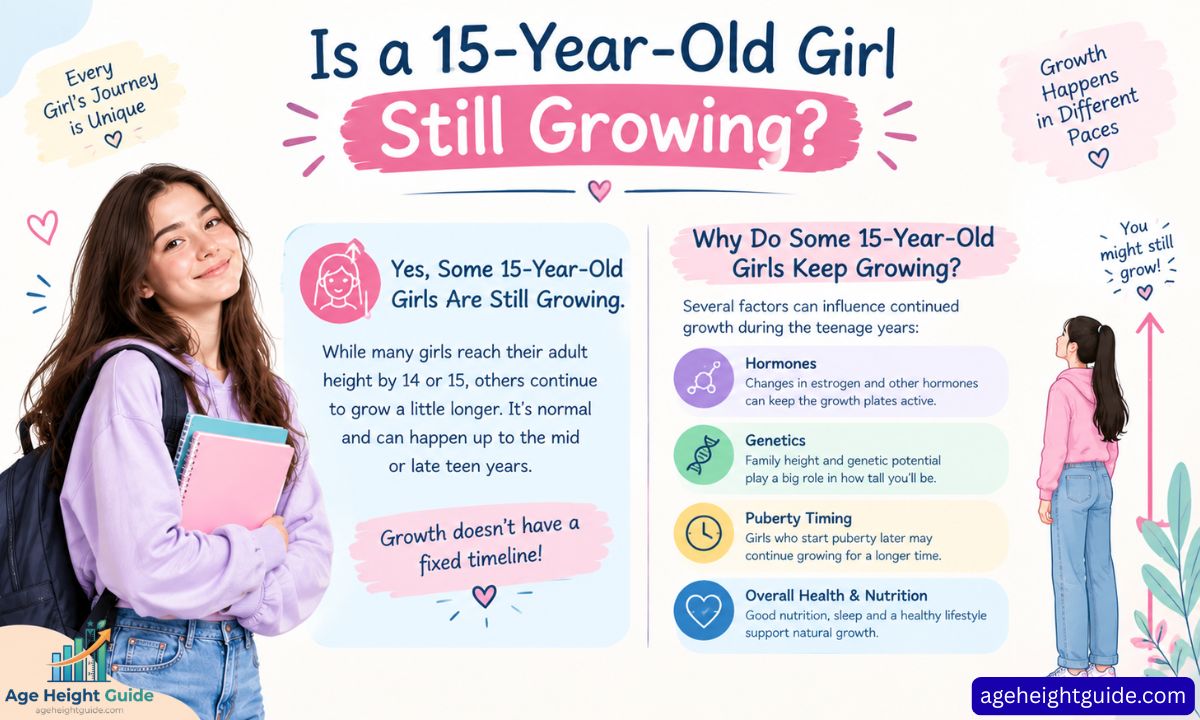
Yes, some 15-year-old girls are still growing.
Growth does not stop at the same age for every girl. Puberty can begin earlier or later, so two girls who are both 15 can be at different points in their development.
Girls usually have their fastest height growth earlier in puberty. The American Academy of Pediatrics explains that the fastest growth commonly occurs between the beginning of breast development and about six months before the first period. After the first period, growth usually slows.
Why do some 15-year-old girls keep growing?
A 15-year-old may still gain height when puberty started later or when the growth plates have not yet matured fully.
Useful clues include:
- Recent increases in height
- The timing of the first period
- Other signs of puberty
- Growth measurements from previous years
- Family patterns of later growth
Puberty timing is important because chronological age alone cannot tell you exactly how much growth remains.
How much can a 15-year-old girl grow?
There is no exact number of inches that every 15-year-old girl will gain.
The amount of remaining growth depends on puberty timing, current growth rate, family height, overall health, and skeletal maturity.
The American Academy of Pediatrics states that most girls grow another 1–2 inches after their first period, although individual growth can vary.
A girl who had her first period recently may have more remaining growth than someone who had it several years earlier.
Other useful factors include:
- Age when puberty started
- Age at first period
- Current height
- Previous yearly height changes
- Family height
- Nutrition
- Chronic health conditions
- Pubertal development
This is why an online height calculator cannot give a guaranteed final height.
Is 5 feet short for a 15-year-old girl?
Being 5 feet tall does not automatically mean a 15-year-old girl has a growth problem.
At about 152 cm, she would be below the 50th percentile on the CDC chart, but being below average is not the same as being unhealthy.
The more useful question is whether her height has followed a steady pattern.
For example, a girl who has consistently tracked along a lower percentile may simply have a naturally shorter height pattern. A girl whose percentile has dropped sharply may need a closer evaluation.
Parents should consider talking with a pediatrician if there is:
- Very slow or stopped growth
- A major drop across growth percentiles
- Delayed puberty
- Unexplained weight loss
- Ongoing digestive or other health problems
- Concerns about nutrition
- A noticeable change from her previous growth pattern
Is 5 feet 4 inches average for a 15-year-old girl?
Yes. 5 feet 4 inches (162 cm) is close to the 50th percentile for the average height for a 15-year-old girl on the CDC girls’ stature-for-age chart.
However, being at the 50th percentile does not make 5 feet 4 inches an ideal or required height. The 50th percentile is simply the midpoint of the reference population.
A girl can be 5 feet, 5 feet 2 inches, 5 feet 6 inches, or another height and still be developing normally.
The key is to interpret height with age, growth history, height percentile, and puberty timing, rather than comparing one measurement with the average.
Is 5 feet 5 inches tall for a 15-year-old girl?
A height of 5 feet 5 inches, or about 165 cm, is slightly above the 50th percentile for many 15-year-old girls on the CDC reference chart.
That does not make it unusually tall.
Small differences from the median are expected because height varies naturally between individuals.
When do girls stop growing?
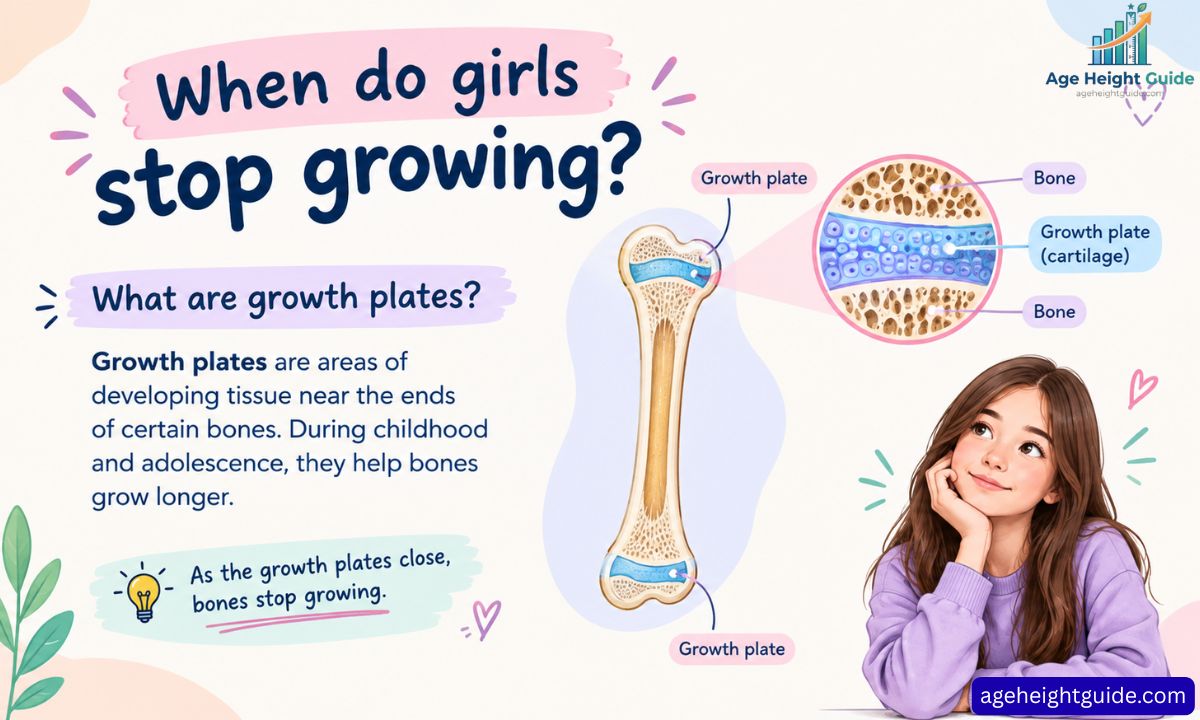
Girls usually reach most of their adult height during puberty, but the timing differs from person to person. When considering the average height for a 15-year-old girl, it is important to remember that some girls may still have growth remaining at this age.
Growth slows as puberty progresses. After the first period, most girls continue to grow for some time, but the rate is usually much slower than during the earlier growth spurt.
What are growth plates?
Growth plates are areas of developing tissue near the ends of certain bones. During childhood and adolescence, they help bones grow longer and contribute to changes in height.
When discussing the average height for a 15-year-old girl, it is important to remember that age alone cannot show whether a teenager has finished growing. Growth plates mature at different times as puberty progresses.
A person’s height, shoe size, or other physical signs cannot reliably confirm whether individual growth plates have closed.
Can a 15-year-old girl grow taller after her first period?
Yes.
Most girls continue to grow after their first period, although growth usually slows. The American Academy of Pediatrics reports that most girls gain another 1–2 inches after menstruation begins, while more growth is possible for some and less for others.
When considering the average height for a 15-year-old girl, remember that the amount of remaining growth can vary widely from one teenager to another.
The amount of remaining growth depends on when puberty began and how far along the girl is in her development. A girl who gets her first period later may have a different growth timeline from someone who entered puberty earlier.
The first period should therefore not be treated as an exact signal that height growth has completely stopped.
What decides how tall a 15-year-old girl will be?

Several factors influence adult height.
Genetics is one of the biggest factors, but it is not the only one. Puberty timing, nutrition, health, sleep, and other biological factors can also influence growth.
How much does genetics affect height?
Family height can provide useful context when understanding the average height for a 15-year-old girl and how much growth she may have left.
Children inherit many genetic factors that influence growth. This is why height often runs in families, and why parents’ heights can provide a useful clue about a child’s potential adult height.
However, a daughter does not have to reach a height that exactly matches either parent. Height is influenced by many genes, so siblings can also have different adult heights.
Environmental and health factors can affect whether a child reaches her expected growth potential. Nutrition, overall health, puberty timing, and other biological factors can all contribute to individual differences in growth.
Can parents estimate adult height?
Parents can use a mid-parental height calculation as a rough estimate.
For a girl, one commonly used formula is:
(Father’s height − 5 inches + Mother’s height) ÷ 2
In centimeters, the equivalent approximation is:
(Father’s height − 13 cm + Mother’s height) ÷ 2
This is only an estimate. It cannot predict a girl’s exact adult height because puberty timing, health, genetics, and individual variation all matter.
Can nutrition still support growth at 15?
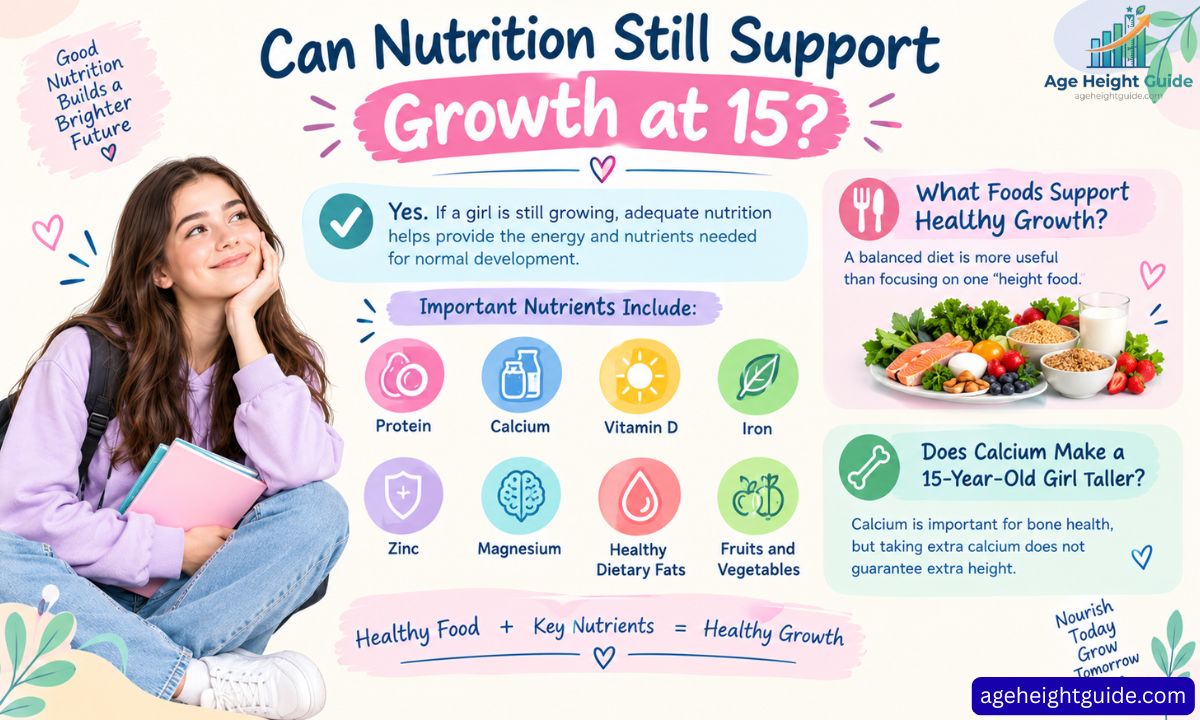
Yes. If a girl is still growing, adequate nutrition helps provide the energy and nutrients needed for normal development.
Nutrition cannot override genetic potential or guarantee extra inches. However, correcting an inadequate diet or nutrient deficiency can support normal growth and overall health.
Important nutrients include:
- Protein
- Calcium
- Vitamin D
- Iron
- Zinc
- Magnesium
- Healthy dietary fats
- Fruits and vegetables
What foods support healthy growth?
A balanced diet is more useful than focusing on one “height food.”
| Nutrient | Food sources |
| Protein | Eggs, fish, chicken, beans, lentils, yogurt |
| Calcium | Milk, yogurt, cheese, fortified alternatives |
| Vitamin D | Fortified foods, eggs, fatty fish |
| Iron | Meat, beans, lentils, leafy greens |
| Zinc | Meat, dairy, beans, nuts |
| Magnesium | Nuts, seeds, whole grains, legumes |
| Healthy fats | Fish, nuts, seeds, avocado |
A varied diet can help teenagers meet their nutritional needs while supporting overall health.
Does calcium make a 15-year-old girl taller?
Calcium is important for bone health, but taking extra calcium does not guarantee extra height. When considering the average height for a 15-year-old girl, calcium intake should be viewed as part of overall nutrition rather than a way to increase height beyond natural growth potential.
If a teenager is not getting enough calcium, improving intake can help support normal bone development. That is different from saying calcium supplements will make an otherwise well-nourished teenager taller.
Food sources should usually be part of a balanced diet, while supplements may be appropriate in some situations based on individual needs.
What about the sugar in most growth gummies?
Parents should look beyond the word “gummy.”
When comparing products related to the average height for a 15-year-old girl, it is important to understand that a supplement cannot determine how tall a teenager will ultimately become.
Some growth gummies contain added sugar, while others use alternative sweeteners. The important step is to read the Supplement Facts label and ingredient list.
Check:
- Added sugar per serving
- Serving size
- Exact nutrient amounts
- Age range
- Ingredient list
- Allergens
- Manufacturer information
- Testing or quality claims
- Directions for use
A supplement should not be presented as a guaranteed way to increase height.
How can parents support a 15-year-old daughter’s health during this window?

Parents cannot control a teenager’s final height, but understanding the average height for a 15-year-old girl can help put her growth into perspective while supporting healthy habits.
1. Encourage enough sleep
Teenagers need consistent sleep for overall health and development.
A regular sleep schedule is more useful than trying to compensate for poor sleep with supplements.
2. Provide balanced meals
Meals should include a mix of protein, whole grains or other carbohydrate sources, fruits, vegetables, and healthy fats.
Avoid making height the only reason to eat well.
3. Pay attention to iron and other nutrients
Teen girls may have increased nutritional needs during adolescence.
If there are concerns about fatigue, restrictive eating, heavy menstrual bleeding, or possible deficiencies, a healthcare professional can help determine whether testing is appropriate.
4. Encourage regular physical activity
Physical activity supports strong bones, muscles, cardiovascular health, and overall well-being.
Exercise does not need to be used as a method to “stretch” the body taller.
5. Avoid extreme dieting
Teenagers are still developing. Restrictive diets can make it harder to meet energy and nutrient needs.
A balanced approach is more appropriate than chasing a specific number on a height chart.
6. Focus on growth instead of comparison
Comparing a teenager with classmates can create unnecessary stress.
Two girls of the same age can be at very different stages of puberty and still develop normally.
What should parents look for in a growth supplement?
If a family is considering a growth supplement, the label deserves careful attention.
| What to check | Why it matters |
| Added sugar | Helps parents understand daily sugar intake |
| Exact nutrient doses | Shows what the product actually provides |
| Serving size | Prevents confusion about daily amounts |
| Age range | Confirms whether the product is intended for the teenager |
| Full ingredient list | Helps identify active ingredients and allergens |
| Third-party testing | May provide additional quality information |
| Manufacturer details | Makes the product easier to evaluate |
| Health claims | Helps identify exaggerated promises |
A supplement should complement a balanced diet, not replace meals.
Parents should also be cautious about products that promise a specific number of inches or claim they can reopen growth plates after closure.
What factors can slow normal growth?
Several health and nutrition issues can affect growth. When looking at the average height for a 15-year-old girl, it is important to remember that individual growth can vary for many reasons.
Possible factors include:
- Inadequate calorie intake
- Nutrient deficiencies
- Chronic illness
- Gastrointestinal conditions
- Hormonal disorders
- Certain medications
- Delayed puberty
- Long-term health problems
- Significant changes in weight
This does not mean that a shorter teenager has one of these conditions. Many healthy girls naturally fall below the average height.
Growth patterns must be interpreted in context. A pediatrician can compare previous measurements and review the child’s overall health.
When should parents talk to a pediatrician about height?

A pediatrician can help when a teenager’s growth pattern seems unusual or changes significantly. If you are concerned about the average height for a 15-year-old girl, a doctor can look beyond the average and assess her individual growth pattern.
Consider discussing height with a doctor if:
- Height growth appears to stop unexpectedly
- The growth percentile drops significantly
- Puberty seems delayed
- Puberty starts unusually early
- There are signs of nutritional deficiency
- There is unexplained weight loss
- A chronic illness may affect growth
- Parents are concerned about overall development
A doctor may review the growth chart, family heights, puberty history, nutrition, medications, and medical history.
In some cases, additional testing may be considered to better understand a teenager’s growth and development.
The honest timeline
The average height for a 15-year-old girl is useful as a reference, but it cannot tell you exactly how tall one individual teenager should be.
Some 15-year-old girls are close to their adult height. Others may still have some growth remaining.
The most useful clues are:
- Current height
- Previous height measurements
- Growth velocity
- Height percentile
- Puberty timing
- Age at first period
- Family height
- Nutrition
- Overall health
The goal should not be to force a teenager toward the 50th percentile.
The goal is to support healthy development and understand whether her growth pattern is appropriate for her.
Frequently Asked Questions
What is the average height for a 15-year-old girl?
The average height for a 15-year-old girl is around 5 feet 4 inches (162 cm) at the 50th percentile on the CDC girls’ stature-for-age chart.
The median is a reference point, not a target that every girl needs to reach.
Is 5 feet short for a 15-year-old girl?
Five feet is below the 50th percentile for many 15-year-old girls, but that alone does not indicate a health problem.
Previous growth measurements and puberty timing provide more useful context.
Is 5 feet 4 inches average at age 15?
Yes. About 5 feet 4 inches, or 162 cm, is close to the CDC 50th percentile for a 15-year-old girl.
Can a 15-year-old girl still grow?
Yes. Some girls continue to grow at 15, especially if puberty started later.
Growth usually slows as puberty progresses.
How much can a girl grow after her first period?
The American Academy of Pediatrics states that most girls grow another 1–2 inches after their first period, although individual results vary.
Can girls grow after age 15?
Some can. Age alone cannot determine whether height growth has ended.
Puberty timing and skeletal maturity are more useful clues.
When do girls stop growing?
Growth usually slows toward the end of puberty. Once growth plates mature and close, bones no longer lengthen normally.
Does a girl’s period mean she has stopped growing?
No.
Girls usually continue to grow after their first period, but the growth rate is slower.
How can I tell if my daughter is still growing?
Look at height measurements taken several months apart.
A pediatrician can also review her growth velocity, percentile pattern, puberty development, and medical history.
What is a healthy height for a 15-year-old girl?
There is no single healthy height.
The CDC growth chart shows a broad distribution of heights, and doctors consider the overall growth pattern rather than one number.
Is being shorter than friends a problem?
Not necessarily.
Friends can enter puberty at different times, so height differences during adolescence are common.
Is being taller than average a problem?
Usually, being taller than the median is not a problem by itself.
The important issue is whether growth follows an appropriate pattern.
Can vitamins make a 15-year-old taller?
Vitamins are important when the body needs them, especially when a deficiency exists.
However, taking extra vitamins does not guarantee additional height beyond a person’s natural growth potential.
Does sleep affect growth?
Good sleep supports overall health and normal development.
A teenager should have a consistent sleep routine rather than relying on supplements to compensate for poor sleep.
Does calcium increase height?
Calcium supports normal bone health, but extra calcium does not guarantee extra height.
A balanced diet that provides enough calcium is more important than taking excessive amounts.
What foods help a teenage girl grow?
Protein-rich foods, dairy or fortified alternatives, fruits, vegetables, whole grains, legumes, nuts, seeds, and other nutrient-dense foods can support a balanced diet.
No single food can guarantee extra height.
Should parents use a growth supplement?
A supplement is not required for every teenager.
If parents are considering one, they should check the ingredient list, nutrient doses, serving size, age range, added sugar, and quality information.
When should parents worry about height?
Parents should talk to a pediatrician if growth seems to stop, the child’s growth percentile changes significantly, puberty is delayed or unusually early, or there are other health or nutrition concerns.
Can a growth supplement guarantee more height?
No supplement should be treated as a guaranteed way to increase height.
Final height depends on many biological factors, including genetics, puberty timing, nutrition, and overall health.

Stoke is the author behind Age Height Guide, creating simple and informative content about average height, age, growth, and related measurements.