

If you’re wondering about the average height for a 2-year-old boy, you’re probably trying to understand whether your toddler is growing at a healthy rate.
At age two, boys can have noticeably different heights, and being taller or shorter than the average does not automatically mean there is a problem.
At 24 months, the median height for boys on the WHO growth chart is about 87.1 cm (34.3 inches). This number is a useful reference, but it is not a target that every 2-year-old boy needs to reach.
Your child’s height percentile, family genetics, nutrition, and overall growth pattern all provide important context.
In this guide, we’ll explain the normal height for a 2-year-old boy, how height percentiles work, how much boys typically grow after age two, and how you can track your toddler’s height at home.
We’ll also cover the signs that may be worth discussing with a pediatrician.
You can also read: Toddler Growth Spurts: Ages, Signs & What to Expect
Key Takeaways
- The average height for a 2-year-old boy at 24 months is about 87.1 cm (34.3 inches) based on WHO growth standards.
- A healthy 2-year-old boy’s height can be above or below the average because every child follows a different growth pattern.
- Height percentiles show how your child’s height compares with other boys of the same age.
- Genetics, nutrition, overall health, and growth patterns can all influence toddler height.
- Tracking your child’s height over time is more useful than focusing on a single measurement.
- A noticeable change in your child’s growth curve or very little growth over an extended period should be discussed with a pediatrician.
How Pediatric Growth Averages Are Calculated
The average height for a 2-year-old boy comes from large sets of childhood growth data. These measurements help create child growth charts that show how boys typically grow at different ages.
Rather than using one fixed number to decide whether a child is growing normally, healthcare professionals compare height with other boys of the same age. They also look at the child’s measurements over time to understand his growth pattern and growth velocity.
This approach is important because a toddler can be shorter or taller than average and still have healthy development. The average simply gives parents a useful reference point when looking at their child’s height-for-age.
Where Growth Data Comes From
The average height for a 2-year-old boy is based on large amounts of childhood growth data. The World Health Organization (WHO) provides height-for-age growth charts for boys from birth through age 5. These charts help healthcare professionals compare a child’s height with a reference population of children of the same age and sex.
The WHO Child Growth Standards were developed from data collected from healthy children in different countries. This gives parents and healthcare professionals a useful reference for understanding toddler growth and child height.
For a 2-year-old boy, the chart should be used according to his exact age because even a few months can make a difference in early childhood.
Which Growth Chart Should You Use at Age 2?
At age 2, the growth chart used can depend on the child’s age, measurement method, and healthcare setting. The WHO growth standards are commonly used for children from birth through 5 years, while the CDC growth charts are widely used in the United States for children age 2 and older.
Because growth charts can use different reference populations and measurement methods, it’s best to use the chart recommended by your child’s pediatrician. The most important factor is tracking your child’s height percentile and growth pattern consistently over time.
Understanding Percentiles and Ranges
A height percentile shows how a child’s height compares with other boys of the same age.
For example, a boy around the 50th percentile is close to the middle of the reference population. A boy at a lower percentile is shorter than the median, while a boy at a higher percentile is taller than the median.
Being at a particular percentile does not automatically mean a child is healthy or unhealthy. A boy who consistently follows a lower growth percentile can be developing normally, just as a boy who stays at a higher percentile can be healthy.
This is why doctors look at the growth curve and previous measurements instead of judging a child from one height reading.
Why Averages Serve as Guidelines
The average height for a 2-year-old boy is a reference point, not a goal.
Children grow at different rates because of genetics, family height patterns, nutrition, and overall health. Some toddlers may be shorter than average and continue growing steadily. Others may be taller and remain on a higher growth curve.
What matters most is whether your child continues to follow a consistent growth pattern over time.
So, instead of asking only whether your toddler is exactly average, consider the bigger picture: his height percentile, previous measurements, weight, development, and general health. This gives a much better understanding of normal toddler growth.
What Is the Average Height for a 2-Year-Old Boy?
The average height for a 2-year-old boy is about 34.3 inches (87.1 cm) at 24 months, based on the WHO Child Growth Standards. This is the median height, meaning it represents the middle point on the growth chart rather than a target every child should reach.
Here is a simple reference:
| Age | Median Height |
| 2 years | 34.3 inches (87.1 cm) |
| 2 years 3 months | 35.2 inches (89.4 cm) |
| 2 years 6 months | 36.1 inches (91.7 cm) |
| 2 years 9 months | 37.0 inches (94.0 cm) |
| 3 years | 37.9 inches (96.1 cm) |
A boy can be shorter or taller than these values and still have healthy toddler growth. What matters most is how his height percentile and growth pattern change over time.
If your child’s height seems far below or above the expected range, or his growth has slowed noticeably, a pediatrician can assess his measurements using an age- and sex-specific growth chart.
Why Height Can Vary At Age Two
There is no single normal height for a 2-year-old boy because children grow at different rates. Two boys who are the same age can have different heights and still be healthy.
A toddler’s height is influenced by genetics, nutrition, health, and other factors. Growth can also happen in spurts, so a child may seem to grow quickly during one period and more slowly during another.
Looking at your child’s measurements over time gives a clearer picture than comparing him with another toddler.
Genetic Influences on Toddler Height
Genetics is one of the strongest influences on child height. A child inherits height-related traits from both parents, which means family height patterns can provide useful context.
If both parents are relatively tall, their child may naturally be taller than the average height for a 2-year-old boy. Likewise, children from shorter families may fall below the median while continuing to grow normally.
Genes do not determine every detail of growth. Nutrition, overall health, and other environmental factors can also affect whether a child reaches his natural growth potential.
Nutritional Impact During Growth Years
Good nutrition supports healthy toddler growth and normal bone development. Young children need a balanced diet that includes protein, calcium, vitamin D, iron, fruits, vegetables, whole grains, and other essential nutrients.
Poor nutrition can affect growth in toddlers, particularly when nutritional problems are severe or continue for a long time. However, giving a child extra food does not make him taller than his natural genetic potential.
The goal is to provide balanced nutrition that supports healthy development rather than trying to increase your child’s height beyond his natural growth pattern.
Medical Conditions That Affect Growth
Most differences in a 2-year-old boy’s height are part of normal variation. However, certain long-term health conditions can affect toddler growth and may cause a child to grow more slowly than expected.
Conditions involving nutrition, digestion, hormones, or chronic illness can sometimes affect height gain. These issues are not the most common explanation for being shorter than average, so parents should not assume that a short toddler has a medical problem.
Pediatricians consider several factors when assessing growth, including previous height measurements, height percentile, weight, family height patterns, nutrition, and overall development.
If your child’s growth appears to slow significantly or his measurements move across several growth percentiles, discuss your concerns with his pediatrician. A healthcare professional can determine whether further evaluation is needed.
How To Measure A 2-Year-Old Boy’s Height Accurately At Home
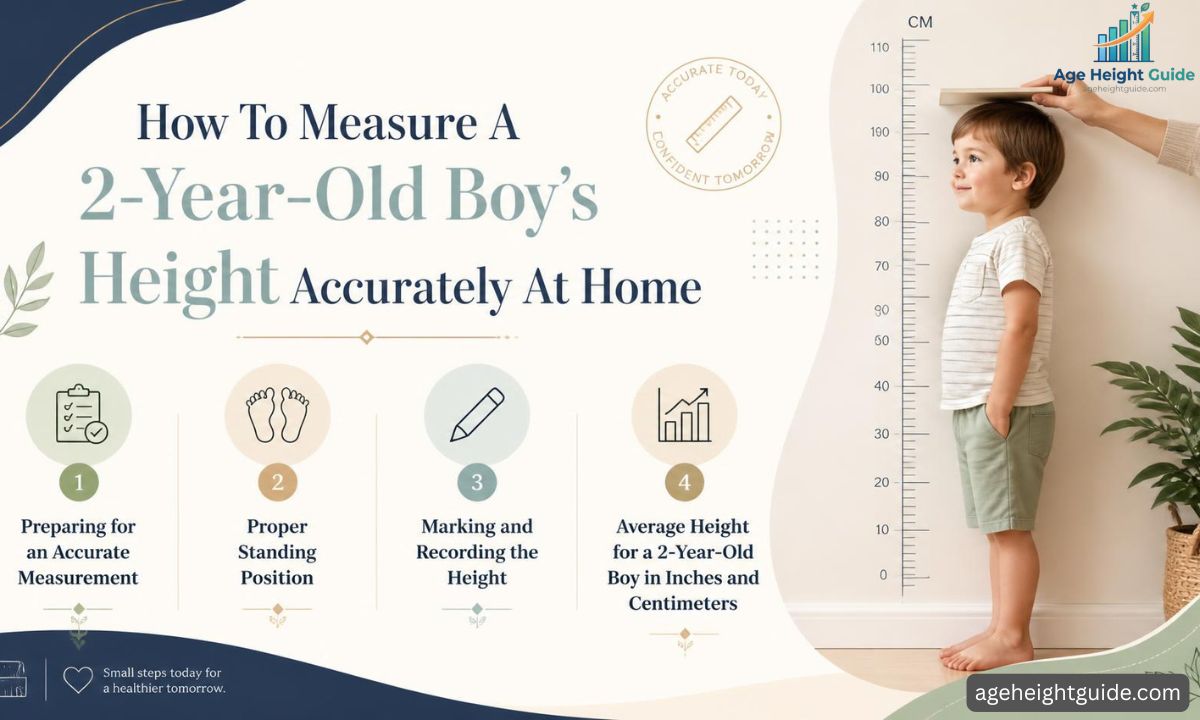
Accurate measurements can help you keep track of your child’s growth pattern between routine healthcare visits. You don’t need complicated equipment, but you do need a flat surface and consistent technique.
At age two, children are generally measured standing rather than lying down. WHO provides height-for-age standards for children from age 2 through 5 years, making accurate standing height especially useful at this stage.
Regular measurements can help you see whether your child’s toddler height is changing steadily over time.
Preparing for an Accurate Measurement
Choose a hard, level floor next to a flat wall. Remove your child’s shoes and bulky clothing that could affect the measurement.
Have your toddler stand naturally with his feet flat on the floor. Use a book or another flat object to mark the highest point of his head.
For better height measurement accuracy, try to use the same wall, equipment, and technique each time. Record the date along with the measurement so you can compare results later.
Avoid measuring every day. Small differences can come from posture or measurement technique and do not represent meaningful changes in child growth.
Proper Standing Position
To get a reliable average height for a 2-year-old boy, ask your toddler to stand straight against a flat wall. His feet should be flat on the floor, and his heels should be close to the wall.
Encourage him to look straight ahead rather than tilting his head up or down. Keep his body relaxed and avoid making him stretch or stand on his toes.
Two-year-olds can have trouble standing still, so you may need a few attempts. A small distraction or simple game can make the process easier.
The goal is to get a consistent height measurement, not a perfect medical measurement at home.
Marking and Recording the Height
Once your toddler is standing correctly, place a flat, hard object such as a book gently on top of his head. Keep the object level with the floor and mark the point where it meets the wall.
Measure from the floor to the mark and record the result in inches or centimeters.
For useful growth tracking, write down your child’s age and the date of each measurement. Taking measurements every few months is generally more helpful than checking height every day.
Keeping these records allows you to compare measurements over time and see your child’s overall growth pattern.
Average Height for a 2-Year-Old Boy in Inches and Centimeters
Ye very useful hai because users different units mein search karte hain.
Example:
| Measurement | Average Height |
| Inches | 34.3 inches |
| Centimeters | 87.1 cm |
What Growth Patterns Matter More Than Exact Numbers

Knowing the average height for a 2-year-old boy can be helpful, but one measurement does not tell you whether your child is growing well.
Healthcare professionals look at repeated measurements to understand growth velocity and whether a child is generally following his established growth curve.
- Consistency Over Totals: A child who remains around a similar height percentile over time may be growing normally even if he is shorter or taller than average.
- Growth Over Time: Toddlers do not grow at the same rate every month. Periods of faster growth can be followed by slower periods.
- Overall Development: Height should be considered alongside weight, nutrition, activity, and other aspects of your child’s development.
For example, a boy who has consistently measured around the 25th percentile may naturally remain shorter than a boy around the 75th percentile. That difference alone does not mean one child is healthier.
The important thing is to understand your child’s individual growth pattern rather than comparing him with another toddler.
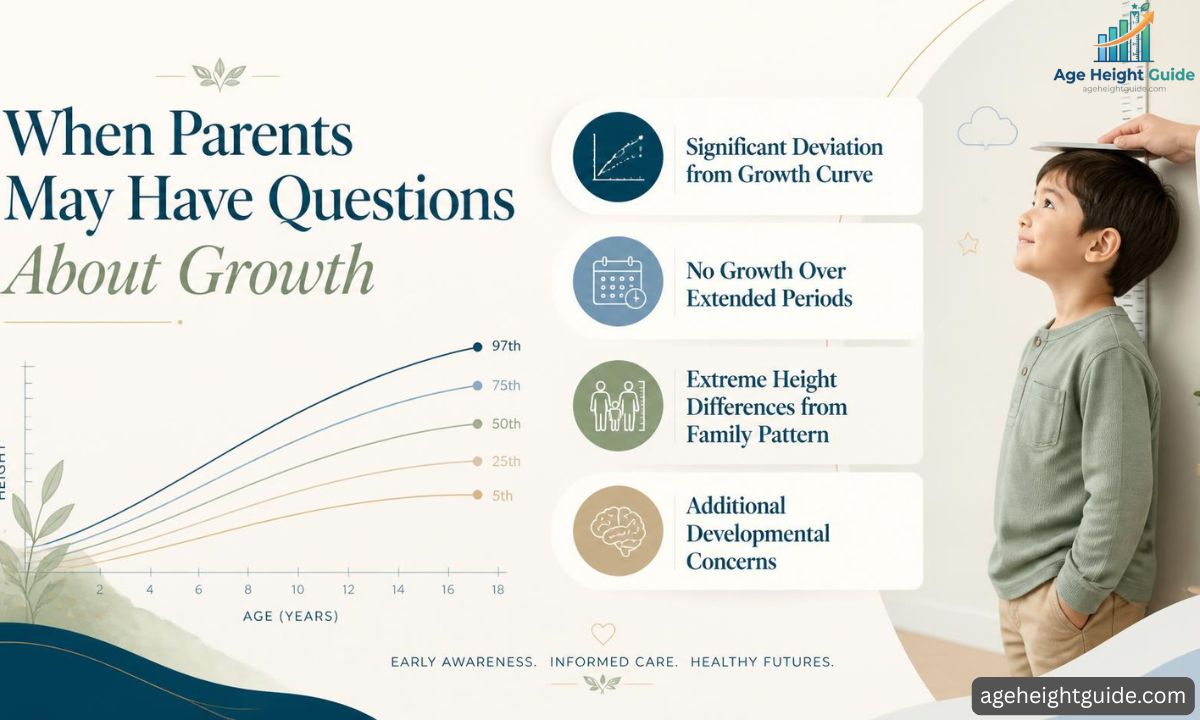
When Parents May Have Questions About Growth

Most differences in 2-year-old boy height are normal. Children can grow at different rates, and a toddler who is shorter or taller than the average height for a 2-year-old boy may still be perfectly healthy.
However, parents should discuss growth concerns with a pediatrician when a child’s measurements show a noticeable change over time or when height concerns occur alongside other health or developmental issues.
Significant Deviation from Growth Curve
If your child’s height moves across several growth percentiles over time, it is worth discussing the pattern with his pediatrician.
A change in percentile does not automatically mean something is wrong. Normal growth spurts, measurement differences, and short-term changes can affect individual readings.
However, repeated measurements that show a significant change in your child’s growth curve can help a pediatrician decide whether further assessment is appropriate.
No Growth Over Extended Periods
Toddlers do not grow at the same rate every month. Growth can happen in spurts, so a short period without an obvious change in height is not necessarily concerning.
If your child shows very little height gain over an extended period, especially when measurements are taken correctly, share your records with his pediatrician.
The doctor can compare current and previous measurements on a child growth chart and consider factors such as nutrition, weight, family height, and overall health.
Extreme Height Differences from Family Pattern
Family genetics can explain many differences in toddler height. Some children naturally grow taller or shorter than their parents might expect.
If your child’s height is significantly different from his family’s typical height pattern, a pediatrician can look at his complete growth history rather than relying on one measurement.
The goal is not to make every child fit the average. Instead, healthcare professionals look for a healthy and consistent growth trajectory and consider whether additional evaluation is needed.
Additional Developmental Concerns
Height development is only one part of your toddler’s overall health. A difference from the average height for a 2-year-old boy does not automatically indicate a problem.
However, height concerns may deserve more attention when they occur alongside other issues, such as poor weight gain, ongoing illness, feeding difficulties, or noticeable developmental concerns.
If several concerns appear together, speak with your child’s pediatrician. They can review his growth chart, previous measurements, weight, nutrition, and overall development to determine whether further evaluation is needed.
Most children with variations in toddler height are healthy. The purpose of monitoring is to understand your child’s individual growth pattern and identify changes that may need professional attention.
Tracking Your Child’s Growth As A Meaningful Family Record
Tracking your child’s height can be useful for understanding growth patterns and keeping a record of important childhood milestones.
Instead of focusing only on whether your child is close to the average, record measurements over time. A series of accurate measurements can show how your child’s height percentile and growth pattern change as he gets older.
You can keep these records in a notebook, on a digital chart, or on a wall-mounted growth chart for toddlers. Bringing your records to healthcare visits can also make it easier to discuss any growth concerns.
Creating Daily Rituals Around Measurement
You don’t need to measure your toddler every day. In fact, frequent measurements can make tiny differences seem more important than they are.
A better approach is to measure your child every few months or around meaningful milestones, such as birthdays.
You can make the process fun by turning it into a simple family routine. As your child gets older, he may enjoy seeing how much he has grown since the previous measurement.
These small moments can make growth tracking feel positive rather than stressful, while still giving you a useful record of your child’s development.
Visual Documentation in Your Home
A growth chart for boys can make it easy to record your child’s height while also creating a visual reminder of how quickly childhood passes.
Instead of keeping every measurement in a notebook, you can mark important milestones directly on a wall growth chart. Over time, those marks create a simple visual history of your child’s height growth.
You can also take photographs at different ages. Pictures of your child standing beside the chart can show changes that numbers alone cannot capture.
Comparing Siblings and Generations
Siblings do not need to have the same height at age two. One child may be taller at this age while another may grow more quickly later.
When comparing siblings, focus on each child’s individual growth curve rather than deciding which child is growing “better.” Genetics, birth patterns, nutrition, and natural growth differences can all influence height.
Some families also enjoy comparing current measurements with parents’ or grandparents’ childhood records. These comparisons can reveal interesting family growth patterns, but they should not replace a pediatrician’s assessment when you have concerns.
Transitioning Growth Records into Keepsakes
The measurements you record today can become meaningful memories as your child grows older.
A toddler growth chart can document milestones from the early years and provide a visual reminder of how quickly your child’s height changes.
Parents can preserve these records through photographs, handwritten notes, or a dedicated height chart for boys. Years later, those simple marks can help tell the story of your child’s journey from toddlerhood to school age and beyond.
Building Confidence Through Progress
As children grow older, seeing their own height growth can help them understand that development happens gradually. A growth chart gives them a simple way to see how much they have changed over time.
Parents can focus on celebrating progress instead of comparing their child’s height with friends, siblings, or other children. Being taller or shorter than the average height for a 2-year-old boy does not determine a child’s health, abilities, or worth.
A positive approach to child growth can help children feel comfortable with their individual development. The goal is to support healthy habits and celebrate each stage of childhood.
Final Thoughts
Understanding the average height for a 2-year-old boy gives parents a helpful reference point, but the average should never be treated as a target. At 24 months, the WHO median height for boys is about 87.1 cm (34.3 inches), while healthy children can naturally measure above or below this point.
Your child’s height percentile, previous measurements, growth velocity, family genetics, nutrition, and overall development provide much more useful information than one number.
If you want to track your toddler’s growth, measure his height consistently every few months and record the date and measurement. If you notice a major change in his growth curve, very little height gain over an extended period, or other health concerns, discuss them with his pediatrician.
Every child has an individual growth pattern. Understanding that pattern can help you monitor development without worrying unnecessarily about whether your child is exactly average.
Frequently Asked Questions
What height range is considered normal for 2-year-old boys?
There is no single normal height for a 2-year-old boy. At 24 months, the WHO median height for boys is about 87.1 cm (34.3 inches), but healthy boys can be shorter or taller than the median. The best way to understand your child’s height percentile is to compare his measurement with an age- and sex-specific growth chart. His previous measurements and overall growth pattern also matter.
A child who consistently follows a lower or higher percentile can still be growing normally. If his growth curve changes significantly over time, talk with his pediatrician.
How much do boys typically grow between ages 2 and 2.5?
After age two, growth usually slows compared with infancy, but every toddler grows at a different rate. Some boys have growth spurts, while others grow gradually. Instead of focusing on an exact height increase, track your child’s height growth over time. If growth slows significantly or stops, discuss it with his pediatrician.
What factors influence how tall my toddler will be?
Several factors can influence toddler height, with genetics playing an important role. Nutrition, overall health, medical conditions, hormones, family growth patterns, and development can also affect child growth.
Being shorter or taller than the average height for a 2-year-old boy doesn’t automatically mean there’s a problem. Healthcare professionals look at the child’s overall growth history rather than focusing on one measurement.
How does nutrition affect my toddler’s growth and height?
Good nutrition supports toddler growth, bone development, and overall health. A balanced diet with protein, calcium, vitamin D, iron, fruits, vegetables, and whole grains helps support healthy height growth.
Poor nutrition may slow growth, but extra food cannot make a child taller than his natural genetic potential. If your toddler has feeding problems or poor weight gain, talk to a healthcare professional.
How can I track my child’s growth at home?
To track your child’s height growth, have him stand barefoot on a level floor against a flat wall. Keep his feet flat and eyes facing forward.
Place a flat book on his head, mark the wall, and measure from the floor to the mark. Record the height, date, and age every few months to monitor his growth pattern. You can also record the measurements on a toddler growth chart and compare them with pediatric checkups.
Why is it important to monitor my toddler’s height development?
Monitoring toddler height helps track your child’s growth curve and height percentile over time. One measurement isn’t enough to show a complete picture.
If your child’s height changes noticeably or occurs with poor weight gain or other concerns, talk to a pediatrician. Most children above or below the average height for a 2-year-old boy are healthy and simply follow their own growth pattern.
Is 32 inches short for a 2-year-old boy?
A height of 32 inches is below the median for a 2-year-old boy, but being shorter than average does not automatically mean there is a problem. Your child’s age in months, family height, previous measurements, and growth curve are important when evaluating toddler height.
What factors affect a 2-year-old boy’s height?
Genetics is a major factor in child height, but nutrition, overall health, family growth patterns, hormonal factors, and long-term medical conditions can also influence toddler growth.

Stoke is the author behind Age Height Guide, creating simple and informative content about average height, age, growth, and related measurements.