


Every child grows at a different pace, so there is no single height that every 2-year-old girl should reach. Still, knowing the average height for a 2-year-old girl can help parents understand where their child falls on a growth chart and follow her growth over time.
At 2 years old, a girl’s height can vary because of genetics, family history, nutrition, health, and growth patterns. A child who is shorter or taller than average may still be healthy if she continues to grow at a steady rate.
For most parents, the 50th percentile is a useful starting point. It represents the middle of the height range for girls of the same age. However, doctors look at the child’s complete growth pattern rather than one height measurement.
The sections below explain typical 2-year-old girl height ranges, growth percentiles, growth rates, and the factors that can affect toddler growth. You’ll also learn when a height difference is usually normal and when it may be worth discussing with a pediatrician.
You can also read: Average Height for a 14-Year-Old Boy: Ultimate & Easy
Key Takeaways:
- The average height for a 2-year-old girl is a useful reference, but children can naturally be shorter or taller than the average.
- A growth chart and height percentile provide more useful context than one measurement alone.
- Genetics, nutrition, sleep, health, and family history can all influence a child’s growth.
- A steady growth pattern over time is often more important than reaching a specific percentile.
- Toddlers may grow in spurts, so height does not always increase by the same amount every month.
- Accurate height measurements help parents and doctors track child growth more reliably.
- Parents should talk with a pediatrician if growth slows suddenly, stops, or changes noticeably across several measurements.
Average Height For 2-Year-Old Girl
The average height for a 2-year-old girl is about 34 inches (86 cm) at the 50th percentile on commonly used growth references. However, healthy girls can be shorter or taller than this number.
| Age | Approx. Median Height |
| 24 months | 34.0 inches (86.4 cm) |
| 30 months | 35.7 inches (90.7 cm) |
| 36 months | 37.4 inches (95.0 cm) |
These numbers are reference points, not height goals. Your daughter’s growth percentile can change slightly over time, and her individual growth pattern matters more than reaching the exact average.
For a better understanding of your child’s growth, compare her height with a suitable growth chart and previous measurements. A pediatrician can also assess her height alongside weight, development, family history, and overall health.
Typical Height Ranges And Growth Percentiles

The average height for a 2-year-old girl is best understood through a growth chart rather than one fixed number. At 24 months, girls can have different heights and still develop normally.
For a quick reference, the 50th percentile represents the middle of the growth range. A girl above or below this point is not automatically healthier or less healthy. Doctors usually look at her height percentile, past measurements, and overall growth pattern together.
| Age | What to Look At | Why It Matters |
| 24 months | Height and percentile | Shows where your child falls on the growth chart |
| 2–2½ years | Change in height | Helps show her growth rate |
| 2½–3 years | Height trend | Shows whether growth stays consistent |
Understanding Growth Chart Percentiles
A growth percentile compares your child’s height with other children of the same age and sex. For example, a girl at the 50th percentile is around the middle of the reference group.
A child at the 25th percentile is shorter than many children her age, but that does not mean something is wrong. She may simply have a different genetic growth pattern.
What matters most is how her measurements change over time. If she continues to follow a similar percentile pattern, that can be reassuring. A sudden change across several percentile lines may need further review.
2-Year-Old Girl Height Chart
A 2-year-old girl height chart makes it easier to understand how height changes across different percentiles. Percentiles compare a child’s height with other girls of the same age and sex.
| Height Percentile | What It Shows |
| 3rd percentile | Around the lower end of the reference range |
| 10th percentile | Shorter than most girls in the reference group |
| 25th percentile | Below the middle of the reference group |
| 50th percentile | Middle of the reference group |
| 75th percentile | Above the middle of the reference group |
| 90th percentile | Taller than most girls in the reference group |
| 97th percentile | Around the upper end of the reference range |
A percentile is not a grade or a measure of health. A girl at the 10th percentile may be perfectly healthy, just as a girl at the 90th percentile may be.
Doctors pay more attention to the child’s growth curve and changes over time. A series of accurate measurements gives more useful information than one height reading.
What the Numbers Actually Mean
Growth chart numbers are reference points, not pass-or-fail targets. Two healthy 2-year-old girls may have different heights and still be developing well.
For example, one child may stay near the 20th percentile while another stays near the 80th percentile. Both can have healthy growth if their height increases steadily.
Parents should also remember that small measurement differences can happen. Shoes, posture, measuring technique, or different equipment can affect the result.
Regional and Population Variations
Height can differ between populations because of genetics, family history, nutrition, health, and living conditions. These differences are one reason doctors do not judge a child’s health from height alone.
A child’s parents can also provide useful context. If both parents are naturally shorter or taller, their child may follow a similar pattern.
When checking your daughter’s height, focus on her own growth trend. A single number gives only a snapshot, while repeated measurements show how she is growing over time.
What Height Percentile Is Normal For A 2-Year-Old Girl?
There is no single height percentile that every 2-year-old girl should reach. Healthy children can fall at different points on a growth chart.
A girl may be at the 15th percentile, 50th percentile, or 85th percentile and still have normal child growth. What matters most is whether she continues to grow at a steady rate.
For example, a child who has followed the 25th percentile for several years may be developing normally even though she is shorter than the average. A sudden drop across several percentile lines may be more important than simply being on a lower percentile.
Parents should also remember that growth charts are reference tools. A pediatrician considers genetics, family history, weight, development, health, and growth pattern when assessing a child’s growth.
If your daughter’s height seems very different from her usual pattern, discuss it with her pediatrician rather than judging her growth from one percentile alone.
How Fast Do 2-Year-Old Girls Grow

Growth usually slows after the first two years of life. During the toddler years, a child may gain height in small steps rather than at a steady rate every month.
For parents tracking a 2-year-old girl’s growth, the overall trend matters more than a single monthly measurement. Your daughter may grow quickly for a short time and then show little change for several weeks.
After age 2, many children continue to grow at a steady pace through early childhood. The exact rate can differ from one child to another because of genetics, nutrition, health, and individual growth patterns.
Monthly Growth Expectations
Toddlers do not always grow at the same rate each month. Growth spurts are common, so you may notice periods when your daughter seems to gain height quickly followed by slower periods.
This can make home measurements confusing. Measuring too often may also make small differences seem more important than they are.
Instead, focus on measurements taken under similar conditions. Use the same wall, keep your child barefoot, and make sure she stands upright. Recording measurements over time gives a clearer picture of her growth rate.
Comparing First and Second Year Growth
Children usually grow much faster during infancy than during the toddler years. During the first year, growth is rapid as babies develop from newborns into active toddlers.
Growth then slows during the second year. This change is normal and continues into early childhood.
| Growth Period | General Pattern |
| Birth to 12 months | Rapid growth |
| 12 to 24 months | Growth begins to slow |
| Age 2 to 3 years | Steady but slower growth |
| After age 3 | Growth remains fairly steady until puberty |
The exact amount of growth can vary between children. That is why doctors consider repeated measurements, growth charts, and the child’s overall health instead of expecting every child to gain the same number of inches.
If your daughter’s height continues to increase along her usual growth percentile, a slower pace after age 2 is often part of normal development.
How Much Should A Girl Grow After Age 2?
After age 2, children usually continue to grow at a slower pace than they did during infancy. Growth can also happen in spurts, so your daughter may grow more during some periods and less during others.
During the preschool years, many children gain height steadily each year. However, the exact amount varies because of genetics, nutrition, health, and individual growth patterns.
Instead of expecting your daughter to gain an exact number of inches every month, look at her overall growth rate over time.
| Age | General Growth Pattern |
| Around 2 years | Toddler growth continues at a slower rate |
| 2–3 years | Steady height gain with possible growth spurts |
| 3–5 years | Gradual, fairly steady growth |
| Before puberty | Growth continues until the later childhood growth spurt |
A pediatrician can compare your child’s measurements over time to determine whether her growth pattern is progressing as expected.
Factors That Can Affect A Toddler’s Height
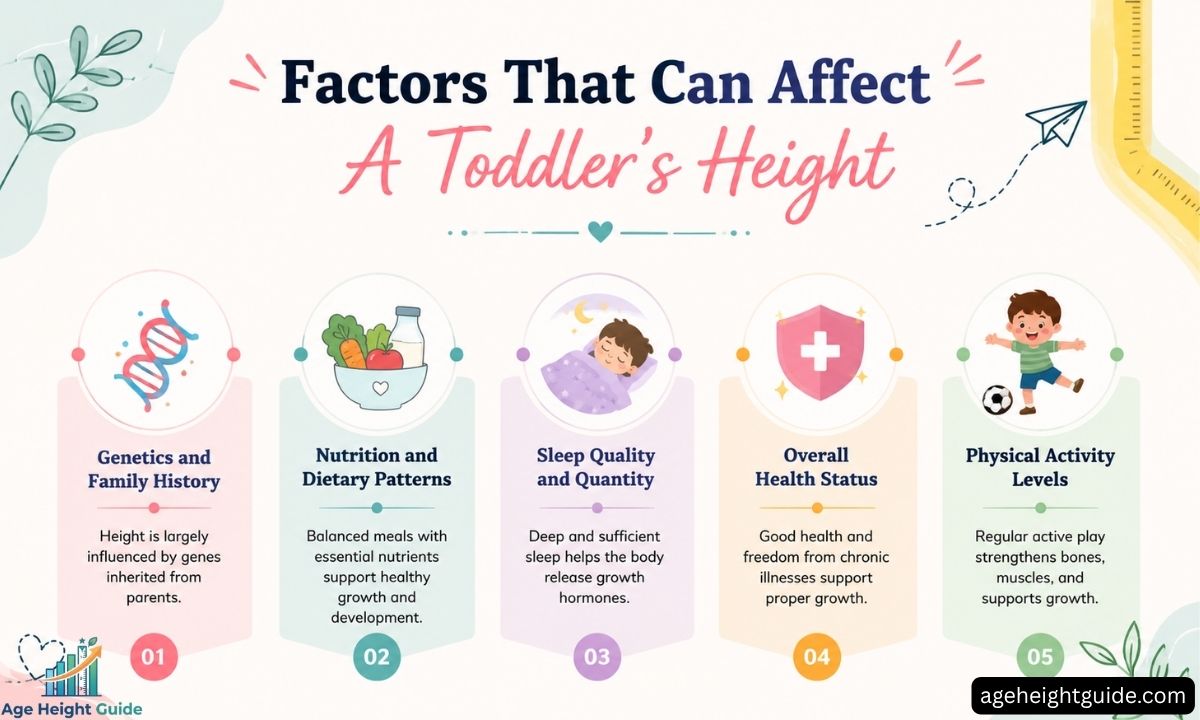
Many factors can influence a child’s height during the toddler years. Genetics plays a major role, but it is not the only factor. Nutrition, sleep, overall health, physical activity, and family history can also affect healthy growth.
A child’s height should always be viewed as part of her wider development. A toddler who is shorter than average may still be growing normally when her height follows a steady pattern on her growth chart.
Genetics and Family History
Genetics and family history have a strong influence on a child’s height. Children often grow within a range that reflects the heights of their parents and other close relatives.
If both parents are shorter, their daughter may also be shorter than average. Likewise, taller parents may have children who naturally grow taller.
This does not mean genetics determines an exact adult height. Several genes work together to influence growth, and children can differ even within the same family.
Nutrition and Dietary Patterns
Good nutrition gives toddlers the nutrients they need for healthy development. A balanced diet can include fruits, vegetables, whole grains, dairy or suitable alternatives, protein, and healthy fats.
Important nutrients include protein, calcium, vitamin D, iron, and other essential vitamins and minerals. Regular meals and a varied diet can help support normal bone and body development.
Picky eating is also common at this age. If your child eats very little, loses weight, or has ongoing feeding problems, discuss these concerns with a healthcare professional.
Sleep Quality and Quantity
Sleep is an important part of toddler development. During sleep, the body carries out many processes that support growth, learning, and recovery.
Most 2-year-olds need about 11 to 14 hours of sleep in 24 hours, including naps. A regular bedtime routine can help your child get enough rest.
Poor sleep alone does not mean a child will be short. However, healthy sleep habits support overall well-being and normal development.
Overall Health Status
A child’s general health can affect her growth rate. Long-term health conditions, poor nutrition, or other ongoing problems may sometimes interfere with normal growth.
This is why pediatricians look at several measurements over time. They may also consider appetite, weight, development, family history, and other signs of health.
A single short measurement does not usually provide enough information to identify a problem. Repeated measurements help show whether a child’s growth pattern is staying consistent.
Physical Activity Levels
Active play supports strong bones, muscles, balance, and overall health. Toddlers can stay active through simple activities such as walking, running, climbing, dancing, and playing outdoors.
Physical activity does not make a child taller than her genetic potential. However, regular movement supports healthy physical development.
The goal is not to increase height through exercise. Instead, encourage age-appropriate play and movement as part of a healthy daily routine.
When Height Variations Are Completely Normal
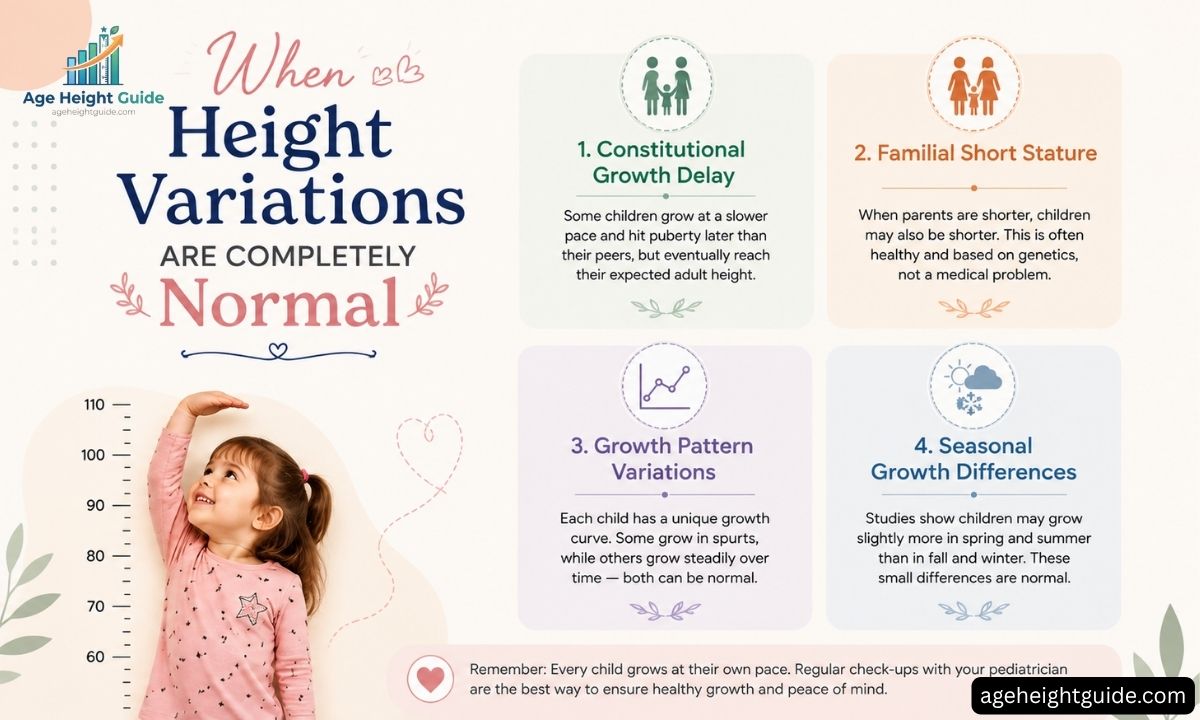
Not every 2-year-old girl will have the same height. Some children are naturally shorter, while others are taller. A difference from the average does not automatically mean there is a health problem.
The most useful sign is often a steady growth pattern over time. If your daughter continues to gain height and remains on a similar part of her growth chart, her individual pattern may simply be normal for her.
Constitutional Growth Delay
Some children grow more slowly during early childhood and catch up later. This pattern is sometimes called constitutional growth delay.
These children may be shorter than their peers for a period but continue to grow at a normal pace. Family history can provide useful clues. A parent or close relative may also have experienced later growth during childhood.
A slower growth pattern should still be discussed with a pediatrician when there are concerns. A healthcare professional can look at your child’s measurements and development over time.
Familial Short Stature
Familial short stature means a child is shorter because shorter height tends to run in the family. These children can remain below the average height while continuing to grow normally.
For example, if both parents are naturally short, their daughter may also have a lower height percentile. She may be healthy even if she does not reach the average height for her age.
The key is usually a consistent growth rate rather than reaching the 50th percentile.
Growth Pattern Variations
Children do not grow at the same speed every month. Some have periods of faster growth followed by slower periods. These normal growth spurts can make height changes look uneven.
This is why parents should avoid judging their child’s growth from one measurement. Several accurate measurements taken over time give a much clearer picture.
A girl who is below the average height can still be developing normally if she continues to follow her expected growth curve.
Seasonal Growth Differences
Some studies have reported small changes in children’s growth rate during different seasons. These differences can occur naturally and are usually much less important than a child’s long-term growth pattern.
Seasonal changes should not be used alone to explain a major change in height. If your daughter’s growth slows noticeably or her growth percentile changes sharply, talk with her pediatrician.
Overall, being shorter or taller than other children is often normal. What matters most is whether your daughter continues to grow healthily and consistently.
When To Talk To A Pediatrician About Growth

Being shorter or taller than the average height for a 2-year-old girl does not automatically mean something is wrong. Children follow different growth patterns, and some naturally grow faster or slower than others.
A pediatrician looks at your daughter’s growth chart, previous height measurements, weight, development, family history, and overall health. This helps them decide whether a change is part of normal growth or needs further evaluation.
Falling Off Growth Curves
A noticeable change in your daughter’s growth percentile can be a reason to seek medical advice. For example, a child who has followed one percentile range for a long time but then drops across several major percentile lines may need a closer look.
One unusual measurement does not always indicate a problem. Measurement errors can happen, especially when checking toddler height at home.
Your pediatrician can repeat the measurement and compare it with earlier records to assess her long-term growth curve.
Concerning Growth Rates
A child who grows much more slowly than expected over several measurements may need an evaluation. The important factor is the pattern over time, not one short period of slower growth.
Your pediatrician may review your child’s growth rate, nutrition, health history, and family heights. They can also check whether her height and weight are developing in a balanced way.
If growth appears to stop or slow for a prolonged period, do not rely on online height charts alone. Professional assessment can help identify the cause.
Additional Concerning Symptoms
Slow growth is more important to discuss when it occurs with other symptoms. Contact your child’s healthcare professional if you notice concerns such as:
- Ongoing poor appetite or feeding problems
- Unexplained weight loss
- Persistent digestive problems
- Unusual tiredness or low energy
- Delayed developmental milestones
- Frequent or ongoing illness
- A clear change in your child’s usual growth pattern
These signs do not automatically mean that a child has a growth problem. They simply provide additional information that a healthcare professional may need to consider.
Disproportionate Growth Patterns
Doctors also consider body proportions when assessing child growth. If your daughter’s head, trunk, arms, or legs appear noticeably out of proportion, mention it during a medical visit.
A pediatrician can examine her overall physical development and compare her measurements with appropriate reference charts.
Parental Intuition
Parents often notice changes before they appear clearly on a growth chart. If you are worried about your daughter’s height, growth, weight, or development, it is reasonable to discuss your concerns with her pediatrician.
You do not need to wait until your child reaches a specific percentile before asking for advice. Your child’s complete growth pattern provides more useful information than one number.
Early questions can also give parents reassurance when a child’s height is simply part of her normal family growth pattern.
How To Measure A 2-Year-Old Girl’s Height At Home
Accurate measurement is important when tracking a 2-year-old girl’s height. A small change can sometimes come from posture or measuring technique rather than actual growth.
Follow these simple steps:
- Remove your child’s shoes and bulky hair accessories.
- Have her stand on a firm, flat floor.
- Keep her feet flat and close together.
- Ask her to stand as straight as comfortably possible.
- Keep her head in a neutral position.
- Place a flat object gently against the top of her head.
- Mark the wall or read the measuring tool.
- Record the height and date for future comparison.
Try to use the same method each time you measure. A growth chart ruler can make home tracking easier, but home measurements should not replace measurements taken by a healthcare professional.
For medical decisions, your pediatrician can take an accurate measurement and plot it on the appropriate growth chart.
Ways Families Track Growth Over Time

Tracking your daughter’s height over time can help you understand her growth pattern instead of focusing on one measurement. Regular records also make it easier for a pediatrician to compare changes across different visits.
For the most useful results, measure your child in a consistent way and record the date with each measurement. A growth chart can then help you see how her height changes as she gets older.
Traditional Wall Markings
Many families use a wall or doorframe to record their child’s height. It is a simple way to create a visual history of toddler growth.
Choose one safe location and measure your daughter under similar conditions each time. Keep the marks dated so you can see how much she has grown between measurements.
If you move or repaint the room, consider transferring the measurements to a separate record or growth chart.
Dedicated Growth Charts
A dedicated growth chart ruler provides an easy way to record height without marking the wall. Many designs can also become a keepsake as your child grows.
For accurate tracking, place the chart on a flat, stable wall and follow the measurement instructions carefully. The chart itself does not replace a medical growth chart used by a pediatrician.
Pediatric Visit Records
Measurements taken during regular pediatric visits provide an important record of your child’s growth and development. Healthcare professionals can plot height and weight on standardized growth charts and compare them with previous measurements.
These records can show whether your daughter is following a consistent growth curve. They can also help identify a significant change that may need further evaluation.
Parents can keep copies of growth measurements at home so they can easily review their child’s progress over time.
Using Professional Tools for Accuracy
Accurate measurement matters when tracking a 2-year-old girl’s height. At home, measure your child without shoes on a firm, level surface.
Have her stand as straight as possible with her feet flat and her head in a neutral position. Use a reliable measuring tool and record the result to the nearest appropriate unit.
Avoid comparing measurements taken with different methods. Small differences can occur because of posture, equipment, or measuring technique.
Photo Documentation and Journals
Photos and growth journals can add a personal touch to your child’s height milestones. You can record the date, height, age, and a short note about what your daughter was doing at that time.
For example, you might note her favorite toy, a new skill, or a memorable birthday. These details turn simple measurements into a meaningful record of childhood development.
A journal should complement, not replace, your child’s medical growth records. For health decisions, rely on accurate measurements and guidance from your pediatrician.
Final Thoughts
Understanding the average height for a 2-year-old girl gives parents a helpful starting point, but the average is not a goal that every child needs to reach. Girls can be shorter or taller than average and still have healthy growth and development.
What matters most is your daughter’s growth pattern over time. A consistent increase in height can be more meaningful than one measurement or a single growth percentile.
Remember that genetics, family history, nutrition, sleep, health, and physical activity can all influence growth. Your daughter’s height may also change in spurts, so small differences from month to month are not always concerning.
Keep a record of her height and compare measurements taken over time. If you notice a major change in her growth curve, very slow growth, or other health or developmental concerns, speak with her pediatrician.
Every child has her own growth journey. The goal is not to make every child the same height. It is to understand her individual pattern and support healthy toddler growth as she develops.
Frequently Asked Questions
What is considered normal growth range for toddler girls?
There is no single height that is considered normal for every toddler girl. The average height for a 2-year-old girl is a useful reference, but healthy children can be shorter or taller than the average.
Doctors use a growth chart and height percentile to see how a child compares with others of the same age and sex. They also look at her previous measurements and overall growth pattern.
What are the key growth milestones from birth to age 3?
Growth is fastest during infancy and gradually slows during the toddler years. By age 2, most children are growing at a slower but steady rate.
Between ages 2 and 3, your daughter’s height, weight, motor skills, language, and social development continue to change. The exact pace can vary from child to child.
Rather than expecting every child to reach the same milestone at the same time, parents should focus on steady growth and development.
What is the average height for a 2 1/2 year old girl?
A 2½-year-old girl is usually taller than she was at 24 months, but the exact height varies. Her growth percentile and previous measurements provide more useful information than one average number.
If your daughter continues to follow a similar growth curve over time, a height above or below the average may still be normal.
Why is it important for parents to track their child’s growth?
Tracking height helps parents and healthcare professionals see changes in a child’s growth pattern over time. It can also help identify a significant change that may need further attention.
Keeping dated measurements makes it easier to compare your child’s height percentile from one visit to the next. It also creates a useful record of her early childhood growth.
How can you personalize a growth chart to reflect your family’s unique story?
A home growth chart can be more than a measurement tool. Families can add dates, names, photos, or short notes about important childhood moments.
You can record your daughter’s height alongside birthdays, new skills, or other memorable events. This creates a personal keepsake while still keeping her actual growth measurements organized.
When should you consult your pediatrician about your child’s growth?
Speak with your pediatrician if your daughter’s growth suddenly slows, stops, or changes noticeably across several measurements. You should also seek advice if height concerns occur alongside weight loss, poor appetite, persistent illness, or developmental concerns.
A pediatrician can review her growth chart, family history, health, and previous measurements. This provides a much better assessment than comparing her height with other children or relying on a single number.
Is 32 Inches Short For A 2-Year-Old Girl?
A height of 32 inches can be below the middle of the growth chart for a 2-year-old girl, but it does not automatically mean that she is unhealthy. A pediatrician will consider her height percentile, previous measurements, family history, and overall growth pattern.
Is 34 Inches Tall For A 2-Year-Old Girl?
A height of 34 inches is close to the middle of commonly used growth references for a 2-year-old girl. However, children naturally vary in height. Her growth percentile and steady growth over time are more useful than comparing her with one average number.
What Is The Average Height Of A 2-Year-Old Girl In Feet?
The average height for a 2-year-old girl is roughly 2 feet 10 inches. The exact average can vary slightly depending on the growth reference used. Healthy children can be shorter or taller than this measurement.
Is 30 Inches Too Short For A 2-Year-Old Girl?
A height of 30 inches would be well below the middle of the usual height range for a 2-year-old girl. However, one measurement is not enough to determine whether there is a growth concern. A pediatrician can check the measurement, growth chart, previous height records, and overall health.
How Can I Help My 2-Year-Old Girl Grow Taller?
Parents cannot change a child’s genetic height potential, but they can support healthy growth and development with balanced nutrition, enough sleep, regular physical activity, and routine healthcare. If you have concerns about slow growth, speak with your pediatrician.
Can A Short 2-Year-Old Girl Catch Up In Height?
Some children who are shorter during the toddler years grow faster later. Family history can provide useful clues about a child’s natural growth pattern. A pediatrician can assess whether your daughter’s growth rate and height percentile are appropriate for her.
Should I Worry If My 2-Year-Old Girl Is Shorter Than Other Children?
Not necessarily. Children grow at different rates, and some healthy children naturally remain shorter than their peers. What matters most is her growth pattern over time. A sudden change in growth or a prolonged slowdown should be discussed with a pediatrician.

Stoke is the author behind Age Height Guide, creating simple and informative content about average height, age, growth, and related measurements.