


Does lifting weights stunt your growth? This is one of the most common questions parents ask when a child or teenager starts strength training.
The short answer is no. Properly designed and supervised strength training has not been shown to stunt normal growth or make healthy children shorter.
The concern usually comes from growth plates. These areas of developing tissue help children’s bones grow longer. Because they are still developing during childhood and adolescence, parents may worry that lifting weights could damage them.
That concern is understandable. Growth plate injuries can happen. However, a growth plate injury is not the same thing as normal, controlled resistance training.
Research has looked at this question directly. One evidence-based review examined 22 reports involving resistance training in prepubertal and early-pubertal youth. The review found improvements in strength without evidence that the training negatively affected height or weight growth.
So, does lifting weights stunt your growth? Current evidence does not support that claim when training is properly designed and supervised.
The bigger issues are poor technique, inappropriate resistance, inadequate supervision, excessive training, insufficient recovery, and not eating enough to support both growth and exercise.
For parents, the goal should not be to keep children away from all resistance exercise. It should be to make sure they learn how to train safely.
You can also read: Average Height for a 12-Year-Old Girl: Healthy Growth Guide
The short answer, with the evidence behind it
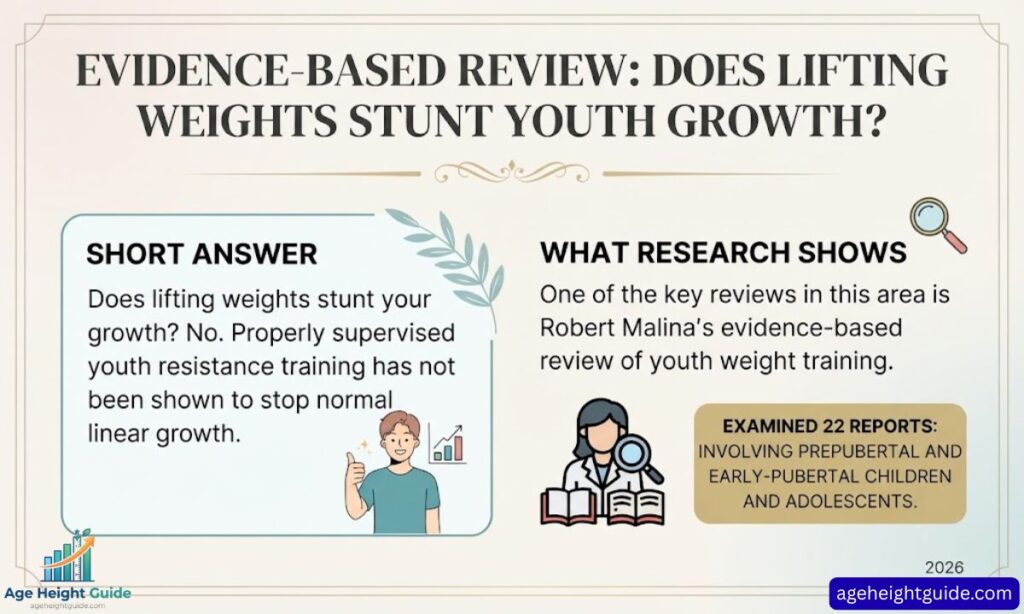
Does lifting weights stunt your growth? No. Properly supervised youth resistance training has not been shown to stop normal linear growth.
The American Academy of Pediatrics has reviewed resistance training in children and adolescents. Its guidance supports appropriately designed strength training when young people receive proper instruction, use suitable resistance, and train with appropriate supervision.
Children can also become stronger before puberty. Early strength gains are often linked to better coordination and nervous-system control rather than simply gaining large amounts of muscle.
Here is the evidence in simple terms:
| Question | Evidence-based answer |
| Does lifting weights stunt your growth? | Properly designed youth resistance training has not been shown to stunt growth. |
| Can children gain strength? | Yes. |
| Can growth plates be injured? | Yes, but injuries are not an inevitable result of strength training. |
| Can children safely use resistance? | Yes, when the program matches their age, skill, and ability. |
| Is heavy lifting automatically dangerous? | No, but inappropriate loading and poor technique increase risk. |
| Should young beginners chase maximum lifts? | No. Technique and controlled progression should come first. |
| Does exercise guarantee extra height? | No. |
| Does nutrition matter? | Yes, especially for growing and highly active children. |
| Does recovery matter? | Yes. |
The important distinction is between appropriate youth strength training and unsupervised attempts to lift very heavy loads.
A child learning a controlled squat with suitable resistance is not doing the same thing as a beginner attempting a maximum barbell squat without coaching.
What does the research actually show?
One of the key reviews in this area is Robert Malina’s evidence-based review of youth weight training.
It examined 22 reports involving prepubertal and early-pubertal children and adolescents.
The review found that resistance training could improve muscular strength. Importantly, it did not find evidence of a negative effect on height or weight growth in the programs reviewed.
However, the evidence was not perfect. Only 10 studies systematically monitored injuries, and three injuries were reported among those studies.
That means the research supports a careful conclusion rather than an extreme one.
It does not mean:
Every type of lifting is safe under every circumstance.
It means that properly designed resistance training has not been shown to stunt normal growth.
The injury numbers nobody publishes

Parents should know that strength training is not risk-free.
Children can get injured while lifting weights just as they can while playing football, basketball, gymnastics, soccer, cycling, skiing, or other sports.
The goal of a good program is to reduce preventable risk.
The main factors that can increase risk include:
- Poor exercise technique
- Excessive resistance
- Sudden increases in training volume
- Lack of supervision
- Incorrect equipment setup
- Training while exhausted
- Inadequate recovery
- Ignoring significant pain
- Trying advanced exercises too soon
- Copying adult training programs
The available evidence suggests that supervised youth resistance training has a relatively low injury rate. But the quality of the research varies, and not every injury will be captured in every study.
What do the injury numbers really mean?
The three injuries reported in the Malina review came from only 10 studies that systematically monitored injuries.
That is important context.
It would be misleading to say that only three children in the entire world have ever been injured while lifting weights.
The studies represent specific training programs with specific participants, coaches, exercises, and monitoring systems.
Instead, the evidence tells parents that injuries were uncommon in the supervised programs reviewed.
This is why the answer to ” Does lifting weights stunt your growth should not be based on fear of the word “weights.”
The better question is whether the child is training in a controlled and age-appropriate way.
Where the myth actually came from

The myth has persisted partly because children have open growth plates.
Growth plates are weaker areas of developing bone. An injury in this area can affect bone development in some cases.
Parents therefore made a logical connection:
Growth plates are important for height → weights create force → weights must stop growth.
But the conclusion does not follow.
Physical activity creates forces throughout the body. Running, jumping, landing, changing direction, falling, and playing sports can all place stress on bones and joints.
That does not mean normal movement stops growth.
The same principle applies to resistance exercise.
The concern should be about injury and training quality, not the mere presence of resistance.
Another source of confusion is the use of the word “weightlifting.”
People may use it to describe anything from a child doing light resistance-band exercises to an experienced athlete performing a competitive clean and jerk.
Those are very different activities.
What are growth plates and why do they matter?

Growth plates are areas of cartilage near the ends of many growing bones.
They help bones increase in length during childhood and adolescence.
As a person reaches skeletal maturity, the growth plates gradually close.
Because they are still developing in children and teenagers, injuries involving them deserve attention.
A growth plate injury can occur from significant trauma, including falls, collisions, or other forces.
However, normal supervised resistance exercise is not automatically a growth plate injury.
Can lifting weights damage growth plates?
It is possible for a child to suffer an injury involving a growth plate during physical activity. But properly designed resistance training has not been shown to damage growth plates or stunt normal linear growth.
Risk becomes more concerning when a child:
- Uses resistance that is too heavy
- Has poor technique
- Trains without supervision
- Loses control of equipment
- Repeatedly trains through pain
- Increases training too quickly
Parents should also remember that sports can produce significant forces.
A child who falls while skateboarding or lands awkwardly during gymnastics may experience much more sudden force than during a controlled strength exercise.
What are the warning signs of a growth plate injury?
Parents should pay attention to symptoms such as:
- Significant pain
- Swelling
- Severe tenderness
- Limited movement
- Difficulty putting weight on a limb
- A visible change in the shape of a joint or limb
- Pain that does not improve with rest
- Repeated pain during activity
A suspected fracture or significant injury should be evaluated by a healthcare professional.
The sports where growth plate fractures actually happen
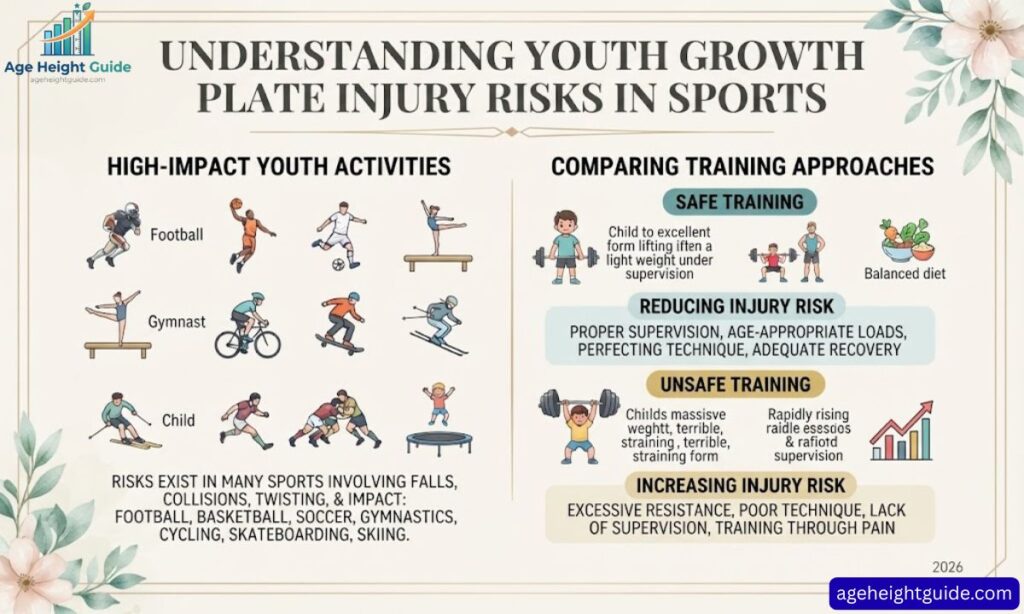
Growth plate injuries are not exclusive to weight training.
They can occur in activities involving falls, collisions, twisting, jumping, or direct impact.
Examples include:
- Football
- Basketball
- Soccer
- Gymnastics
- Cycling
- Skateboarding
- Skiing
- Contact sports
- Jumping activities
- Other high-impact physical activities
This is important because some parents view a gym as inherently dangerous while considering sports automatically safe.
Neither view is accurate.
Every physical activity has some injury risk.
The goal is to manage that risk through proper instruction, appropriate progression, protective equipment where needed, and good recovery.
So if you are wondering, does lifting weights stunt your growth, the answer should not be based on comparing “weights” with “no weights.”
Instead, compare safe training with unsafe training.
Strength training and weightlifting are not the same thing
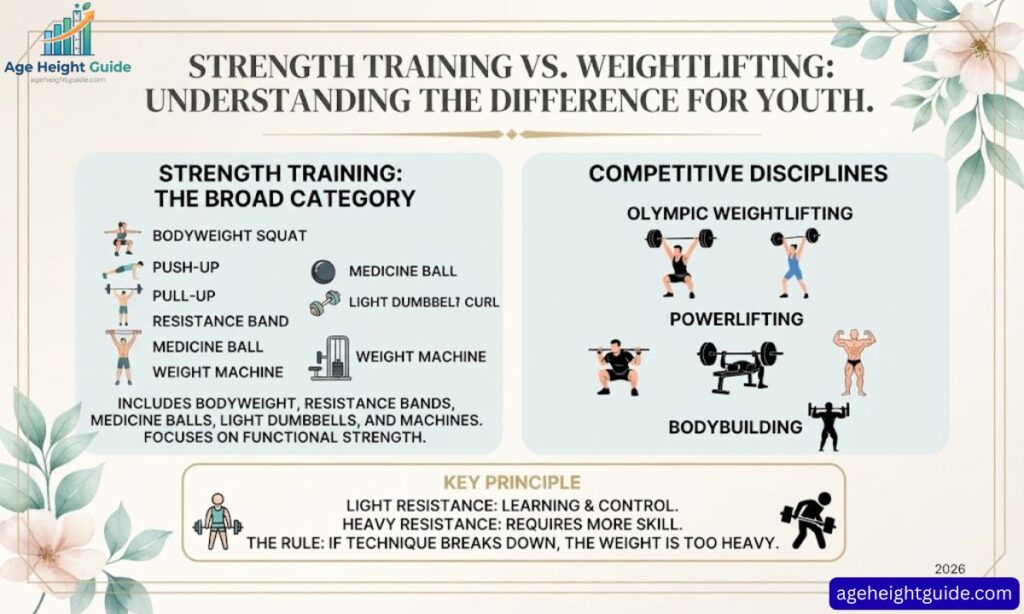
The terms strength training, resistance training, and weightlifting are often used as if they mean the same thing.
They do not.
Strength training is the broad category. It can include:
- Bodyweight squats
- Push-ups
- Pull-ups
- Resistance bands
- Medicine balls
- Light dumbbells
- Weight machines
- Other resistance exercises
Competitive weightlifting usually refers to Olympic lifts such as:
- Snatch
- Clean and jerk
Powerlifting centers around:
- Squat
- Bench press
- Deadlift
Bodybuilding focuses heavily on muscle development and physique.
These activities have different goals and different technical demands.
A young beginner does not need to follow an adult bodybuilding or competitive powerlifting routine.
What is the difference between light and heavy resistance?
Light resistance allows a child to learn the movement while maintaining control.
As skill improves, resistance can be increased gradually.
Heavy resistance is not automatically harmful. However, a heavier load demands more skill and control.
The risk rises if the child uses a load they cannot control.
A useful rule is:
If increasing the weight causes technique to break down, the weight is too challenging for that exercise at that time.
Does heavy lifting stunt growth?
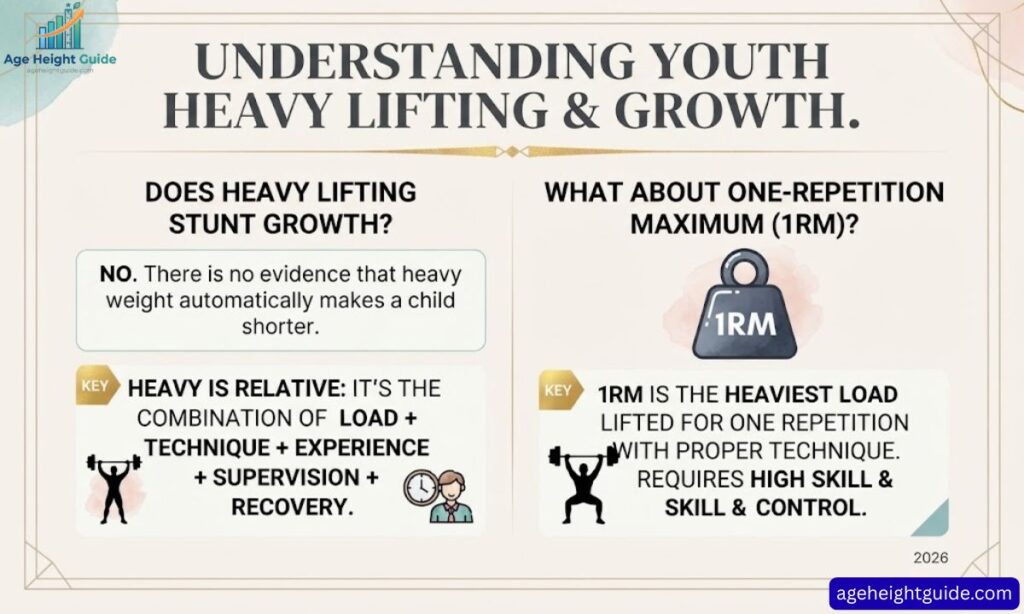
Does lifting weights stunt your growth when the weight is heavy? There is no evidence that a heavy weight automatically makes a child shorter.
However, “heavy” is relative.
A weight that is manageable for an experienced teenager may be inappropriate for a beginner.
The concern is therefore not simply the number printed on the weight.
It is the combination of:
Load + technique + experience + supervision + recovery.
A young athlete may eventually use heavier resistance safely as their skill develops. But there is little reason for a beginner to make maximum lifting the center of every workout.
What about one-repetition maximum testing?
A one-repetition maximum, or 1RM, is the heaviest load that can be lifted for one repetition with proper technique.
Modern pediatric guidance is more nuanced than the old idea that young people must never perform any form of maximum testing.
Under appropriate supervision and testing procedures, strength testing can be performed safely in youth.
However, maximum lifting should not be the main objective for a young beginner.
The priority should be:
Learn the movement → master the technique → build consistency → progress gradually.
What age can a child start strength training?

There is no single age when every child suddenly becomes ready for structured strength training.
Readiness matters.
A child should be able to:
- Follow instructions
- Understand basic safety rules
- Maintain attention
- Perform movements with control
- Communicate discomfort
- Use equipment appropriately
The Mayo Clinic notes that strength training can be included in a child’s fitness routine around age 7 or 8 when the child can follow directions and use proper form.
That does not mean every child of that age needs to start lifting barbells.
For younger children, strength-building can involve:
- Climbing
- Running
- Jumping
- Bodyweight exercises
- Resistance bands
- Movement games
Can an 8-year-old lift weights?
An 8-year-old may participate in age-appropriate resistance exercises if they can follow instructions and maintain good form.
The goal should be movement skill and strength development.
It should not be about seeing how much weight the child can lift.
Can a 10-year-old lift weights?
Yes, a 10-year-old may be able to perform structured resistance exercises with appropriate instruction.
The program should remain age-appropriate and supervised.
Can a 12-year-old lift weights?
Yes.
A 12-year-old can participate in properly designed youth strength training.
At this age, puberty may also be starting or progressing, so physical changes can happen quickly.
The training plan should adapt to the child’s development rather than assuming that every 12-year-old has the same strength or maturity.
Can teenagers lift weights?
Yes.
Teenagers can safely participate in resistance training when they receive proper instruction and use appropriate resistance.
Teenagers may also begin more advanced strength programs as their technique and training experience improve.
The key is progression, not rushing.
Does lifting weights make kids shorter?

Does lifting weights stunt your growth by making children shorter? There is no good evidence that properly supervised strength training makes healthy children shorter.
A child’s height is influenced by many factors, including:
- Genetics
- Puberty timing
- Nutrition
- Overall health
- Hormonal factors
- Chronic illness
- General development
Two children of the same age can have very different heights and still be developing normally.
That is why doctors look at a child’s growth trajectory rather than judging height from one measurement.
What if my child is shorter than classmates?
Being shorter than classmates does not automatically mean something is wrong.
Some children enter puberty earlier. Others enter puberty later.
A child may also naturally be shorter or taller because of family height patterns.
If a child is crossing downward through growth percentiles, growing much more slowly than expected, or showing other concerning symptoms, a pediatrician can review their growth chart and development.
Strength training should not automatically be blamed.
What your child will and will not get out of it
Parents sometimes expect strength training to directly increase height.
That is not its purpose.
A well-designed program can help children develop physical skills and become stronger.
Potential benefits include:
| Benefit | What it may support |
| Strength | Ability to produce and control force |
| Coordination | Better control of movement |
| Muscular endurance | Ability to repeat physical tasks |
| Bone health | Healthy bone development when combined with appropriate activity |
| Sports performance | Strength for running, jumping, throwing, and other movements |
| Physical confidence | Learning new physical skills |
| General fitness | A broader active lifestyle |
However, strength training does not guarantee:
- A specific adult height
- Extra inches
- Faster puberty
- A particular body shape
- A specific sports result
- A certain amount of muscle
This distinction is important.
Does lifting weights increase height?
No exercise can guarantee a specific increase in adult height.
Strength training supports physical fitness, but it should not be treated as a height-increasing treatment.
A healthy child’s final height depends on many biological factors.
Exercise can help support overall health, movement, muscle strength, and bone health. Those benefits are valuable even if the child does not become taller because of the exercise.
So when parents ask, does lifting weights stunt your growth, the answer is not “weights increase height” either.
The evidence supports a more balanced message:
Strength training can support healthy development, but it does not determine a child’s final height.
What a safe program actually looks like

A safe youth program should be simple, progressive, and supervised.
| Training area | Safer approach |
| Supervision | Qualified coach or trained adult |
| Technique | Learn the movement before increasing resistance |
| Resistance | Manageable for the child’s current ability |
| Repetitions | Controlled and consistent |
| Progression | Increase gradually |
| Warm-up | Prepare the body before resistance work |
| Equipment | Properly fitted and maintained |
| Recovery | Include rest between sessions |
| Pain | Do not ignore significant pain |
| Maximum lifting | Not the main focus for young beginners |
| Nutrition | Enough food to support activity and growth |
| Hydration | Adequate fluids |
| Sleep | Consistent age-appropriate sleep |
Step 1: Learn the movement
Before adding resistance, a child should understand how the movement works.
For example, they can learn a squat using bodyweight first.
Once the technique is consistent, resistance can be introduced gradually.
Step 2: Use manageable resistance
The child should be able to control the full movement.
The goal is not to make every set exhausting.
Step 3: Progress slowly
Adding a little resistance over time is generally more appropriate than making large jumps.
Progress can also come from improving:
- Technique
- Control
- Repetitions
- Range of motion
- Consistency
Progress does not always mean adding more weight.
Step 4: Build recovery into the plan
Young athletes need time to recover.
A program should not constantly push the child toward fatigue.
Rest days and adequate sleep are part of training.
Step 5: Stop when technique breaks down
If the child’s form changes significantly, the set should stop or the resistance should be reduced.
Good technique matters more than completing a predetermined number of repetitions.
How heavy should weights be for kids?
There is no universal weight limit that applies to every child.
The appropriate resistance depends on:
- Age
- Body size
- Training experience
- Exercise
- Technique
- Strength
- Maturity
- Supervision
A child should be able to complete the movement with control.
Warning signs include:
- Jerking the weight
- Losing balance
- Twisting the body
- Holding the breath excessively
- Using momentum to finish repetitions
- Losing proper posture
If these happen, reduce the resistance or stop the exercise.
What does good technique look like?
Technique varies by exercise, but the basic principle is the same:
The child should control the movement rather than letting the weight control the movement.
For a squat, this means controlled lowering and standing.
For a push-up, it means maintaining body control.
For a resistance-band row, it means controlling the band during both the pulling and return phases.
For free weights, the child should know how to pick up, carry, use, and return the equipment safely.
A qualified youth coach can teach exercise-specific technique.
Can overtraining affect growing bones?

This is an important topic because the does lifting weights stunt your growth debate often focuses on the wrong risk.
The bigger concern for some young athletes is under-recovery.
A child who trains for several sports, practices frequently, sleeps poorly, and does not eat enough may have difficulty recovering.
Potential warning signs include:
- Persistent fatigue
- Declining performance
- Irritability
- Poor sleep
- Repeated soreness
- Frequent injuries
- Reduced motivation
- Poor appetite
- Difficulty recovering between sessions
This does not mean normal strength training harms growing bones.
It means training stress needs to be balanced with recovery and adequate nutrition.
Can too much exercise affect growth?
Excessive training combined with inadequate energy intake can create health problems for young athletes.
Growing children need energy for both development and exercise.
The concern is especially relevant when a child is:
Training more + eating less + recovering poorly.
Parents should therefore pay attention to the entire routine rather than focusing only on the weight room.
The risk almost nobody writes about: not eating enough
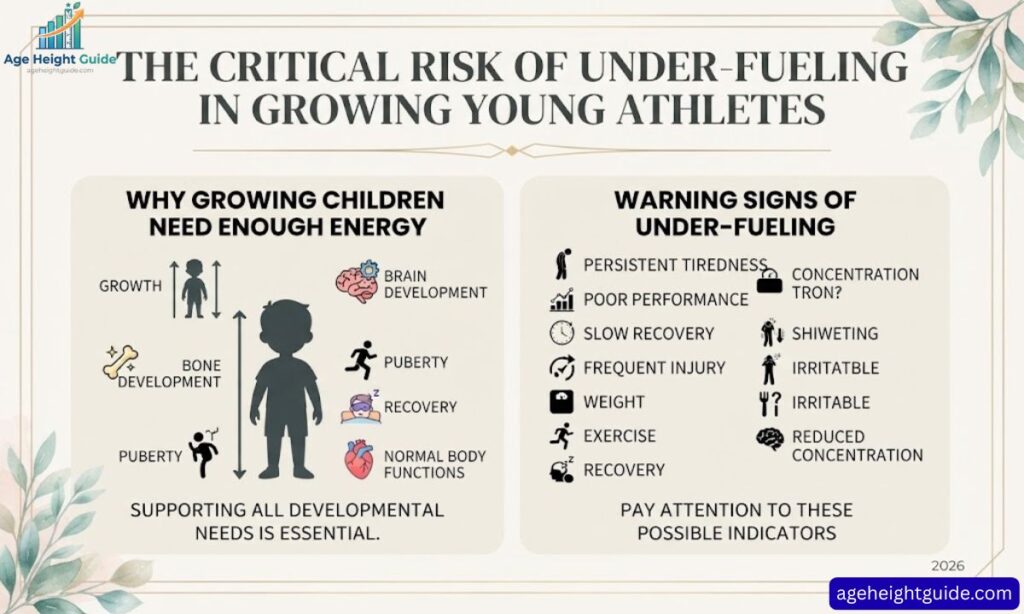
A growing child needs enough energy to support:
- Growth
- Brain development
- Bone development
- Puberty
- Exercise
- Recovery
- Normal body functions
This is sometimes described using the concept of energy availability.
If training demands rise while food intake stays too low, the body may not have enough energy for all of its needs.
That does not mean exercise stunts growth.
It means under-fueling can become a health concern.
What are signs of under-fueling?
Possible warning signs include:
- Persistent tiredness
- Poor training performance
- Slow recovery
- Frequent injuries
- Unexplained weight loss
- Feeling cold often
- Irritability
- Changes in appetite
- Reduced concentration
These signs can have many causes, so parents should not assume that nutrition is always responsible.
If they persist, professional evaluation may be appropriate.
Where nutrition fits, and where it does not

Nutrition plays a major role in normal growth and athletic recovery.
A growing athlete needs adequate amounts of:
- Protein
- Carbohydrates
- Healthy fats
- Calcium
- Vitamin D
- Iron
- Zinc
- Other vitamins and minerals
- Fluids
A balanced diet is generally the foundation.
What about protein?
Protein helps the body build and repair tissues.
Good food sources include:
- Eggs
- Milk
- Yogurt
- Cheese
- Chicken
- Fish
- Beans
- Lentils
- Nuts
- Seeds
- Soy foods
Starting strength training does not automatically mean a child needs large amounts of protein powder.
Food should generally come first.
How much calcium do growing children need?
Calcium is important for developing bones.
The NIH lists a recommended dietary allowance of about 1,300 mg of calcium per day for children ages 9–13 and teenagers ages 14–18.
Food sources include:
- Milk
- Yogurt
- Cheese
- Calcium-fortified alternatives
- Certain leafy vegetables
- Other calcium-rich foods
Individual needs can vary based on diet and health.
Does a child who lifts weights need supplements?
Not necessarily.
A child with a balanced diet may not need a sports supplement.
Supplements may be considered in specific circumstances, such as a documented deficiency or restricted diet, but parents should discuss these situations with a healthcare professional.
A height supplement should not be presented as a guaranteed method of increasing adult height.
How much physical activity do kids need?
Strength training is only one part of a healthy active lifestyle.
The U.S. Physical Activity Guidelines recommend that children and adolescents ages 6–17 get at least 60 minutes of moderate-to-vigorous physical activity each day.
The weekly activity should include:
- Aerobic activity
- Muscle-strengthening activity
- Bone-strengthening activity
Muscle- and bone-strengthening activities should be included at least three days per week.
Children do not need to spend 60 minutes lifting weights.
Daily activity can come from:
- Running
- Walking
- Cycling
- Sports
- Playing
- Climbing
- Jumping
- Swimming
- Resistance exercises
- Active games
A varied routine is often more practical and enjoyable.
Why recovery matters during puberty
Puberty brings rapid physical changes.
Bones grow. Muscles develop. Body composition changes. Hormonal changes occur. Sports performance can change.
Training should adapt to those changes.
Recovery includes:
- Adequate sleep
- Enough food
- Rest days
- Hydration
- Managing total sports volume
- Taking pain seriously
A teenager who participates in several sports may already have a high training load before adding gym sessions.
Parents should therefore consider the child’s total activity, not just their weight-room time.
Does sleep affect growth?
Sleep is an important part of healthy development and recovery.
Children and teenagers need age-appropriate sleep, and young athletes should take sleep seriously when training demands are high.
Poor sleep can affect:
- Recovery
- Mood
- Concentration
- Athletic performance
- General health
This is another reason not to reduce the growth question to a single activity.
Healthy development involves the whole routine:
Nutrition + sleep + physical activity + recovery + overall health.
Does lifting weights stunt growth if a child trains every day?
The problem with daily training is not simply that a child is touching weights every day.
The issue is whether the child has enough recovery between demanding sessions.
Different types of activity place different demands on the body.
A child might have light movement on one day and a harder sports practice on another.
But repeatedly training the same muscles intensely without recovery can contribute to fatigue and injury.
A good program balances training and rest.
Is bodybuilding safe for teenagers?
Teenagers can participate in resistance training, but bodybuilding introduces different goals.
A teenager focused heavily on appearance may be tempted to:
- Train excessively
- Restrict calories
- Use unnecessary supplements
- Compare their body with adults
- Chase rapid muscle gain
Parents should encourage healthy development rather than extreme body-composition goals.
A qualified coach or healthcare professional can help when a teenager wants to pursue more advanced training.
What if my child wants to become stronger for sports?
Strength training can be useful for many sports.
A young athlete may want to improve:
- Sprinting
- Jumping
- Throwing
- Balance
- Stability
- General strength
- Movement control
The strength program should complement the sport rather than interfere with it.
A football player, gymnast, swimmer, or basketball player may have different training needs.
Myth versus evidence, side by side
| Common myth | What the evidence supports |
| Does lifting weights stunt your growth? | Properly designed youth resistance training has not been shown to stunt normal growth. |
| Kids should never lift weights. | Age-appropriate resistance exercise can be part of youth fitness. |
| Every weight exercise damages growth plates. | Growth plate injuries can occur, but normal supervised resistance exercise is not the same as traumatic injury. |
| Children must wait until age 18. | Readiness, technique, supervision, and exercise selection matter. |
| Heavy weights automatically make children shorter. | No evidence shows that lifting itself automatically reduces height. |
| Children cannot gain strength before puberty. | They can gain strength through training. |
| More weight always means better results. | Technique and gradual progression are more important. |
| Children need protein supplements to lift weights. | Balanced food can provide protein; supplements are not automatically necessary. |
| Exercise makes children taller. | Exercise supports health but does not guarantee additional height. |
| Training through pain builds toughness. | Significant or persistent pain should not be ignored. |
| Daily hard training is better. | Recovery is an essential part of training. |
What parents should check before a child starts lifting
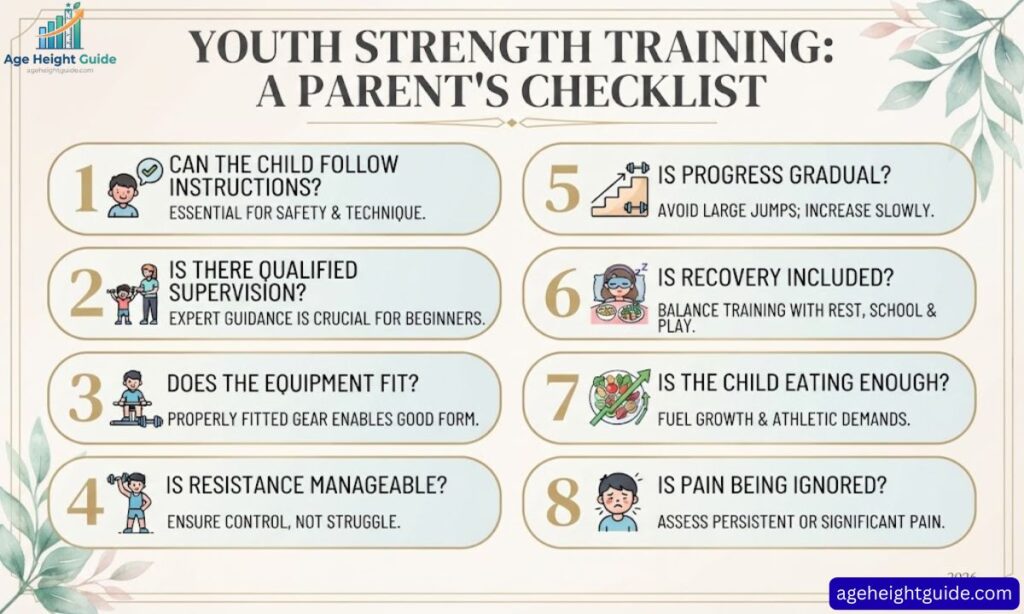
Before starting a structured program, ask:
1. Can the child follow instructions?
If not, structured resistance training may need to wait.
2. Is someone qualified supervising?
Young beginners should not be left alone with unfamiliar equipment.
3. Does the equipment fit?
Poorly fitted equipment can make technique harder.
4. Is the resistance manageable?
The child should be able to control the movement.
5. Is progression gradual?
Large jumps in resistance are unnecessary.
6. Is recovery included?
Training should fit around sleep, school, sports, and normal life.
7. Is the child eating enough?
A growing athlete needs adequate energy.
8. Is pain being ignored?
Persistent or significant pain should be assessed.
When should parents talk to a doctor?
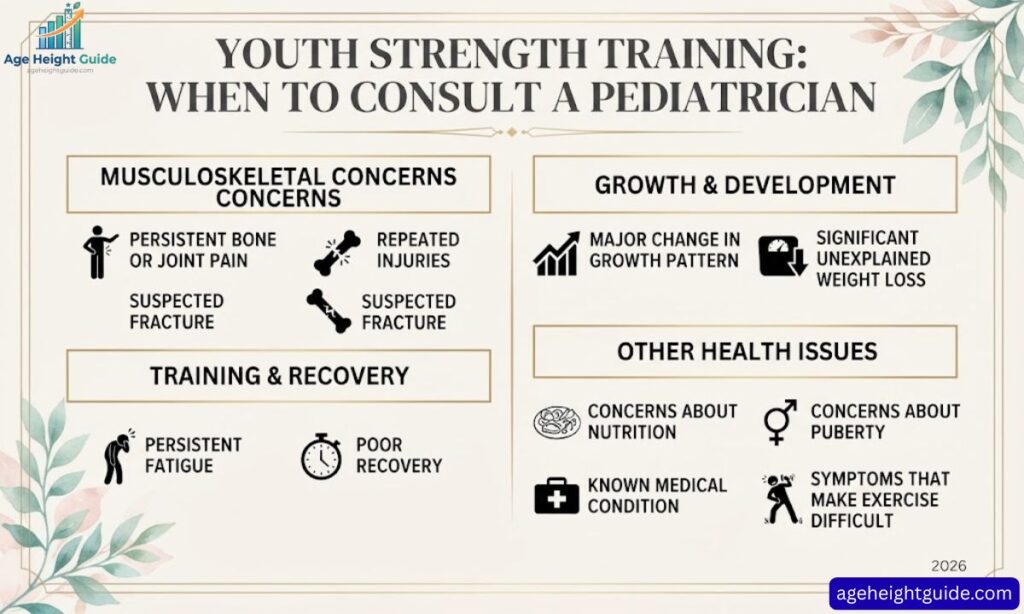
Parents should consider talking with a pediatrician or other qualified healthcare professional if a child has:
- Persistent bone or joint pain
- Repeated injuries
- A suspected fracture
- A major change in growth pattern
- Significant unexplained weight loss
- Persistent fatigue
- Poor recovery
- Concerns about nutrition
- Concerns about puberty
- A known medical condition
- Symptoms that make exercise difficult
A doctor can review the child’s growth chart, medical history, development, nutrition, and activity level.
The purpose is not to discourage exercise.
It is to make sure the child’s overall health is supported.
A practical safe-training checklist
Use this checklist when reviewing a child’s program:
| Check | Good sign |
| Instruction | Child understands the exercise |
| Technique | Movement remains controlled |
| Resistance | Appropriate for current skill |
| Progression | Changes are gradual |
| Supervision | Qualified adult is available |
| Equipment | Properly fitted and maintained |
| Recovery | Rest is built into the plan |
| Nutrition | Child eats enough |
| Hydration | Fluids are adequate |
| Sleep | Consistent age-appropriate sleep |
| Pain | Significant pain is not ignored |
| Goals | Strength and skills matter more than appearance |
Does lifting weights stunt your growth? The bottom line
Does lifting weights stunt your growth? No. Current evidence does not show that properly designed and supervised youth resistance training stunts normal height growth.
The evidence review of 22 reports in prepubertal and early-pubertal youth found strength improvements without evidence of reduced height or weight growth.
That does not mean weight training is completely risk-free.
Children can suffer injuries during strength training, especially when they use poor technique, inappropriate resistance, unsuitable equipment, or inadequate supervision.
The safest approach is to focus on:
- Good technique
- Age-appropriate exercises
- Manageable resistance
- Gradual progression
- Qualified supervision
- Adequate food
- Proper hydration
- Enough sleep
- Recovery
- Early attention to significant pain
Most importantly, parents should separate strength development from height development.
Strength training can help a child become stronger, improve movement skills, and participate confidently in physical activity.
It does not guarantee extra inches.
And there is no good evidence that properly performed strength training automatically takes inches away.
If a child has persistent pain, repeated injuries, unusual growth changes, nutritional concerns, or questions about puberty, a pediatrician can provide individualized guidance.
Frequently Asked Questions
Does lifting weights stunt your growth?
No. Properly designed and supervised resistance training has not been shown to stunt normal linear growth in healthy children and adolescents.
The main concern is avoiding preventable injuries through proper technique, appropriate loading, supervision, and recovery.
Does weightlifting stop height growth?
No evidence shows that normal, appropriately supervised strength training stops height growth.
A child’s final height depends on many factors, including genetics, puberty timing, nutrition, and overall health.
Can lifting weights make you shorter?
No. Proper strength training does not automatically make a child shorter.
If a child appears shorter than classmates, their overall growth pattern is more useful than a single comparison.
Can a 12-year-old lift weights?
Yes. A 12-year-old can participate in an age-appropriate strength program when they can follow instructions and use proper technique.
The program should emphasize skill and gradual progression rather than maximum lifting.
Can an 8-year-old lift weights?
An 8-year-old may be able to perform structured resistance exercises if they can follow directions and maintain good form.
Bodyweight exercises and light resistance can be suitable starting points.
What age is safe to start lifting weights?
There is no universal starting age for every child.
Readiness and supervision matter. The Mayo Clinic notes that strength training can be introduced around age 7 or 8 when a child can follow instructions and use proper form.
Is weightlifting bad for teenagers?
Not automatically.
Teenagers can benefit from properly designed resistance training.
The risk depends more on the training method, technique, supervision, loading, recovery, and overall health than on simply being in a gym.
Does heavy lifting stunt growth during puberty?
There is no evidence that appropriately performed resistance training during puberty automatically stops growth.
Young beginners should still avoid making maximum lifting the main focus of training.
Can lifting weights damage growth plates?
Growth plate injuries can happen during physical activity, but properly designed youth resistance training has not been shown to harm growth plate health.
Significant injuries should be evaluated by a healthcare professional.
Does lifting weights increase height?
No. Strength training should not be considered a guaranteed height-increasing method.
It can support fitness, strength, movement, and healthy physical development.
How heavy should weights be for kids?
There is no single safe weight for every child.
The resistance should be manageable enough for the child to maintain good technique throughout the exercise.
Can overtraining affect growth?
Excessive training combined with inadequate nutrition and recovery can create health problems.
The concern is not ordinary strength training itself but an unhealthy imbalance between training demands and recovery.
Can not eating enough affect growth?
Yes. Growing children need enough energy and nutrients for normal development.
Young athletes who consistently train hard without adequate food may have problems with recovery, health, and performance.
Does a child who lifts weights need supplements?
Not automatically.
A balanced diet can provide many nutrients needed for growth and training.
Supplements should be considered carefully and, when appropriate, discussed with a healthcare professional.
Is bodyweight training better than weights for kids?
Bodyweight training can be an excellent starting point.
However, resistance bands, light free weights, machines, and other forms of resistance can also be used appropriately when the child is ready and properly supervised.
Can strength training help sports performance?
Yes. Proper strength training can support strength, movement control, muscular endurance, and physical skills that are useful across many sports.
It should complement sports practice rather than replace it.
Should kids lift weights every day?
Not necessarily.
Young athletes need recovery. The appropriate schedule depends on the child’s age, program, sport, intensity, and total activity level.
What should a parent do if a child has pain while lifting?
Significant, persistent, or worsening pain should not be ignored.
Stop the activity and seek appropriate medical advice, especially if there is swelling, loss of movement, severe tenderness, or suspected injury.

Stoke is the author behind Age Height Guide, creating simple and informative content about average height, age, growth, and related measurements.