


Does coffee stunt your growth? This is one of the most common questions parents hear when children or teenagers start drinking coffee. The short answer is no. Current evidence does not establish that drinking coffee makes children shorter or directly stops normal height growth.
The old idea that coffee makes kids short has been around for generations. It is often repeated as a simple warning: “Don’t drink coffee because it will stunt your growth.” However, the science is more complicated than that.
Coffee contains caffeine, a stimulant that can affect the nervous system. Caffeine can influence sleep, appetite, alertness, mood, and daily routines. Those effects are important for children and teenagers, but they are different from directly stopping bones from growing.
There is also another issue that parents may overlook. Caffeine is not found only in coffee. Children and teens can get caffeine from soda, tea, iced tea, energy drinks, chocolate, caffeinated candy, energy bars, gum, and some medicines or supplements.
So, if you are wondering, does coffee stunt your growth, the evidence-based answer is no. The more useful questions are how much caffeine a child consumes, when they consume it, whether it affects their sleep, and whether caffeinated drinks are replacing nutritious foods or drinks.
Healthy growth depends on many factors. Genetics, adequate calories, balanced nutrition, vitamin and mineral status, sleep, physical activity, overall health, puberty timing, and certain medical conditions can all influence how a child grows.
This guide looks at what research actually says about coffee and height, caffeine, sleep, calcium, growth plates, puberty, nutrition, and healthy growth.
You can also read: Does Drinking Milk Make You Taller? 2026: Facts & Hope
Does coffee stunt your growth? The short answer

If you are asking, “Does coffee stunt your growth?”, current scientific evidence does not show that ordinary coffee consumption directly reduces a child’s final height.
There is no established evidence that coffee makes healthy children shorter by stopping their bones from lengthening. Drinking coffee has also not been shown to directly damage normal growth plates.
Harvard Health has discussed the common coffee-and-height myth and notes that research does not support the idea that coffee makes people shorter. Cleveland Clinic has also addressed this question, with pediatric endocrinologist Roy Kim, MD, explaining that caffeine does not meaningfully determine how tall a child becomes.
That distinction matters.
Coffee and caffeine can affect several things that are relevant to childhood health. For example, caffeine can make it harder for some children to fall asleep. It may also reduce appetite in some people or encourage a child to choose a caffeinated drink instead of a more nutritious option.
But these effects do not mean:
Coffee → damaged growth plates → shorter child
There is no established scientific pathway showing that ordinary coffee consumption directly causes this outcome.
Coffee does not directly make kids shorter
The statement “coffee makes you shorter” is an oversimplification of several different health questions.
Height is primarily influenced by a combination of genetics and environmental factors. During childhood, bones lengthen through the activity of growth plates. Puberty eventually causes these growth plates to mature and close as part of normal development.
There is no established evidence that drinking coffee causes this process to happen prematurely.
A child who drinks coffee may still grow normally. A child who never drinks coffee may also grow at a different rate because children naturally have different genetic growth patterns and puberty timing.
This is why doctors do not determine whether a child will reach their expected height by asking whether they drink coffee.
Instead, pediatricians usually look at:
- The child’s height and weight
- Growth over time
- Growth velocity
- Family height patterns
- Puberty stage
- Nutrition
- General health
- Possible medical conditions
One height measurement tells you much less than a consistent growth pattern over several years.
For example, a 12-year-old who is shorter than classmates may still be growing normally if they are following their expected growth curve.
On the other hand, a child who suddenly stops growing at the expected rate may need evaluation even if they never drink coffee.
So the coffee itself is not the main measurement.
The child’s overall growth pattern is what matters.
Where the coffee myth actually came from

The exact origin of the belief that coffee stunts growth is difficult to identify. It appears to have developed from older concerns about caffeine and health, including questions about calcium, bones, and children’s development.
Over time, a complicated discussion became a simple warning:
“Coffee is bad for bones, so coffee stops children from growing.”
That conclusion goes beyond what the evidence establishes.
One reason the myth may have become popular is that caffeine can affect calcium handling in the body. Some research has found that caffeine can cause a small increase in calcium excretion.
But a small change in calcium excretion does not automatically mean that a child develops weak bones or becomes shorter.
What matters more is the child’s overall calcium intake and nutritional status.
If a teenager drinks coffee occasionally while eating a balanced diet that provides enough calcium and other nutrients, that is very different from a teenager consuming large amounts of caffeinated drinks while regularly skipping meals.
The second situation can create nutritional and sleep concerns without proving that coffee directly stopped the child’s height growth.
Coffee and growth: correlation is not causation
This is an important concept when discussing coffee and growth.
Imagine a teenager starts drinking coffee at age 15. Around the same time, their height gain slows.
It might be tempting to say:
“Coffee caused the growth to stop.”
But puberty naturally changes growth speed.
Children generally experience periods of rapid growth followed by slower growth. The timing varies from person to person.
A teenager may therefore start drinking coffee during a period when their natural height growth is already slowing.
That creates a correlation, but correlation does not prove causation.
The same principle applies to many childhood health questions. Two things happening around the same time does not automatically mean one caused the other.
For coffee, the evidence has not established a direct pathway in which ordinary caffeine consumption causes shorter adult height.
The more clearly documented concern is caffeine’s effect on sleep and other daily habits.
What the research on caffeine and children actually studied
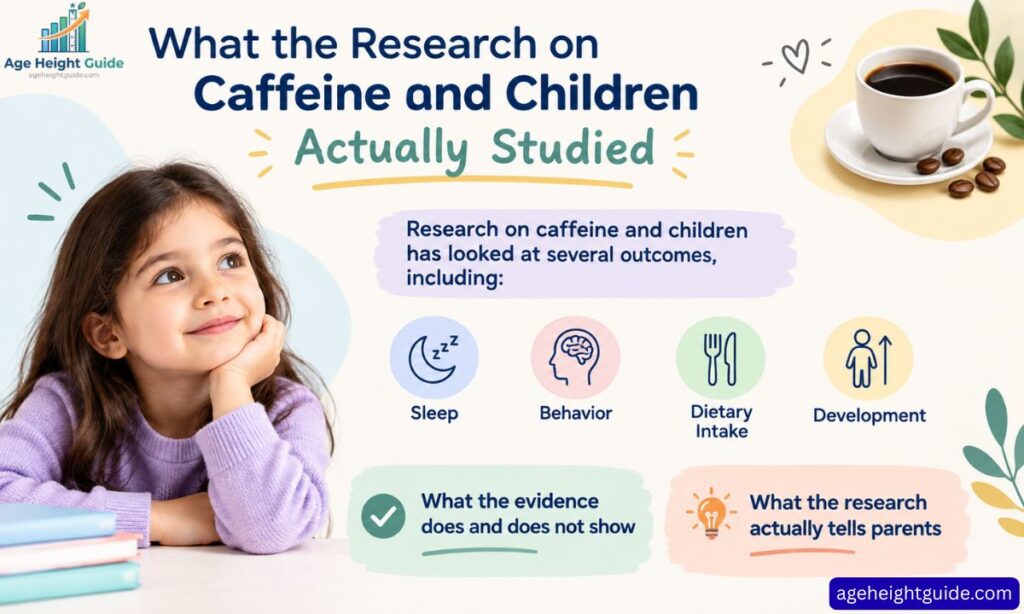
Research on caffeine and children has looked at several outcomes, including sleep, behavior, dietary intake, and development.
One important example is a 2020 systematic review by Torres-Ugalde and colleagues. Researchers screened 5,468 articles and included 24 studies that met their criteria.
The review examined caffeine exposure in children and adolescents and discussed possible effects on growth and development.
The review raised concerns about caffeine potentially affecting children through indirect pathways, particularly sleep. That is different from demonstrating that coffee directly makes children shorter.
This distinction is often lost when the coffee myth is discussed online.
A study can show that caffeine affects sleep.
Another study can show that sleep is important for healthy development.
But that does not automatically prove:
Caffeine causes shorter adult height.
The evidence has to demonstrate that specific relationship.
Current evidence does not establish that ordinary coffee consumption directly prevents a healthy child from reaching their genetically influenced height.
What the evidence does and does not show
| Question | What current evidence indicates |
| Does coffee directly stunt height? | No established evidence |
| Does caffeine affect sleep? | Yes, particularly with higher or late-day intake |
| Can caffeine affect appetite? | It can reduce appetite in some people |
| Can caffeinated drinks replace nutritious foods? | Yes |
| Does nutrition matter for healthy growth? | Yes |
| Does genetics influence height? | Yes, strongly |
| Can medical conditions affect growth? | Yes |
| Does coffee damage normal growth plates? | No established evidence |
| Does caffeine automatically cause shorter adult height? | Not established |
The important takeaway is that the research does not support treating coffee as a direct cause of short stature.
Instead, caffeine should be considered as one part of a child’s overall diet and lifestyle.
What the research actually tells parents
A useful way to interpret the evidence is to separate direct effects from indirect effects.
A direct effect would mean caffeine itself changes the biological process responsible for bone lengthening and therefore reduces final height.
An indirect effect could involve caffeine causing poor sleep, replacing nutritious food, or contributing to unhealthy daily habits.
The second group deserves attention because it is biologically and practically plausible.
That does not mean every child who drinks coffee will experience these problems.
It means parents should focus on amount, timing, frequency, and overall habits rather than assuming that one cup of coffee will make a child shorter.
What the research says about caffeine and sleep

Sleep is one of the clearest reasons to take caffeine consumption seriously in children and teenagers.
Caffeine is a stimulant. It can increase alertness and make a person feel less tired. That is exactly why adults often use coffee to stay awake.
But the same effect can become a problem when a child consumes caffeine too close to bedtime.
The 2020 systematic review discussed several studies examining caffeine consumption and children’s sleep.
One study involved 625 children between 6 and 10 years old. Researchers found an association between caffeine intake and approximately 15 fewer minutes of sleep per night.
Another study involved 210 children aged 9 to 15. Children using caffeine to deal with daytime drowsiness took about 4 additional minutes to fall asleep.
A third study included 201 children aged 5 to 12 consuming approximately 52 to 109 mg of caffeine per day. The study found reduced total sleep.
These findings do not prove that coffee causes shorter height.
They do show why caffeine can matter during childhood.
Why sleep matters during the growing years
Sleep is a major part of a healthy childhood routine.
Children need sleep for many normal body and brain functions. Poor sleep can affect energy, concentration, mood, learning, physical activity, and daily functioning.
For teenagers, the problem can become a cycle.
A teenager sleeps too little.
They feel tired the next day.
They drink caffeine to feel more alert.
The caffeine makes it harder to sleep at night.
They become tired again the next day.
This does not mean caffeine is always the cause of poor sleep. School schedules, homework, screen use, stress, social activities, and many other factors can contribute.
But caffeine can make the cycle harder to break.
That is why parents who ask does coffee stunt your growth may get more useful information by first asking:
“Is my child getting enough sleep?”
Timing matters
Caffeine timing can be just as important as caffeine quantity.
A caffeinated drink consumed early in the morning may affect sleep differently from a strong caffeinated drink consumed late in the afternoon or evening.
Caffeine can remain active in the body for several hours, although the exact duration varies between people.
Some children and teenagers may be more sensitive than others.
Signs that caffeine may be interfering with sleep include:
- Difficulty falling asleep
- Restlessness at bedtime
- Feeling tired despite spending enough time in bed
- Needing caffeine to get through the school day
- A repeated pattern of late-day caffeine use
If these patterns appear, reducing caffeine and improving sleep habits may be more useful than worrying about coffee directly affecting height.
Can coffee affect calcium and bone health?

The connection between coffee, calcium, and bones is one of the main reasons the growth myth has survived.
Caffeine can increase urinary calcium excretion by a small amount. However, this does not mean that normal coffee consumption automatically causes weak bones or prevents children from growing.
Bone health depends on much more than one dietary factor.
Children need adequate:
- Calcium
- Vitamin D
- Protein
- Energy
- Other vitamins and minerals
- Physical activity
The overall diet matters.
For example, consider two teenagers.
Teen A occasionally drinks coffee but regularly eats yogurt, cheese, fortified foods, vegetables, protein-rich foods, and balanced meals.
Teen B drinks several caffeinated sodas every day, rarely eats breakfast, and frequently replaces meals with snacks.
The second teenager may have a less balanced diet.
The concern is not simply:
“Coffee causes short height.”
It is:
“Is the child’s overall diet providing what a growing body needs?”
Calcium needs during childhood
Calcium is essential for normal bone development.
According to NIH guidance, recommended daily calcium intake is:
| Age | Recommended calcium |
| 4–8 years | 1,000 mg/day |
| 9–13 years | 1,300 mg/day |
| 14–18 years | 1,300 mg/day |
Good food sources include milk, yogurt, cheese, calcium-fortified beverages, tofu made with calcium, and some vegetables.
Vitamin D also matters because it helps the body absorb calcium.
The goal is not to avoid every food or drink that contains caffeine.
The goal is to make sure caffeine does not contribute to an inadequate diet.
If a child’s diet is already low in calcium and other nutrients, a pediatrician or registered dietitian can help identify practical changes.
How much caffeine is safe for kids, by age
Caffeine guidance for children is different from the way adults usually think about coffee.
Adults may use coffee regularly without major problems. Children and teenagers can be more sensitive to caffeine, and they do not need caffeine as part of a healthy diet.
The American Academy of Child and Adolescent Psychiatry (AACAP) updated its guidance in April 2026.
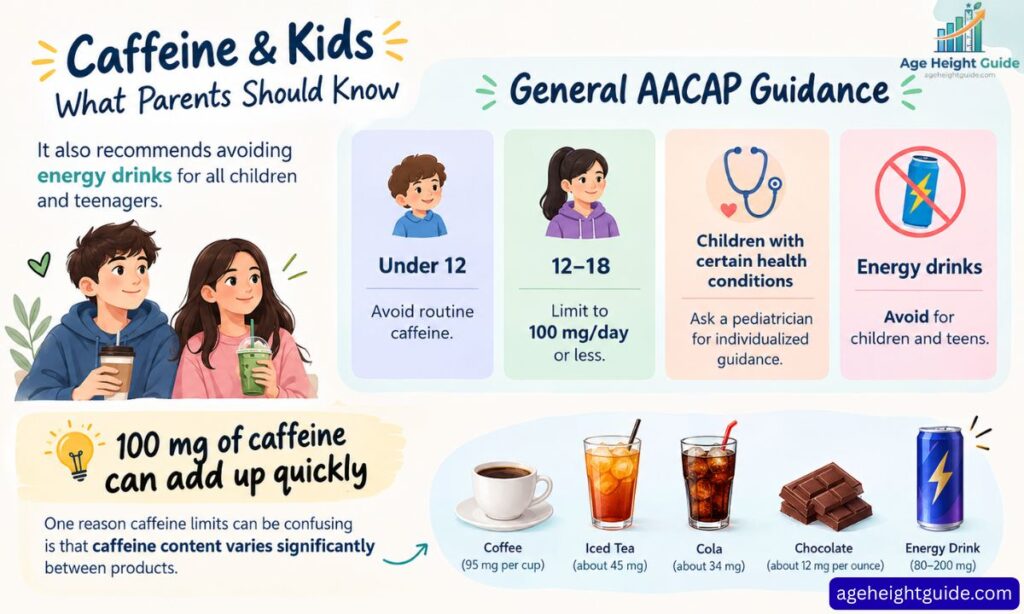
AACAP states that there is no proven safe dose of caffeine for children. It recommends avoiding routine caffeine use in children under 12.
For children and teenagers aged 12 to 18, AACAP recommends limiting caffeine to at most 100 mg per day.
It also recommends avoiding energy drinks for all children and teenagers.
| Age | General AACAP guidance |
| Under 12 | Avoid routine caffeine |
| 12–18 | Limit to 100 mg/day or less |
| Children with certain health conditions | Ask a pediatrician for individualized guidance |
| Energy drinks | Avoid for children and teens |
These are practical guidelines, not a statement that drinking a particular amount of caffeine will automatically affect height.
100 mg of caffeine can add up quickly
One reason caffeine limits can be confusing is that caffeine content varies significantly between products.
A teenager might think:
“I only had one drink.”
But the size and caffeine content of that drink matter.
A large coffee can contain much more caffeine than a small serving.
Tea can also contribute caffeine.
Soda can contribute caffeine.
Chocolate can contribute smaller amounts.
Energy drinks can contain substantial caffeine.
This means parents should check product labels whenever possible.
Where kids actually get their caffeine (it is not usually coffee)
When parents hear the word caffeine, they often think about coffee.
But children can get caffeine from many other sources.
The 2020 review discussed caffeine sources such as soda, coffee, and tea. AACAP also identifies several other sources, including energy drinks and products containing added caffeine.
| Caffeine source | What parents should know |
| Soda | Some varieties contain caffeine |
| Coffee | Caffeine varies by serving and preparation |
| Iced tea | Can contain significant caffeine |
| Sweet tea | May contain caffeine |
| Energy drinks | Can contain high amounts of caffeine |
| Chocolate | Naturally contains some caffeine |
| Coffee-flavored foods | May contain caffeine |
| Energy bars | Some contain added caffeine |
| Gum and candy | Caffeine may be added |
| Some medicines | Certain products contain caffeine |
| Workout supplements | Some may contain added caffeine |
This is why simply asking whether a child drinks coffee may not tell you their total caffeine exposure.
A better approach is to consider the entire day.
Coffee + tea + soda + energy drinks + chocolate + caffeinated snacks + medicines or supplements
can add up.
How much caffeine is in common drinks?
There is no single caffeine amount for every coffee, soda, or tea.
The amount can change depending on:
- Brand
- Serving size
- Brewing method
- Type of coffee
- Tea variety
- Recipe
- Concentration
- Added caffeine
For example, brewed coffee can contain substantially more caffeine than many soft drinks.
An energy drink can also contain a large amount of caffeine in one serving.
That is why comparing products by the word “drink” is not enough.
Parents should look for the actual caffeine amount listed on the label.
If a teenager is trying to stay below 100 mg of caffeine per day, the label becomes especially important.
The nutrient swap nobody talks about

The caffeine and growth discussion becomes more useful when we look at what caffeine-containing drinks replace.
Imagine a child drinks a large caffeinated soda every afternoon.
If that drink replaces water, the nutritional impact may be different than if it replaces a meal or calcium-rich drink.
Now imagine a teenager regularly uses coffee to suppress hunger and then skips breakfast.
The problem is no longer simply coffee.
The problem becomes insufficient nutrition.
Growing bodies need energy and nutrients. If a child consistently eats too little, their nutritional status can suffer.
That is why parents should look at the entire dietary pattern.
Nutrition matters more than the coffee myth
Healthy growth depends on adequate nutrition.
Important nutrients include:
Protein: supports tissues and normal development.
Calcium: supports bone structure and mineralization.
Vitamin D: helps with calcium absorption and bone health.
Iron: supports blood and oxygen transport.
Zinc: contributes to normal growth and many body functions.
Magnesium: supports bone and muscle function.
Healthy fats: provide energy and support normal body functions.
Carbohydrates: provide energy for an active growing body.
Fruits and vegetables: provide vitamins, minerals, fiber, and other beneficial compounds.
Children also need enough total calories.
A perfect list of nutrients does not help if a child is consistently eating too little.
The foundation should therefore be a varied, balanced diet.
What actually affects how tall your child grows

If coffee is not a proven cause of short stature, what actually influences height?
The answer involves several interacting factors.
1. Genetics
Genetics is one of the strongest influences on adult height.
Family height patterns can provide useful context for understanding a child’s expected growth.
This explains why healthy children from different families can have very different heights.
Genetics does not mean nutrition is irrelevant.
It means nutrition and health generally help a child reach their natural growth potential rather than overriding their inherited biology.
2. Getting enough calories
Growing bodies require energy.
A child who consistently does not eat enough may not receive sufficient calories and nutrients for normal development.
Long-term undernutrition can interfere with healthy growth.
This is especially important for children who:
- Have a very restricted diet
- Frequently skip meals
- Have eating difficulties
- Have increased nutritional needs
- Have chronic digestive problems
If inadequate intake is suspected, professional evaluation is appropriate.
3. Nutritious foods
A child needs more than calories.
A balanced diet should include different food groups and provide enough protein, carbohydrates, fats, vitamins, and minerals.
Examples include:
- Eggs
- Fish
- Meat or other protein sources
- Milk and yogurt
- Beans and lentils
- Whole grains
- Fruits
- Vegetables
- Nuts and seeds when age-appropriate
- Calcium-fortified foods
The exact diet can vary by culture, preference, budget, and dietary needs.
There is no single “height food” that makes every child taller.
4. Vitamin and micronutrient status
Micronutrients are important for normal development.
Deficiencies in nutrients such as vitamin D, iron, zinc, or other essential nutrients can affect health.
However, this does not mean every child needs a growth supplement.
If a deficiency is suspected, the right approach is to identify it and correct it appropriately.
A supplement should fill a genuine nutritional gap rather than be marketed as a guaranteed way to add inches.
5. Growth disorders
Some children grow more slowly because of an underlying health condition.
Possible contributors can include:
- Hormonal disorders
- Chronic illnesses
- Gastrointestinal conditions
- Nutritional deficiencies
- Genetic conditions
- Delayed or unusual puberty patterns
This is why growth monitoring matters.
A child who is short but consistently following their expected growth curve may have a different situation from a child whose growth rate suddenly falls.
6. Healthy daily routines
Daily habits also matter.
Children benefit from:
- Regular sleep
- Nutritious meals
- Physical activity
- Time outdoors
- Healthy hydration
- Reasonable screen habits
- Consistent routines
None of these guarantees extra height.
They support the conditions needed for healthy development.
What matters most for healthy growth?
| Growth factor | Why it matters |
| Genetics | Strongly influences expected adult height |
| Adequate calories | Provides energy for development |
| Balanced nutrition | Supplies essential nutrients |
| Calcium & vitamin D | Support normal bone health |
| Sleep | Supports healthy development and daily function |
| Physical activity | Supports bones, muscles, and overall health |
| Overall health | Chronic conditions can affect growth |
| Growth monitoring | Helps identify unusual growth patterns |
The important takeaway is that coffee is not a major determinant of height.
Can coffee make you shorter?
The question “Can coffee make you shorter?” is essentially another way of asking, does coffee stunt your growth?
Current evidence does not establish that ordinary coffee consumption makes children or teenagers shorter.
There is no established evidence that drinking coffee directly stops the long bones from lengthening.
The myth often comes from combining several real facts:
- Caffeine affects the nervous system.
- Caffeine can affect sleep.
- Caffeine can influence calcium excretion.
- Nutrition affects growth.
- Bones require calcium and vitamin D.
Those facts are real, but they do not add up to proof that coffee directly causes shorter adult height.
The more useful approach is to look at total caffeine, sleep, nutrition, and overall health.
Does coffee affect growth plates?
Growth plates, also called epiphyseal plates, are areas of developing tissue near the ends of long bones.
During childhood and adolescence, these areas allow bones to grow in length.
As puberty progresses, growth plates gradually mature and eventually close. Once growth plates have closed, bones no longer lengthen in the same way.
There is no established evidence that ordinary coffee consumption damages healthy growth plates or causes them to close early.
That means the statement:
“Coffee closes your growth plates.”
is not supported by current evidence.
If a child’s growth pattern changes significantly, the appropriate response is not to assume coffee is responsible.
A pediatrician can review growth charts, family history, puberty development, nutrition, and possible medical causes.
What about coffee and puberty?
Puberty is another area where parents may worry about caffeine.
Children do not all enter puberty at the same age. The timing and speed of puberty vary naturally.
Genetics, hormones, nutrition, overall health, and other biological factors influence development.
Current evidence does not establish ordinary coffee consumption as a cause of shorter adult height or premature closure of growth plates.
A teenager may also start drinking coffee around the same time their growth rate naturally changes.
Again, timing alone does not prove causation.
If puberty appears unusually early, unusually late, or otherwise concerning, that is a reason to speak with a pediatrician rather than blaming coffee.
What to do if your teen already drinks coffee every day

If your teenager already drinks coffee, there is no need to assume their height has been harmed.
Instead, focus on practical habits.
1. Check the timing
Find out when the caffeine is consumed.
If caffeine is being consumed in the afternoon or evening, consider whether it is affecting bedtime or sleep quality.
2. Count all caffeine sources
Do not count only coffee.
Add up caffeine from:
Coffee + tea + soda + energy drinks + chocolate + caffeinated snacks + certain medicines or supplements.
The total daily amount gives you a better picture.
3. Cut energy drinks first
AACAP recommends avoiding energy drinks for children and teenagers.
If an adolescent regularly consumes energy drinks, that is worth addressing regardless of the coffee-and-height myth.
4. Look at what caffeine is replacing
Ask what happens around the caffeinated drink.
Is your teen:
- Skipping breakfast?
- Replacing milk with soda?
- Eating fewer nutritious foods?
- Using caffeine because they are constantly tired?
- Staying awake late because of caffeine?
These questions can reveal the real issue.
5. Watch for side effects
Too much caffeine can cause problems such as:
- Trouble sleeping
- Restlessness
- Headaches
- Nausea
- Irritability
- Anxiety or jitteriness
- Increased heart rate
- Difficulty relaxing
Not every child experiences these effects, but they are reasons to reconsider caffeine intake.
6. Talk with your pediatrician
If you are concerned about your teenager’s caffeine use, growth, nutrition, or sleep, a pediatrician can provide individualized guidance.
Professional advice is especially useful if your child has a medical condition, takes medication, has a restricted diet, or shows an unusual change in growth.
Where a growth multivitamin fits, and where it does not
A growth multivitamin should not be viewed as a shortcut to extra height.
A multivitamin cannot change a child’s genetics.
It cannot guarantee a certain adult height.
It also cannot replace adequate sleep, calories, protein, calcium, vitamin D, or a balanced diet.
What a multivitamin can potentially do is provide selected nutrients when a child does not get enough from food.
That distinction is important.
Nutrition support is not the same as height enhancement.
When nutrition support may make sense
A pediatrician may consider nutritional support when a child has:
- A very limited diet
- Multiple food restrictions
- A diagnosed nutrient deficiency
- Increased nutritional requirements
- Difficulty meeting nutrient needs through food
For example, a child with a known deficiency may need targeted supplementation.
But supplementation should be based on the child’s needs.
Taking more vitamins than necessary does not automatically result in more height.
What to look for in a children’s multivitamin
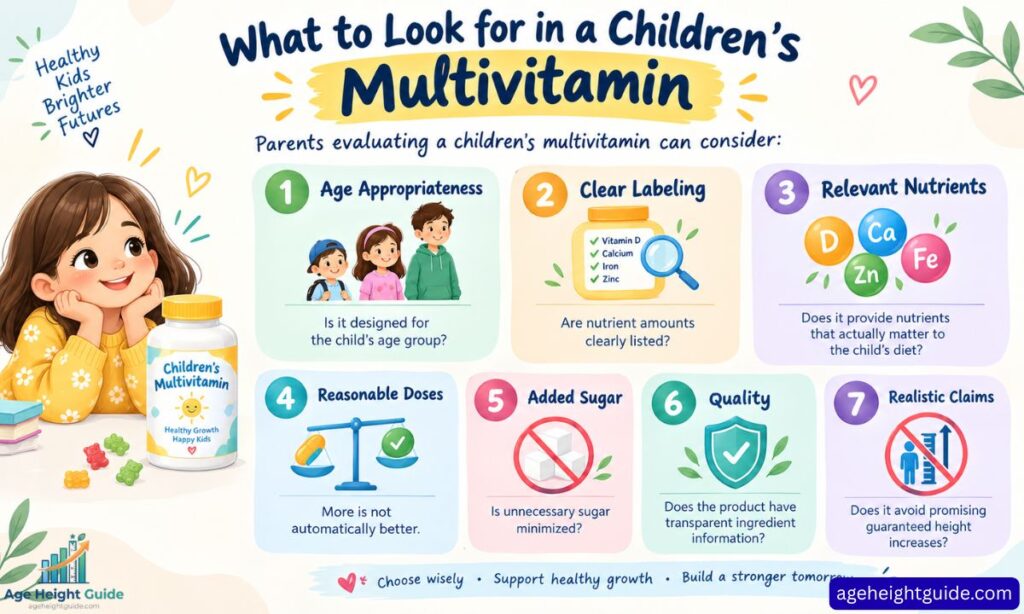
Parents evaluating a children’s multivitamin can consider:
Age appropriateness: Is it designed for the child’s age group?
Clear labeling: Are nutrient amounts clearly listed?
Relevant nutrients: Does it provide nutrients that actually matter to the child’s diet?
Reasonable doses: More is not automatically better.
Added sugar: Is unnecessary sugar minimized?
Quality: Does the product have transparent ingredient information?
Realistic claims: Does it avoid promising guaranteed height increases?
A responsible nutrition product should support nutritional needs rather than make unrealistic promises.
Does a growth supplement make a child taller?
There is no responsible basis for promising that a supplement will add a specific number of inches to a healthy child’s height.
A child’s final height is strongly influenced by genetics and normal development.
If a child has a nutritional deficiency, correcting it can help support normal health and development.
That is very different from making a healthy, well-nourished child grow beyond their natural genetic potential.
Parents should therefore be careful with products that promise dramatic height increases.
A supplement can be part of a nutrition plan when appropriate.
It should not replace:
Balanced food + adequate sleep + physical activity + medical care when needed.
The Bottom Line: Does Coffee Stunt Your Growth?
If you searched does coffee stunt your growth, the evidence-based answer is no.
Current evidence does not establish that ordinary coffee consumption directly makes children shorter, damages healthy growth plates, or prevents normal height growth.
The old coffee-height myth likely became popular because caffeine, calcium, bones, and childhood development are all related topics. But those connections do not prove that coffee directly stops a child from growing.
Caffeine can still matter.
Too much caffeine may interfere with sleep. It may affect appetite or cause unwanted side effects. Caffeinated drinks can also replace water, milk, or nutritious foods. Energy drinks are a particular concern for children and teenagers.
For healthy growth, focus on the factors that matter more:
Balanced nutrition.
Adequate calories.
Enough sleep.
Regular physical activity.
Calcium and vitamin D.
Overall health.
Healthy daily routines.
Growth monitoring over time.
There is no single food, drink, gummy, or supplement that determines a child’s final height.
The goal should be to help children reach their normal growth potential through good nutrition, healthy routines, and appropriate medical care when needed.
Frequently Asked Questions
Does coffee stunt your growth?
Does coffee stunt your growth? Current evidence does not establish that coffee or caffeine directly reduces a child’s final height. The more established concerns involve caffeine’s effects on sleep, appetite, and daily routines.
Can coffee stunt a 13-year-old’s growth?
There is no established evidence that ordinary coffee directly stops a 13-year-old from growing. However, caffeine can interfere with sleep, especially when consumed later in the day. AACAP recommends limiting caffeine to no more than 100 mg per day for ages 12–18.
Does caffeine stunt growth?
Current evidence does not establish that caffeine directly causes shorter adult height. Caffeine can affect sleep and may influence appetite, which is why total intake still matters.
Is coffee bad for kids?
Coffee is not proven to stunt height, but children do not need caffeine for normal growth. AACAP recommends avoiding routine caffeine use in children under 12 and avoiding energy drinks for children and teens.
How much caffeine can a 12-year-old have?
AACAP’s 2026 guidance says there is no proven safe dose for children and recommends avoiding routine caffeine under age 12. For ages 12–18, AACAP recommends limiting caffeine to no more than 100 mg per day.
Can coffee affect sleep in children?
Yes. Caffeine can make it harder to fall asleep and may reduce sleep duration, particularly when intake is high or occurs later in the day.
Does coffee cause calcium loss?
Caffeine can increase calcium excretion by a small amount. However, this does not establish that coffee causes weak bones or shorter height. Overall calcium intake and nutritional status are more important.
Does coffee close growth plates?
There is no established evidence that coffee closes healthy growth plates. Growth plate closure is a normal part of bone maturation and puberty.
What actually affects how tall a child grows?
Height is influenced by genetics, nutrition, adequate calories, overall health, puberty timing, and certain medical conditions. Growth patterns over time are more informative than a single height measurement.
Can nutrition affect a child’s height?
Yes. Adequate calories and balanced nutrition support normal growth and development. Severe or prolonged nutritional deficiencies can interfere with healthy development.
Does a multivitamin make kids taller?
A multivitamin does not guarantee extra height. Correcting a genuine nutrient deficiency can support normal health, but supplements should not be presented as a guaranteed way to increase height.
What should I do if my teen drinks coffee every day?
Check the total amount of caffeine, avoid energy drinks, consider caffeine timing, protect sleep, and make sure coffee is not replacing nutritious meals or calcium-rich foods. Talk with a pediatrician if you have concerns about growth, nutrition, sleep, or side effects.
Is coffee worse than soda for kids?
It depends on the product, serving size, caffeine amount, sugar content, and overall diet. Neither should be judged only by the name of the drink. Energy drinks deserve particular caution because AACAP recommends avoiding them for children and teens.
Can avoiding coffee make you taller?
No. Avoiding coffee does not directly make a child taller. Height depends on genetics, normal development, nutrition, and overall health.
This article is for informational purposes only and is not medical advice. If you are concerned about your child’s growth, puberty, nutrition, sleep, caffeine intake, or development, speak with a qualified pediatrician or other healthcare professional.

Stoke is the author behind Age Height Guide, creating simple and informative content about average height, age, growth, and related measurements.