


The average height for a 13-year-old boy is about 5 feet 1 inch (156 cm) around the 50th percentile on the CDC growth chart. But the average is only one point on the chart. A boy can be shorter or taller than this and still be growing normally.
For parents, the more useful question is not only how tall a 13-year-old boy should be. It is also whether his height is following a steady pattern over time.
At age 13, many boys are still in an active stage of puberty and growth. Some have already started a strong growth spurt, while others may be earlier in puberty and have more growth ahead. Family height, puberty timing, nutrition, sleep, health, and activity can all play a role.
CDC growth charts show height as a range of percentiles rather than one ideal number. They are useful for tracking growth over time, but they are not meant to be used as a stand-alone diagnosis.
You can also read: Average Height for a 13-Year-Old Girl: 2026 Growth Guide
How tall is the average 13-year-old boy?

The average height for a 13-year-old boy is about 5 feet 1 inch, or 156 cm, at the 50th percentile on the CDC boys’ stature-for-age chart.
This means that about half of boys are shorter and about half are taller at that point on the chart. It does not mean that every healthy 13-year-old boy should be close to 5 feet 1 inch.
The CDC growth chart includes percentile curves from early childhood through age 20. These curves help doctors see where a child’s height falls compared with other children of the same age and sex.
A better way to think about the average height for a 13-year-old boy is as a reference point.
For example, one boy may be 4 feet 11 inches at 13 and continue growing steadily through later puberty. Another may be 5 feet 6 inches and have already gone through much of his growth spurt.
Both situations can occur in healthy teenagers.
Average height for a 13-year-old boy in feet and cm
| Measurement | Approximate height |
| Average height for a 13-year-old boy | 5 ft 1 in |
| In centimeters | 156 cm |
| 50th percentile | About 156 cm |
| Lower end of common chart range | About 147 cm |
| Higher end of common chart range | About 170 cm |
These values are best viewed as chart references, not strict limits for healthy growth. The CDC provides stature-for-age charts for boys ages 2–20.
What is the normal height range for a 13-year-old boy?
There is no single normal height for a 13-year-old boy.
Pediatricians usually look at height percentile, previous measurements, growth pattern, and puberty rather than judging a child from one measurement.
The CDC chart shows a wide spread of heights at age 13. Around the 5th percentile, a boy is close to 147 cm. Around the 50th percentile, he is close to 156 cm. Around the 95th percentile, he is close to 170 cm. The exact value changes slightly with the child’s age in months.
| Age | 5th percentile | 50th percentile | 95th percentile |
| 11 years | ~135 cm | ~144 cm | ~156 cm |
| 12 years | ~140 cm | ~149 cm | ~163 cm |
| 13 years | ~147 cm | ~156 cm | ~170 cm |
| 14 years | ~153 cm | ~164 cm | ~176 cm |
| 15 years | ~160 cm | ~170 cm | ~181 cm |
The CDC’s boys’ stature-for-age chart is designed to show percentile patterns across ages 2–20.
Is 5 feet short for a 13-year-old boy?
Being 5 feet tall at 13 does not automatically mean a boy is too short.
The average height for a 13-year-old boy is about 5 feet 1 inch, but his growth trajectory matters more than one measurement. If he has been growing steadily and his puberty is progressing normally, one height measurement may not be concerning.
A boy who enters puberty later may remain shorter than classmates for a while and then have a later growth spurt.
Is 5 feet 5 inches tall for a 13-year-old boy?
A height of 5 feet 5 inches is above the 50th percentile for a 13-year-old boy on the CDC chart.
That does not mean he will necessarily become a very tall adult. Puberty timing, family height, and remaining growth all matter.
The same principle works in both directions. Being above or below the average does not tell you the final adult height by itself.
Is a 13-year-old boy still growing?

Yes, many 13-year-old boys are still growing.
Boys often experience their major growth spurt during puberty, but puberty does not begin at exactly the same age for everyone. Some boys enter puberty earlier. Others develop later.
This creates a wide range of normal development.
A boy who is shorter than his classmates may simply be earlier in puberty. Another boy may already have experienced a large part of his growth spurt.
This is why comparing classmates can be misleading.
A more useful question is:
Has his height been increasing steadily over time?
A pediatrician can review measurements on a growth chart and look at the pattern across several visits.
What is growth velocity?
Growth velocity means how quickly height changes over a period of time.
For example, a doctor may compare a child’s height from one visit with the height measured several months later.
A single height tells you where a child is today.
Growth velocity helps show what is happening over time.
This distinction is important when evaluating teen growth. A child who is below average but growing consistently may have a very different situation from a child whose growth has slowed significantly.
When do boys stop growing?

Most boys do not finish growing at age 13.
Growth usually continues through later adolescence, but the timing varies. The puberty stage is more useful than using one fixed age for every boy.
The growth plates, also called epiphyseal plates, are areas of developing tissue near the ends of long bones. While they remain open, bones can continue lengthening.
When growth plates eventually close after puberty, further natural increase in bone length is no longer expected.
This is why a 13-year-old may still have substantial growth ahead.
Growth timeline for boys
| Stage | What may happen |
| Early puberty | Testicular development and other puberty changes begin |
| Early to middle puberty | Height growth may start to accelerate |
| Peak growth period | Height can increase more quickly |
| Later puberty | Growth gradually slows |
| After growth plates close | Natural height growth ends |
There is no single age when every boy stops growing. Puberty timing, genetics, and skeletal maturity all differ.
If a parent is concerned about unusually early, late, or slow puberty, a pediatrician can assess the child’s development rather than relying on an age-only estimate.
What decides how tall a 13-year-old boy will be?
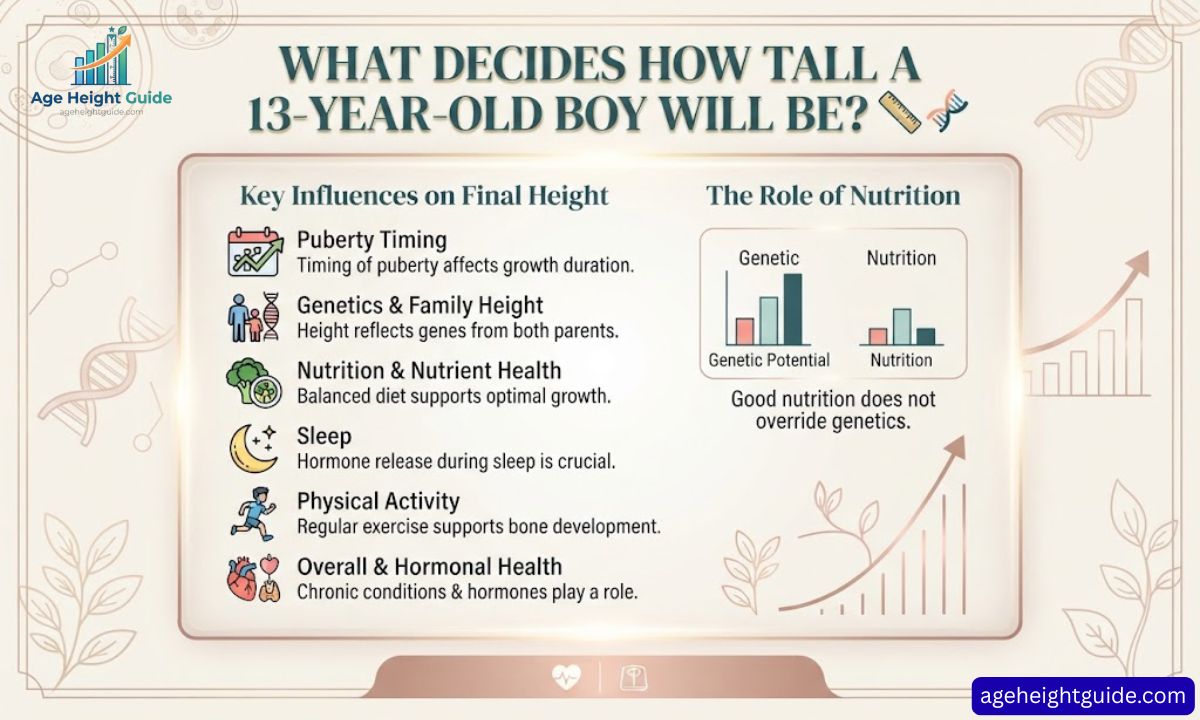
Several factors influence final height.
The largest influence is usually genetics. Family height helps set much of a child’s expected height range.
But genes are not the only factor.
Other influences include:
- Puberty timing
- Nutrition
- Sleep
- Overall health
- Physical activity
- Chronic medical conditions
- Certain medications
- Hormonal health
- Long-term nutrient deficiencies
Genetics and family height
A child’s height reflects many genes inherited from both parents.
This is why two boys who are the same age can have very different heights and still be developing normally.
A mid-parental height estimate can give families a rough idea of expected adult height, but it is only an estimate. It cannot predict an exact final height.
Can nutrition change genetic height potential?
Good nutrition does not override genetics.
Instead, adequate nutrition helps support normal development and allows the body to use the growth potential it already has.
A child who has a genuine nutritional deficiency may have impaired growth. Correcting that deficiency can support normal growth.
But giving extra nutrients to a child who already gets enough does not mean he will grow beyond his natural potential.
That distinction is important when evaluating kids’ growth supplements.
Can nutrition still support growth at 13?

Yes. Good nutrition remains important during adolescence.
At 13, bones, muscles, and other tissues are developing rapidly. The body needs enough energy, protein, vitamins, and minerals to support normal development.
Important nutrients include:
- Calcium
- Vitamin D
- Protein
- Zinc
- Magnesium
- Iron
- Other vitamins and minerals from a balanced diet
For example, the NIH lists a calcium recommended intake of 1,300 mg per day for children ages 9–13 and teens ages 14–18. Calcium can come from foods such as milk, yogurt, cheese, fortified beverages, tofu, and some vegetables.
Food should come first
A balanced diet should be the starting point.
A growing 13-year-old can get important nutrients from:
| Food group | Examples |
| Protein foods | Eggs, chicken, fish, beans, lentils |
| Dairy or alternatives | Milk, yogurt, cheese, fortified soy milk |
| Fruits | Berries, oranges, bananas, apples |
| Vegetables | Broccoli, leafy greens, carrots, peppers |
| Whole grains | Oats, whole-grain bread, brown rice |
| Healthy fats | Nuts, seeds, avocado, fish |
A supplement may be useful when a child has a documented deficiency or has difficulty meeting nutritional needs. It should not replace a varied diet.
What about the sugar in most growth gummies?
Parents should check the nutrition label before choosing growth gummies for kids.
Some gummy supplements contain added sugar. Others use alternative sweeteners.
The important point is that sugar does not make a supplement more effective for height growth.
When comparing a kids growth gummy, look beyond the front of the package.
Check:
- Added sugar
- Serving size
- Ingredient amounts
- Vitamin and mineral doses
- Sweeteners
- Proprietary blends
- Age recommendations
- Third-party testing, when available
- Health claims
A supplement should not promise guaranteed inches.
No gummy can guarantee a particular adult height.
Sugar-free does not automatically mean better
A sugar-free growth gummy may reduce added sugar, but sugar content is only one part of the evaluation.
Parents should also ask:
What nutrients are actually included?
How much does each serving provide?
Are the doses clearly listed?
Does the child actually need those nutrients?
These questions are more useful than judging a product only by whether it tastes sweet.
How can parents support a growing 13-year-old boy?
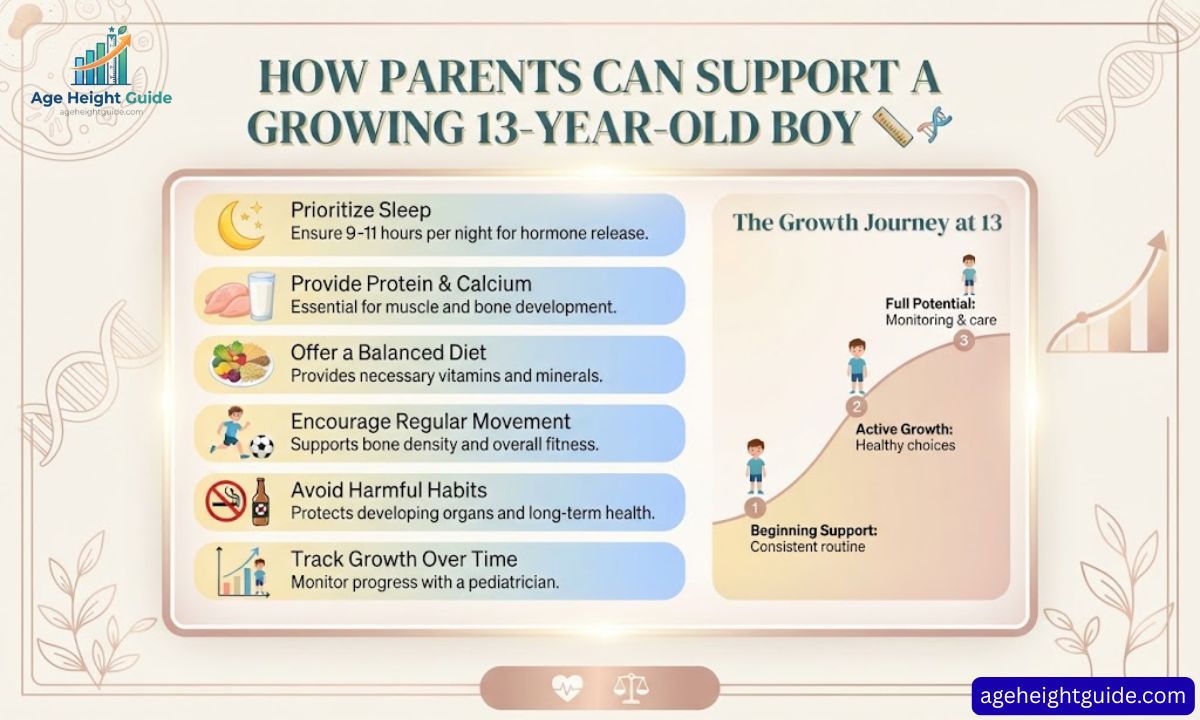
Parents cannot control a child’s final height.
They can, however, support the habits that help normal growth and development.
1. Prioritize sleep
Teenagers need consistent sleep.
A regular bedtime can make it easier to get enough rest. A calm bedroom and fewer late-night screens can also help.
Instead of treating sleep as a height trick, think of it as part of overall healthy development.
2. Provide enough protein and calcium
Protein supports muscles and tissues.
Calcium supports bones.
For boys ages 9–13, the NIH recommends 1,300 mg of calcium per day.
Good food sources include dairy products, fortified foods, beans, tofu, and selected vegetables.
3. Offer a balanced diet
Try to build meals around:
protein + whole-food carbohydrates + vegetables or fruit + healthy fats
This is more useful than focusing on one “height food.”
4. Encourage regular movement
Running, jumping, sports, walking, and age-appropriate strength training can support fitness and bone health.
Exercise does not add inches on demand.
It is part of a healthy lifestyle.
5. Avoid smoking and other harmful habits
A healthy growth environment includes avoiding tobacco and other substances that can harm adolescent health.
6. Track growth over time
Keep records of height measurements from routine medical visits.
The trend is more informative than comparing a teenager with classmates.
What should parents look for in a growth supplement?
If a parent is considering a growth supplement for a 13-year-old boy, the label deserves close attention.
A useful checklist is:
| What to check | Why it matters |
| Added sugar | Helps parents understand the product’s overall nutrition profile |
| Clear ingredient doses | Shows how much of each nutrient the child receives |
| Age range | The product should be appropriate for the child’s age |
| Vitamin D | Important for calcium absorption and bone health |
| Calcium | Supports normal bone development |
| Zinc | Important for normal growth and development |
| Magnesium | Supports normal body functions |
| Vitamin K | Involved in bone-related processes |
| Third-party testing | Can provide additional information about product quality |
| Honest claims | Avoid products promising guaranteed height increases |
Be careful with “proprietary blends”
A proprietary blend can make it difficult to see exactly how much of each ingredient is included.
Clear labeling is easier for parents to evaluate.
More ingredients also do not automatically mean better results.
The key question is whether the child actually needs the nutrients and whether the product provides reasonable amounts.
When should parents talk to a pediatrician?

This is an important part of understanding the average height for a 13-year-old boy.
A child does not need to be close to the average to be healthy.
However, parents should discuss growth with a pediatrician if they notice concerns such as:
- Height growth has slowed or stopped.
- The child is dropping across several growth percentiles.
- Puberty appears much earlier or later than expected.
- The child has ongoing digestive problems or poor appetite.
- There is unexplained weight loss.
- There is a known chronic health condition.
- Family members are concerned about overall development.
The CDC notes that growth charts help clinicians form an overall clinical impression and should not be used as the sole diagnostic tool.
A pediatrician can combine growth measurements, growth velocity, family history, puberty stage, nutrition, and overall health when deciding whether further evaluation is needed.
The honest timeline
There is no reliable supplement that can promise a specific number of inches by a specific date.
Growth happens over time.
The average height for a 13-year-old boy is only a reference point. A 13-year-old may grow quickly during puberty, then slow down later. Another boy may have a later growth spurt.
That difference does not automatically mean something is wrong.
The most useful approach is simple:
Track growth.
Support good nutrition.
Protect sleep.
Encourage activity.
Follow normal medical care.
Treat real nutritional or medical problems when they are found.
The goal should not be to force a child to become taller than his natural potential.
The goal is to support healthy development while growth is still occurring.
What is the average height for a 13-year-old boy in cm?
The average height for a 13-year-old boy is about 156 cm, around the 50th percentile on the CDC boys’ stature-for-age chart.
However, age in months matters. A boy who has recently turned 13 and a boy who is nearly 14 are not at the same point on a growth chart.
That is why pediatricians use age-specific measurements rather than one number for everyone who is labeled “13.”
How much should a 13-year-old boy grow in a year?
There is no single yearly amount that applies to every 13-year-old boy.
For the average height for a 13-year-old boy, growth can vary widely during puberty. Growth can speed up during puberty and slow down later.
A boy in an active growth spurt may gain height much faster than a boy who has not yet entered his peak growth period.
This is another reason growth velocity is useful.
A series of accurate measurements can show whether height is progressing steadily.
Can a short 13-year-old boy still grow taller?
Yes.
The average height for a 13-year-old boy is only a reference point. A shorter-than-average 13-year-old may still have substantial growth ahead, especially if puberty started later.
Family height and puberty timing can help explain why some boys are shorter at 13 but continue growing during later adolescence.
Being short at 13 does not automatically predict short adult height.
Final takeaway
The average height for a 13-year-old boy is about 5 feet 1 inch (156 cm) at the 50th percentile on the CDC growth chart.
But there is no single height a 13-year-old boy “should” be.
What matters more is the overall pattern.
A boy may be shorter or taller than average and still develop normally. Genetics, puberty timing, nutrition, sleep, health, and activity all play roles in healthy development.
The best goal is not to chase a number.
It is to give a growing teenager the nutrition, sleep, activity, and medical care he needs while his body develops naturally.
Frequently Asked Questions
What is the average height for a 13-year-old boy?
The average height for a 13-year-old boy is about 5 feet 1 inch (156 cm) around the 50th percentile on the CDC boys’ stature-for-age chart. Average height is only a reference point. A healthy boy can be shorter or taller than this.
What is the normal height for a 13-year-old boy?
There is no single height that every 13-year-old boy should reach. CDC growth charts show a wide range of heights across percentiles. Doctors also consider the child’s growth pattern, family height, puberty stage, and health.
Is 5 feet short for a 13-year-old boy?
Five feet is below the 50th percentile for a 13-year-old boy, but that alone does not mean a boy is unhealthy or finished growing. His previous measurements and growth velocity provide more useful context.
Is 5’5″ tall for a 13-year-old boy?
Yes, 5 feet 5 inches is above the CDC’s 50th percentile for a 13-year-old boy. Being taller than average does not predict an exact adult height because puberty timing and genetics vary.
Is a 13-year-old boy still growing?
Many boys are still actively growing at 13. Puberty timing varies widely. Some boys may be near their peak growth period, while others may have their larger growth spurt later.
When do boys stop growing?
Boys generally continue growing through later adolescence, but there is no single stopping age that applies to everyone. Growth slows as puberty progresses and eventually stops after the growth plates close.
Can nutrition make a 13-year-old boy taller?
Good nutrition supports normal growth when the body has adequate energy and nutrients. Correcting a true nutritional deficiency can help normal development. However, extra nutrients do not guarantee additional height in a child who already meets his nutritional needs.
How much calcium does a 13-year-old boy need?
The NIH recommends 1,300 mg of calcium per day for children ages 9–13. Calcium can come from foods such as milk, yogurt, cheese, fortified foods, tofu, and some vegetables.
Can a growth gummy make a 13-year-old boy taller?
No supplement should promise guaranteed height increases. A supplement may help fill a nutritional gap when one exists, but it cannot override genetics or guarantee a specific adult height.
What matters more than average height?
A child’s growth trajectory is often more useful than a single comparison with the average. Doctors can look at repeated height measurements, percentile patterns, puberty development, family history, nutrition, and overall health.
When should I talk to a pediatrician about my son’s height?
Talk with a pediatrician if growth seems to slow significantly, the child drops across growth percentiles, puberty seems unusually early or delayed, or there are other health or nutrition concerns. Growth charts are useful tools, but they are not a diagnosis by themselves.

Stoke is the author behind Age Height Guide, creating simple and informative content about average height, age, growth, and related measurements.