


The average height for a 15-year-old boy is about 5 feet 7 inches (170 cm) at the 50th percentile on the CDC boys’ stature-for-age growth chart.
This number is only a reference point. It does not mean every boy should be 5 feet 7 inches. Some healthy boys are shorter. Others are taller. Height can vary widely during the teen years.
At age 15, puberty can also affect height. Some boys have already passed their main growth spurt. Others are still growing. Genetics, nutrition, sleep, physical activity, and overall health can also affect development.
The best way to understand a teen’s growth is to look at his height over time. One measurement cannot show the full picture. A growth chart can help show whether his growth is following a steady pattern.
You can also read: Average Height for a 13-Year-Old Boy: 2026 Growth & Health.
How tall is the average 15-year-old boy?
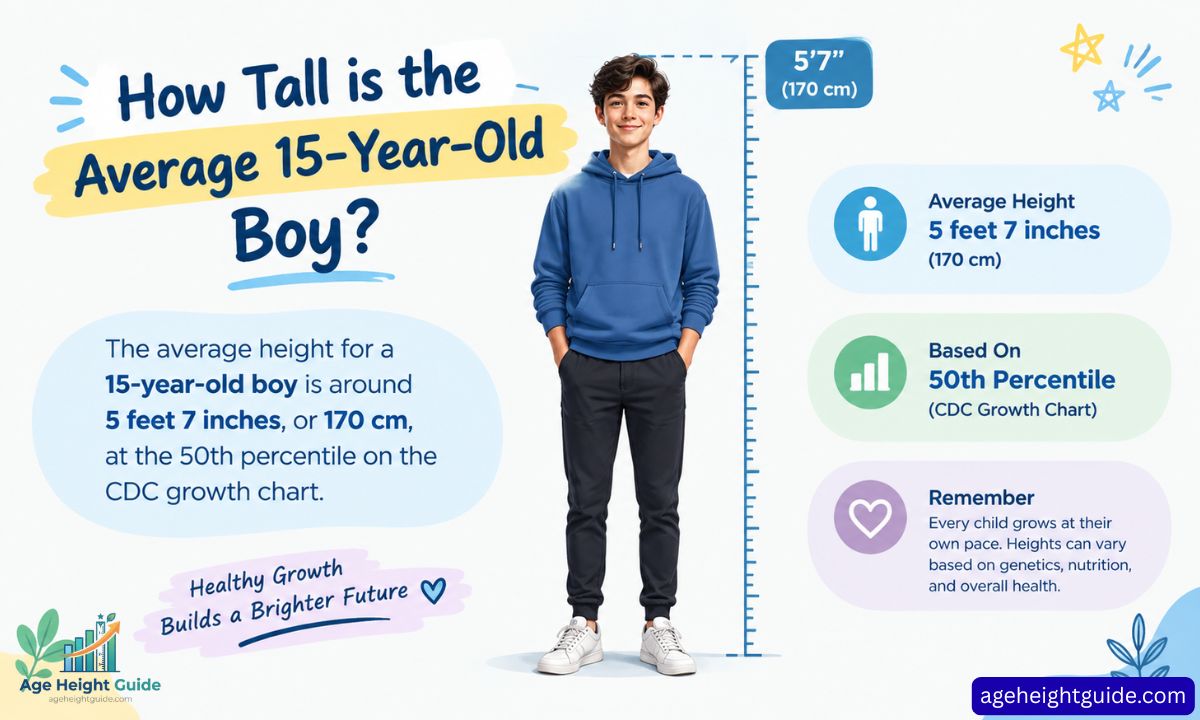
The average height for a 15-year-old boy is around 5 feet 7 inches, or 170 cm, at the 50th percentile on the CDC growth chart.
The 50th percentile is the middle of the reference group. It does not represent an ideal height. It also does not mean that every healthy teen should reach this number.
For example, one 15-year-old boy may be 5 feet 2 inches. Another may be 5 feet 11 inches. Their heights are different. Both may still have healthy growth.
What matters is the overall pattern. A doctor may compare current height with earlier measurements. They may also look at growth velocity and pubertal development.
The CDC growth chart gives a useful way to compare height by age. It shows percentiles rather than one required height.
| Age | 5th Percentile | 50th Percentile | 95th Percentile |
| 13 years | 4’9″ | 5’1″ | 5’6″ |
| 14 years | 5’0″ | 5’4″ | 5’9″ |
| 15 years | 5’1″ | 5’7″ | 6’0″ |
| 16 years | 5’3″ | 5’8″ | 6’1″ |
| 17 years | 5’4″ | 5’9″ | 6’2″ |
These numbers show how height is distributed on the reference chart. They are not medical cutoffs. A boy below or above these points is not automatically unhealthy.
A growth chart becomes more useful when several measurements are recorded. This helps show the direction of growth. It also gives more context than one height measurement.
What is the normal height range for a 15-year-old boy?

There is no single height that defines a normal 15-year-old boy.
Teen boys can have very different heights. This is especially true during puberty. Some boys grow earlier. Others grow later.
On the CDC reference chart, the 5th percentile for boys around age 15 is about 5’1″ (155 cm). The 50th percentile is about 5’7″ (170 cm). The 95th percentile is about 6’0″ (183 cm).
These numbers describe the reference population. They do not define who is healthy or unhealthy.
A growth pattern is often more useful than one percentile. A teen who stays on a similar growth curve may be developing normally. A sudden change in growth pattern may deserve more attention.
Parents can also consider puberty timing. A boy who enters puberty later may be shorter than his classmates for a while. He may then continue growing after some of them have slowed down.
Average Height for a 15-Year-Old Boy by Percentile
The average height for a 15-year-old boy is around 5 feet 7 inches (170 cm) at the 50th percentile on the CDC reference chart. Height varies widely at this age, so the average should not be treated as a target.
| Percentile | Approx. Height | Height in cm |
|---|---|---|
| 5th percentile | 5’1″ | 154 cm |
| 25th percentile | 5’4″ | 163 cm |
| 50th percentile | 5’7″ | 170 cm |
| 75th percentile | 5’10” | 178 cm |
| 95th percentile | 6’0″ | 184 cm |
The 50th percentile represents the middle of the reference population. A boy below this point is not automatically too short, and a boy above it is not automatically too tall.
The 5th to 95th percentile range also should not be treated as a strict definition of normal or abnormal height. Doctors look at the full growth pattern, including previous measurements, growth velocity, puberty timing, family height, and overall health.
For the most accurate comparison, a teenager’s exact age in months should be considered when reading a growth chart. A 15-year-old who is 15 years and 11 months may have a different percentile than a boy who has just turned 15.
Why the average is not a target
The word “average” can create confusion.
The 50th percentile is simply the midpoint. It is not a goal. A boy does not need to reach the 50th percentile to have healthy growth.
Some boys naturally fall below the midpoint. Others naturally fall above it. Family height can help explain some of this variation.
It is better to follow a teen’s own growth pattern. Comparing him with classmates can give a misleading picture.
Is a 15-year-old boy still growing?

Yes. Many 15-year-old boys are still growing.
There is no birthday when height growth suddenly stops. Boys go through puberty at different times. Their growth can therefore happen on different schedules.
Some boys have already had a large growth spurt by age 15. Others may still be in the middle of puberty. A later-developing boy may have more growth remaining than an earlier-developing boy.
This is why age alone cannot tell you how much height a teenager has left.
Previous measurements are more useful. If a boy has gained height over the past year, that provides evidence that growth is still happening.
Growth spurts during the teen years
A growth spurt can cause height to increase quickly. This usually happens during puberty.
Growth does not always happen at the same rate. A teen may grow several centimeters over a period of months. Growth may then slow for a while.
Short periods with little visible change do not always mean growth has stopped.
The longer trend matters more. Tracking height over several months can give a clearer picture.
When do boys stop growing?
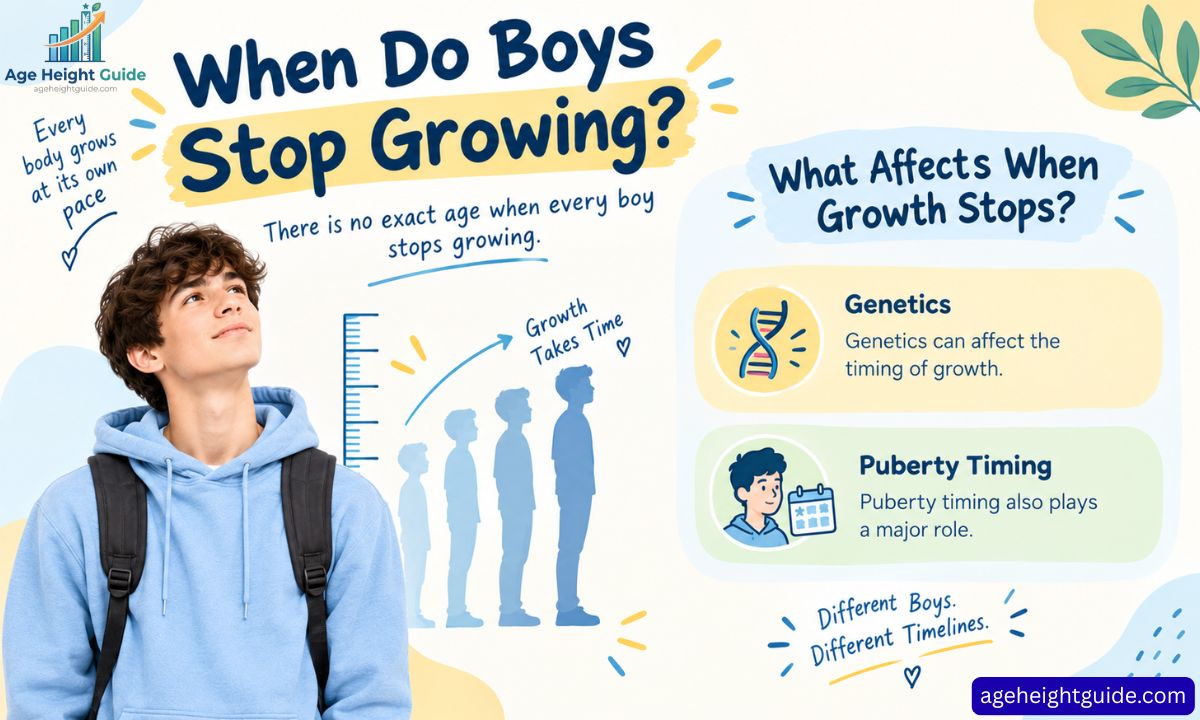
There is no exact age when every boy stops growing.
Many boys reach most of their adult height during the later teen years. The exact timing depends on puberty and skeletal maturity.
The growth plates are important in this process. They are areas of developing tissue near the ends of long bones.
During childhood and adolescence, growth plates allow bones to become longer. As puberty progresses, these areas mature.
The growth plates eventually close. Once they have fully closed, the long bones can no longer lengthen through normal growth.
What affects when growth stops?
Genetics can affect the timing of growth. Puberty timing also plays a major role.
Nutrition and overall health matter too. Certain health conditions can affect normal growth. Hormonal problems can also change the growth pattern.
Sleep is important for overall health and development. However, getting more sleep than needed does not guarantee extra height.
This means two boys who are both 15 can have different amounts of growth remaining.
What decides how tall a 15-year-old boy will be?
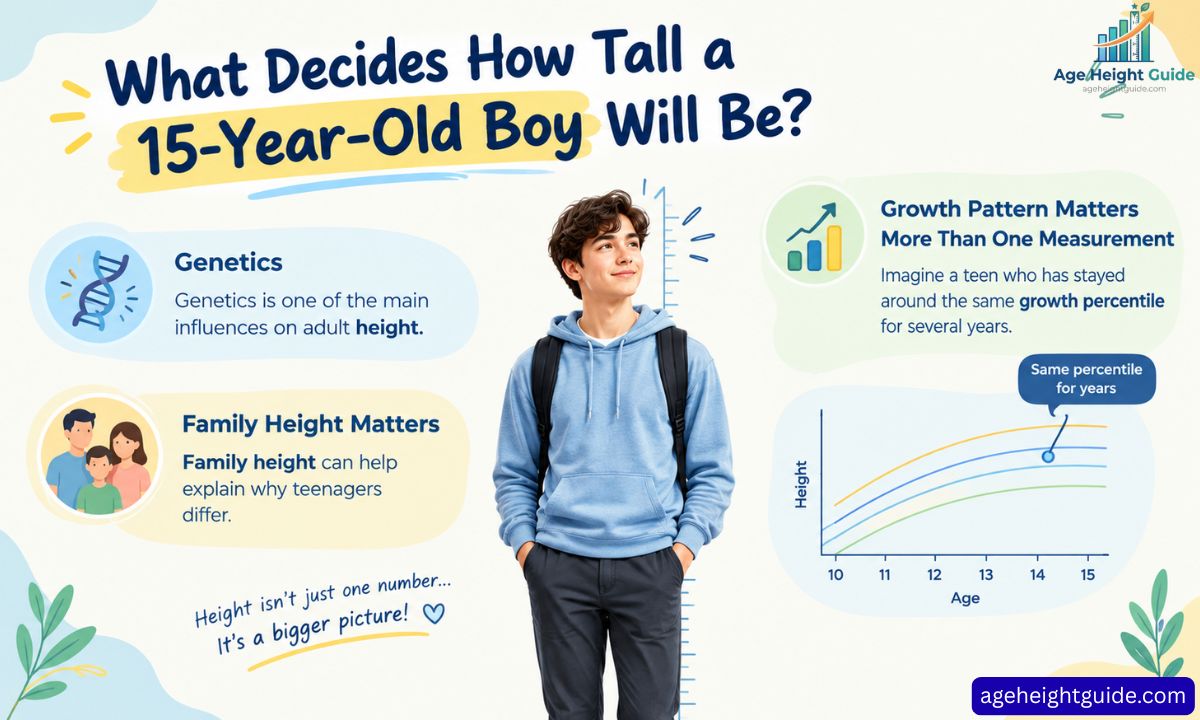
Genetics is one of the main influences on adult height.
Family height can provide useful context. A teenager with shorter parents may naturally be shorter than his classmates. A teenager with taller parents may naturally be taller.
However, genetics is not the only factor.
Puberty timing can change when growth happens. Nutrition can affect normal development. Overall health can also influence growth.
Sleep and regular physical activity support general health. They are part of a healthy lifestyle during adolescence.
Family height matters
Family height can help explain why teenagers differ.
A boy does not need to match the height of his father, brother, or classmates at age 15. Each person has an individual growth pattern.
This is why comparing one 15-year-old boy with another is not always useful.
A better approach is to compare his current height with his previous measurements. This shows whether he is continuing to grow.
Growth pattern matters more than one measurement.
Imagine a teen who has stayed around the same growth percentile for several years.
He may be below the 50th percentile. His growth can still be steady.
Now imagine another teen whose height suddenly drops across several percentile lines.
That change may be more important than the actual percentile.
Growth charts are therefore better viewed as tracking tools. They are not grades.
Can nutrition still support growth at 15?

Yes. Nutrition remains important during adolescence.
A growing teen needs enough energy and nutrients. These support normal bone, muscle, and body development.
However, good nutrition does not guarantee extra height. It helps the body function and develop normally.
If a teen has a genuine nutritional deficiency, correcting it can be important. But taking large amounts of nutrients when they are not needed does not automatically increase height.
The goal should be adequate nutrition. It should not be megadosing.
Important nutrients during the teen years
Protein is important for normal tissue growth and repair. Good sources include eggs, fish, chicken, beans, lentils, and yogurt.
Calcium supports bone health. Milk, yogurt, cheese, and fortified foods can provide calcium.
Vitamin D also supports bone health. It helps the body absorb calcium.
Iron, zinc, magnesium, and other nutrients support normal body functions. A varied diet can help provide these nutrients.
What should a 15-year-old eat?
A balanced diet can include several food groups.
Protein can come from eggs, fish, chicken, beans, lentils, and yogurt. Fruits and vegetables provide vitamins, minerals, and fiber.
Whole grains can provide carbohydrates and other nutrients. Healthy fats can come from nuts, seeds, avocado, and olive oil.
No single food can determine a teenager’s final height.
A balanced eating pattern is more important than one specific growth supplement.
What about the sugar in most growth gummies?

Sugar is one factor parents can check when choosing a daily gummy.
Some growth gummies contain added sugar. Sugar can make gummies taste better. However, frequent high-sugar foods can add calories without providing many important nutrients.
Parents should read the Nutrition Facts label. They should also check the ingredient list.
Look at the serving size and added sugar. Check the amount of each active nutrient. Also check the age recommendation.
Some products use a proprietary blend. This can make it harder to see the exact amount of each ingredient.
Marketing terms can also be misleading. Words such as “growth” or “height support” do not prove that a product will increase height.
Do sugar-free gummies make a teenager taller?
No.
Sugar-free does not mean height-increasing.
A sugar-free gummy may simply contain less added sugar. That can be useful for dietary reasons. It does not prove that the product will make a 15-year-old boy taller.
The same applies to products called “growth boosters.”
A supplement may help fill a nutritional gap. It cannot guarantee additional height.
How can parents support a growing 15-year-old boy?
Parents cannot control a teenager’s final height.
They can support habits that help normal development.
Balanced meals are a good starting point. Regular meals can help a teen get enough energy and nutrients.
Sleep also matters. Teens ages 13–18 are generally recommended to get 8–10 hours of sleep per 24 hours.
Regular physical activity supports bone, muscle, and cardiovascular health. Teens can choose activities they enjoy.
Walking, cycling, swimming, sports, and age-appropriate strength training can all be part of an active lifestyle.
Parents should also avoid unnecessary dieting. Restrictive diets can make it harder for teens to meet their nutritional needs.
Height should be measured over time. Recording the date and measurement can help create a useful growth history.
What should parents look for in a teen growth supplement?
A teen growth supplement should be viewed as a nutritional product.
It should not be treated as a guaranteed height booster.
Parents can check the exact nutrient amounts. The serving size is also important.
Added sugar is another factor to consider. The ingredient list should be easy to understand.
Age guidance should match the teenager. Parents can also look for information about quality testing.
Most importantly, be careful with strong health claims. A product should not promise a specific increase in height.
Can vitamins make a 15-year-old boy taller?
Vitamins are important for normal body functions.
If a teenager has a vitamin deficiency, correcting it can support normal health and development.
However, extra vitamins do not automatically make a well-nourished teenager taller.
Taking more is not always better.
The goal is to meet nutritional needs.
Supporting normal growth is not the same as creating extra growth.
How much growth can a 15-year-old boy have left?
There is no single answer for every teen.
Remaining growth depends on puberty timing and skeletal maturity. Current height and previous growth also provide useful information.
Family height can add more context. Overall health and nutrition matter too.
A boy who entered puberty later may have more growth remaining than another boy of the same age.
This is why online calculators can only provide estimates.
Can you predict final adult height?
Doctors can use several factors when estimating adult height.
They may review current height and previous measurements. They may also consider family height and puberty stage.
Growth velocity can provide additional information.
In some situations, a doctor may consider a bone age X-ray. This can help assess skeletal maturity.
No method can predict adult height perfectly.
How does puberty affect the height of a 15-year-old boy?

Puberty is a major part of adolescent growth.
Hormonal changes cause many physical changes. These include changes in height, body shape, muscle mass, and sexual development.
The timing is different for each boy.
Some boys have their main growth spurt before age 15. Others are still progressing through puberty at this age.
A later-developing boy may therefore be shorter than classmates for a period.
This does not automatically mean that he will remain shorter as an adult.
Early puberty vs. later puberty
An early-developing boy may grow sooner. He may also reach adult height sooner.
A later-developing boy may grow later. His height may increase after some classmates have already slowed down.
This creates large differences between boys of the same age.
Puberty timing is therefore an important part of understanding teen growth.
How should you track a 15-year-old boy’s growth?
A simple growth record can be very useful.
Measure height under similar conditions each time. Have the teen stand straight on a flat surface.
Record the date and height.
Do not worry about tiny daily changes. They are not useful for judging growth.
Instead, compare measurements over several months.
For example, a parent might record a teen’s height in January, April, July, and October.
The goal is to see the overall trend.
A steady increase can show that growth is continuing. A sudden change in the pattern may be worth discussing with a healthcare professional.
Example growth record
| Date | Age | Height |
| January | 14 years, 7 months | 165 cm |
| April | 14 years 10 months | 167 cm |
| July | 15 years, 1 month | 169 cm |
| October | 15 years 4 months | 170 cm |
The numbers in this example are only for illustration.
The important part is the tracking method.
A growth record provides more information than asking whether a teenager is “tall enough.”
When should parents talk to a pediatrician?
Being shorter or taller than average does not automatically mean there is a health problem.
However, parents should discuss concerns with a pediatrician when growth seems unusual.
For example, a teen may stop gaining height unexpectedly. His growth pattern may also change sharply.
Delayed or unusually early puberty can also be worth discussing.
Other symptoms matter too. Chronic health problems, poor nutrition, or concerns about hormones can affect growth.
A pediatrician can review previous height measurements. They can also look at family history and puberty development.
If needed, they can decide whether further testing is appropriate.
The honest timeline

There is no guaranteed growth timeline for every 15-year-old boy.
Some boys experience their main growth spurt earlier. Others experience it later.
Growth usually speeds up during puberty. It then gradually slows as puberty progresses.
Many boys approach their adult height during the later teen years.
The exact timeline depends on the individual.
The important point is that two boys of the same age can have very different growth patterns.
What actually supports healthy growth?
The basics are simple.
A teenager needs enough food and a balanced diet. He also needs enough sleep and regular physical activity.
Good general health matters too.
These habits support normal development. They do not guarantee a specific adult height.
That distinction is important when reading advice about teen growth or evaluating a growth supplement.
Frequently Asked Questions
What is the average height for a 15-year-old boy?
The average height for a 15-year-old boy is about 5 feet 7 inches (170 cm) at the 50th percentile on the CDC boys’ stature-for-age chart. This is the midpoint of the reference population. It is not a required or ideal height. Healthy boys can be shorter or taller than this.
Is 5 feet short for a 15-year-old boy?
Five feet is below the 50th percentile for boys around age 15. However, height alone does not show whether a teen is growing normally. A doctor may look at previous height measurements, growth velocity, puberty timing, family height, and overall health before deciding if there is a concern.
Is 5’5″ short for a 15-year-old boy?
Five feet five inches is below the 50th percentile for a 15-year-old boy. This does not automatically mean there is a growth problem. Some boys naturally have a shorter stature. Puberty timing and family height can also affect when a teen grows.
Is 5’7″ a good height for a 15-year-old boy?
Five feet seven inches is close to the 50th percentile on the CDC reference chart for boys around age 15. It represents the midpoint of the reference population. It should not be viewed as an ideal or required height. A healthy teen can be shorter or taller than this.
Is 6 feet tall for a 15-year-old boy?
Six feet is near the upper end of the CDC reference distribution for boys around age 15. A teen at this height may simply be taller than average. Being tall does not automatically indicate a health problem. Growth patterns and overall development provide more useful information.
How much should a 15-year-old boy grow each year?
Growth speed can change during puberty. A teen may grow quickly during a growth spurt and then slow down as puberty progresses. There is no single yearly growth rate that applies to every boy. Doctors often look at growth velocity over time instead of relying on one fixed number.
Can a 15-year-old boy still grow taller?
Yes, many boys are still growing at age 15. The amount of remaining growth varies from person to person. Puberty timing, skeletal maturity, genetics, and previous growth all matter. A boy who enters puberty later may continue growing after some of his classmates have slowed down.
What helps a 15-year-old boy grow taller?
No food, exercise, or supplement can guarantee extra height. However, balanced nutrition, adequate sleep, regular physical activity, and good overall health support normal growth and development. These habits help a teen meet his body’s needs while he is still developing.
Do vitamins make boys taller?
Vitamins support normal body functions and development. If a teenager has a genuine vitamin deficiency, correcting it can support normal health. However, taking extra vitamins does not automatically make a well-nourished teenager taller. More nutrients are not always better.
Does sleep affect growth?
Adequate sleep supports overall health and development during the teen years. Teens ages 13–18 are generally recommended to get 8–10 hours of sleep per 24 hours. A consistent sleep schedule can make it easier to get enough rest. However, sleeping more than needed does not guarantee extra height.
Does exercise stop a 15-year-old boy from growing?
Normal physical activity does not automatically stop a 15-year-old boy from growing. Sports, walking, cycling, swimming, and age-appropriate strength training can support overall health. Exercise should be performed with safe technique and suitable training practices.
How can I know if my 15-year-old boy is still growing?
Look at his height over time rather than relying on one measurement. Previous measurements can show whether his height is still increasing. The puberty stage also provides useful context. If there are concerns, a doctor can review his growth chart, growth velocity, puberty development, and overall health.
What is the normal height for a 15-year-old boy in cm?
The CDC 50th-percentile height for a 15-year-old boy is about 170 cm. There is a wide range of heights around this midpoint. A teen does not need to be exactly 170 cm to have healthy growth. His growth pattern is more useful than one number.
Does being shorter than classmates mean a boy will stay short?
Not necessarily. Boys enter puberty at different times, so their growth can happen on different schedules. A later-developing teen may be shorter than classmates for a period. He may continue gaining height after some of his peers have already slowed down.
When should I worry about my son’s height?
One height measurement usually provides limited information. A bigger concern is a major change in the growth pattern or unusually slow growth over time. Delayed puberty or other health symptoms may also need attention. A pediatrician can review the complete growth history and decide whether further evaluation is needed.
Can a growth supplement guarantee more height?
No. A growth supplement cannot guarantee a specific increase in height. It may help address a nutritional gap when one exists. However, it cannot override genetics or guarantee extra growth. Parents should be cautious about products that promise a specific number of inches.
What is the most important thing to remember about a 15-year-old boy’s height?
The average height for a 15-year-old boy is a useful reference point, but it is not a target. A healthy teenager may be shorter or taller than average. The complete picture matters more. This includes growth pattern, growth velocity, puberty timing, family height, nutrition, sleep, and overall health. One number cannot tell the whole story.

Stoke is the author behind Age Height Guide, creating simple and informative content about average height, age, growth, and related measurements.