


The average height for a 13-year-old girl is about 5 feet 2 inches (158 cm) at the 50th percentile on the CDC growth chart. This number is a useful reference. It is not a height that every girl should reach.
Girls grow at different rates. Puberty also starts and progresses at different times.
A 13-year-old girl may be shorter or taller than the average and still have a healthy growth pattern. What matters more is how her height changes over time. A pediatrician may look at her height percentile, previous measurements, growth velocity, family height, puberty stage, nutrition, and overall health.
The CDC growth chart is designed to show how a child’s height compares with other children of the same age and sex. It is most useful when several measurements are viewed together. One height measurement cannot tell you how tall a girl will be as an adult.
At age 13, some girls are already close to their adult height. Others are still growing. Puberty timing is one important reason for this difference. A girl who entered puberty later may have more growth remaining than a girl who entered puberty earlier.
You can also read: Average Height for a 16-Year-Old Boy: Healthy 2026 Guide.
How tall is the average 13-year-old girl?

The average height for a 13-year-old girl is about 5 feet 2 inches (158 cm) at the 50th percentile on the CDC reference chart. The 50th percentile represents the middle of the reference population. It does not mean that 5 feet 2 inches is the required or ideal height for a 13-year-old.
For parents, this distinction is important. The word average can make one number seem like a goal. It is not.
A girl who is 4 feet 11 inches may be following a healthy growth curve. Another girl who is 5 feet 5 inches may also be developing normally.
Height is influenced by many factors. Genetics plays a major role. Puberty timing also matters. Nutrition, general health, sleep, and some medical conditions can affect growth during childhood and adolescence.
This is why the average height of a 13-year-old girl should be used as a reference rather than a pass-or-fail measurement. A child’s own growth history can tell a parent much more than comparing her height with classmates.
The CDC provides stature-for-age growth charts for children and adolescents from ages 2 through 20. These charts help healthcare professionals track height across percentiles and over time.
Average height for a 13-year-old girl in feet and centimeters
| Reference point | Approximate height |
| 5th percentile | 4 ft 10 in (148 cm) |
| 50th percentile | 5 ft 2 in (158 cm) |
| 95th percentile | 5 ft 6 in (168 cm) |
These are rounded reference values. They should not be treated as strict boundaries for healthy development.
What is the normal height range for a 13-year-old girl?
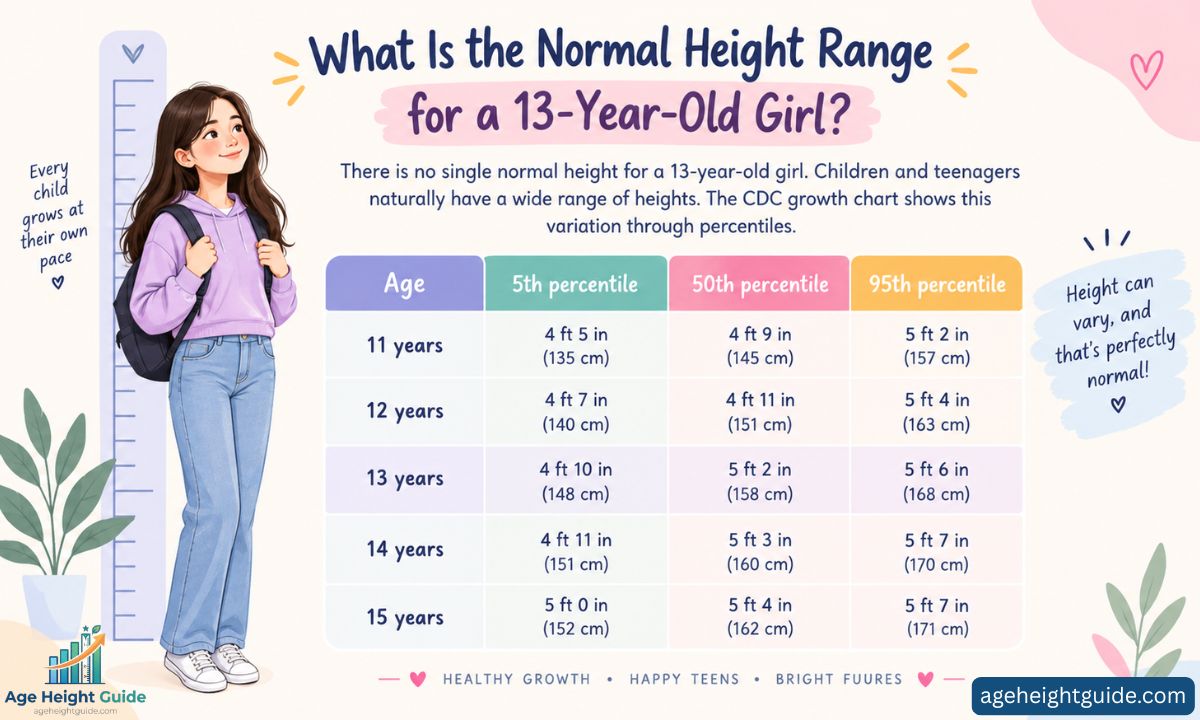
There is no single normal height for a 13-year-old girl. Children and teenagers naturally have a wide range of heights. The CDC growth chart shows this variation through percentiles.
At age 13, a height around 5 feet 2 inches is close to the 50th percentile. A girl around 4 feet 10 inches may be near the 5th percentile. A girl around 5 feet 6 inches may be near the 95th percentile.
These percentiles describe the distribution of height in the reference population. They do not, by themselves, determine whether a child is healthy or unhealthy.
| Age | 5th percentile | 50th percentile | 95th percentile |
| 11 years | 4 ft 5 in (135 cm) | 4 ft 9 in (145 cm) | 5 ft 2 in (157 cm) |
| 12 years | 4 ft 7 in (140 cm) | 4 ft 11 in (151 cm) | 5 ft 4 in (163 cm) |
| 13 years | 4 ft 10 in (148 cm) | 5 ft 2 in (158 cm) | 5 ft 6 in (168 cm) |
| 14 years | 4 ft 11 in (151 cm) | 5 ft 3 in (160 cm) | 5 ft 7 in (170 cm) |
| 15 years | 5 ft 0 in (152 cm) | 5 ft 4 in (162 cm) | 5 ft 7 in (171 cm) |
A girl can be below the 50th percentile and continue to grow steadily. She may simply have a naturally shorter family growth pattern. Another girl can be above the 50th percentile and also be healthy.
A change in growth pattern can be more useful than the exact percentile at one point in time.
Is 5 feet short for a 13-year-old girl?
A height of 5 feet is below the 50th percentile for a 13-year-old girl on the CDC reference chart. However, being below average does not automatically mean that a girl is too short or has a health problem.
A pediatrician may look at previous height measurements before assessing the growth pattern. If she has consistently tracked around a similar percentile, that pattern may provide useful context.
A sudden drop in growth velocity can be more important than her exact height.
Is 5 feet 2 inches average for a 13-year-old girl?
Yes. About 5 feet 2 inches (158 cm) is around the 50th percentile for a 13-year-old girl on the CDC growth chart. This means about half of girls the same age are shorter, while about half are taller. So, 5 feet 2 inches is close to the average height for a 13-year-old girl.
The average is only a reference point. It is not a height every girl needs to reach. Girls grow at different rates. Some may have already passed their main growth spurt. Others may still have more growth ahead. A girl who is 5 feet tall can still be growing normally. A girl who is 5 feet 6 inches can also have a healthy growth pattern.
What matters more is the growth pattern over time. Parents can look at previous height measurements, growth rate, puberty stage, and family height. A height percentile can add useful context. However, it does not diagnose a health problem by itself. Healthy growth can occur above or below the average height for a 13-year-old girl.
What does height percentile mean for a 13-year-old girl?
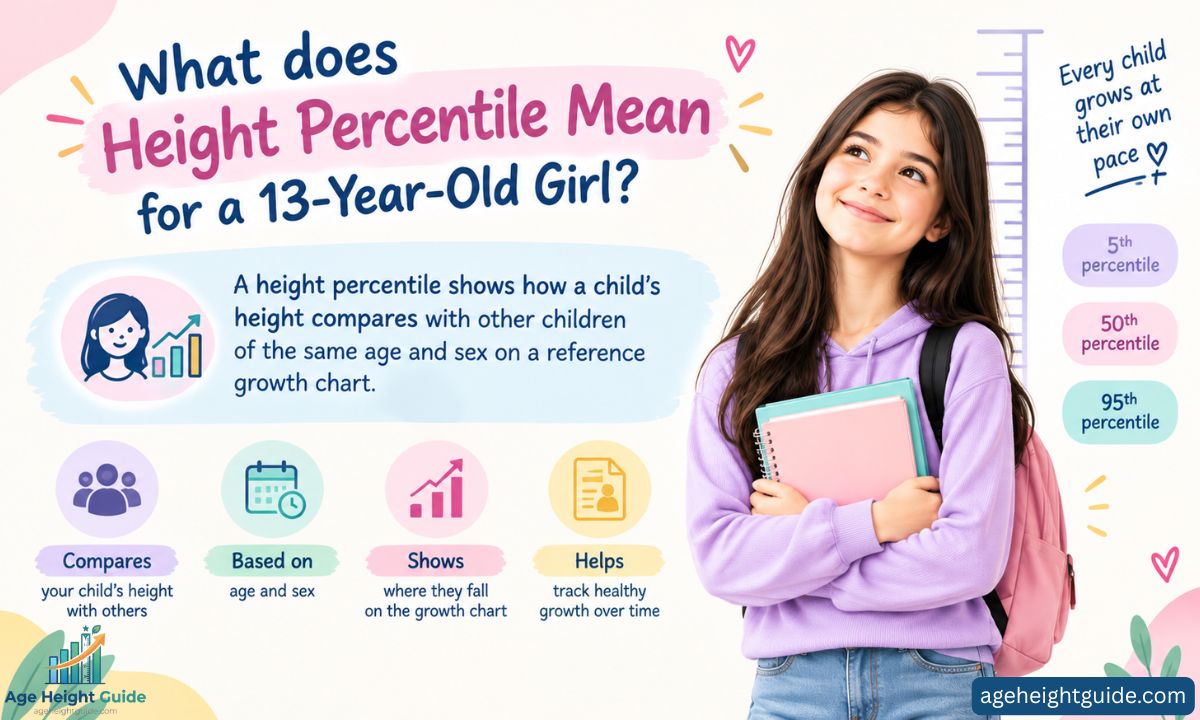
A height percentile shows how a child’s height compares with other children of the same age and sex on a reference growth chart.
For example, a girl near the 50th percentile is close to the middle of the reference group. A girl near the 10th percentile is shorter than most girls in that reference group. That does not automatically mean she is unhealthy.
Likewise, a girl near the 90th percentile is taller than most girls in the reference group. The percentile alone does not predict her final adult height.
The most useful information often comes from looking at the growth curve over time. If a girl has followed a similar percentile for several years, that pattern can provide useful context.
A noticeable change in growth velocity may deserve more attention. This is one reason pediatricians use repeated measurements rather than judging growth from one number.
Is a 13-year-old girl still growing?
Yes, many 13-year-old girls are still growing. However, the amount of growth left can vary widely.
Girls usually have their fastest height growth during puberty. The timing varies from person to person. Some girls enter puberty earlier, while others enter later.
A girl who began puberty later may continue growing at 13 when another girl is already closer to her adult height.
The first period is another useful puberty milestone. It usually occurs after the fastest phase of the pubertal growth spurt. However, getting a period does not mean that height growth stops immediately.
Many girls continue to gain some additional height after their first period. The amount varies with puberty timing and individual development.
How much can a 13-year-old girl grow?

There is no single number that can predict exactly how much height a 13-year-old girl has left to gain. The amount of growth left can vary widely from one girl to another.
A girl who entered puberty later may still have several inches of growth ahead. Another girl who is further along in puberty may be much closer to her adult height. This is why the average height for a 13-year-old girl should be used as a reference, not as a prediction of how tall she will become.
Several factors can affect how much growth remains, including:
- Puberty stage
- Age when puberty began
- Whether menstruation has started
- Growth over the past 1–2 years
- Current height and height percentile
- Family height patterns
- Nutrition and overall health
- Timing of growth spurts
Growth can slow as puberty progresses
Girls usually experience their fastest height growth during the earlier stages of puberty. Growth may slow as puberty progresses and the growth plates become more mature.
For example, a girl who is still in an active growth spurt may gain more height than a girl who is already near the end of puberty. However, there is no reliable rule that says every 13-year-old girl will gain a specific number of inches.
Getting a first period also does not mean that height growth stops immediately. Some girls continue to grow afterward, although the amount varies.
Look at growth patterns, not one measurement.
A single height measurement cannot show how much growth a girl has left. A better clue is her growth pattern over time.
If her height has increased steadily and she continues to follow a similar percentile on a growth chart, that pattern can provide more useful information than comparing her height with friends or with the average.
For example, being shorter than the average height for a 13-year-old girl does not automatically mean that a girl has a growth problem. She may simply have a different growth pattern or puberty timing.
Can a height calculator predict remaining growth?
Online height calculators can give rough estimates. They often use information such as the child’s current height and the heights of the parents.
These tools can be useful for general information, but they cannot account for every part of a child’s development. They should not be treated as an exact prediction of adult height.
A healthcare professional can make a more meaningful assessment by reviewing previous height measurements, growth velocity, puberty development, family height patterns, and overall health.
When there is a medical reason to investigate growth, a doctor may also consider a bone age X-ray. This can provide information about skeletal maturity and whether the growth plates are still developing.
The key point is that no fixed number of inches applies to every 13-year-old girl. Her puberty stage and growth pattern provide much more useful clues than the average alone.
What is a growth spurt?
A growth spurt is a period when a child grows faster than usual. During puberty, this increase in growth rate can be noticeable.
For girls, the fastest height growth generally occurs before the first period. After menstruation begins, growth usually slows, although additional height gain can still occur.
Parents should therefore consider puberty timing when looking at the height of a 13-year-old girl. Two girls with the same birthday can be at very different stages of development.
When do girls stop growing?
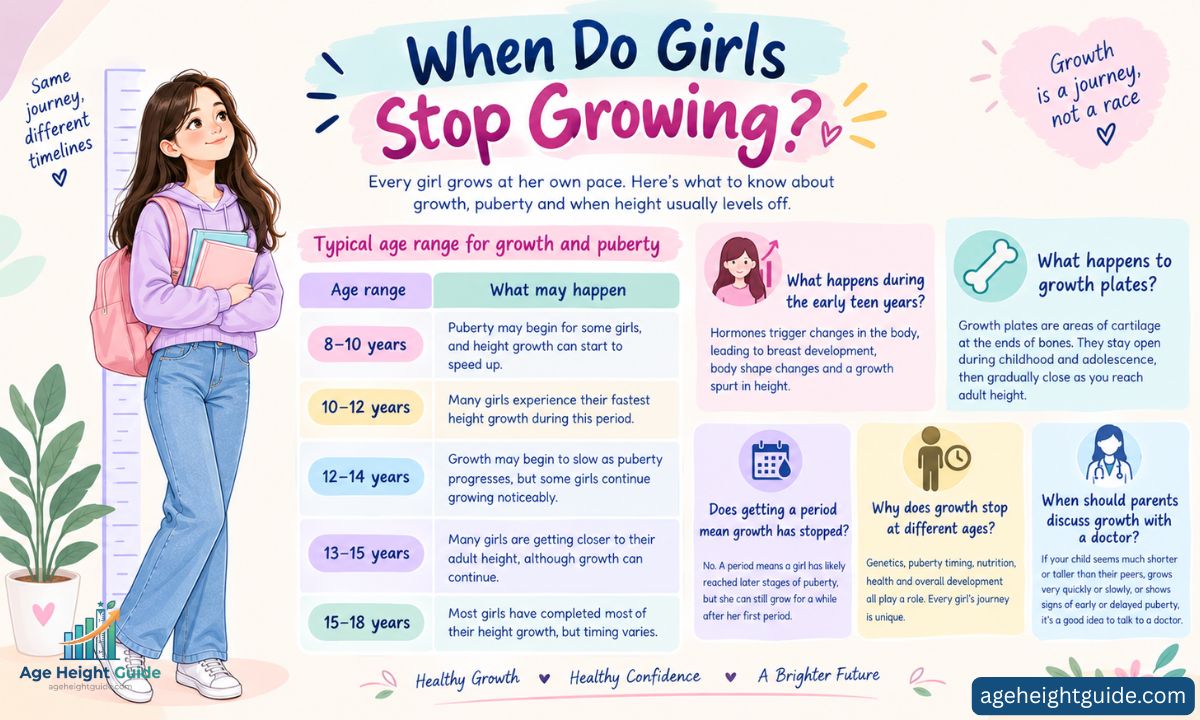
Girls usually stop gaining significant height after puberty is largely complete and the growth plates have fused. There is no exact age when every girl stops growing. Puberty can start and progress at different times, so the timing of final height also varies.
Typical age range for growth and puberty
| Age range | What may happen |
|---|---|
| 8–10 years | Puberty may begin for some girls, and height growth can start to speed up. |
| 10–12 years | Many girls experience their fastest height growth during this period. |
| 12–14 years | Growth may begin to slow as puberty progresses, but some girls continue growing noticeably. |
| 13–15 years | Many girls are getting closer to their adult height, although growth can continue. |
| 15–18 years | Most girls have completed most of their height growth, but timing varies. |
These are general age ranges, not strict cutoffs. A girl who enters puberty earlier may finish growing sooner. A girl who enters puberty later may continue growing for longer.
What happens during the early teen years?
Many girls experience their fastest height growth during the earlier stages of puberty. Growth can be rapid for a period of time and then gradually slow as puberty progresses.
A 13-year-old girl may therefore be at a very different stage of development from another girl of the same age. This is why the average height for a 13-year-old girl cannot predict how much growth she has left.
What happens to growth plates?
Growth plates are areas of developing tissue near the ends of long bones. They allow bones to become longer during childhood and adolescence.
As puberty progresses, the growth plates gradually become thinner and eventually fuse. Once they have fused, the long bones can no longer increase in length. Significant natural height growth is generally complete at this stage.
Does getting a period mean growth has stopped?
No. Getting a first period does not mean that height growth stops immediately.
Some girls continue to gain additional height after their first period. The amount can vary based on puberty timing and individual development.
This is another reason the average height for a 13-year-old girl should be viewed as a reference rather than a prediction of final height.
Why does growth stop at different ages?
Puberty does not happen at exactly the same age for everyone. Genetics also influence growth patterns and the timing of puberty.
A girl who starts puberty earlier may reach her adult height sooner. A girl who starts later may continue growing for longer.
Parents should therefore focus on the child’s growth pattern over time rather than one height measurement.
When should parents discuss growth with a doctor?
Growth charts can help show whether a child is following a consistent pattern. A noticeable slowdown in height growth may be worth discussing with a pediatrician.
A healthcare professional can review previous height measurements, puberty development, family height patterns, and overall health. When medically appropriate, a bone-age X-ray can provide additional information about skeletal maturity.
The average height for a 13-year-old girl does not determine when she will stop growing. Puberty timing, genetics, growth history, and skeletal maturity all provide useful context.
In short, girls do not all stop growing at the same age. Many complete most of their height growth during the mid-teen years, while others may finish earlier or continue a little longer. The average height for a 13-year-old girl is useful for comparison, but her individual growth pattern gives more meaningful information.
Does getting a period mean a girl has stopped growing?
No. A first period does not mean that height growth stops on the same day.
The first period usually happens after the peak of the pubertal growth spurt. Girls may continue growing afterward, although growth tends to slow.
The amount of growth after the first period varies. Some girls gain more height than others.
This is why the age of the first period can provide context, but it cannot be used by itself to predict final height.
When do growth plates close in girls?
Growth plate closure occurs as puberty progresses, but the timing varies from person to person.
A healthcare professional can assess skeletal maturity when there is a medical reason to do so. A bone age X-ray of the hand and wrist can sometimes provide additional information about skeletal development.
Physical signs alone cannot confirm that growth plates are open or closed.
What decides how tall a 13-year-old girl will be?

Many factors can affect how tall a girl will eventually become. Genetics is one of the largest influences, but it is not the only factor. Puberty timing, nutrition, overall health, sleep, and other biological factors can also affect growth.
The average height for a 13-year-old girl is useful as a general reference. It cannot predict the final height of one specific child.
How much does genetics affect height?
Family height can help explain why some children are naturally taller or shorter than others. A child inherits genetic information from both parents, and many genes can influence height.
This is why children from taller families may have a higher expected height range. Children from shorter families may naturally be shorter. Neither pattern automatically means that a child is developing abnormally.
A child also does not need to match the height of classmates. Comparing children of the same age can be misleading because their growth and puberty may happen at different times.
Why does puberty timing matter?
Puberty has a major effect on the timing of height growth. Girls who enter puberty earlier may experience their growth spurt sooner.
Girls who enter puberty later may have a different growth timeline. They may continue growing at an age when some of their peers have already started to slow down.
This is one reason the average height for a 13-year-old girl should not be used to predict how much growth she has left. Two girls who are both 13 can be at very different stages of puberty.
Can nutrition affect height?
Nutrition provides the building blocks needed for normal growth and development. A balanced diet should provide enough calories, protein, vitamins, and minerals to support the body’s needs.
Important nutrients for growing children include calcium, vitamin D, iron, zinc, magnesium, and protein. The exact needs can vary by age, diet, and individual health.
A nutrient deficiency can affect normal growth if it is significant or remains untreated. However, taking extra nutrients when they are not needed does not guarantee additional height.
Can health conditions affect growth?
Overall health can also influence growth. Some medical conditions can affect appetite, nutrient absorption, hormones, or the body’s ability to grow normally.
If a child grows much more slowly than expected, drops across several growth-chart percentiles, or has other concerning symptoms, a pediatrician can evaluate the situation.
A doctor may review previous height measurements, weight, growth velocity, family history, puberty development, and overall health.
What about sleep and physical activity?
Healthy sleep and regular physical activity support normal development. They are important parts of a healthy lifestyle during the teen years.
However, these habits should not be viewed as ways to force a child to become taller. Good habits support the growth a child’s body is naturally capable of achieving.
Can healthy habits make a girl taller than her genetic potential?
Healthy habits can help a child reach her natural growth potential. They cannot guarantee a height beyond that biological potential.
The average height for a 13-year-old girl is therefore best used as a comparison point, not a target. A girl’s own growth pattern provides more useful information about her development.
In short, final height is influenced by genetics, puberty timing, nutrition, health, and other biological factors. There is no single food, vitamin, exercise, or supplement that can guarantee a specific adult height..
Can parents predict adult height?
There is no perfect way to predict adult height.
A doctor may consider current height, previous measurements, height percentile, growth velocity, family heights, puberty stage, and overall health. In some cases, a bone age assessment may also provide additional information.
A commonly discussed method is the mid-parental height estimate. For a girl, the calculation generally uses the mother’s height and the father’s height with an adjustment. This gives an estimate, not a guarantee.
A predicted adult height should therefore be treated as an estimate or range rather than a promise.
How much does genetics affect height?
Genetics and height are closely connected. Family height can strongly influence a child’s potential adult height.
This does not mean that genetics determines one exact final number. Height is influenced by many genes, while development can also be affected by nutrition, health, and other environmental factors.
A short parent does not guarantee a short child. A tall parent does not guarantee a tall child.
This is why comparing your daughter with another 13-year-old can be misleading. Their family backgrounds and puberty timelines may be completely different.
Can nutrition still support growth at 13?

Yes. Nutrition for teenage girls remains important during adolescence.
At 13, the body is developing rapidly. Bones, muscles, blood, and other tissues need adequate nutrients.
Important nutrients include protein, calcium, vitamin D, iron, zinc, magnesium, and other vitamins and minerals.
Calcium is especially important for bone health. The NIH Office of Dietary Supplements lists 1,300 mg of calcium per day for children ages 9 through 18. Good food sources include dairy products, fortified foods, tofu, and some fish and vegetables.
Iron also deserves attention, especially after menstruation begins. Iron needs increase during adolescence, and inadequate intake can contribute to iron deficiency.
The key idea is simple. Correcting a genuine nutritional deficiency can support normal health and development. Taking extra nutrients when a child already gets enough does not guarantee additional height.
What nutrients support healthy growth?
A balanced diet can provide many of the nutrients needed during adolescence.
| Nutrient | Role in healthy development | Food examples |
| Protein | Supports muscles and body tissues | Eggs, fish, chicken, beans, yogurt |
| Calcium | Supports bones and teeth | Milk, yogurt, cheese, fortified foods |
| Vitamin D | Helps the body absorb calcium | Fortified foods, fatty fish, supplements when advised |
| Iron | Supports blood and normal development | Meat, beans, lentils, leafy greens |
| Zinc | Supports normal growth and immune function | Meat, dairy, beans, nuts |
| Magnesium | Supports many body functions | Nuts, seeds, whole grains, leafy greens |
No single nutrient is a height booster. Healthy growth depends on overall nutrition and health.
What should a 13-year-old girl eat for growth?
There is no special food that makes a 13-year-old girl taller.
Instead, meals should provide a mix of protein, carbohydrates, healthy fats, fruits, vegetables, and nutrient-rich foods.
Protein can come from eggs, dairy, fish, chicken, beans, lentils, and other foods. Calcium can come from milk, yogurt, cheese, and fortified alternatives. Fruits and vegetables provide vitamins, minerals, and fiber.
A varied diet is usually more useful than focusing on one so-called height growth food.
Parents should also avoid making height the main focus of meals. Food should support overall health, energy, learning, activity, and development.
What about the sugar in most growth gummies?

Parents comparing growth gummies for kids should look beyond the word “growth” on the package.
Some gummies contain added sugar. Others use alternative sweeteners. The amount varies by product.
Added sugar does not directly determine whether a child will grow taller. However, parents may still want to compare sugar content because supplements should fit into an overall healthy eating pattern.
The more important questions are what nutrients the product provides, how much of each ingredient it contains, whether the doses are clearly listed, and whether the product makes realistic claims.
A kids growth supplement should not be treated as a substitute for balanced meals.
Products that promise guaranteed inches deserve caution. There is no supplement that can guarantee a specific adult height.
How can parents support a growing 13-year-old girl?
Supporting growth does not require a complicated routine. The basics matter most.
Sleep is one of them. Teenagers need enough sleep for overall health, learning, mood, and physical development. A regular bedtime can help. Keeping phones and other distractions away from the bed may also make it easier to get enough rest.
Nutrition is another major part of healthy development. A 13-year-old girl needs enough energy and nutrients to support her growing body. Restrictive diets can make it harder to meet nutritional needs.
Physical activity is also important. Walking, running, sports, jumping, and age-appropriate strength training can support fitness and bone health. Normal exercise does not automatically stop a healthy child from growing.
Parents can also track height over time. Measuring every day is unnecessary. Consistent measurements taken months apart are much more useful.
What about sleep and growth at age 13?
Sleep is often discussed when parents ask about teenage growth.
A good sleep routine supports overall health. It can also help teenagers maintain energy, concentration, and daily function.
However, sleep should not be presented as a trick that guarantees extra height.
The goal is to give the body the conditions it needs for normal development.
A teenager who regularly sleeps too little may experience other health and daytime problems as well. Good sleep is therefore important even when height is not a concern.
Does exercise stunt growth in girls?
Normal, age-appropriate exercise does not automatically stunt growth.
Activities such as running, swimming, cycling, sports, and properly supervised resistance training can be part of a healthy lifestyle.
The important factors are appropriate training, good technique, enough food, enough recovery, and proper supervision when needed.
Exercise should be viewed as part of overall health rather than as a method for adding inches.
What should parents look for in a growth supplement?
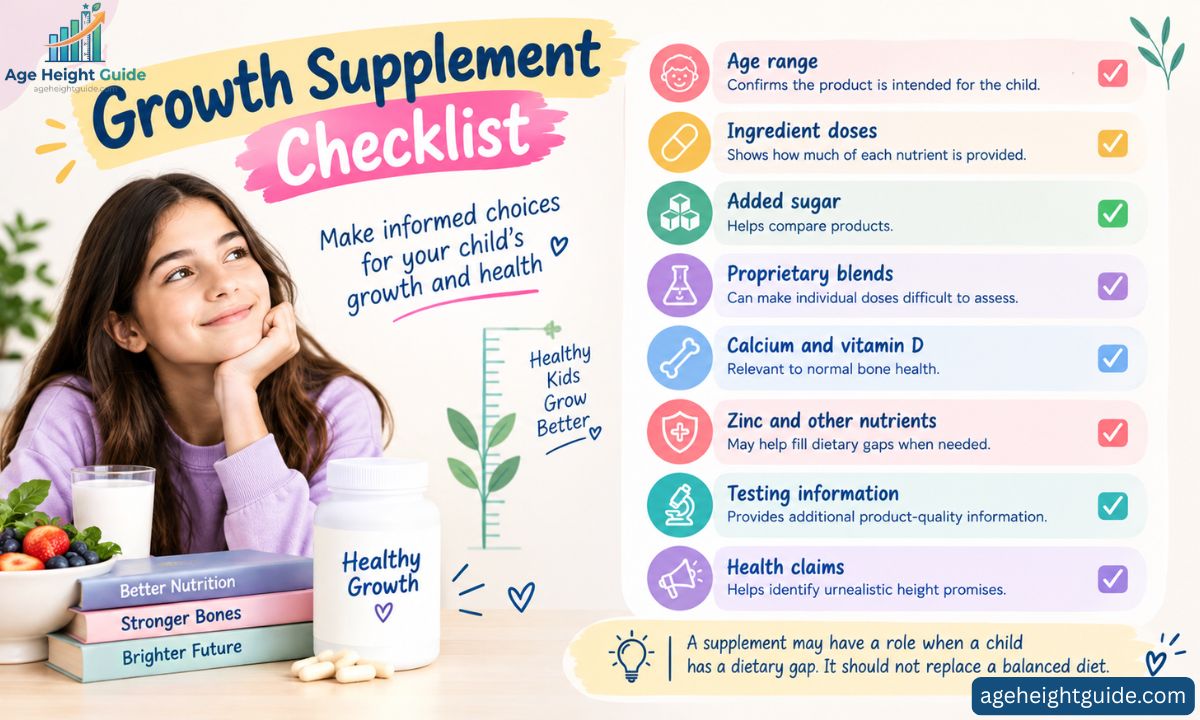
If parents are considering a growth supplement for a 13-year-old girl, they should read the label carefully.
First, look for exact ingredient amounts. A product that lists each dose clearly is easier to evaluate than one that uses a vague proprietary blend.
Next, check the age range. A product designed for adults may not be appropriate for a teenager.
Parents should also check added sugar, serving size, allergens, ingredient doses, and any third-party testing information provided by the manufacturer.
Most importantly, look at the claims.
A responsible supplement should not promise that a child will gain a certain number of inches.
Growth supplement checklist
| What to check | Why it matters |
| Age range | Confirms the product is intended for the child |
| Ingredient doses | Shows how much of each nutrient is provided |
| Added sugar | Helps compare products |
| Proprietary blends | Can make individual doses difficult to assess |
| Calcium and vitamin D | Relevant to normal bone health |
| Zinc and other nutrients | May help fill dietary gaps when needed |
| Testing information | Provides additional product-quality information |
| Health claims | Helps identify unrealistic height promises |
A supplement may have a role when a child has a dietary gap. It should not replace a balanced diet.
Can vitamins make a 13-year-old girl taller?
No vitamin can guarantee that a 13-year-old girl will become taller.
Vitamins and minerals are important for normal body functions. If a child has a genuine deficiency, correcting that deficiency can support normal health and development.
But more is not always better.
A child who already receives enough of a nutrient does not necessarily grow taller by taking additional amounts.
This is an important distinction when evaluating height vitamins for girls or teen growth supplements.
The goal should be to meet nutritional needs, not to take large doses in the hope of forcing extra growth.
When should parents talk to a pediatrician about height?
Parents should not panic because their daughter is shorter than her classmates.
Instead, look at the growth pattern.
A pediatrician may be helpful if a girl’s growth seems to slow sharply, her height moves downward across several percentiles, puberty seems unusually early or delayed, or other health symptoms are present.
A doctor can review previous measurements and compare them with a CDC growth chart. They can also consider family height, nutrition, puberty, medical history, and other factors.
If necessary, a pediatrician may order additional tests or consider a bone age assessment.
The important point is that online height charts cannot replace an individual medical assessment.
The honest timeline
There is no exact age when every girl stops growing.
Some girls are close to their final height at 13. Others still have meaningful growth ahead.
The timing depends on puberty, genetics, growth history, and overall development.
Parents should therefore avoid trying to predict final height from one number.
A better approach is to support healthy habits while the child is growing. That means balanced nutrition, enough sleep, regular activity, and routine healthcare.
A supplement should only fill a genuine nutritional need. It should not be presented as a guaranteed way to increase height.
Average height for a 13-year-old girl vs. normal height
Average height and normal growth do not mean the same thing.
Average height refers to the midpoint of a reference population. Healthy growth includes a much broader range.
For a 13-year-old girl, about 5 feet 2 inches is close to the 50th percentile on the CDC chart. But girls can be below or above that number and still have a healthy development pattern.
This is why parents should not ask only, “What is the average height for a 13-year-old girl?”
A better question is, “How has my daughter’s height changed over time?”
That question focuses on the growth pattern rather than one comparison number.
How to tell if a 13-year-old girl is growing normally
A single measurement cannot answer this question.
Healthcare professionals often look at repeated measurements. They compare them with age-based growth charts and consider whether the child is following a consistent growth curve.
Puberty also matters.
A girl who recently entered puberty may have a different growth pattern from a girl who is nearing the end of puberty.
Family height is another useful piece of information.
Nutrition and general health also matter. A child with adequate nutrition and no concerning health symptoms may simply have a different natural growth pattern from her peers.
How tall should a 13-year-old girl be?
There is no exact height that a 13-year-old girl “should” be.
The average height for a 13-year-old girl is approximately 5 feet 2 inches, but that is only the 50th percentile reference point.
A girl can be 4 feet 11 inches, 5 feet 2 inches, or 5 feet 5 inches and still need to be assessed in the context of her own growth history.
Height should not be treated like a school grade.
There is no single number that makes a girl healthy or unhealthy.
Can a 13-year-old girl still grow after her first period?
Yes.
A first period usually means that the fastest part of the pubertal growth spurt has already happened. It does not mean that all height growth has ended.
Many girls continue to grow after their first period. The amount varies from person to person.
Girls who start puberty earlier and girls who start later may have different amounts of growth remaining at the same chronological age.
This is another reason why age alone cannot predict final height.
Does sleep affect growth in teenagers?
Adequate sleep supports overall adolescent health.
Sleep is important for physical development, learning, concentration, and daily energy.
Parents should focus on a regular sleep schedule rather than using sleep as a promise of extra height.
A healthy sleep routine is one part of a healthy lifestyle. It works together with nutrition, physical activity, and general health.
What can affect a girl’s growth?
Many factors can influence growth during puberty.
Genetics is a major factor. Puberty timing can also change when growth happens.
Nutrition matters because severe or prolonged nutritional deficiencies can interfere with normal development. Some chronic illnesses can affect growth as well.
Hormonal conditions may also affect growth.
This does not mean that every short child has a medical problem. Differences in height are not automatically signs of disease.
The growth pattern is what helps healthcare professionals decide whether further evaluation is needed.
How to support healthy growth without chasing inches
Parents do not need to search for a magic height growth supplement.
The foundation is simple.
A 13-year-old girl needs enough food, protein, calcium, vitamin D, iron, and other nutrients. She also needs adequate sleep and regular physical activity.
Parents can encourage healthy habits without making height the center of attention.
This is especially important during adolescence. Excessive focus on weight, height, or body measurements can create unnecessary stress.
The goal should be healthy development, not reaching a specific number on a measuring tape.
Final Takeaway
The average height for a 13-year-old girl is about 5 feet 2 inches (158 cm) at the 50th percentile on the CDC reference chart. But this number is only a starting point.
A girl does not need to be exactly 5 feet 2 inches to be healthy.
Some girls are shorter. Some are taller. Some have already passed their fastest growth spurt. Others are still developing.
The most useful things to consider are height percentile, growth velocity, puberty timing, family height, nutrition, sleep, physical activity, and overall health.
Good nutrition can help a child meet her body’s nutritional needs. Adequate sleep and regular activity also support healthy development. But no food, vitamin, exercise, or growth supplement can guarantee a specific adult height.
If your daughter’s growth pattern changes sharply or you are concerned about her development, a pediatrician can review her measurements and provide an individual assessment.
The goal is not to make every 13-year-old girl the same height. The goal is to support healthy growth and development while her body follows its own natural pattern.
Frequently Asked Questions
What is the average height for a 13-year-old girl?
The average height for a 13-year-old girl is about 5 feet 2 inches (158 cm) at the 50th percentile on the CDC reference chart. This is a midpoint, not a required height. Many healthy girls are shorter or taller than this number.
What is a normal height for a 13-year-old girl?
There is no single normal height for a 13-year-old girl. The CDC chart shows a broad distribution of heights. Around age 13, approximately 4 feet 10 inches to 5 feet 6 inches corresponds to the 5th to 95th percentile reference points used here. Growth pattern matters more than one measurement.
Is 5 feet short for a 13-year-old girl?
Five feet is below the 50th percentile for a 13-year-old girl. However, that does not automatically mean she has a growth problem. Previous measurements and the overall growth pattern are important.
Is 5 feet 2 inches average for a 13-year-old girl?
Yes. About 5 feet 2 inches (158 cm) is around the 50th percentile for a 13-year-old girl on the CDC growth chart.
Is a 13-year-old girl still growing?
Many are. Some girls are still in an active growth phase, while others are closer to their adult height. Puberty timing is a major reason for this difference.
How much does a girl grow after her first period?
Many girls gain additional height after their first period, but the amount varies. Nemours notes that girls often grow around 1 to 2 more inches after menstruation begins. This should be treated as a general pattern, not a guaranteed amount for every girl.
When do girls stop growing?
Girls usually stop gaining significant height after puberty is largely complete and their growth plates have fused. The exact timing differs from girl to girl.
Can vitamins make a 13-year-old girl taller?
Vitamins cannot guarantee extra height. Correcting a real nutritional deficiency can support normal health and development, but taking more nutrients does not automatically produce additional height.
What nutrients support growth in teenage girls?
Important nutrients include protein, calcium, vitamin D, iron, zinc, and magnesium. A varied diet is the best foundation for meeting nutritional needs.
How much calcium does a 13-year-old girl need?
Children and teenagers ages 9 through 18 generally need 1,300 mg of calcium per day, according to the NIH Office of Dietary Supplements. Food sources can include milk, yogurt, cheese, fortified foods, tofu, and certain fish.
What is the best way to predict adult height?
There is no perfect prediction method. A healthcare professional may consider current height, growth history, family height, puberty stage, and sometimes bone age. These factors can provide an estimate but cannot guarantee a final height.
Does being below average mean my daughter will be short as an adult?
Not necessarily. A girl can be below the 50th percentile and continue to follow a healthy growth curve. Puberty timing and family height also influence adult height.
Does being taller than average mean a girl will keep growing longer?
No. Current height does not tell you exactly how much growth remains. Puberty stage and previous growth measurements are more useful when considering remaining growth.
Does exercise stunt growth in girls?
Normal, age-appropriate physical activity does not automatically stunt growth. Exercise can support physical fitness and bone health when combined with appropriate nutrition and recovery.
Can a growth supplement guarantee height?
No. A growth supplement cannot guarantee a certain number of inches. Products that make guaranteed-height claims should be treated with caution.
When should I talk to a pediatrician about my daughter’s height?
Consider speaking with a pediatrician if growth slows noticeably, the child’s height percentile changes significantly, puberty seems unusually early or delayed, or there are other health concerns. A doctor can evaluate the full growth pattern rather than relying on one measurement.

Stoke is the author behind Age Height Guide, creating simple and informative content about average height, age, growth, and related measurements.