


Does drinking milk make you taller? It is one of the most common questions parents and teenagers ask about height growth. Milk is often described as a food that helps children grow taller, but the real answer is more nuanced.
Milk does not guarantee extra inches. It cannot change a child’s genes or make someone taller after normal bone growth has ended.
But milk can still matter.
Milk provides calcium, protein, and, when fortified, vitamin D. These nutrients support bone development, normal growth, and overall nutrition. If a child is not getting enough of these nutrients, improving the diet can help support normal growth.
Research also suggests that dairy supplementation can have a small effect on linear growth in some children. A 2012 systematic review and meta-analysis of 12 controlled trials estimated the most likely effect at about 0.4 cm of additional growth per year for roughly 245 mL of milk daily.
However, the researchers also noted limitations in several studies and rated the overall evidence as moderate quality.
So, does drinking milk make you taller?
It can support the nutrition a growing child needs. But it is not a height shortcut.
The bigger picture includes genetics, puberty timing, nutrition, sleep, physical activity, health, and growth pattern.
You can also read: What Stunts Your Growth? 10 Real Causes & Myths (2026)
Does drinking milk make you taller? The short answer

No single food can guarantee extra height.
Drinking milk can support normal growth because it provides nutrients needed for bones and general nutrition. But a child who already gets enough calcium, protein, vitamin D, calories, and other nutrients should not expect extra glasses of milk to automatically create extra inches.
The better question is not:
“Can milk make me taller?”
It is:
“Is my diet giving my body the nutrients it needs while I am still growing?”
That difference is important.
Children and teenagers grow at different rates. Some enter puberty early. Others have their growth spurt later. Two children of the same age can therefore have very different heights and still be developing normally.
Growth charts help put height into context. The CDC explains that growth charts are used to track children and adolescents over time and should not be used as the sole diagnostic tool.
The practical answer
| Question | What the evidence suggests |
| Can milk support normal growth? | Yes, as part of a balanced diet |
| Does milk guarantee extra height? | No |
| Can calcium support growing bones? | Yes |
| Does more milk always mean more height? | No |
| Can milk overcome genetics? | No |
| Is milk required for healthy growth? | No |
| Can children get calcium without dairy? | Yes |
| Can milk reopen closed growth plates? | No |
| Does drinking milk at night add special height benefits? | No established benefit |
If your child enjoys milk, it can be a useful part of their diet.
If your child does not drink milk, that does not mean they cannot grow normally.
What the research actually found

Research on milk and child growth does not support a simple “milk makes you tall” or “milk has nothing to do with growth” answer.
Different studies have examined different ages, populations, amounts of dairy, and outcomes.
Some studies used controlled dairy supplementation. Others observed children’s normal diets and compared milk intake with height. These designs answer different questions.
One important study is the 2012 systematic review and meta-analysis by de Beer. It included 12 controlled trials from Europe, the United States, China, Northern Vietnam, Kenya, Indonesia, and India. The analysis estimated that dairy supplementation was associated with about 0.4 cm of additional growth per year for each roughly 245 mL of milk consumed daily.
However, this does not mean every child who drinks one glass of milk will gain 0.4 cm more height.
Several included studies had limitations, including problems with randomization or differences between groups at baseline. The authors therefore described the overall evidence as moderate quality.
What the research can and cannot tell us
| Evidence | What it tells us | What it does not prove |
| Controlled dairy trials | Dairy supplementation may have a small effect on linear growth | Every child will gain extra height from milk |
| Observational studies | Milk intake can be associated with height differences | Milk alone caused the difference |
| Calcium research | Calcium is important for normal bone development | Extra calcium automatically increases final height |
| Growth charts | They show a child’s growth pattern compared with a reference population | A percentile predicts exact adult height |
| Nutrition research | Correcting nutrient gaps can support normal development | More of one nutrient always produces more growth |
The important takeaway is simple:
Milk can contribute to healthy growth, but it is not a height-increasing drug.
And the measured effects in research are small. They should not be turned into claims that milk can add several inches to a healthy child.
The finding nobody quotes: who the effect is biggest in

The de Beer meta-analysis found that the response to dairy supplementation was not identical across all groups.
Its meta-regression found that lower height-for-age and being a teenager were associated with a greater effect from supplementation.
That finding is important.
A child who is missing calories or important nutrients may have more room to benefit when a nutritional gap is corrected.
A child who already eats enough and has adequate nutrition has less reason to expect extra milk to create extra height.
This is why nutrition and height growth should be viewed through the idea of adequacy.
If a child has inadequate calcium, protein, vitamin D, calories, or another important nutrient, improving the diet can support normal development.
If those needs are already being met, adding much more of one food does not necessarily produce additional growth.
Growth is more than one food
A child’s healthy growth can be influenced by:
- Genetics
- Puberty timing
- Overall calorie intake
- Protein
- Calcium
- Vitamin D
- Iron and zinc
- Sleep
- Physical activity
- Chronic illness
- Hormonal conditions
- General health
That is why a child’s height should be considered over time rather than judged from one measurement.
The CDC says growth charts are designed to help track growth patterns and contribute to an overall health picture. They are not a stand-alone diagnostic tool.
A child who is shorter than classmates may still be growing normally.
Likewise, being tall at one age does not guarantee a specific adult height.
It is not the milk; it is what is in the milk

Milk is not a special height-building food.
Its value comes from the nutrients it provides.
A typical serving of milk contains calcium and protein. Many types of milk also provide vitamin D through fortification.
Calcium is especially important during childhood and adolescence because the body is building and maintaining bone.
The NIH lists these recommended calcium intakes:
| Age | Recommended calcium per day |
| 1–3 years | 700 mg |
| 4–8 years | 1,000 mg |
| 9–13 years | 1,300 mg |
| 14–18 years | 1,300 mg |
These amounts do not mean children need to get all their calcium from milk.
The NIH lists many other calcium sources, including yogurt, cheese, fortified beverages, calcium-set tofu, sardines, salmon with bones, kale, broccoli, and bok choy.
Milk is one option, not the entire growth plan
If a child enjoys milk, it can be an easy way to add calcium and protein.
If another child prefers yogurt or cheese, those foods can also contribute.
If a family avoids dairy, fortified soy milk and other calcium-fortified foods can help fill the gap.
The goal is adequate nutrition for healthy growth, not forcing one particular food.
This matters even more for picky eaters.
A child who refuses milk but eats a varied diet can still get the nutrients needed for normal growth.
How much calcium a glass of milk actually delivers

A major reason milk is associated with height growth is its calcium content.
According to the NIH, calcium needs rise to 1,300 mg per day for children ages 9–13 and teens ages 14–18.
Here is how common calcium-rich foods compare:
| Food | Calcium per serving | Approx. share of 1,300 mg |
| Plain low-fat yogurt, 8 oz | 415 mg | 32% |
| Calcium-fortified orange juice, 1 cup | 349 mg | 27% |
| Part-skim mozzarella, 1.5 oz | 333 mg | 26% |
| Nonfat milk, 1 cup | 299 mg | 23% |
| Calcium-fortified soy milk, 1 cup | 299 mg | 23% |
| Whole milk, 1 cup | 276 mg | 21% |
| Calcium-set tofu, ½ cup | 253 mg | 19% |
| Canned pink salmon with bones, 3 oz | 181 mg | 14% |
Food values can vary by product and preparation, so labels matter.
Two cups of nonfat milk provide about 598 mg of calcium.
That is useful, but it is still less than half of the 1,300 mg daily recommendation for children and teens who need that amount.
This shows why milk for growing kids should be viewed as part of a complete eating pattern rather than a complete growth solution.
Does calcium make you taller?
This question needs a careful answer.
Calcium is necessary for normal bone development.
But:
“Calcium is needed for healthy bones”
is not the same as:
“More calcium will make a healthy child taller.”
The first statement is well supported.
The second is not a general rule.
If a child is not meeting their calcium needs, improving intake is sensible.
If their calcium intake is already adequate, adding much more calcium does not guarantee a taller final height.
How much milk should a growing child drink?

This is another common question behind ” Does drinking milk make you taller.
There is no universal amount of milk that guarantees additional height.
Milk should fit into the child’s overall diet.
A balanced eating pattern should also provide:
- Fruits
- Vegetables
- Whole grains
- Protein foods
- Healthy fats
- Dairy or suitable alternatives
- Water
- Other nutrient-rich foods
A child has limited appetite.
If large amounts of milk leave little room for meals, the diet can become less varied.
So the goal is not:
“Drink as much milk as possible.”
The better goal is:
“Meet nutritional needs with a varied diet.”
That is a much more useful approach to healthy growth.
Why more milk is not better
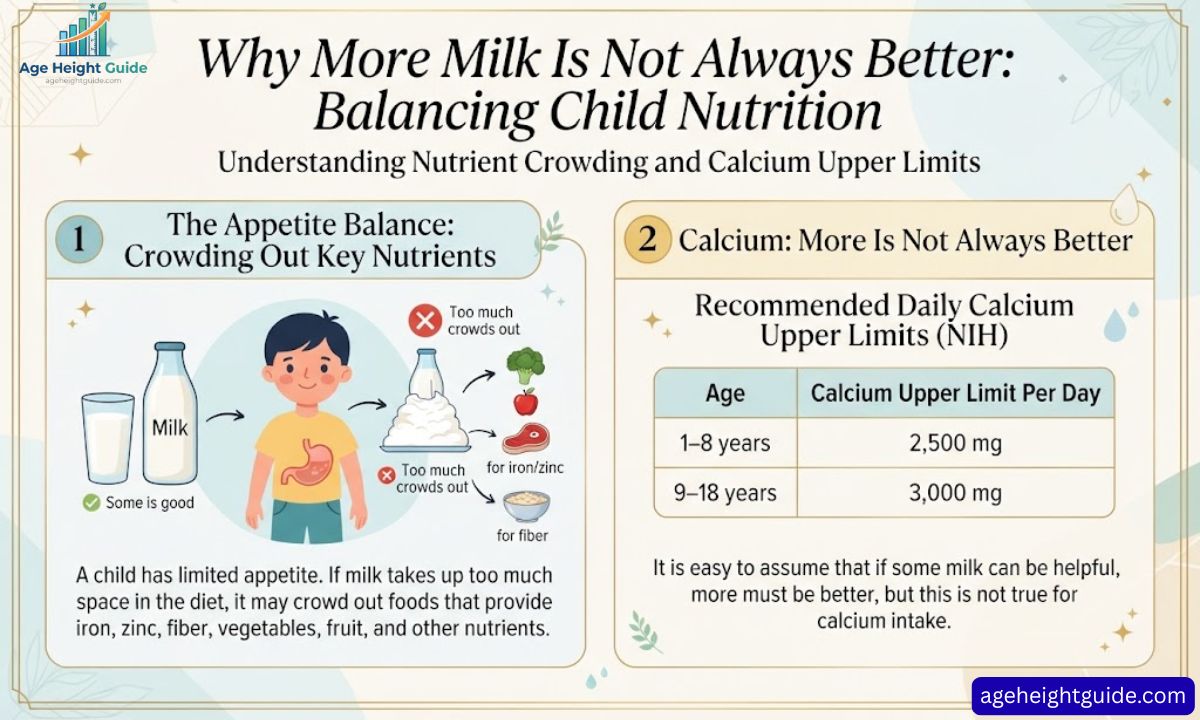
It is easy to assume that if some milk can be helpful, more milk must be even better.
Research does not support that simple equation.
The ECLS-B observational research examined milk intake alongside height and body weight in thousands of young children. Observational data can identify relationships, but they cannot prove that milk itself caused the differences.
There is also a practical issue.
A child has limited appetite.
If milk takes up too much space in the diet, it may crowd out foods that provide iron, zinc, fiber, vegetables, fruit, and other nutrients.
More calcium is not automatically better
The NIH also provides upper intake limits for calcium from all sources. For children ages 1–8, the upper limit is 2,500 mg per day. For ages 9–18, it is 3,000 mg per day.
| Age | Calcium upper limit per day |
| 1–8 years | 2,500 mg |
| 9–18 years | 3,000 mg |
These limits include calcium from food, drinks, and supplements.
This does not mean parents need to obsess over every milligram.
It simply shows why “more” should not automatically be treated as “better.”
The goal is to meet nutritional needs, not maximize one nutrient.
What to do if your child will not drink milk

Your child does not have to drink milk to grow normally.
Some children avoid milk because of:
- Lactose intolerance
- Milk allergy
- Taste or texture
- Vegan diets
- Family dietary choices
- Personal preference
The good news is that non-dairy calcium foods for kids are widely available.
The NIH lists calcium sources such as fortified beverages, tofu, certain fish, kale, broccoli, and bok choy.
Calcium-rich alternatives to milk
| Food or drink | Calcium |
| Plain low-fat yogurt, 8 oz | 415 mg |
| Fortified orange juice, 1 cup | 349 mg |
| Calcium-fortified soy milk, 1 cup | 299 mg |
| Firm tofu made with calcium sulfate, ½ cup | 253 mg |
| Canned pink salmon with bones, 3 oz | 181 mg |
Check food labels because calcium levels can differ between brands.
What about spinach?
Spinach contains calcium, but its calcium is not absorbed as efficiently as calcium from some other foods because spinach is high in oxalate.
That does not make spinach unhealthy.
It simply means that children should get calcium from a variety of foods rather than depending on spinach alone.
The larger point is important:
Do not search for one perfect milk replacement. Build a varied diet.
What milk cannot do

Milk can provide useful nutrients.
But milk cannot:
- Change a child’s genes
- Guarantee a specific adult height
- Reopen closed growth plates
- Reverse every growth problem
- Replace a balanced diet
- Correct every nutritional deficiency by itself
- Make a healthy child several inches taller simply by increasing milk intake
This distinction is essential when evaluating milk and height claims online.
Milk and growth plates
Height increases while the bones are still developing.
Once the growth plates have fused and normal growth has ended, drinking milk cannot restart long-bone growth.
The exact timing varies from person to person.
That is why age alone cannot tell you exactly how much height a child has left.
If you are concerned about growth, a pediatrician can consider the child’s growth history, puberty development, family pattern, nutrition, and overall health.
Milk and genetics
Genetics has a major influence on adult height.
But genetics is not the only factor.
Nutrition, health, hormones, puberty, and other environmental factors can influence how a child grows.
The realistic goal is therefore not to “beat genetics.”
It is to provide the conditions that support normal growth and development.
Can milk make you taller after puberty?
If normal growth is complete and the growth plates have fused, milk cannot make the long bones longer.
For teenagers who are still growing, milk can remain a useful part of a balanced diet because it provides nutrients such as calcium and protein.
That is different from saying milk will add a predictable number of inches.
Puberty timing varies considerably.
Two teenagers who are the same age can be at very different points in their growth spurt.
This is why one age-based height comparison is not enough to determine whether someone has finished growing.
Does drinking milk at night make you taller?
There is no established special height benefit from drinking milk at night.
If milk fits your diet, you can drink it at a convenient time.
The important issue is the overall nutritional pattern across the day.
A glass of milk before bed does not become a special growth drink simply because you drink it at night.
If your goal is natural height growth, focus on adequate nutrition, sleep, activity, and overall health rather than meal timing alone.
Can drinking milk make you taller if you are short?
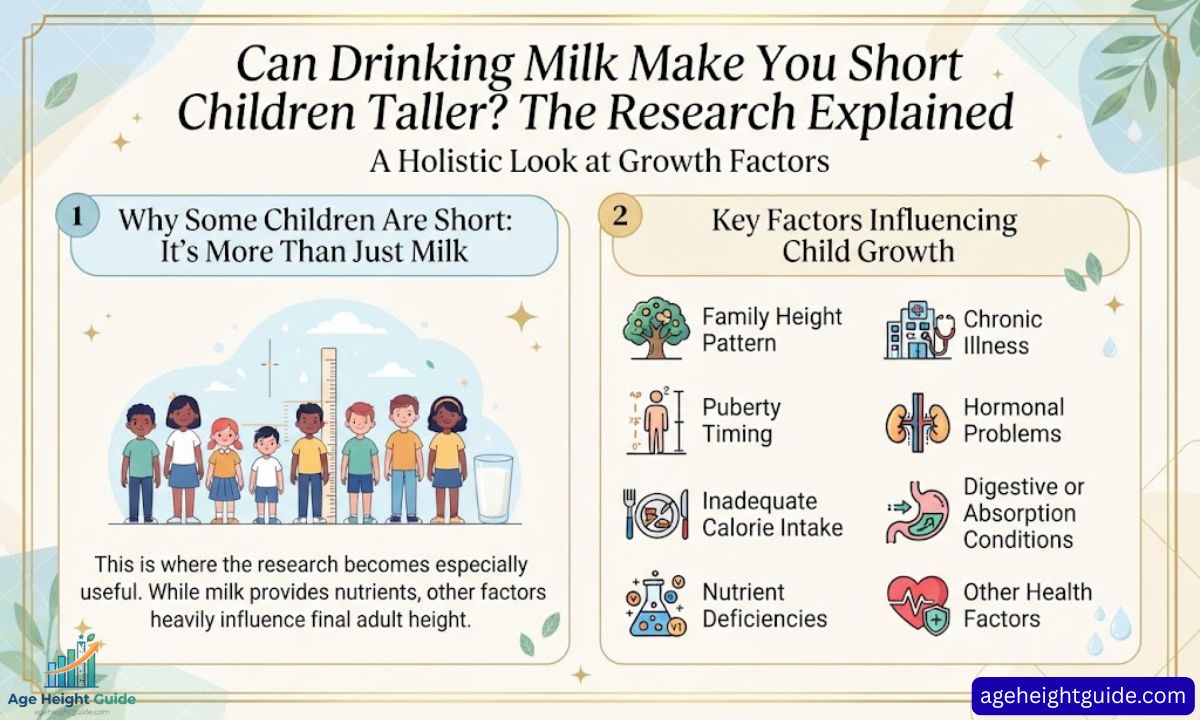
This is where the research becomes especially useful.
The de Beer meta-analysis found that lower height-for-age was associated with a greater response to dairy supplementation.
That does not mean every short child needs more milk.
Being shorter than classmates can be completely normal.
But if a child is short because of inadequate nutrition, correcting that nutritional problem can matter.
The key is finding out why growth is slower.
Possible factors include:
- Family height pattern
- Puberty timing
- Inadequate calorie intake
- Nutrient deficiencies
- Chronic illness
- Hormonal problems
- Digestive or absorption conditions
- Other health factors
This is why a growth pattern matters more than simply asking whether a child drinks milk.
When to talk to your pediatrician
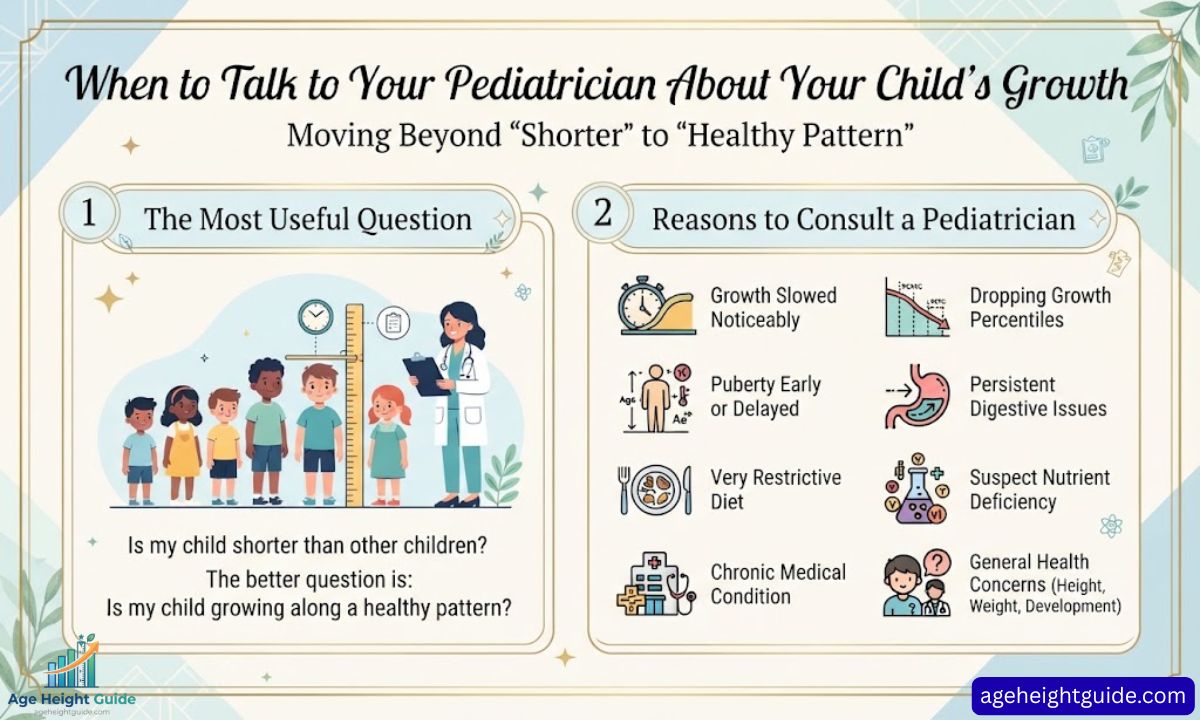
The most useful question is not:
“Is my child shorter than other children?”
It is:
“Is my child growing along a healthy pattern?”
CDC growth charts help clinicians track height and other measurements over time. They are not intended to be used as a stand-alone diagnosis.
Talk with a pediatrician if:
- Your child’s growth seems to have slowed noticeably.
- Your child is dropping across growth percentiles.
- Puberty seems unusually early or delayed.
- Your child has persistent digestive symptoms.
- Your child follows a very restrictive diet.
- You suspect a nutrient deficiency.
- Your child has a chronic medical condition.
- You are concerned about height, weight, or development.
A pediatrician can look at several pieces of information together.
That may include previous height measurements, weight, family heights, puberty development, diet, symptoms, and overall health.
A single height measurement rarely tells the whole story.
Where a supplement fits, honestly
A supplement should not be the first answer to does drinking milk make you taller.
Food comes first.
If a child eats a varied diet and meets their nutritional needs, a supplement is not a shortcut to extra height.
However, supplements can sometimes help when a genuine nutrient gap exists or when a healthcare professional recommends one.
The purpose should be to support adequate nutrition.
It should not be to promise inches.
What a growth supplement can and cannot do
| A responsible supplement claim | A claim to avoid |
| Helps provide selected nutrients | Guarantees extra inches |
| Can help fill a dietary gap | Makes every child taller |
| Supports normal nutrition | Overrides genetics |
| Can complement a balanced diet | Replaces healthy food |
| May help when intake is inadequate | Reopens closed growth plates |
| Can provide nutrients a child may be missing | Guarantees a specific final height |
This distinction matters because height supplements for kids are often marketed with stronger promises than the evidence supports.
When evaluating a supplement, consider:
- Ingredients
- Actual doses
- Age suitability
- Safety
- Product quality
- Third-party testing where applicable
- Whether the child actually needs the nutrients
- Whether the product complements rather than replaces food
The goal is healthy growth and development, not chasing an arbitrary height number.
A better daily approach to healthy growth
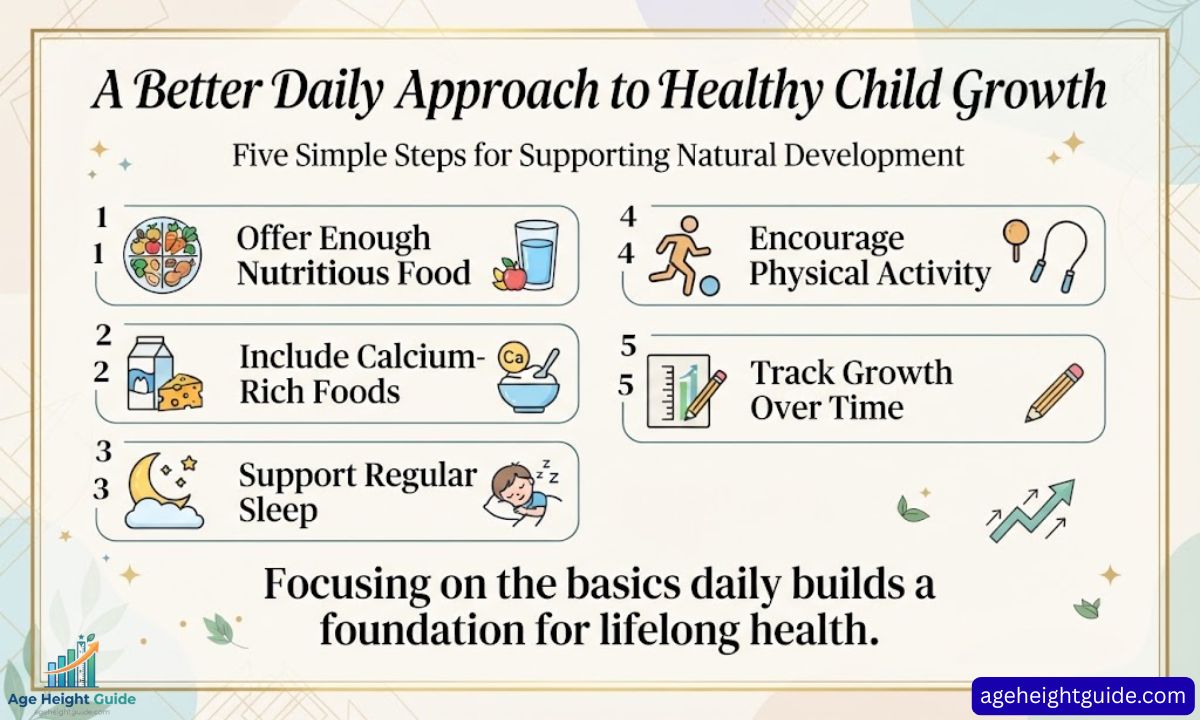
If you want to support your child’s natural growth, focus on the basics.
1. Offer enough nutritious food
Growing children need enough energy and a varied diet.
Include sources of:
- Protein
- Calcium
- Vitamin D
- Iron
- Zinc
- Fruits
- Vegetables
- Whole grains
- Healthy fats
2. Include calcium-rich foods
Milk is one option.
Other choices include:
- Yogurt
- Cheese
- Fortified soy milk
- Calcium-set tofu
- Certain fish
- Calcium-fortified foods
The NIH confirms that calcium can come from many foods, not only dairy.
3. Support regular sleep
Sleep is an important part of a healthy routine for children and teenagers.
Healthy eating, physical activity, and adequate sleep all contribute to overall health and development.
4. Encourage physical activity
Children do not need special height exercises to become taller.
Regular physical activity supports general fitness, muscles, bones, and overall health.
5. Track growth over time
Do not judge growth from one measurement.
A series of accurate height measurements can show whether a child is following a consistent pattern.
CDC growth charts are designed specifically for tracking growth over time.
Milk vs. other calcium sources for growing kids
Milk is convenient, but it is not nutritionally unique when it comes to calcium.
| Food | Why it can help |
| Milk | Calcium + protein; often vitamin D fortified |
| Yogurt | High calcium and protein |
| Cheese | Concentrated calcium source |
| Fortified soy milk | Can provide calcium and protein |
| Calcium-set tofu | Plant-based calcium source |
| Salmon with bones | Calcium plus protein and other nutrients |
| Kale | Calcium-containing vegetable |
| Broccoli | Provides calcium plus other nutrients |
This is why a child who does not drink milk can still have a nutritionally adequate diet.
The focus should be on the total diet, not one food.
The bottom line: Does Drinking Milk Make You Taller?

So, does drinking milk make you taller?
Milk can support normal growth, but it does not guarantee extra height.
The best available evidence does not support the idea that simply drinking more and more milk will push a healthy child far beyond their natural growth potential.
A 2012 meta-analysis of 12 controlled trials estimated a small average growth effect from dairy supplementation—about 0.4 cm per year per roughly 245 mL of milk daily—but the authors also reported limitations in several studies and rated the overall evidence as moderate quality.
The more useful takeaway is:
Milk is a nutritious food, not a height shortcut.
If your child drinks milk, it can contribute calcium, protein, and other nutrients to a balanced diet.
If your child does not drink milk, they can still meet their nutritional needs through yogurt, cheese, fortified beverages, tofu, fish, vegetables, and other foods.
And if your child’s growth seems unusually slow, the answer is not necessarily another glass of milk.
Look at the whole picture.
Track the growth pattern.
Provide adequate nutrition.
Support healthy sleep and physical activity.
Address genuine nutrient gaps.
And speak with a pediatrician when growth concerns persist.
That approach is much more useful than searching for one food that promises extra inches.
Frequently Asked Questions
Does drinking milk make you taller?
Not directly. Drinking milk provides calcium, protein, and other nutrients that support normal growth, but it does not guarantee extra height.
A 2012 meta-analysis of 12 controlled trials found a small average effect from dairy supplementation under the conditions studied. The estimated effect was about 0.4 cm per year per roughly 245 mL of milk daily, with moderate-quality overall evidence.
How much milk should a growing child drink?
There is no amount of milk that guarantees additional height.
Milk should fit into a varied diet that also includes vegetables, fruits, whole grains, protein foods, and other nutrient-rich choices.
Drinking more milk is not automatically better.
Does calcium help children grow taller?
Calcium is essential for normal bone development.
For children ages 9–13 and teens ages 14–18, the NIH recommends 1,300 mg of calcium per day.
However, getting more calcium than a child needs does not mean the child will become taller.
Can milk increase height after puberty?
If normal growth is complete and the growth plates have fused, milk cannot make the long bones longer.
Teenagers who are still growing can benefit from a balanced diet containing adequate calcium, protein, vitamin D, and other nutrients.
Is milk necessary for healthy growth?
No.
Milk is a convenient source of several nutrients, but it is not the only option.
Yogurt, cheese, fortified soy beverages, calcium-set tofu, and certain fish and vegetables can also contribute calcium.
What if my child does not drink milk?
Do not panic.
Build the diet around other calcium-rich foods and fortified products.
Check food labels because calcium levels in plant-based beverages and other fortified foods can vary.
Does drinking milk at night make you taller?
There is no established special height benefit from drinking milk at night.
What matters more is the child’s overall nutrition, sleep, activity, and health.
Can drinking too much milk be a problem?
Large amounts of one food can crowd out other foods in a child’s diet.
Calcium also has an established upper intake limit. The NIH lists 2,500 mg per day for children ages 1–8 and 3,000 mg for ages 9–18 from all sources.
Does milk make teenagers taller?
Milk can contribute nutrients needed for normal development, but it does not guarantee additional height.
A teenager’s growth depends on many factors, including genetics, puberty timing, nutrition, and overall health.
Can a growth supplement make a child taller?
No supplement can honestly guarantee a specific increase in final height.
A supplement may help fill a nutritional gap when needed, but it should complement a balanced diet rather than replace healthy food.
What matters more than drinking milk for height?
The bigger picture matters.
Adequate nutrition, calcium, vitamin D, protein, sleep, physical activity, and general health all support healthy development.
A child’s growth pattern over time is more informative than one food or one height measurement.
Can milk make you taller if you are naturally short?
Milk can help provide nutrients needed for normal growth, but it cannot guarantee that a naturally shorter child will become taller.
If a child is short because of inadequate nutrition, correcting that nutritional gap may support normal growth. If the child is healthy and growing consistently, height may simply reflect their family growth pattern.
Is milk better than yogurt for height growth?
There is no simple rule that milk is better.
Both can provide calcium and protein. Yogurt can also be a useful calcium source, and some children may tolerate or prefer it more than milk.
The important factor is meeting overall nutritional needs.
Does drinking more milk increase growth hormone?
Milk should not be treated as a growth-hormone booster.
Even if a food affects a growth-related hormone or marker, that does not automatically mean it will increase a child’s final adult height.
The practical goal is adequate nutrition and healthy development.
What is the best drink for healthy growth?
There is no single drink that guarantees height.
Milk and fortified alternatives can provide useful nutrients, while water should also be part of a healthy daily routine.
The overall diet matters much more than finding a special height growth drink.
This article is for general informational purposes and is not medical advice. If you have concerns about your child’s growth, nutrition, puberty, or development, speak with a qualified pediatrician.

Stoke is the author behind Age Height Guide, creating simple and informative content about average height, age, growth, and related measurements.